

An increase in litigation doesn’t just mean more cases for in-house legal teams. It means more matters to manage, more information to preserve, more outside counsel to coordinate, and more costs to track.
As caseloads grow, processes that work well today can quickly become bottlenecks. Manual intake, disconnected systems, and inconsistent reporting make it harder for legal departments to maintain visibility and control.
With consumer protection litigation reaching its highest level in a decade, legal operations leaders have an opportunity to evaluate whether their existing processes are ready for what’s ahead.
In-house legal teams should prepare by testing whether their matter intake, legal hold, outside counsel and spend reporting processes still work at a higher caseload. Lex Machina’s 2026 Consumer Protection Litigation Report, released October 20, 2026, counted 20,353 consumer protection cases filed in federal court in 2025. That is a 31% increase over the prior year and the highest annual total in the ten years the report covers.
Those figures describe federal dockets across all industries. They do not predict the caseload of any one company. They do raise a practical question for legal operations leaders: if matter volume in a category like this keeps climbing, which of today’s processes would hold up?
Volume tests process before it tests people. A manual step that a team absorbs at low volume becomes a backlog at higher volume, and the backlog shows up as late holds, uneven outside counsel staffing and spend that is hard to forecast.
What does rising federal litigation volume mean for in-house legal departments?
It means more matters entering the department’s workflow faster, often in the same practice areas and with the same repeated steps. Consumer protection claims are a useful example because a single issue can generate many similar matters, each needing intake, a preservation decision, outside counsel assignment and budget tracking.
The report points to where the growth is concentrated. Telephone Consumer Protection Act filings rose 63% in 2025, from 1,682 to 2,748 cases. Fair Credit Reporting Act filings rose 44% to 7,750, about 38% of all federal consumer protection filings, up from 19% in 2016. Data breach lawsuits rose 21%. The report also counts more than 12,000 new consumer protection suits in the first half of 2026.
The 2025 filing count is a signal about the market, not a forecast for a specific department. Teams that wait for their own numbers to rise before reviewing their processes are working with a delay. Teams that review early can fix the slowest step first.
Which legal operations processes come under strain first?
Four processes tend to show strain first when matter volume grows, because each depends on repeated manual work:
- Intake and triage. Requests arrive by email, calls and forms. Without a consistent way to record the matter type, business unit and urgency, assignment depends on whoever sees the request first.
- Legal holds. A hold has to reach the right custodians promptly, and the team has to know who has acknowledged it. Tracking this across inboxes and spreadsheets gets harder with every additional matter.
- Outside counsel assignment. Matching a matter to a firm, confirming approved rates and applying billing guidelines takes time that multiplies with each new matter.
- Spend forecasting. Finance needs a reliable view of expected and actual costs by matter type. Reports assembled by hand lag behind a fast-moving docket.
Each of these also leaves a record. When regulators, courts or leadership ask what the department did and when, the quality of that record matters as much as the speed of the work.
Identifying where these processes break down is the first step toward building a legal operation that can handle growing demands without adding unnecessary complexity.
How can a legal team test its readiness before volume rises?
Ask five questions and time how long each takes to answer:
- How many matters of a given type are open today, and who owns each one?
- How long does it take to issue a legal hold after a claim arrives, and who has not yet acknowledged an open hold?
- Who approves outside counsel for a new matter, and are rates and billing guidelines applied automatically?
- Can the team produce a spend forecast for a matter type without rebuilding a spreadsheet?
- Which of these answers depend on one person’s knowledge rather than a system?
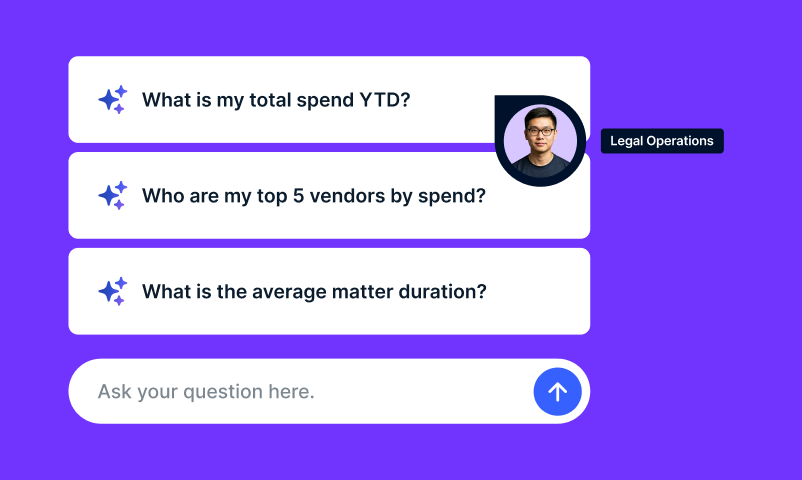
Any question that takes more than a few minutes to answer, or that relies on one person, marks a process worth fixing first. Onit’s guidance on where legal hold processes break down covers the second question in more depth, and the questions legal leaders should be able to ask their data covers the first and fourth.
How can software help legal teams handle a higher caseload?
Once legal teams understand where their processes are most vulnerable, the next step is identifying opportunities to standardize repetitive work, improve visibility, and reduce manual effort.
Software helps most where work is repetitive and the record matters. For legal holds, Onit Legal Holds lets teams issue notices, track custodian responses and keep the full record of a hold in one place. It supports reusable templates for different matter types, automated reminders and escalations for custodians who have not responded, and dashboards that show open holds and outstanding acknowledgments.
Connecting holds to the matter record also reduces re-entry. With Unity ELM, hold activity sits alongside the matter it came from, so the team can report on both without assembling information from separate systems.
Tools do not replace the decisions a legal team makes, such as when to issue a hold or which firm to retain. They shorten the steps around those decisions, which is where volume creates delay.
Key takeaways
- Federal courts recorded 20,353 consumer protection filings in 2025, up 31% and the highest total in ten years, according to Lex Machina’s 2026 Consumer Protection Litigation Report. Telephone Consumer Protection Act filings rose 63% and Fair Credit Reporting Act filings rose 44%.
- Industry-wide filing counts signal market direction. They do not predict any one company’s caseload.
- Intake, legal holds, outside counsel assignment and spend forecasting are the processes most likely to strain as matter volume grows.
- A simple test of readiness is how long it takes to answer five operational questions, and which answers depend on one person.
- Centralizing holds and matter records helps teams act faster and keep a defensible record of what they did.
To see what a more structured hold process looks like in practice, read how to simplify legal holds with Unity.