

Vendor relationships don’t fail overnight. They drift. Rates creep up through one-off exceptions. Matter scoping stays vague to avoid slowing intake. Invoice issues repeat across engagements because no one connects the pattern to the firm behind it. By the time a legal operations team recognizes the problem, legal vendor management has already stalled… the behavior is already habitual, and the budget has already absorbed the cost.
Connected contract and matter systems change that dynamic. When contract terms, matter performance, and invoice data exist in a single operational environment, vendor accountability shifts from reactive to structural.
Accountability gaps don’t announce themselves
Most legal departments manage vendor relationships across separate systems. Contract terms live in one repository. Matter details sit in spreadsheets or a standalone matter management platform. Invoice data routes through an eBilling tool that doesn’t connect to either. Vendor performance exists in someone’s memory or, at best, a quarterly review deck assembled by hand.
When these systems operate in isolation, accountability becomes a manual exercise. Teams have to pull data from multiple sources, reconcile inconsistencies, and reconstruct timelines to answer basic questions: Is this firm billing within the agreed rate structure? Are matter outcomes consistent with projected costs? Are invoices reflecting the scope defined at matter opening?
Without connected systems, those questions take days to answer and often go unasked.

What disconnection costs in legal vendor management
Fragmented legal vendor management creates compounding costs that aren’t always visible in any single report. Spending rarely spikes suddenly. It drifts upward through quiet signals: outside counsel rates increasing through exceptions that become routine, matter scopes left vague to avoid slowing intake, and invoice issues tied to the same firms repeating across engagements.
When legal workflow management tools don’t connect intake to matters to spend, those signals stay hidden. Teams feel the pressure of rising costs without the visibility to trace them to their source. By the time leadership and finance ask questions, the underlying issues have been compounding for months.
This is the operational cost of disconnected systems. It isn’t just inefficiency. It’s lost leverage in every vendor negotiation, budget conversation, and performance review.
How connected systems reframe vendor relationships
Connecting contract data to matter management creates a closed loop that didn’t exist when systems operated separately. Contract terms agreed upon at engagement set expectations. Matter performance data tests whether those expectations are being met. Invoice review enforces compliance against both.
When these systems share a single operational record, discrepancies surface automatically rather than through manual investigation. A firm billing outside agreed rate structures triggers a flag before the invoice reaches approval. Matter costs trending above forecast generate an alert tied to the responsible vendor. Clause-level obligations from the engagement letter connect to outcomes tracked throughout the matter lifecycle.
This isn’t about creating friction with outside counsel. It’s about replacing anecdotal accountability with structural accountability. Firms that perform well have the data to demonstrate it. Firms that don’t have fewer places to hide.
What vendor intelligence actually requires
Effective legal vendor management depends on data that reflects how firms actually perform across real work, not how they present themselves in pitch decks or annual reviews. That requires connecting the right data points across the contract and matter lifecycle.
At the contract stage, terms matter. Rate structures, billing guidelines, staffing expectations, and scope definitions all set the baseline for accountability. If those terms exist only in a signed document stored in a separate repository, they can’t be enforced automatically or referenced in real time during invoice review or matter oversight.
At the matter stage, performance data matters. Cycle times, budget variance, timekeeper activity, and outcome patterns all reveal how a firm actually operates. Without matter management software that captures this information consistently and connects it to vendor records, performance reviews rely on incomplete information or manual reconstruction.
At the invoice stage, compliance matters. AI-driven invoice review tools can flag billing anomalies, identify patterns of non-compliance, and enforce guidelines before invoices reach approval. But that enforcement is far stronger when invoice data connects to both the contract terms that define the rules and the matter data that provides context for each line item.

Visibility enables different conversations
Legal operations teams that connect these systems report a meaningful shift in how they engage with outside counsel. Instead of reactive conversations about why a specific invoice was flagged, they can surface pattern-level insights: this firm consistently exceeds budget on matters of this type, or this timekeeper’s rate doesn’t align with the agreed structure across multiple engagements.
That kind of evidence-based conversation changes the dynamic. It shifts the burden from legal ops teams having to prove a problem to outside counsel having to explain one.
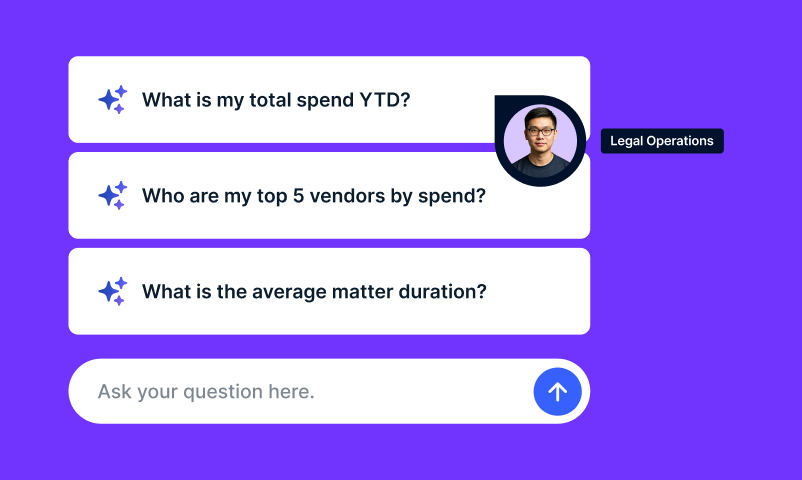
Modern eBilling platforms, when connected to matter management and contract repositories, provide exactly this kind of visibility. Dashboards show spend by firm, matter type, and practice area. Analytics identify billing behavior patterns rather than individual exceptions. Reports compare forecasts created at matter opening to actual outcomes, revealing where estimates consistently diverge from reality.
What effective legal matter management makes possible
Legal matter management software that centralizes budgets, timekeepers, invoices, and outcomes in one place does more than reduce administrative work. It creates the infrastructure for vendor accountability to function as an operational capability rather than a quarterly exercise.
When matter records are structured consistently, legal ops teams can analyze spend by vendor across comparable matter types. They can benchmark outside counsel performance against peer firms. They can identify which engagements deliver value aligned with contract terms and which ones consistently miss expectations.
This analysis isn’t possible when matter data lives in spreadsheets and vendor information lives in separate systems. Industry benchmarks indicate legal departments using data-driven tools can save an average of 12 to 18 percent in legal spending. That figure reflects what becomes possible when accountability is structural rather than manual.
The role of contract data in ongoing oversight
Contract lifecycle management tools contribute to vendor accountability beyond the signing stage. Obligations don’t end at execution. Payment terms, milestone requirements, confidentiality provisions, and staffing commitments all require ongoing monitoring.
When CLM systems connect to matter management, obligation tracking becomes part of daily operations rather than a periodic audit. Alerts surface when renewal dates approach. Flags appear when performance deviates from contract terms. Reporting connects contract compliance to matter outcomes, giving legal ops teams a complete picture of whether vendor relationships are delivering on their original terms.
What integration changes for legal operations leaders
Legal operations leaders who have connected contract, matter, and spend data describe a fundamental shift in how they approach vendor management. The work moves from chasing information to acting on it.

Vendor decisions that previously relied on anecdotal knowledge become evidence-based. Quarterly business reviews shift from status updates to performance analysis grounded in operational data. Budget conversations with finance become more credible because spend forecasts connect to matter-level detail rather than high-level estimates.
The goal isn’t to create adversarial relationships with outside counsel. Most firms perform well when expectations are clear and consistently enforced. Connected systems make that consistency possible at scale, across all vendors, all matters, and all invoices, without requiring manual oversight of every interaction.
Building vendor accountability into operations
Vendor accountability doesn’t require more manual reviews. It requires earlier awareness of risk patterns, and systems designed to surface them automatically.
Teams that achieve predictability in vendor management tend to share specific characteristics. They connect intake, matters, and invoices to understand cost drivers before work begins. In addition, they focus on behavior patterns rather than individual line items. They rely on systems to surface signals instead of expecting people to find them manually. They treat spend insight as an operational capability, not a quarterly exercise.
That approach requires connected systems. It requires contract terms that travel with the matter. It requires invoice review that references both. And it requires analytics that reveal patterns across the entire vendor portfolio, not just isolated incidents.
If your team is ready to move beyond reactive vendor management and build accountability into how work actually flows, explore our comprehensive guide, Make Your Move: A Strategic Guide to Escaping the Manual Maze of Modern Legal Work. It outlines practical steps legal teams can take to connect their systems, reduce manual work, and create the visibility that vendor accountability actually depends on.