

Tag: legal operations

What is Legal eBilling? How Modern Legal Teams Drive Spend Control

an image that represents a legal ops professional handling legal eBilling

Legal eBilling is how modern legal teams bring order, accuracy, and transparency to their spend. It replaces manual billing chaos with automated workflows that capture data, enforce billing rules, and help teams understand exactly where their money goes. For departments under pressure to do more with less, eBilling provides structure, accountability, and time back in the day.

What is legal eBilling?

Legal eBilling is the electronic submission, review, and approval of invoices between law firms and corporate legal departments. Instead of exchanging invoices through email or spreadsheets, firms upload invoices directly into a secure eBilling platform. Most use a standardized format called LEDES (Legal Electronic Data Exchange Standard), which helps organize billing data consistently.

Once received, the eBilling system automatically checks each invoice against company billing guidelines, rate cards, and budgets. If something doesn’t match, it gets flagged for review. The invoice is then routed through an approval process where reviewers can accept, reject, or adjust line items as needed.

This structure creates consistency across the entire billing cycle. Invoices are processed faster, fewer errors slip through, and teams can focus on analysis rather than administration.

legal eBilling representation with data and analytics

How legal eBilling works

A legal eBilling workflow is built around automation and visibility. Here’s what it typically looks like:

  1. Law firms submit invoices electronically. They log into the eBilling platform and upload invoices using approved formats like LEDES.
  2. The system validates automatically. Pre-set rules flag issues such as incorrect rates, missing matter codes, or out-of-scope tasks.
  3. Invoices move through approvals. The platform routes them to the right reviewers based on your internal workflows.
  4. Legal teams monitor progress. Dashboards and reports provide real-time updates on pending, approved, or rejected invoices.
  5. Finance syncs with legal. Once approved, invoices flow into accounting systems for payment, keeping budgets and records aligned.

This process eliminates repetitive tasks, reduces human error, and creates a digital record of every billing action taken. Law firms benefit too because they process payments faster, and set clear billing rules upfront.

Why legal billing matters for modern legal teams

Billing is one of those processes that can quietly drain hours from a legal department each month. And so, without automation, it’s easy for mistakes to pile up. Rates may differ from agreed terms. Tasks that fall outside of policy get billed. In many cases, approvals stall because the right person doesn’t see an email in time.

Legal eBilling fixes that by standardizing and streamlining how invoices move through review. As a result, the system enforces rules automatically and provides visibility into each invoice’s status. Then, teams can track pending items, approved expenses, and real-time spending.

legal eBilling and legal teams

This visibility is a game changer for legal ops. It allows teams to track spend by matter, law firm, or region, and uncover insights that drive smarter decisions. With clean, reliable data, legal departments can forecast budgets, monitor trends, and show measurable value to the business.

What to look for in a modern eBilling system

The best eBilling solutions are flexible, intuitive, and built to support collaboration between legal teams and law firms. Key features to prioritize include:

  • LEDES support and global capability: Ensure compatibility with industry standards and multiple currencies.
  • Configurable billing rules: Set your own policies, rate structures, and approval workflows.
  • Dashboards and analytics: Access spend reports and compliance tracking in real time.
  • Vendor collaboration tools: Make it simple for law firms to submit and track invoices.
  • Integration readiness: Connect seamlessly with matter management or financial systems.

An effective legal eBilling platform should be easy to implement, simple for firms to use, and powerful enough to scale with the department’s needs.

The benefits of legal eBilling

Once legal eBilling is in place, the improvements are felt quickly. Teams spend less time chasing down invoices and more time analyzing results. Finance gains accurate, up-to-date data, and law firms have a smoother experience submitting bills.

Some of the biggest benefits include:

  • Faster approvals: Automated routing reduces delays and shortens payment cycles.
  • Stronger compliance: Built-in rules enforce outside counsel guidelines automatically.
  • Better forecasting: Real-time data makes budgeting more predictable and accurate.
  • Improved visibility: Every invoice and matter is tracked and searchable.
  • Reduced rework: Standardized processes catch errors before they cause problems.

Together, these benefits add up to measurable ROI. Legal departments that adopt eBilling typically see a faster invoice turnaround, fewer disputes, and greater alignment with finance.

legal eBilling image of person signing contract or bill

Common misconceptions about eBilling

It’s common for teams to assume eBilling is too complex, too expensive, or only for large enterprises. The reality is that modern solutions are far easier to deploy and maintain than they used to be. Cloud-based platforms now offer intuitive interfaces, built-in templates, and quick onboarding for both internal users and law firms.

Another misconception is that eBilling is only for tracking costs. While cost control is a major benefit, the true value lies in visibility. With the right data, legal ops teams can benchmark performance, justify budgets, and drive continuous improvement across their department.

The future of legal eBilling

Legal eBilling continues to evolve alongside the rest of legal technology. Automation and AI are already changing how invoices are reviewed and analyzed. Smart systems can now identify unusual billing patterns, predict potential overspend, and suggest optimization opportunities before issues arise.

These advances will make eBilling even more proactive in the years ahead. Instead of simply managing invoices, it will help legal teams make strategic decisions about where to invest time and budget.

Why it matters

Legal eBilling isn’t just about paying bills more efficiently. It’s about gaining the clarity and control that every modern legal department needs. It gives teams confidence in their data, alignment with finance, and the time to focus on higher-value work.

For growing legal ops teams, eBilling is the foundation for smarter, more strategic operations.

Ready to see how Onit helps legal teams simplify billing and spend management? Book a demo today.

*Post updated on 11/6/2025

The Future of Legal Operations: 5 AI Skills Every Leader Needs

Future of Legal Operations 5 AI Skills Leaders Need

The future of legal operations refers to the shift from traditional process and spend management toward a strategic, AI-first model where legal departments drive business value. This future is already unfolding. Artificial intelligence is no longer limited to pilots or side projects. It is embedded in workflows, analyzing contracts, managing spend, and even completing tasks independently.

For legal ops leaders, this means technical knowledge is not enough on its own. To succeed in the future of legal operations, leaders need a new skill set that blends AI fluency, adaptability, and strategic leadership.

The future of legal ops requires leaders to develop new skills beyond technical expertise. The most important include AI fluency, strategic decision-making, adaptability, collaboration, and leadership. The AI Buyer’s Guide helps legal ops teams assess readiness and build a roadmap for success.

Why does the future of legal operations require new skills?

The future of legal operations requires new skills because the role of legal departments is evolving. Tasks that once depended entirely on humans — like reviewing contracts or processing invoices — are now supported or completed by AI. As a result, leaders must focus less on manual execution and more on orchestration: deciding which tasks belong with humans, which belong with AI, and how the two can work together.

This shift means the most valuable legal operations skills are no longer limited to compliance oversight or matter management. Leaders must now prioritize continuous learning, collaboration across functions, and the ability to guide teams through technological change.

Future of Legal Operations - Image of AI and Humans together

What AI skills are essential for the future of legal operations?

The essential skills for the future of legal operations combine technical fluency with leadership and adaptability. The five most important AI skills for legal ops leaders are:

  1. AI fluency and prompting – understanding how AI systems work and how to interact with them effectively.
  2. Strategic decision-making with AI insights – interpreting Generative AI outputs within business context.
  3. Adaptability in hybrid human and AI teams – evolving roles and responsibilities as automation grows.
  4. Collaboration across AI-augmented workflows – aligning legal with other enterprise systems.
  5. Leadership for the AI era – coaching, hiring, and inspiring teams through change.

Each of these skills ensures that legal departments can use AI not just to reduce costs but to elevate their role as a trusted business partner.

1. AI fluency and prompting

AI fluency means knowing how to use AI responsibly, effectively, and efficiently. Prompting is a core part of this skill. The way a request is phrased can determine whether an AI tool produces a generic output or a tailored, actionable insight. Legal ops leaders need to model this fluency for their teams and provide frameworks that help staff improve. With the right AI prompting skills, legal departments can move beyond surface-level outputs to gain meaningful guidance that supports strategy.

2. Strategic decision-making with AI insights

AI tools can process thousands of contracts, invoices, or data points in seconds. But they cannot replace human judgment. The future of legal operations depends on leaders who can take AI-driven insights and apply them in the right business context. For example, when AI highlights risk in a contract, a skilled leader knows how to weigh that risk against revenue timelines, supplier relationships, or market pressures. This balance of data-driven insights and human judgment is where legal ops adds its greatest value.

3. Adaptability in hybrid human and AI teams

As AI takes on more tasks, legal departments will increasingly become hybrid teams — with humans and AI agents working side by side. Adaptability is the skill that allows leaders to evolve roles, reallocate responsibilities, and help people focus on higher-value work. Legal ops leaders must prepare their teams for constant evolution, ensuring they are comfortable shifting into new responsibilities as AI expands. Adaptability is no longer a soft skill; it is a critical capability for operational success.

4. Collaboration across AI-augmented workflows

Collaboration has always been central to legal operations, but in the age of AI it extends beyond people. Legal must now coordinate with AI systems that integrate into finance, procurement, and compliance functions. Strong collaboration skills ensure that legal data and workflows align with enterprise systems rather than existing in silos. Leaders who foster cross-functional trust and transparency will position their departments as true business partners in the future of legal operations.

Future of Legal Operations - Collaboration with AI for better workflows

5. Leadership for the AI era

The most important skill for the future of legal operations is leadership itself. AI adoption requires guiding teams through uncertainty, setting a clear vision, and rethinking how to hire and coach talent. Instead of recruiting only for technical expertise, leaders must now prioritize curiosity, adaptability, and a growth mindset. Coaching teams means not just teaching them how to use tools, but helping them challenge assumptions, question outputs, and continuously learn. Leaders who embrace this approach will build legal departments that thrive in any environment.

How can legal ops leaders prepare today?

To prepare for the future of legal operations, leaders need both awareness of critical skills and the right frameworks to assess their technology and team readiness. This is where practical guidance makes the difference. Onit’s AI Buyer’s Guide offers a clear framework for evaluating whether your current solutions and processes are ready to support AI-driven legal operations. It helps you identify gaps, prioritize investment areas, and build a roadmap that positions your team to succeed in the years ahead.

Leading the future of legal operations

The future of legal operations will not be defined by technology alone. It will be shaped by the leaders who know how to combine AI tools with human skills. Legal ops leaders who build fluency in AI, make strategic decisions with confidence, adapt to hybrid teams, collaborate across the enterprise, and lead through change will set their departments apart. These are not skills for tomorrow. They are the capabilities legal teams must begin strengthening today.

The future of legal operations belongs to leaders who act now.

Download the AI Buyer’s Guide to start evaluating your current environment and take the first step toward building the skills and systems that matter most.

Want to ensure your legal team is prepared for the future of AI? Check out our webinar, Leadership in the Age of AI: Prepare Your Legal Team for the Future.

Agentic AI in Legal Operations: What It Is and Why It Matters 

Agentic AI in Legal Operations: What It Is and Why It Matters

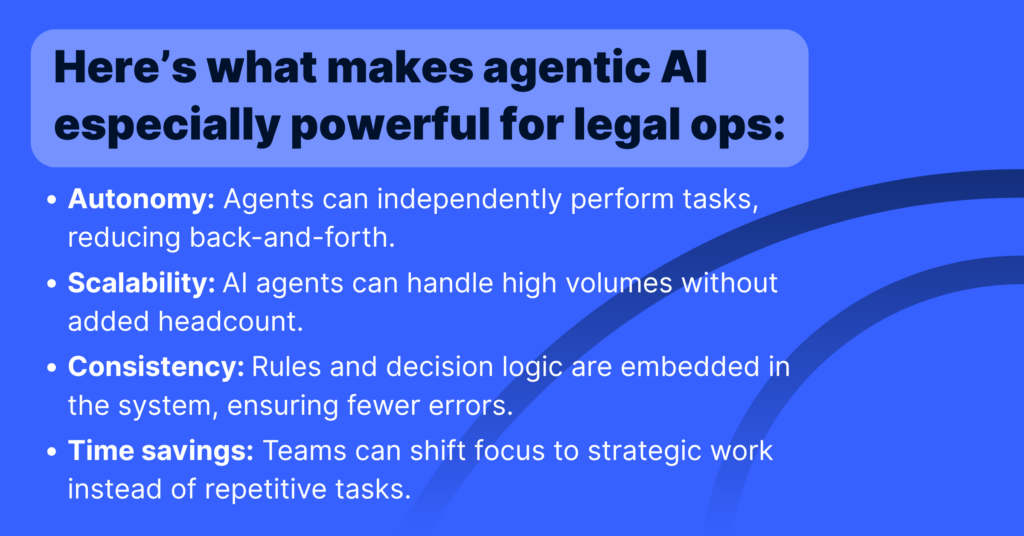
The legal tech world has no shortage of buzzwords, but every once in a while, one sticks for good reason. Agentic AI is one of them. Agentic AI in legal operations is stepping into the spotlight as legal departments continue to look for ways to streamline operations, manage risk, and do more with less. Unlike traditional AI tools that wait for instructions, agentic AI can make decisions, take action, and complete complex legal workflows autonomously. 

Let’s break down what agentic AI is, how it works, and why it’s becoming an essential part of legal operations strategy

What Is Agentic AI? 

Agentic AI refers to a new class of AI tools designed to plan, execute, and adapt multi-step tasks on their own, with minimal human input. These “AI agents” don’t just answer prompts — they take goals and run with them. 

For example, instead of asking an AI to redline a single clause, a legal operations team could give an agentic AI a broader task: review this contract, identify risky clauses, suggest edits, and generate a final version based on company policy. And it would do it — autonomously. 

The key difference between agentic AI and standard generative AI is agency: the ability to make decisions, use tools, and iterate toward a goal. 

Representation of Agentic AI for legal ops, with person holding cell phone and using AI

How Agentic AI Powers Legal Workflow Automation 

In legal operations, time is money — and repetitive tasks are the bottlenecks. Agentic AI in legal operations can help automate end-to-end legal processes such as: 

  • Reviewing and redlining contracts based on predefined rules 
  • Extracting data from legal documents and routing it to the right systems 
  • Managing intake and triage for legal service requests 
  • Drafting reports, summaries, and status updates across departments 

By enabling AI agents to interact with tools (like databases, document editors, and workflows), Agentic AI in legal operations creates a smarter, self-sufficient layer of automation that reduces manual effort while increasing speed and consistency. 

How Does Agentic AI Work: A Brief Explanation

At its core, Agentic AI blends a powerful language model with access to tools, data, and logic, giving it the ability to not just respond but act.  
 
Think of it this way: traditional AI tools wait for you to tell them what to do, step-by-step. Agentic AI starts with a goal and figures out how to get there. It doesn’t just generate an answer, it drafts the document, finds the data, reviews the terms, and refines the output until the task is done.  
 
These tools are often built by connecting a language model with software tools, business rules, and datasets the designated agent can access and use. Depending on the complexity of the workflow, this setup can be customized to suit specific tasks — whether that’s redlining contracts, generating reports, or routing approvals.  

Benefits of Legal AI Automation for In-House Teams and Law Firms 

Some teams opt for pre-configured setups with broader capabilities, while others tailor their systems for more focused use cases.  

The choice comes down to speed vs. precision — some teams need flexibility, while others prioritize control and simplicity. 

Benefits of Agentic AI in legal ops

The result? Faster legal service delivery, better alignment with business goals, and a more modern, resilient legal ops function. That’s exactly the kind of impact Agentic AI in legal operations is designed to deliver. 

What to Know Before Implementing Agentic AI in Legal Operations 

Of course, agentic AI isn’t magic. There are tradeoffs: 

  • Cost and complexity: Building agentic systems — especially at enterprise scale — can require time, money, and technical expertise. 
  • Testing and trust: Because agentic systems can produce a range of outputs, validating their performance and accuracy takes careful design. 
  • Overengineering risk: Sometimes a simple rule-based automation is enough. Not every task requires a multi-agent system. 

The key is finding use cases where autonomy pays off and implementing right-sized solutions. 

Why Agentic AI Is the Future of Legal Tech 

The shift toward agentic AI reflects a broader movement in legal operations: from reactive support to proactive enablement. Legal teams are no longer just processing work — they’re driving innovation, shaping policy, and delivering business value. 

The future is PEOPLE PLUS AI. We're going to be completing tasks 25% faster and to a higher quality. - Jean Yang, VP of AI Transformation

Agentic AI isn’t just another tool in the tech stack. It’s a teammate.  

And in some cases, it’s doing the work 70x to 270x faster. In our recent Better Call GPT research from the Onit AI Center of Excellence, we found that AI-powered contract review using Large Language Models (LLMs) can dramatically outperform human reviewers. This isn’t just about speed — it’s about freeing legal teams to shift their focus from manual review to high-impact strategic work. When AI agents handle the grunt work, legal becomes a driver of business velocity.

How Onit Is Supporting Legal AI Automation 

At Onit, we’re focused on helping legal teams evolve through automation, innovation, and intelligence. Whether you’re exploring your first AI use case or scaling your legal ops ecosystem, our platform is built to support modern workflows — including emerging agentic AI capabilities. 

Want to see how legal AI automation can transform your team’s impact?

Explore our solutions to discover how Onit is helping legal departments streamline workflows, accelerate service delivery, and embrace the future of legal tech with confidence.

Ready to Take the Next Step?

If your team is ready to move from experimentation to execution — and you want a smarter, faster way to operate — we’re here to help. Book a demo and see agentic AI in action.