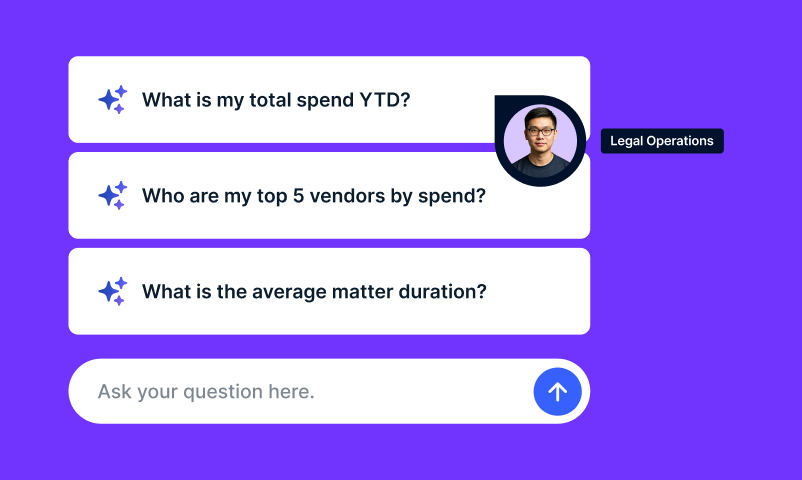


Legal leaders should be able to ask direct questions about spend, budgets, matters, vendors and overall operations, then receive a clear answer while there is still time to act. The standard is not speed alone. The answer should also be accurate – current, grounded in the legal department’s system of record, aligned with the user’s permissions and specific enough to support a decision.
That expectation changes the role of legal data. Instead of becoming a quarterly reporting exercise, data becomes part of day-to-day leadership. The most useful questions fall into three groups: where money is going, where attention is needed and whether the answer can withstand scrutiny.
What is happening with legal spend right now?
Leadership questions rarely arrive on the reporting calendar. Your CFO may ask how accruals are tracking against budget before a forecast meeting. Your general counsel may need to know which matters are driving variance before an executive update. Procurement may want to understand which vendors are associated with the most invoice rejections or adjustments before a review.
Legal leaders should be able to ask:
- How is current legal spend tracking against budget?
- Which matters and vendors are driving the variance?
- How do accrued amounts compare with final invoice spend?
- Which invoices are received, on hold, rejected or approved?
- Which business units are represented in current matter allocations?
These are not unusual analytics requests. They are routine management questions. When each one requires a report request, an export and spreadsheet reconciliation, the answer can arrive after the decision window has passed. Manual legal reporting also consumes time that legal operations doesn’t have or could be better spent applying to any number of other items already on their plate.
Where should Legal investigate before a problem grows?
Good legal reporting explains what happened. Better access to legal data helps leaders decide what to examine next. A high-level total may be useful, but the next question often carries the real insight.
Legal leaders should be able to ask:
- Which vendors had the most rejected or adjusted invoices this year?
- Which open matters have active purchase orders?
- Which open matters had no invoicing activity during the period?
- Which invoice reviewer rules apply to a particular vendor?
- How are budgets, accruals and final spend comparing across open matters?
The value comes from connecting financial and operational context. Spend without matter information can hide what is driving the number. Accruals without final spend make reconciliation harder. Vendor totals without rejection or adjustment patterns provide an incomplete view of performance.
The goal is not to replace legal judgment with an automated conclusion. It is to make the relevant governed data easier to explore, so leaders can identify patterns, ask follow-up questions and decide where human review is needed.
Can the answer stand up to scrutiny?
A fast answer is useful only when people understand what it means and where it came from. Legal teams work with sensitive information, different access levels and financial definitions that can change the result. “Spend,” for example, may mean billed spend or final spend after adjustments and taxes. A system should ask for clarification when the request is ambiguous instead of guessing.
Legal leaders should also be able to ask:
- Is this answer based on the current system of record?
- Does it reflect the permissions of the person asking?
- Can the team review the underlying detail?
- Can the result be presented clearly in a leadership update?
- If the question is unclear or unsupported by available data, will the system say so?
These questions establish a practical standard for governed, conversational analytics: current data, permission-aware access, structured answers, supporting visuals and a clear path for validation. They also keep professional judgment where it belongs, with the legal team.
Make faster answers a leadership expectation
Legal departments already hold information about invoices, matters, vendors, timekeepers, budgets, accruals, allocations and purchase orders. The leadership opportunity is to make that information easier to question without moving it into disconnected tools or rebuilding the same analysis for every meeting.
Ask Unity turns governed Unity ELM data into clear, actionable answers and provides guidance on product-related questions. Users can explore legal spend, matters, vendors, budgets, accruals and other operational data through natural-language questions, then review structured responses with supporting charts and tables. When a request is unclear, Ask Unity prompts the user to refine it instead of filling gaps with speculative output.
Explore the Ask Unity datasheet to see how legal teams can move from a plain-language question to a decision-ready answer inside Unity ELM.