August Product Launch: Stronger legal operations, from insight to action
Legal teams need accurate spend data, clear workflows, and answers they can use right away. The August Product Launch strengthens the work behind those outcomes.
Launching today, these enhancements help teams manage legal spend, review invoices, work with outside counsel, route legal requests, and turn contract data into action.
Unity ELM: More control over legal spend workflows
Pro Forma Invoicing
Resolve invoice changes before they become final
Tax-sensitive invoices can create unnecessary rework when issues surface after the final invoice or tax document has been issued.
Unity ELM Pro Forma Invoicing gives your team a controlled way to review and adjust eligible invoices before finalization. Once the review is complete, the vendor can finalize the invoice and provide the required Government Invoice ID.
Key highlights
Review and adjust eligible invoices before finalization.
Support VAT- and tax-sensitive invoice workflows.
Maintain a documented history of client adjustments, vendor reconciliation, approvals, and final invoice details.
Add an optional secondary internal approval step while your team validates the process.
Reduce post-finalization rework for Legal and outside counsel.
The result: Your team can resolve billing changes while they are still practical to address, with a clearer path from review through final invoice and payment.
Clearer invoice and timekeeper context
Small workflow improvements can make a meaningful difference when your team is reviewing high invoice volume.
Key highlights
View invoice-level taxes and discounts more clearly.
See additional purchase-order detail directly from the invoice.
Review approval steps with reviewer details expanded by default.
View legal entity codes in matter allocations.
Open dashboard invoice links in the actionable My Invoices experience.
See when an approved timekeeper rate expires and when a future rate takes effect.
The benefit for your team: Less navigation and fewer manual lookups when reviewing invoices, approvals, allocations, and timekeeper rates.
Ask Unity: Expanded data access and product guidance
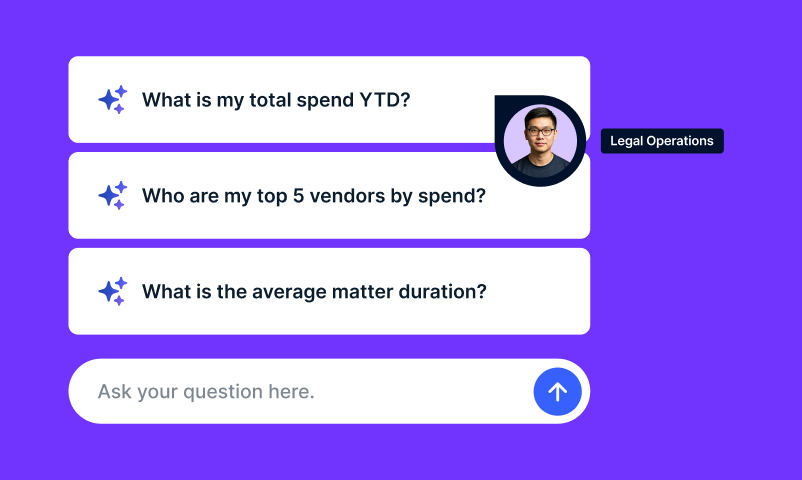
Get answers from more of your Unity ELM data, in the flow of work
A question about spend should not require a new report, a spreadsheet, or a wait for someone to pull the numbers.
Ask Unity now expands beyond invoice and spend analysis to include additional Unity ELM datasets. Users can ask questions in plain language about:
Budgets
Accruals
Matter allocations
Purchase orders
Invoice reviewer rules
Client-configured custom attributes
Ask Unity remains available on Unity pages, so users can investigate an issue without leaving the matter, invoice, or workflow they are reviewing. It also provides product guidance and a path to Support when self-service is not enough.
Key highlights
Compare budgets, accrued amounts, and final spend.
Explore matter allocations and purchase-order activity.
Understand which invoice reviewer rules apply to a vendor.
Analyze client-configured data alongside standard Unity ELM data.
Access Ask Unity through the persistent in-page chat experience.
Save page-level conversations to Ask Unity history.
Get product guidance and escalate to Support from the same conversation.
The result: Legal and Finance can answer more operational questions from the Unity ELM system of record, without switching between reports, spreadsheets, and support channels.
Spend Agent: More context and control for AI invoice review
Auto Adjustments
Move from identifying a variance to assessing its financial impact
Finding a billing issue is only the first step. Your team also needs to know what the issue means financially and decide how to act.
Spend Agent Auto Adjustments calculate a recommended monetary adjustment when Spend Agent identifies line-item violations. Reviewers can see the original amount, the issue, the relevant billing guidance, and the recommended adjustment together.
Key highlights
Calculate a recommended monetary adjustment for line-item violations.
Review the evidence and billing guidance behind each recommendation.
Use Sentry mode when a reviewer should approve or reject the recommendation.
Use Auto mode for qualifying invoices when automated action fits your operating model.
Enable or disable adjustments by vendor while continuing to use Spend Agent insights.
Override a recommended adjustment with a manual adjustment when needed.
The benefit for your team: Spend less time calculating clear-cut adjustments and more time focused on the exceptions that require judgment.
Matter-level engagement documents
General billing guidelines do not always capture the terms of a specific engagement.
Matter-level engagement documents give Spend Agent the context of the matter and vendor under review. Add engagement letters, billing guidelines, rate agreements, fee arrangements, and other relevant documents so invoice review reflects the terms that apply to that engagement.
Key highlights
Include matter-specific agreements and exceptions in invoice review.
Use more than one relevant document for a matter and vendor.
Prioritize matter-level terms when they conflict with general vendor billing guidelines.
Add PDF email correspondence when it contains terms relevant to review.
The result: Invoice review reflects the agreement for the engagement, not just a general vendor policy.
Unity RFP: Connect vendor selection to matter execution
RFP-to-Matter Integration
Vendor selection should not create a second round of data entry.
Unity RFP now connects sourcing decisions to the matter and budget workflows that follow. Link an RFP to an existing matter, create a new matter during setup, or initiate an RFP from the Matter vendor tab.
Key highlights
Transfer the approved RFP total to the related matter as its budget.
Capture budget start and end dates during RFP setup and proposal approval.
Transfer winning rates and fees into Matter Management.
Add the selected vendor to the matter after proposal approval.
Reduce duplicate data entry between sourcing and matter execution.
The benefit for your team: Preserve negotiated value and move from vendor selection to matter execution with less administrative work.
Engagement letters
Create clearer expectations before outside counsel begins work.
Key highlights
Draft engagement letters in the RFP editor or upload a file.
Add letters during RFP setup, while responses are in progress, or when approving a proposal.
Send engagement letters to selected vendors for acknowledgment.
Preserve engagement letters when an RFP is saved as a template.
The result: More consistent engagement terms and a clearer record that selected firms received and acknowledged them.
Business users need a simple way to get the right request to Legal. Legal needs enough context to route it well.
Unity LSR adds five legal-specific request types:
Employment
Intellectual Property
Product Legal Review
Insurance
Legal Operations
Each request type is available through both form-based and chat-based intake. Preconfigured fields and seeded, admin-editable picklists help capture the information Legal needs from the start.
Key highlights
Give business users clearer choices than a general legal question.
Collect domain-relevant information for Employment, Intellectual Property, Product Legal Review, Insurance, and Legal Operations requests.
Use Request Agent to support classification and required-field collection.
Vendors need a simple way to submit invoices, budgets, rates, and other information accurately. Legal teams need fewer avoidable errors and less rework.
Counsel Exchange enhancements improve the day-to-day experience for law firms and vendors.
Key highlights
See more invoice line-item detail and customize grid views.
Interpret validation messages and warnings more easily.
Support clearer error handling and bulk invoice-submission workflows.
Refine timekeeper and rate-management workflows with additional filters.
Review selected budgets before bulk submission.
Filter and navigate matter budgets by date range and page.
Protect in-progress work with an unsaved-changes prompt.
Access Support Assistant, hashes, API keys, and system announcements more easily.
The benefit for your team: Cleaner submissions, faster corrections, and less friction across the e-Billing process.