

Author: Onit

The Key to Streamlined Legal Operations in 2023

With The Conference Board forecasting that the U.S. economy will formally enter a recession in early 2023, many large enterprises are having flashbacks to the past two significant periods of economic turmoil in 2008 and 2018. Likewise, PwC’s 26th annual global CEO survey highlighted the need for businesses to “evolve or die,” per the 4,410 CEO respondents. Seventy-three percent of CEOs believed that global economic growth would decline in 2023. Moreover, nearly 40% did not think their companies would be economically viable a decade from now if they continued their current path.

Behind this sobering economic backdrop are three other prominent trends driving further business complexity:

For corporate legal leaders, these forces represent two sides of the same coin.  On one side, they represent significant run-rate work for already heavily utilized legal teams. But, on the other side, they represent an opportunity for legal leaders to partner with the C-suite and business unit leaders to provide the best possible business guidance on the legal elements of each of these trends.

Corporate legal departments have their own set of challenges. With corporations expecting to do additional work with fewer resources and less budget, so must legal. An E&Y law survey reveals that general counsels expect workloads to increase 25% over the next three years, yet 75% do not expect budgets to keep pace. Per ALM, 2023 rate hikes are 7% to 8% for many corporations, with high-end firms commanding more than a 30% increase.

So, what is the path forward for the corporate legal department? In discussions with Onit customers, we hear that most of their time and expense goes into daily run rate legal matters and activities: contracts, business agreements, I.P. and trademark requests, legal holds management, real estate agreements, and so forth. Unfortunately, this leaves little time for legal to partner with business leaders and provide the guidance the business desperately needs.

Executives now expect legal to operate like other business functions. This includes delivering higher satisfaction amongst internal clients, providing superior legal outcomes (and thus better business outcomes), improving operational efficiency, and demonstrating ROI on spending. To do so, corporate legal departments must optimize legal operations.

They are not alone. Today, many legal departments connect to the business in more influential, material ways – from impacting revenue generation and growth to EBITDA and operational efficiency. While legal operation has existed for decades, the function is at an inflection point. Forward-thinking organizations represent torchbearers for a new chapter in legal operations’ history – an era of optimized legal operations.

Even for departments that have not established a formal legal operations function or team, the operations of legal still happen every day. Nascent legal ops initiatives should adopt a start-up mentality and embrace a modern operating model versus taking a similar adoption path that more mature legal operations functions took.

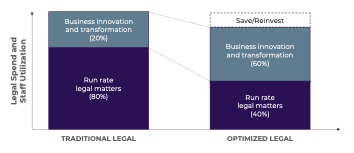
Legal’s path to making a more material impact on the business requires a focus on driving down the mix of time and money spent on run rate legal matters, so legal teams are freed to focus more on innovation and transformation initiatives.

The Transformation to Optimized Legal

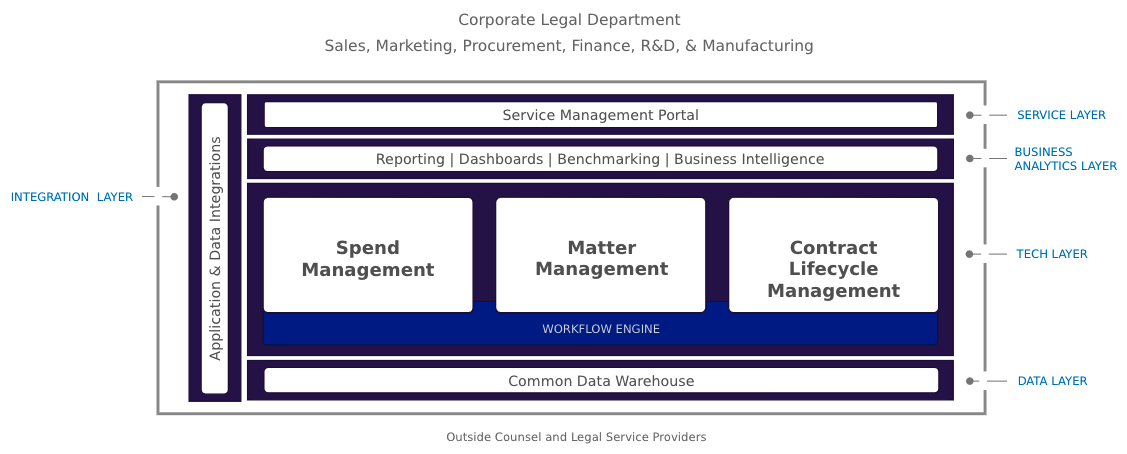
Such a transformation will rely on the usual combination of people, processes, and technology. Corporate legal leaders must now challenge legal operations technology providers to deliver the technology piece of the equation – a modern software platform for managing sophisticated legal matters and contracts with more intelligence, speed, and efficiency. Such a platform needs to provide a digital self-service capability, automate workflows and collaboration, and apply artificial intelligence to bring insights to bear at the point of decision or need.

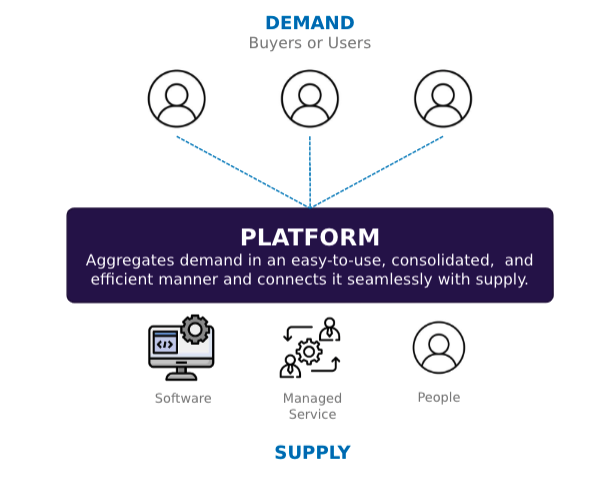
Why is a platform the linchpin to this transformation? In this next blog, learn how a platform approach starts with a business model, not technology, that can enable Legal to materially impact the business.

Introducing the 2023 Enterprise Legal Reputation (ELR) Report

This multinational study uncovers the power of legal departments to influence material growth, business value, and every aspect in between, even during periods of economic uncertainty — through better communication, efficient workflows, and more positive interactions with Legal’s internal clients.

The basis of all relationships lies in their interactions. In quantum physics, all properties are relational. Subatomic particles whirl through space, acquiring new properties only when they integrate with other particles.

When it comes to legal operations, interactions are just as fundamental. They are the underlying atomic units that permit Legal to collaborate and directly impact materiality and operational efficiency, even within our current macroeconomic climate.

The 2023 Enterprise Legal Reputation (ELR) Report, a study of 4,000 enterprise employees and 500 corporate legal professionals spanning the United States, United Kingdom, France, and Germany, focuses on the year-over-year (YoY) impressions of Legal’s brand image and its ability to influence every corner of its businesses, from revenue generation and EBITDA to corporate culture.

We are living in challenging economic times. The mantra everywhere, it seems, is “do more with less.” Yet just as there are clues to solving cosmic mysteries, the ELR Report discloses ways in which Legal can repair the energy and dynamics within its own systems: via better interactions.

THE PEOPLE, PROCESS & TECHNOLOGY OF LEGAL

Many organizations have long embraced a business framework called people, process, and technology (PPT). Designed to optimize efficiency and maintain balance, PPT is common across numerous disciplines, from HR and operations to IT and cybersecurity.

People are necessary to provide talent, wisdom, and insight.

Processes are required to accomplish work with productivity, scale, and efficiency.

Technology assists people in executing processes to achieve innovation.

So much has changed across the corporate landscape — and the world — since the 2022 Enterprise Legal Reputation (ELR) Report debuted. Last January’s boom economy is now a bust, besieged by geopolitical conflict, inflation, and devastating layoffs. Cost containment and EBITDA have emerged as major business priorities. However, the principal finding in 2022’s ELR Report continues to echo and is, in reality, magnified now in 2023: Legal can, and should, play a meaningful part in generating and elevating business materiality and growth.

In times like these, managing people, process, and technologies in triangulated fashion enables legal professionals to materially impact their businesses more than they ever have, or have ever been expected to, before. PPT transforms the way Legal is valued, evolving the department’s brand image from a back-office, tactical function to a front-office business driver, material influence, and cultural champion.

The first chapter of the 2023 ELR Report delves into perceptions of Legal’s brand image through the lens of corporate employees. It reveals that while almost four in five (78%) respondents acknowledge the enduring image of the legal department as a trustworthy protector of the business that offers sage advice, less than one in three (27%) considers Legal a good business partner.

Further, relationships with Legal have declined in every department in less than a year. Even interactions with “Legal-friendly” allies, like HR and Finance, have fallen from 62% to 56% and 62% to 51%, respectively. Functions that traditionally mesh less well with Legal — those that perhaps push the proverbial envelope and blur the metaphorical lines — like Sales and Procurement have plummeted even more, from 43% to only 30%, and 37% to just 22%.

That said, functions that interact most with Legal still experience the best relationships. The more Legal collaborates with a department, the stronger its relationship tends to be. And when it comes to measures of materiality, like sales and revenue generation, Legal truly stands out. More than half (56%) of employees acknowledge that Legal positively impacts sales and revenue operations. A similar number (53%) say Legal accelerates deal cycles –- a YoY increase of five percentage points.

LEGAL’S QUANTUM LEAP

A jump between energy levels by electrons orbiting within an atom is known, in the world of physics, as a quantum leap.

As enterprises control costs and overhaul operations, Legal needs to take a true quantum leap into the role of direct material influencer by becoming a more interactive partner that communicates effectively and responds efficiently. In fact, nearly half (43%) of ELR corporate employees specifically state that greater communication and collaboration is the most essential way Legal can support its internal clients, especially amid economic uncertainty.

Fission and fusion are quantum processes by which atoms change. Fission occurs when a neutron smashes into another atom, causing it to split. Fusion occurs when atoms amalgamate and merge. Vast amounts of energy are released by both, but fusion creates the most long-term impact –- as well as greater safety, stability, and sustainablity.

The same can be said of Legal, its internal clients, and executive teams as they continue to search for new strategies to achieve greater EBITDA and drive profitability in a positive and meaningful material way.

People. Process. Technology.

Interacting and collaborating with people.

Streamlining efficient processes.

Bringing people and process together with modern, innovative technology.

This is Legal’s moment of impact. It’s time for Legal to stand out as a business protector and partner in the eyes of its clients –- and these three elements can fuse to create a game-changing, materially successful, and future-proof legal department of tomorrow.

Read Chapter 1 of the 2023 ELR Report to discover new and enduring perceptions of the legal department, how corporate employees view their interactions and relationships with Legal, and ways in which Legal can evolve its brand image to more directly impact revenue generation, growth, and operational efficiency.

What is Legal Spend Management?

Legal spend management is the practice of controlling outside counsel spend. Management of outside counsel spend involves having visibility of spend, identifying and actioning cost-reduction opportunities, and budgeting future spend.

SPECIALIZED LEGAL E-BILLING IS NECESSARY FOR SPEND MANAGEMENT

A typical legal team will receive thousands of invoices a year. Reviewing these invoices manually is time-consuming and prone to error. The first stage in legal spend management is to automate the review of legal invoices, a process known as e-billing. Legal e-billing differs from a generic accounts payable (AP) system in a few ways and is essential for legal spend management:

    • Different billing guidelines – what firms can and cannot invoice for – exist for different firms. Trying to remember and accurately apply these rules when manually reviewing invoices is a daunting task, and mistakes will slip through the net, resulting in overpayment. Legal e-billing functionalities allow the corporate legal team to set up rules; incoming invoices are automatically reviewed, approved, rejected, or flagged for further review.
    • A legal invoice can contain hundreds of line items for different work and task codes. A standard AP system cannot track these effectively. E-billing allows law firms to submit LEDES format invoices, which enables the management and reporting of these task codes and allows the legal team to analyze the costs of different work types, compare value across firms, and budget headcount and spend required for future work.
    • Some legal e-billing solutions allow law firms to submit their work in progress with the corporate legal team reviewing or rejecting the work the firm wants to bill. This means invoices are theoretically approved before they are formally submitted, which removes unexpected invoice amounts, reduces the number of rejected invoices, and speeds up payment to the firm.
    • Legal spend management software integrates with accounts payable solutions (if desired) so the organization’s accounting processes can still be followed; the legal team gains additional visibility and control to manage legal spending effectively.

LEGAL SPEND MANAGEMENT SOFTWARE BEYOND E-BILLING

While legal e-billing reduces costs quickly by enforcing billing guidelines and increasing team productivity, full legal spend management goes further than this. As law firms become better at submitting compliant invoices, the savings from guideline compliance start to stabilize. This tends to happen 1-2 years after implementation. At this point, legal operations will use the accumulated matter spend data to make more strategic spend management decisions.

However, this can be done earlier on in the spend management journey. Legal spend management software enables legal operations to report on legal spend and use spend data to make sourcing decisions, drive negotiations and selection, and create a collaborative, value-driven relationship with firms. Features of legal spend management software, besides e-billing, include spend dashboards and reports, RFP tools, and legal analytics capabilities. Most legal spend management solutions also contain legal matter management features, which would not exist in an AP system. The matter data gives a fuller picture of legal work and its associated cost.

BENEFITS OF LEGAL SPEND MANAGEMENT SOFTWARE

Return on investment (ROI) is very easy to prove with legal spend management, as most benefits are directly related to lowering costs. These benefits include:

    • Significantly reduce legal spend. A fairly typical legal department can save 4 EUR per invoice, 5% of the external legal spend costs in the first year, and 8% of the external legal spend costs after the second year (all data is subject to average empirical values). Download our business case guide to calculate your potential savings.
    • Speed up invoice processing time and take advantage of early pay discounts from firms.
    • Visibility of work in progress and accumulating costs without waiting for the invoice.
    • Track and report on matter budgets, improving the accuracy of forecasts over time.
    • Improve visibility into matters and their associated costs through real-time dashboards and automated reports to stakeholders.
    • Automate manual processes to improve team productivity and free counsel to concentrate on high-value work.
    • Accurate, consistent, comparable, and reliable data across all matters.
    • Improved collaboration internally and with outside counsel that drives better matter outcomes and higher quality firm relationships.
    • Make data-driven strategic legal operations and management decisions, including sourcing, panel reviews, and negotiations.
    • Like-for-like comparison and review of law firm rates and value for money.
    • Fairer, competitive, and comparable proposals from firms

Request a demo of BusyLamp eBilling.Space today.

What is LEDES and the UTBMS?

The first time you hear the acronyms LEDES or UTBMS, you might think, “What’s Ledes got to do with legal spend management? The UTB-em-what now?” These tongue-twisting abbreviations are legal industry standards for coding and submitting legal invoices when using e-billing software. Read on to learn the basics of LEDES and UTBMS.

WHAT IS A LEDES FILE?

LEDES stands for “Legal Electronic Data Exchange Standard” and is a framework for the exchange of legal e-billing information. The LEDES file format specifications are globally recognized as the legal industry standard for recording legal e-billing data. The file formats go beyond e-billing, also providing formats for legal budgeting, timekeeper information, and IP matter information.

WHAT IS UTBMS?

UTBMS stands for “Uniform Task-Based Management System” and is a series of codes used to classify legal services. Outside counsel records their time and classifies the work using the appropriate code from the UTBMS set. UTBMS-coded time entries and invoices show the timekeeper, the tasks (e.g., taking a witness statement), activities undertaken (e.g., drafting a letter), the time spent, and the rate and cost of the item of work. As with the LEDES format, such codes standardize how legal work gets recorded worldwide, with law firms, legal departments, and e-billing vendors using the same codes.

HISTORY OF UTBMS

Before e-billing, paper invoices would contain lengthy descriptions of services that could run for multiple pages. It was difficult to digest the work and determine how much it cost. Driven by the need to digitalize this process, and alongside the formation of LEDES, The American Bar Association, the Association of Corporate Counsel, and PricewaterhouseCoopers formed a group to create a unified electronic billing standard. The UTBMS codes are sometimes known as ABA task codes for this reason. They decided that electronic invoice time entries should be task-based and aggregated by the type of work performed:

  • Task codes are a granular description of the service provided by an area of law. Task codes are organized in sets under their less-granular phases within the law: Litigation, Bankruptcy, Trademark, etc.
  • Activity codes identify the specific service performed or “how “the work is being done.
  • Expense codes were created to categorize expenses on matters. This group eventually morphed into the LEDES Oversight Committee. The LOC has since updated and created several UTBMS standards and codes, but other organizations do so as well. The revision and evolution of the codes continue today.

BENEFITS OF UTBMS FOR CORPORATE LEGAL

For law firms, standard invoice file formats and time entry recording significantly reduce administrative burden since they use the same standards regardless of who the client is or what e-billing software they use. Most law firms, and indeed all the large firms, use the LEDES file format and UTBMS code set as standard, and many have been doing so since the mid-90s. For in-house legal departments, the use of UTBMS also delivers significant benefits:

  • Legal e-billing systems can electronically review invoice submissions before they reach a human reviewer. The system checks the invoice against the billing rules – for example, if a specific task code reaches a pre-defined budget threshold – and can flag or reject the invoice automatically if desired. This saves in-house counsel time reviewing invoices manually, freeing them up to do more high-value work. BusyLamp legal spend management customers notice billing errors missed during the previous process (error-prone, human review).
  • Standard codes allow for easy comparison of work performed across different matters or firms. Cost, efficiency, and quality can all be compared quickly and consistently.
  • This legal spend reporting can be used to negotiate better rates, decide which work to bring in-house/outsource, evaluate which firms to use for which types of work or matters, and to make a business case for additional headcount.

Request a demo of BusyLamp eBilling.Space today.

6 Ways Legal Spend Management Technology Can Reduce Your Costs

With the increased pressure on legal departments to improve efficiency and control costs, modern legal spend management solutions are a sensible option as they quickly generate savings that exceed the initial investment. E-billing automates processes and allows legal departments to identify cost-saving measures in the immediate term and by using data-driven strategies for the future. Here are six of the ways legal spend management can reduce your costs.

1. ENFORCEMENT OF LEGAL BILLING GUIDELINES

E-billing software automatically checks invoices against billing guidelines such as caps on hours, total spend, expenses, overtime, or staffing rules. Human reviewers will make mistakes and miss certain invoice and line-item violations. This is especially the case for departments with multiple guidelines or different rules for different firms. Your company’s specific rules can be loaded into the e-billing software, which then automatically evaluates invoices during processing. Non-compliant invoices that may have previously gone unnoticed will be rejected or flagged for review, and compliant invoices will automatically be approved for payment.

2. REAL-TIME COST TRANSPARENCY

E-billing offers visibility and consistency of how legal bills, matter information, and budgets are input, processed, and centrally stored. This creates greater control vs. spreadsheets by default. Modern Legal Spend Management software has additional tools to improve visibility of the entire matter lifecycle and associated costs. Onit’s European legal spend management solution BusyLamp, for example, allows law firms to enter work in progress (WIP) and draft invoices before invoicing the respective line items, so the legal department does not need to wait for the bill to get this information. Legal departments can also submit cost estimates and instruct firms directly from the software. This increased transparency makes budgeting easier and reduces unexpected costs.

3. INVOICE PROCESSING AND TIME EFFICIENCIES

As with many software tools, legal spend management dramatically improves efficiency and accuracy. With BusyLamp, information is processed digitally without needing sorting and organizing, as bills are forwarded automatically to a designated person after being checked for guideline compliance. This saves a vast amount of administration time spent doing tasks that carry the risk of significant manual errors, and some tasks are made redundant, such as data entry, scanning, and filing. Coupled with other process automation, lawyers are freed up to spend time on actual legal work, their area of expertise, not tedious manual tasks.

4. REPORTING EFFICIENCIES

Having real-time, secure, accurate, and consistent, centralized data saves time accessing and reporting on documents, matters, and financials. A lot of time is wasted by legal staff of all seniorities manually compiling reports from multiple on- and offline sources. Using Legal Spend Management software, custom reports, as required by the business, can be scheduled for automatic creation and delivered to stakeholders by email. When ad-hoc reports are inevitably needed, they can be compiled in just a few clicks.

5. LEGAL ANALYTICS FOR STRATEGIC DECISION MAKING

Over time, legal spend management creates a database of all historic matters and their associated spend, broken down into UTBMS and LEDES codes. Analytics can gain insights into legal spend and inform data-driven decision-making by comparing savings, spending trends, and budget-to-actuals across law firms, matter types, practice areas, jurisdictions, timekeeper seniority, and more. This further reduces costs and improves legal operations. E-billing captures spend accurately and comprehensively. Without it, analyzing spend is incredibly time and resource intensive. With e-billing, the legal department is armed with valuable information for long-term legal spend management. It can contribute to business goals and achieve year-over-year improvements, becoming a driver of value and savings for the company instead of a cost center.

6. VENDOR SOURCING

Modern legal spend management solutions like BusyLamp include tools to submit RFPs and cost estimates for work to law firms. Pre-structuring the requests in a consistent format ensures a fair and easily comparable response from the firms. Proposals are more likely to be competitively priced, as firms know they compete for the work. Using data from responses and estimates can empower a legal department to make more informed resourcing and budgeting decisions faster.

To find out exactly how much you can save in each area, download the Building a Business Case for e-Billing Guide, which provides calculations for each saving category that can be achieved with a legal spend management solution.

What Legal Ops Teams Should Know About RFPs

When humans make decisions, they are nearly always impacted by invisible biases. And we are not the ones to blame! If anything, we will have to blame evolution for that. Humans only naturally rely on feelings, experiences, and personal views when making decisions. After all, in the past, this bias has often decided between life and death. Luckily, nowadays, the business decisions we must make daily are usually less dramatic. Yet they are equally shaped by experience, so we often stick with the tried and tested. This path often appears as “the safe choice,” but it leaves no room for improvement and might even sometimes prevent you from making the best or most cost-effective choice for your business.

Request for Proposals (RFPs) are a powerful tool to pre-empt this potential bias and choose a data-based approach to selecting the most suitable provider for your matter. A standardized template, for example, ensures that your legal teams repeatedly ask themselves and their vendors critical questions that support finding the right vendor. We have learned first-hand how crucial selecting the right vendor is to the project’s success going forward. Here, we will provide helpful tips on which features your RFP should include to best support you and your team in the decision-making process and pave the way for a successful project outcome.

BE PRECISE AND ASK THE RIGHT QUESTIONS

Be specific in your questions and provide law firms with information that gives a clear picture of the task. Precise questions are the be-all and end-all because the more general your questions are, the broader the law firms’ answers will be. Of course, you do not want to read pages and pages of marketing materials from law firms, which exist to represent themselves positively but are ultimately not a good decision-making aid. To get away from the so-called “gut feeling” and marketing materials, determine a set of questions that tells you which law firm is best for the upcoming project and your company. From the law firm’s point of view, it is helpful to have as much information as possible about the matter and, if relevant, about your industry to formulate precise answers and for them to respond with an offer. The more specific your questions are, the more likely you are to receive well-prepared answers that will help you to find legal advice that suits you and your business. Allow enough time for the drafting; you will usually get it back afterward because the RFP process will benefit from it.

HOW CAN BUSYLAMP HELP YOU STREAMLINE THIS PART OF THE PROCESS?

Frequently, a simple document or spreadsheet is used to gather and send a set of questions to law firms – it takes no tech expert to know that there are more modern and efficient solutions. Onit’s European legal spend management solution BusyLamp eBilling.Space, for example, summing compilation of relevant answers for your evaluation. This gives you summarized tabular data supported by graphs, allowing you to compare responses instantly. The RFP module asks law firms specifically for the information relevant to you and provides specialized templates, e.g., for finance and M&A transactions. Therefore, all the information in the law firms’ responses is in a standardized format of your choosing and adapts flexibly to subsequent changes.

ESSENTIAL FUNCTIONS THAT SPEED UP YOUR SOURCING-PROCESS

Depending on the complexity of the matter, it is good practice to allow law firms to take up to three or four weeks to answer all your questions. We understand that there are often more urgent cases in the work schedule where the law firms need an almost immediate response – e.g., in corporate cases or an M&A acquisition. BusyLamp provides a functionality especially valuable for these specific cases, allowing users to limit the time to file a response. Additionally, software solutions generally save a significant amount of your time in the RFP process because answers on staffing, costs, hours, etc., will be received uniformly formatted, which allows a simple and intuitive comparison of the answers received. This leaves valuable time for other tasks, especially if your project is already very time critical.

DON’T FORGET TO NEGOTIATE

Ask the law firms about alternative cost structures and possibilities for discounting. Negotiation is possible, and it can be done without difficulty in a software-based environment. Finally, you do not want to simply receive an overview of standard rates. If law firms add to or adjust their responses after the initial offer, you will need to reassemble data at this point and track the changes. As an in-house legal team, you should be able to back up your negotiation results with numbers at any time. If a law firm revises its offer during the RFP process, you will want to note this later in your reports. A good negotiation result can make you feel good, but you should have clear numbers up your sleeve to back this up. BusyLamp works for you and records if the offer has changed during the RFP process. For example, it points out whether an hourly rate has changed within an RFP (i.e., if the rate was lowered compared to the previous response).

KICK-OFF FOR A SUCCESSFUL COLLABORATION

In BusyLamp, the RFP module is only the first step in creating and managing the matter. After interviewing, evaluating, and selecting the law firm, the data from the RFP module is applied to a new matter with the corresponding budget settings by simply clicking one button. In the same step, the law firm receives an invitation to start collaborating on the matter in BusyLamp. If desired, it is possible to have the matter checked and the budget approved by the departments responsible with our approval module. Software-powered RFP processes are a time and resource-saving alternative to the old-fashioned and clunky manual processes. In conclusion, a powerful RFP tool is essential for selecting your vendor. It bypasses the urge to act based on biases and allows a data-driven approach instead. Doing that decisively shapes the outcome of the overall project’s success.

BusyLamp is acknowledged by our clients for its value-adding, continuously enhanced RFP tool. With the right decision made, the entire matter management cycle can be followed up in our legal spend management solution — a vital asset in times of remote working.

Request a demo of eBilling.Space today and see our RFP functionality for yourself.

Key Performance Indicators (KPIs) that All Legal Departments Should Consider

In today’s business world, where analytics plays such a key role in performance management and the strategic distribution of resources, it’s not a matter of “if” key performance indicators (KPIs) should be instituted, but “when,” “what,” “how,” and “why.”

Some might say that the best answer for “when” is yesterday, if not before. However, KPIs are not something to rush into or put into place without careful consideration of the goal desired, what activities or metrics are the best to monitor, and how the process of data gathering and analysis alone might affect performance (sometimes tasks that are not being closely measured can become demoted or disregarded). Additionally, recognize that the correct KPIs for your in-house legal department are likely different from those most appropriate in measuring the performance of your outside counsel.

Here, we will look at KPIs (Key Performance Indicators) that all legal departments should consider but not necessarily implement. It is unlikely you will need (or want!) all of these.

Cost and cost-effectiveness: Gone are the days of external law firm invoices with only the cryptic explanation “For Services Rendered.” As part of legal spend management, it is critical to track outlay; the availability of sophisticated billing software makes it easier than ever to collect and evaluate detailed reports tailored to your needs.

KEY PERFORMANCE INDICATORS (KPIS) FOR LEGAL DEPARTMENTS INCLUDE:

  • Total cost of services (inside and outside)
  • Legal spend as percentage of revenue
  • Budget-to-actual total spend comparison (e.g., percent handled within budget)
  • Outside expense versus in-house In-house lawyers versus revenue
  • Cost per matter
  • Cost per lawyer
  • Spend after implementing billing compared to spend without

Process, process efficiency, and productivity: Is performance consistently meeting expectations regarding staffing, casework, and time usage? Relevant data in this area can cover the following:

  • Percentage of cases solved/resolved successfully
  • Matters per attorney and/or per paralegal
  • Staffing (internal) or billing (external) of paralegals to lawyers
  • Matter practice area and which department raised the matter
  • Legal matter time and expense versus administrative tasks
  • Legal matters handled versus revenue
  • Number of law firm secondees and/or contractors vs. permanent staff
  • Time for legal invoice processing and payment
  • Deadline compliance

Cycle time: Timeliness in the delivery of services is always important; spotting shifts in performance against this metric, especially notable trends in a particular area, can allow an issue to be investigated to determine the root cause. Here, you might monitor:

  • Time per legal dispute
  • Time to trial
  • Time per non-trial matter
  • Response time for e-mails or other requests

Customer satisfaction: Can be determined by surveys of stakeholders and “clients,” including those in departments that interact with inside and outside counsel. Metrics can include:

  • Level of satisfaction (e.g., on a scale of 1 to 5, etc.)
  • Number of complaints filed
  • Subject of complaints (to reveal trends, etc.)
  • Are law firms delivering promised benefits (secondees, training)

Determining the most critical areas, how to monitor and measure them, and expected performance levels are at the foundation of the process. These decisions must be made with leadership and other departments to ensure that they align with the company’s overall strategic vision, specific business unit strategies, and other considerations. The Key Performance Indicators – which need to be clear, measurable, and achievable and should be validated against comparable benchmarks – must then be effectively communicated to all affected parties.

Accurate collection of data, measurement, and analysis must follow – and it’s important to confirm that systems are in place to allow for these steps to be conducted before finalizing the KPIs themselves.

Establishing and measuring KPIs, of course, is only half of the process; even more important is evaluating the data and determining what action needs to be taken to improve a current situation. (Evaluation could also indicate that systems are working well and even suggest that appropriate reward or recognition is warranted.)

Information is power. Implementing and acting upon smart, well-defined KPIs can incentivize superior performance – especially if, for example, fees or bonuses are at risk – and they can greatly help manage legal spend and reduce costs. Even reviewing current performance measures and processes in preparation for establishing KPIs can bring rewards in acting as a business health check-up. There is no time like now to begin.

Learn more about BusyLamp from Onit, our end-to-end legal spend management solution built for European corporate legal departments. 

How Corporate Legal Teams Benefit from RFPs

A Request for Proposal (RFP) is a powerful tool for legal departments to streamline their work and to meet the growing corporate demand to “do more with less.” In our blog “What is a Request for Proposal,” we have introduced some key functions of an RFP tool and summarized the information typically included. If the term RFP is new to you, feel free to read this blog first. Let’s start by exploring the advantages smart RFP tools offer in-house legal teams (and their law firms).

THE BENEFITS FORMAL RFP FUNCTIONS OFFER CLIENTS

Traditionally, law firms would respond to a request for a quotation for legal work in various formats – e-mail, a written document, or even a phone call. Obviously, from a client’s perspective, this has several drawbacks. At the top of the list is that the client has difficulty reviewing the different proposals and identifying the best provider for this legal work. Having an RFP procedure in place, as offered with our legal spend management solution BusyLamp, allows the client to see all the law firms’ proposals together – meaning there is a consistent and single source of truth. Further, the in-house team can have a visual representation of the different quotes – showing things like the resources proposed, the split of partner and associate involvement, the rates and hours for these timekeepers, the average hourly rate, total estimated costs/expenses, and an overall time frame for the matter thus allowing easy comparison and review of the quotes. It will also allow the law firm to propose an alternative charging arrangement if required, including doing the work for a fixed or capped fee.

Crucially from a risk perspective, using a purpose-built RFP application also allows the client to see an audit trail of the process. This point is essential, as using software to support the procurement process enables the client to demonstrate that an “even-handed” decision has been made. This evidence can be used to justify the final decision, offering important safeguards for everyone involved in the proposal/procurement process.

Finally, we should look at some unexpected benefits after seeing law firms use this technology. RFPs allow legal departments to quantify the results of their negotiations with law firms and thus make them visible. For example, they can reduce the time spent by their timekeepers during the RFP process and show the savings later in their reports. One key area is that the client can monitor those firms who are consistently under or over-bidding in their proposals – for whatever reason – and perhaps review why; for example, is the client allowing enough time for the response to be prepared appropriately, or does the law firm lack the necessary resources to present a convincing and detailed proposal? The client can also collect valuable data for each law firm. This will be invaluable in relationship negotiations and allow a sensible conversation with law firms based on accurate data.

As previously noted, using RFP technology means that the client can hold all proposal information in one secure place, retain all previous proposals, and monitor how law firms have performed by comparing actual costs versus estimates. Also, this application allows in-house lawyers to share documents with law firms in a secure and controlled manner and aids the client in building a centralized pricing knowledge repository.

Request a demo of eBilling.Space today and see our RFP functionality for yourself.

5 Key Skills of Successful Legal Operations Managers

Legal operations is gradually becoming one of the most important disciplines for legal departments around the globe. Broadly speaking, legal operations encompasses all the responsibilities of a legal department that are not the law itself, including spend management, increasing efficiency and productivity of the legal department, vendor management, legal technology implementation. It is, therefore, multi-faceted with many roles and responsibilities and enables legal counsel to focus on providing legal advice in the most valuable and productive way possible. A legal operations team needs a wide range of skills to generate the best outcomes.

Fortunately, the legal operations head does not need to be perfect in those areas, as they can sometimes build a diverse team around them. Nevertheless, an excellent legal operations manager should always strive to develop generalist skills to mentor and lead the specialists within the team. Those with teams are the fortunate ones, though. A solo legal operations manager runs most legal operations functions in Europe, and it is even more critical that this person develops the necessary key skills.

Whether you’re already in the job or aspire to transition into legal operations, here are five essential skills every legal operations professional should have or be actively working on improving, especially if they are in a “team of one.”

1. STAKEHOLDER MANAGEMENT AND COMMUNICATION

A legal operations manager needs to define and identify the relevant stakeholders for projects to understand their needs and address them while balancing competing requirements and priorities. On occasion, final budget decisions will be made in other departments of the organization, so maintaining effective communication and a positive relationship with all stakeholders is vital. The legal operations director is the link between the legal department and the rest of the organization, ensuring stakeholders are involved and updated. This may also entail influencing stakeholders to buy into a project in the first place by identifying how the project benefits the wider business. As other departments may be unfamiliar with the legal department’s workflow and the resulting obstacles, a legal operations manager must be able to explain projects and benefits in terms that make sense outside of the legal silo. They should be able to network and communicate with people at several levels throughout the organization. As Ben Eason, Head of Legal Transformation at Barclays, says, “Evidence of flexibility, interchangeability, negotiation, and managing stakeholders are crucial. These skills are arguably the most important for legal operations success.”

2. LEGAL DEPARTMENT BUDGETING

A legal operations manager should be able to manage and calculate the budget the legal department has and the budget it might need, even if this responsibility is outside their remit. Reliable, stable financial planning will help the legal department to develop consistently. While there should be an understanding of previous and actual budgets, as this helps with forecasting, actually planning the future is more important. The legal department will constantly be pressured to be more efficient, and resource optimization is key to success. Part of the job will be to spot new cost-saving opportunities. Spend management tools can make the visibility of these metrics, and therefore decision making, much easier. The legal operations director should have the acumen to acquire a budget for a project when there isn’t one by communicating with the budget holder/s and creating a business case that advocates what is best for the legal department and the whole organization. This links with stakeholder management and communication skill in that the business case must resonate with the budget holder/s aims and objectives, not just the legal department.

3. LEGAL TECHNOLOGY KNOWLEDGE

Technology is playing an ever more significant role in the role of a legal operations manager as legal departments strive to become more agile, collaborative, and efficient. A legal operations head needs to have an innovative and curious approach to problem-solving. They should be confident in rolling out tech (or knowing where to go for help) and have the ability to plan and implement a long-term process and technology roadmap. The rapidly evolving legal technology landscape can cause distractions, so staying up to date with legal tech trends and new entrants to the market to avoid any sense of overwhelm is important. This also helps the legal operations manager ensure projects and plans stay true to the department’s objectives. The ability to critically evaluate the relevance of the current plan and pivot quickly if required is essential. Since many lawyers are still doing repetitive and time-consuming tasks manually, the legal operations manager should find solutions to streamline and/or automate these processes by using existing enterprise tech or evaluating legal-specific vendors. An excellent legal operations head will know how to map out current processes and decide which can be improved by changing processes vs. those which require technology to solve and then prioritize accordingly.

4. FIRM AND VENDOR MANAGEMENT

In some organizations, the legal operations team manages the procurement of external legal services from law firms and vendors. In many companies, firms and vendors are traditionally selected through personal contacts or loyalty, though this status quo is being challenged more frequently now. A good legal operations manager has to turn this thinking around and focus on more effective and transparent solutions for the department. Instead of agreeing on standard pricing and staffing models, the head of legal operations should facilitate the negotiation of more flexible and transparent pricing models to create positive incentives. This can be a win-win for clients and firms, incentives such as ‘volume discounts’ encourage counsel to drive more work towards a single firm to reach the threshold that triggers a discount. Legal operations professionals not from a legal background need to familiarize themselves with how legal services are billed; rates, AFAs, LEDES, etc. They also need to approach vendor management with sensitivity to influence in-house counsel to the new way of thinking.

Legal services aren’t a commodity, and it can be challenging to quantify added value, so it is about more than “lowest cost wins.” By setting up a structured bidding request, as one example, the legal operations manager can force competitive rates from the firms while requiring counsel to objectively decide which proposal generates the most value for the cost. Another part of the work in this area is the administration of efficient onboarding for new vendors or firms. After choosing the right vendor/firm, clear rules (such as billing guidelines) must be introduced to measure the performance of the collaboration and get maximum value for money. The head of legal operations also needs to facilitate fair, transparent, and data-driven performance reviews with vendors and firms.

5. DATA LITERACY

Data literacy is vital for the work of a legal operations director. Many legal departments are making decisions inefficiently, using outdated processes such as spreadsheet reporting, anecdotal feedback, or simply “gut feel.” A legal operations professional is unlikely to start their job with sophisticated reporting tools and must be confident in navigating the existing paper or spreadsheet reports to find the needed data. While there is no need for a legal operations manager to be a data scientist, data literacy goes beyond compiling reports. Many legal departments waste time compiling frequent reports in which most data goes unused. The director of legal operations needs to avoid data tracking for the sake of it and understand how to use the information to develop the department and the organization as a whole. They should identify the goals (using existing data to help, if appropriate), work backward to identify key performance indicators (KPIs) and important metrics, and then ensure the department can capture the data points needed to measure KPIs. This consistent data lays the foundations for analytical capabilities to enable strategic decision-making and solve problems.

An excellent legal operations head needs to know how to structure, gather and analyze the relevant legal data. This can help in practical ways, such as maximizing value when negotiating external contracts or making a business case for increased headcount and budgets. Data literacy will also help the legal operations head to balance the needs of the department in an objective manner and decide where to focus their efforts.

Learn more about BusyLamp from Onit, our end-to-end legal spend management solution built for European corporate legal departments. 

Addressing European Matter Management: A Complete, Proven ELM Solution from Onit 

When it comes to European matter management solutions, Legal organizations across the continent know that current options on the market just cannot measure up. As the needs of the legal organization grow into the spend management realm — extending beyond pure matter management for Legal in Europe — departments need a complete, robust ELM (Enterprise Legal Management) solution to match that growth.

Too often, the options for these organizations consist of either disparate systems or “point” solutions for either matter management or spend management with varying levels of sophistication and maturity. These “out-of-the-box” European matter management products offer limited or minimal configurability and require tiresome duplication of data when not integrated with a spend management system. As a result, reporting and analysis of data needs consolidation and exporting from two different places. That’s a mixture that results in significant challenges. Beyond the constant need for synchronization, this process is prone to errors — and requires constant, time-consuming manual data manipulation to ensure accuracy.

The European matter management market deserves a better solution than the ones out there. The good news? That a complete ELM solution is on the way.

Onit Matter Management + BusyLamp eBilling.space Integration

Available in July of 2023, Onit’s Matter Management and BusyLamp eBilling.space integration offers a complete, configurable, and proven ELM solution for European organizations with a single system of records for matter data. It removes the need for data duplication across two systems by offering a single source of truth for users, combining the power of Onit Matter Management with the unique vendor and spend management capabilities of BusyLamp eBilling.space that specifically address the requirements of European corporate legal teams.

The seamless integration provides European legal departments an easy-to-use and complete ELM solution that saves time, reduces errors, and enables streamlined processes. Solution users only enter matter data once; from there, the click of a button synchronizes relevant matters (those related to outside counsel) with the spend management solution. Empowered by Onit Matter Management + BusyLamp eBilling.space, European legal departments can get valuable time back for projects that help to materially grow the organization rather than spending time on the menial tasks of data consolidation, duplication, and proofing.

The comprehensive European ELM solution delivered by Onit Matter Management + BusyLamp eBilling.space will also deliver further innovations in 2023; future additions to the offering will include consolidated reporting and analytics for further organizational insights.

Interested in learning how Onit Matter Management + BusyLamp eBilling.space can help streamline your organization? Schedule a demo here.