In 2021, more than half of legal departments (54%) spent more internally than they spent on outside costs. Where did that budget go? Toward funding their legal operations.
Legal operations (also called “legal ops”) is the combination of all the business activities, processes, and people that empower an in-house legal team to serve a company’s legal needs using a strategic business approach.
Unlike the legal administration team in law firms, which focuses on admin tasks like answering calls, drafting documents, and conducting legal research, legal operations teams support in-house counsels with skills like planning, financial management, vendor management, matter management, technology management, and legal data analytics.
How legal ops has changed over the years
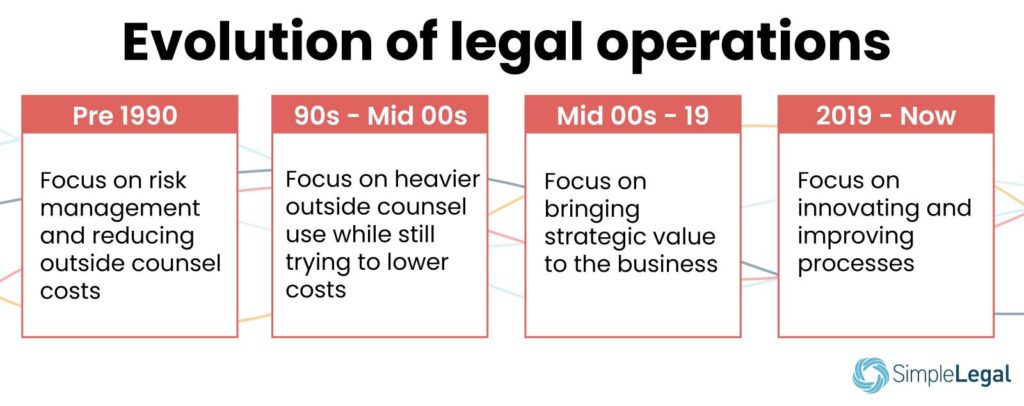
Before 1990, in-house legal departments were more focused on risk management than on maximizing resources. The goal was simple: Reduce outside counsel costs.
The ’90s through the mid-2000s saw the development of an official, more complex legal operations department that facilitated heavier use of outside counsel even though keeping costs low was still a goal.
The major transformation began in the mid-2000s and carried on to 2019.
Legal ops began to focus on not just reducing costs but also on the granular breakdown of those costs and the ROI they delivered. By embracing technology and automation, legal ops teams could break down spend by matter type and evaluate outside firms by their past performance.
Because of the strategic insights legal ops delivered, legal departments could now see the value in having a legal ops team. Whereas only larger legal departments could afford a formal legal operations team before 2000, a formal legal operations team has become more common now, even at smaller companies.
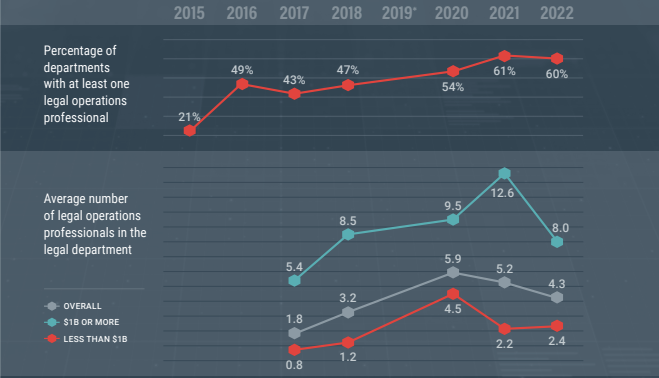
In our own customer base, we’ve seen formal legal operations manager job titles in legal departments with as few as five people. But some teams are even smaller. A 2022 Association of Corporate Counsel (ACC) report found that 60% of legal departments have at least one legal operations professional on the team. (For comparison, in 2018, only 47% of departments had at least one legal ops professional employed.) On average, legal ops departments contain around four employees.
The 12 key functions of a legal ops team in 2022 and beyond
According to the Corporate Legal Operations Consortium’s (CLOC) “core 12” competencies list, these are the 12 key legal operations functions:
1. Business intelligence
Legal ops collects and analyzes business intelligence data based on important metrics to glean actionable insights for more strategic decision-making.
2. Financial management
Legal ops also plans legal spend, creates budgets, implements and monitors e-Billing for legal services, manages accruals, and forecasts expenses, among other things.
3. Firm and vendor management
Legal ops professionals choose the right firms by performing due diligence, uncovering opportunities, negotiating better rates, handling contract management, and, overall, onboarding new vendors quickly.
4. Information governance
With the goal of reducing corporate risk, legal ops is tasked with creating clear information governance policies, communicating those policies to employees, and managing data security and compliance.
5. Knowledge management
Legal ops also engages in knowledge management by facilitating knowledge hubs, creating templates, and preventing knowledge loss, e.g., from staff departure or role changes.
6. Organization optimization and health
Legal ops creates a hiring vision for cultural fit, encourages team members’ work/life balance, and maintains a good pipeline of talents — all in the interest of optimizing the health and productivity of their department.
7. Practice operations
Legal ops manages the practice by allocating tasks to the right skill level for better speed and efficiency.
8. Program and project management
The legal ops team comes up with ways to manage projects, workflows, and programs quickly (without compromising on quality).
9. Service delivery models
Legal ops defines and structures service provider relationships, breaks down larger projects into assignable tasks, and reduces reliance on more expensive law firms.
10. Strategic planning
Legal ops creates team goals that align with the priorities of internal and external stakeholders.
11. Legal Technology
Legal ops vets and leverages legal software to automate time-consuming and repetitive tasks and to increase accuracy in data collection.
12. Training and development
Legal ops also creates training resources for new hires and facilitates career development for employees.
Ideally, a good legal ops department will be able to carry out most of these functions to improve logistics and processes and, overall, allow your law team to focus on being better lawyers for your organization.
How do you build a legal operations team?
Building the right legal ops team for your department involves understanding what you need, hiring the right person for each role, and equipping them to do their job.
Determine what your department is ready for
There are three levels of legal operations:
- Admin
- Optimize
- Strategizer
They all have different responsibilities. The admin-level focuses on basic management activities, such as vendor management, payments, compliance, and reporting. The optimizer-level focuses on improving those processes, and the strategizer focuses on maximizing results. Understanding your legal department’s maturity level will help you pinpoint what position you need to be hiring for.
Choose what role to hire for based on your needs
It can be overwhelming to try to build a complete team from scratch, and the time investment can be a drain on your internal resources. If you are just starting out (at the admin level), you need a manager more than you need an analyst.
Empower your team with the right tech
Legal operations is not nearly as effective without technology, and it seems like key decision-makers have begun to take notice. According to Gartner, the shake-up felt during the beginning of the pandemic led many business leaders to reevaluate their legal department’s tech use, with an eye toward increasing departmental capabilities to make strategic, data-driven decisions.
Tech allows you to automate manual legal work, streamline document management, and simplify data collection and reporting, to name a few benefits. Your team will need dedicated legal ops software that features e-Billing, reporting and analytics, spend, matter, and vendor management to run efficiently.
Typical legal ops jobs
There are three main legal operations jobs within corporate legal departments: the legal operations manager, the legal operations specialist, and the legal operations analyst. There’s a fourth position — the director of legal operations — who would be the overall head of the legal ops department, but it’s common for the department to be led by the legal operations manager.
These positions work together to manage, improve, and analyze activities in the legal ops department.
Here’s a brief rundown of what each role does.
Legal operations manager
Also called the legal operations director, the legal operations manager manages and supports the team around tasks like vendor management, budgeting, and staffing. Where there’s no director of legal operations (the head of legal operations), the legal operations manager also reports directly to the general counsel and oversees tasks like resource allocation, change management, and decision-making.
Legal ops managers may spend their day-to-day directly overseeing other members of the legal team. For the rest of the organization, they are the go-to source for project status updates, budget questions, and productivity reports.
Legal operations specialist
If the legal ops manager oversees the department, the specialist is the expert who executes on departmental projects and goals. The legal ops specialist works with the legal operations manager to create and improve processes for an efficient and effective legal team, facilitate change, and control costs. Specialists tackle the hands-on work of legal ops and report on their work to their manager.
Specialists may handle a variety of tasks, including updating each individual matter. Or they might handle the outreach to stakeholders in other departments who are needed to complete each step of the process.
Legal operations analyst
If a legal ops team uses a tech suite to track and understand analytics, the legal ops analyst would be the expert on those tools.
The legal ops analyst regularly examines the legal team’s operations to identify room for change and helps implement those changes. The analyst may study changes in the team’s budget to identify areas where they could better allocate resources and save costs. They may also handle other departmental reporting on core key performance indicators (KPIs), like average time spent per matter.
Qualities of good legal ops leaders
Legal ops leaders also have an increasingly important role to play as strategic advisors within the C-suite of the organization. According to the ACC, 98% of chief legal officers (CLOs) are consulted on important business decisions that affect the entire organization — not just legal. 36% say they spend more than one-third of their time advising business leaders on strategic initiatives, and 77% say they “almost always” attend board meetings.
Good legal operations leaders tend to fit one of four distinct personas:
- The uber-analyst who brings quantitative rigor to the legal department
- The MBA who brings additional operational and financial discipline to the legal department and their vendors
- The lawyer who has chosen a more business-focused career path
- The highly analytical JD/MBA who is valued for their legal and business expertise
And while a JD or an MBA is a great addition, the people you require for these roles don’t need to have those degrees. What they need to have is:
- A strong understanding of the core business
- The ability to translate the needs of business departments into legal requirements
- The ability to manage outside law firm performance
- A commitment to using the internal legal department to grow the company
It’s clear that, from the top down, business leaders have begun to see the strategic value in giving legal ops a seat at the decision-making table.
If building your legal operations team is something you want to focus on, we have four legal ops job description templates you can look at to get you started.
It’s time to embrace legal operations for a value-driven legal department
Legal departments have a company-wide responsibility to protect and grow the business while also managing internal and outside counsel budgets. They face increasing pressure to do more with less. That’s where the legal operations role comes in: these professionals drive efficiency and create value not just for their team of in-house lawyers but for the entire organization.
But a legal operations team is only as effective as the technology available to them. In fact, CLOC lists technology as one of the core competencies for effective legal operations professionals.
Want to empower your legal ops team with software that makes it easier to get results? SimpleLegal helps modern legal teams better manage their spend, matters, vendors, and so much more for efficient legal operations. Schedule a demo of SimpleLegal to learn more about how dedicated legal operations technology can help your team function.