Category: Marketing

What is a Breach of Contract | ContractWorks

Simple in theory, breach of contract is a concept that can seem almost infinitely complex in reality — the source of unending lawsuits and the basis for an entire subset of contract law. But what is breach of contract, exactly, and why is it an increasingly important part of basic business strategy?Technically, a breach of contract is when a party fails to meet any or all of the obligations outlined in a binding agreement with one or more other parties, or when it impedes another party from doing so. The contract can be written or oral, and the parties can be individuals, businesses, government entities, or virtually any other type of group or organization.
 
Breaches can be as clear-cut as failing to finish a job, deliver a product, or meet a timeframe. But they’re often much more complex, involving misinterpretations of contract language, unanticipated contingencies (like supply chain issues), or the failure to properly define important terms. Breaches are rarely considered to be criminal acts, but rather a common legal procedure between private parties.
 
Let’s take a closer look at the different types of breach of contract, their consequences, and a few ways to avoid the fallout of unintentional breaches.

What are the 4 Types of Breach of Contract?

The four types of breach of contract are material, minor, anticipatory, and actual.

Material Breach of Contract

A material breach occurs when one party receives significantly less benefit, or a significantly different result, than what the contract specified. This can include failure to meet all or part of an obligation, or a failure to do so on time. Direct and indirect damages may be pursued by other parties to the contract.

Minor Breach of Contract

Also called a partial or immaterial breach, a minor breach of contract occurs when the main deliverable is fulfilled, but one or more other obligations are not. Legal remedies may be pursued only if financial losses can be proved, so contingencies like late deliveries may not qualify.

Anticipatory Breach of Contract

In an anticipatory breach of contract, one party makes it clear it doesn’t intend to fulfill its obligations, even if an actual breach has not yet occurred. Anticipatory breaches can be explicitly announced, or inferred from a party’s actions or communications.

Actual Breach of Contract

In an actual breach of contract, a party has already failed to fulfill its obligations within the agreed-upon timeframe — or done so incompletely or improperly. Remedies include compensatory damages for direct economic losses, and consequential damages for indirect losses also resulting from the breach.

What are the Consequences of a Breach of Contract?

Although breaches can be resolved privately and amicably without legal action, the most common consequences of a breach of contract are lawsuits and monetary damages equaling the exact amount owed.
 
So, for example, if only half of a $50,000 obligation was paid, the most likely outcome of a successful legal action would be the remaining $25,000 in compensatory damages. Exceptions would include consequential and reliance damages, which provide compensation for expenses incurred in the fulfillment or anticipation of a contract, or as a result of it — for instance, the cost of materials purchased for a project that ultimately didn’t happen.
 
As stated above, a breach of contract must be material to qualify for a lawsuit, with a provable loss of value or material change to its agreed-upon outcomes. In some cases, rulings may require one party to resume carrying out the contract, rather than pay monetary damages. In some cases, the consequences of a breach may be specified in the actual contract (e.g., a dispute resolution clause).

With some exceptions — such as fraud — a contract breach isn’t criminal, and rulings aren’t punitive. (Some states simply don’t allow punitive damages.) In fact, breaches are often regarded as a healthy part of a working economic system and even a social good, letting businesses make necessary adjustments out of operational or strategic necessity. (See, for instance, the efficient breach theory.)

But even without criminal penalties, a breach of contract can still have harmful consequences, including legal fees, reputational harm, and the loss of referrals and new business.

How to Reduce Risk of Breach of Contract

The risk of contract breach can be reduced by making sure everyone is aware of their responsibilities, keeping tabs of contract performance, and ensuring that all contracts are easily accessible at times.

Make sure everyone is aware of their responsibilities

It’s not uncommon for breaches to occur through simple oversight or lack of awareness — or for the individuals or teams involved in negotiating a contract to be different from those who must fulfill it. A thorough process for contract management that pays diligent attention to handover will help ensure that obligations are understood and upheld throughout the organization.

Keep tabs on contract performance 

Time is of the essence when it comes to containing losses. Actively monitoring contract performance helps ensure that all parties meet their obligations, and can help identify and contain potential problems before they’re actionable. Contract management software solutions that include automated notifications and reminders make this step relatively simple and straightforward.

Make sure your contracts are always accessible

Knowing where to find every active contract and being able to quickly access any key detail can significantly reduce the chances of an important deadline or deliverable slipping through the cracks — and thus, risk of accidental breach. Today, a variety of tools can help tackle this task, from simple contract management software to more complex end-to-end lifecycle management systems.

What’s Your Strategy for Avoiding Breach of Contract?

Today, a breach of contract may be a fairly mundane legal procedure rather than a serious criminal act. But, as we’ve seen, the consequences can still be harmful, and even ruinous — particularly in the case of an accidental or unforeseen breach. For that reason, a comprehensive process for contract management is a must not only for large businesses, but for any organization looking to safeguard its future.

You can find more information about how to implement an effective contract management process here. And download our General Counsel’s Guide to Contract Execution, Storage, and Renewal for more simple, effective tips for avoiding the common legal and financial risks associated with contract management.

6 Key Clauses Found in Commercial Contracts

Commercial contracts are needed for any business to partner with vendors, bring on new customers, or hire new employees. But what goes into a commercial contract? This blog explores some of the most common clauses found in commercial contracts, as well tips for effectively managing these agreements throughout the contracting process.

What is a Commercial Contract?

In the simplest terms, a commercial contract is a legally binding agreement between two or more parties. Most of the time, commercial contracts come in the form of written documents, but they can also be verbal agreements in certain situations. Commercial contracts explain, in detail, what all parties are obligated to do in order for the contract to remain valid, and what the repercussions are should any party fail to comply with the agreed upon terms and conditions.

6 Key Clauses Found in Commercial Contracts

Contracts are used in virtually every industry, and many of the contract clauses that are used are applicable across sectors. In fact, there are certain contract clauses that are likely to make an appearance in just about any contract that is drafted. Commercial contracts, in particular, tend to contain a standard set of terms and conditions. 

Here are six key clauses found in commercial contracts:

Confidentiality

When two or more firms enter into a contract, there will no doubt be a significant exchange of information in order for both sides to perform their contractually stipulated obligations. In light of the need to furnish certain information about each side’s financial and business practices, it is imperative for the contract to contain a strongly worded confidentiality clause. This clause should preclude both sides from divulging any and all information that is shared during the course of the transaction. Of course, this is particularly important when there is valuable intellectual property at stake.

Force Majeure

The phrase force majeure literally translates as a “greater force.” This clause should always be included in commercial contracts, as it can protect parties from circumstances that arise that are beyond anyone’s control. For example, in the event of a natural catastrophe, such as an earthquake or hurricane, a shipment schedule may be unavoidably disrupted. In general, the definition of force majeure is rather broad, with many contracts including wording about things like terrorist attacks and even acts of God. This clause is important to include to ensure that any failure to perform due to such an unforeseeable disruption is not considered a breach of contract.

Termination Triggers

In business, things often do not occur as planned, and thus parties must be able to cut and run as necessary. For contracts, this usually involves the inclusion of a termination clause. This section of the contract must clearly lay out the circumstances under which one or both parties may terminate the contract, irrespective of the time left under the agreement. For example, if one of the parties is acquired by another entity, the other party to the contract may reserve the right to terminate the agreement.

Jurisdiction

These days, cross-border transactions are fairly routine, both in the domestic and international sense. When the parties to a contract are located in more than one state, or perhaps more than one country, it may not be clear which state’s laws govern the arrangement. Therefore, commercial contracts should always specify the state that will have jurisdiction over the agreement, so that it is perfectly clear which laws are applicable.

Dispute Resolution

Even the most well-drafted contracts are susceptible to conflict. As a result, it is of the utmost importance to clarify the parties’ plans for dispute resolution in the event that an issue arises. In many contracts, it is now common practice for firms to include an arbitration clause, requiring the parties to submit to arbitration prior to or in lieu of seeking a remedy via litigation. This is generally a faster, cheaper way to solve contract-related problems, although some contracts still allow for traditional legal recourse.

Damages

In light of the frequency of contract breaches and in an effort to deter them, it is also standard practice for commercial contracts to contain clauses related to damages. In general, liquidated damages clauses will be included, which is usually a predetermined amount that will be owed if one side fails to perform. Of course, a court may award other types of damages beyond that amount depending on the nature and impact of the breach.

Effectively Managing Commercial Contracts

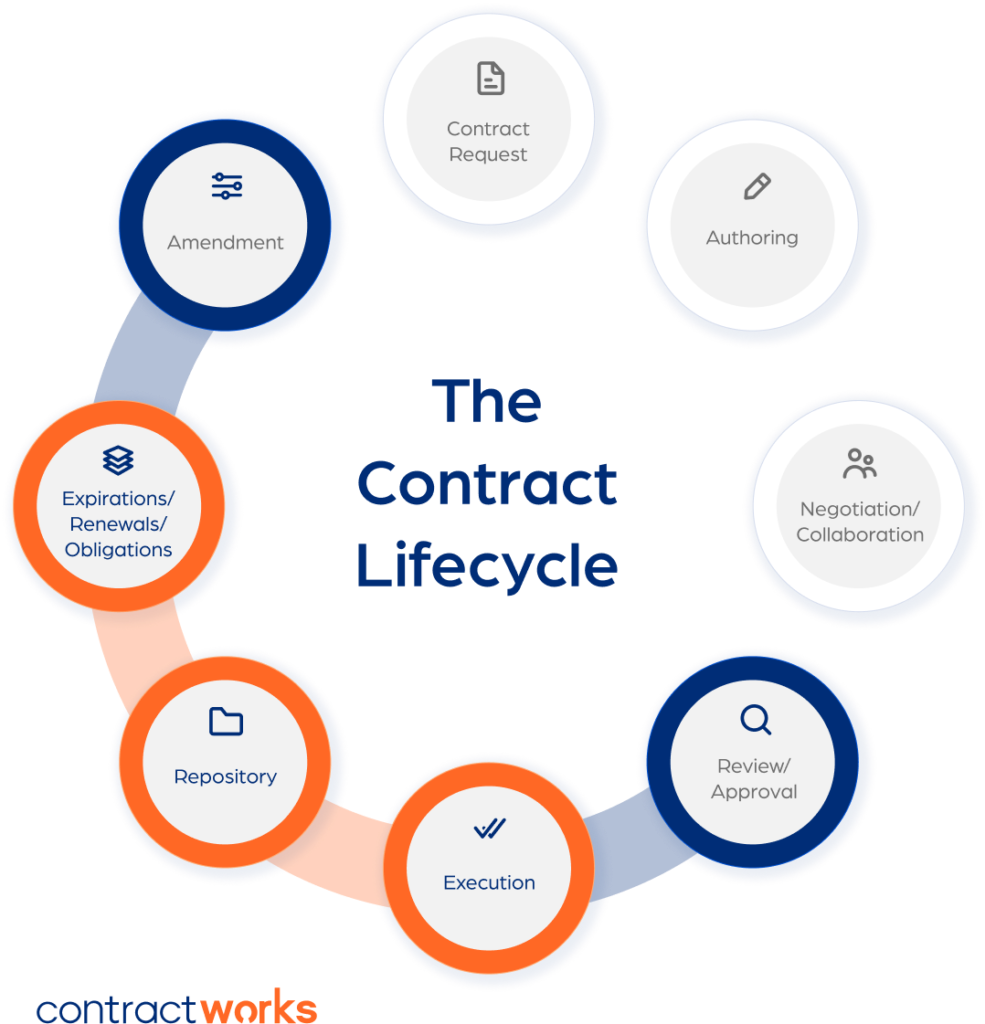
Commercial contracts lay the foundation for how your business operates, so it’s important that you develop a structured plan to manage your agreements throughout the contract lifecycle. There are various stages that make up the contract management process, ranging from planning and contract implementation through contract closeout.

Here’s a brief overview of the seven stages of contract management so you can determine what steps you need to take to succeed in each part of the process:

1. Planning

As the name suggests, this is the time to plan out your process for managing each agreement, determine roles and responsibilities, and assign resources to ensure the contract is monitored closely and obligations are met.  

2. Implementation

The implementation stage is the process of putting your plan into action, and ensuring you have all the right tools in place to manage agreements, including contract lifecycle management software.

3. Pre-contract

During the pre-contract stage, new agreements are carefully drafted, reviewed, and signed. Be sure each contract includes all of the required terms and conditions (including the clauses covered above), so all parties feel confident that the agreement clearly states what is expected of them.

4. Handover

Since the individuals who drafted and negotiated the contract aren’t necessarily the ones who will monitor the active agreement, this is the time to make sure that the contract manager is up to speed and understands all milestones, obligations, and other contract details.

5. Contract

The contract stage is the period of time when the agreement is active and the parties involved are working to deliver services according to the agreed upon terms.

6. Pre-renewal

Before decisions are made about the future of a contract – whether it should be terminated, negotiated, or renewed – the agreement should be evaluated to determine the impact it has on the business. The pre-renewal stage is when this evaluation happens, so stakeholders have the information needed to decide next steps.

7. Post-contract

The post-contract stage, or contract closeout, is the time to wrap up all items related to the agreement and conduct a post-mortem, so you can improve the way future commercial contracts are managed.

Final Thoughts 

Regardless of the size of your business or the industry it operates in, it’s imperative that your commercial contracts are carefully drafted and reviewed thoroughly, both before signing and on a regular basis. For help getting started building out your process for managing commercial agreements, download The Master Checklist for Contract Review & Management.

Contract Management vs Contract Administration

The terms contract management and contract administration are often confused for one another or used interchangeably, but they actually represent different phases of the overall contracting management workflow. To state it as simply as possible, contract administration is the work done before a contract is signed into effect and contract management covers everything done after signing to ensure that deliverables and deadlines are adhered to as outlined in the agreement.

Below is a more in-depth overview of the differences between contract administration and contract management and helpful tips for excelling in both phases of the contracting process.

What is Contract Administration?

The professionals responsible for a company’s contract administration focus their work on the planning and execution of contracts. The planning process often includes sourcing potential contracting partners, for example via sending out requests for proposal. In addition, contract administrators help with ironing out the details of the contract arrangement, working with prospective partners to negotiate on contract matters such as price, delivery schedules, and performance expectations.

Although the word administration makes it seem as though this facet of the contracting cycle is essentially administrative in nature, it requires a great deal of strategy and business savvy. Entering into legally sound, mutually advantageous contracts is critical to the financial success of many businesses, so it is imperative to find the right partners and put into place fair agreements.

Best Practices for Preparing a Contract Administration Plan

Creating and following a strong contract administration plan puts your team in a good position to successfully manage each new contract throughout the lifecycle of the agreement. This formal document should describe in explicit detail what is expected of both parties during the term of the agreement in order to limit possible breaches of contract or other issues that lead to either side not fulfilling their contractual obligations.

Consider the following five best practices when preparing a contract administration plan.

1. Define the scope and deliverables

The first step to ensuring a successful contracting process is to clearly lay out expectations, including the scope and deliverables. Scope creep is a common issue that can derail any contract, so including in writing exactly what the contract does and does not cover will help keep the contract on track.

2. Include a detailed timeline

It may sound like a given, but contract administration plans should include a detailed timeline accounting for every important milestone throughout the life of the contract, including project start and end dates, deadlines for deliverables, and progress updates.

3. Sort out finances

To avoid contract disputes and maintain positive relationships between both parties, everyone involved in the contract administration process should know the financial terms of the agreement, including the value of the contract, payment intervals, and the process to address the need for any additional expenses (depending on the type of contract).

4. Plan the work

To ensure transparency and accountability, the plan should include details about how the contract deliverables will be executed, including the people who will be working on each part of the agreement (including both internal and third-party personnel, if applicable). Having a plan for measuring success throughout the life of the contract will keep both parties aligned and allow for course correction if needed.

5. Anticipate the risks

Every contract comes with risk, but putting plans in place to account for those risks can prevent the contract from failing. Outline the most likely risks for each agreement and the steps that should be taken in the event those events actually happen. Building in some flexibility for timelines and budgets will allow for minor, unexpected delays or problems to be taken in stride and prevent the contract (and potentially the relationship) from suffering significantly.

What is Contract Management?

Contract management occurs after a contract has been executed and taken effect. Thus, this entails working to ensure that the terms and conditions contained within the contract are adhered to and that all of a party’s contractual obligations are met satisfactorily. 

During the contract management phase, it is always possible that circumstances will change, necessitating modifications to the contract agreement. Of course, the contract management team tends to work closely with the other party to the agreement, so they are in a good position to know whether the relationship is working or if it is necessary to pursue opportunities elsewhere. As a result, it makes sense for the contract administrators and managers to remain in close communication, in the event that they are in fact separate teams within a company.

Stages of Contract Management

Knowing what to expect at each of the seven essential stages of the contract management process will increase your ability to meet contract requirements and deliver optimal results. 

1. Planning stage

During the planning stage, you should outline the specifics of your team’s most pressing contract management pain points, needs, and goals, then determine what kind of approach or system would best enable you to address those areas. You’ll also want to consider the resources you have available to allocate to the contract management process. 

2. Implementation stage

After you know what your contract management process should look like, you can begin to implement the tools and systems needed to support those efforts. If you only have a handful of contracts to manage, you can likely track your deadlines, deliverables, and other obligations with manual solutions like shared drives, calendars, and spreadsheets. If you have more complex contract management needs, consider implementing dedicated contract management software to help you keep track of your agreements and important deadlines.

This is also the time when everyone involved with your contract management process should be onboarded and trained on your contract lifecycle management solution so they’re completely comfortable using the software.

3. Pre-contract stage

During the pre-contract stage, you should work closely with the contract administration to start understanding the important details of the new agreement. This will help you prepare for the contract management process and incorporate any specific guidelines that will help you manage the contract and deliverables effectively.

4. Handover stage

If the individuals who negotiated an agreement are not the same people who will be executing and delivering against the terms of the contract, it’s imperative to have a thorough handover process, often involving dedicated meetings to ensure alignment and common understanding of roles, responsibilities, and key deliverables.

5. Contract stage

The contract stage is when the work defined in the agreement is executed and deliverables are completed, hopefully according to the agreed upon timeline and budget. This is also one of the areas where contract management software can help you stay on track and give you the foundation needed to measure performance along the way. Features like automated alerts and notifications and custom reports will let you know of any upcoming deadlines related to deliverables, termination windows, and any other dates you determine are worth tracking.

6. Pre-renewal stage

Typically, as a contract winds down, you must determine if you want to renew, renegotiate, or terminate it completely. More often than not, there are strict timelines that determine when these actions can occur without penalty, so it’s in your best interest to start thinking about these scenarios well before the contract’s end date. 

7. Post-contract stage

Once a contract has ended and the dust has settled, there are a couple of post-contract tasks to complete. Before archiving your contract, review the contract terms in detail to confirm that all conditions have been met and invoices have been settled. 

Finally, conducting a post-mortem will give you an opportunity to uncover valuable information about the contract and your contract management process – including both successes and shortcomings – that can help you improve your future agreements. 

Contract Management Best Practices

There are many different ways to approach contract management, and a plethora of solutions and methods for accomplishing your contracting goals. Here are seven contract management best practices that apply to just about every situation, regardless of the size and complexity of your contract portfolio.

1. Keep all of your contracts in one place

To manage your contracts effectively, you have to know where they are. By keeping all of your organization’s contracts in one location, you’ll know exactly where to go to find an agreement or track down dates, terms, and other specific contract details.

2. Set and measure contract management KPIs

Setting and measuring contract management KPIs is the best way to determine how your contracts are performing and gives you a way to share that information with internal stakeholders. These KPIs also enable you to identify any ineffective parts of your contract management process and develop strategies to improve by reducing risks, eliminating unnecessary costs, or finding missed opportunities in your agreements.

3. Balance storage security and access

Legal departments and contract managers must find the right balance between contract security and access. Those who use contract management software have a secure online repository to house all of their sensitive contracts, and can easily assign varying levels of access so only specific users and groups can view certain files and folders. This allows legal teams to share some of the contract management responsibilities without losing control of your repository.

4. Track contract approval time

The quicker you can move a contract through the approval process, the less time it takes to start seeing the value from that agreement. But, in order to optimize that process for greater efficiency, you first must have a system in place for monitoring it. Tracking contract approval time will help you understand your contract cycle and determine whether improvements are needed.

5. Automate contract communications

Today’s contract management technology allows legal teams to automate many aspects of the contracting process, especially around communications. For example, cloud-based repositories allow users to schedule and send specific individuals automated contract alerts and notifications, removing the need for manual reminders and unnecessary emails. And with the modern solutions available, many businesses have eliminated the process of physically sending documents back and forth for wet signatures, instead turning to electronic signature options for immediate action.

6. Conduct regular compliance reviews

One benefit of having a structured contract management process is the ability to improve your organization’s compliance with industry regulations. By regularly monitoring federal, state, and other legal regulations and ensuring your contracts adhere to those laws, you can protect your business from avoidable penalties and fines. Make it a point to regularly check for updates to the regulations that pertain to your company, and review active contracts to determine if action is needed to remain compliant.

7. Anticipate evolving business needs

Most businesses and their needs evolve over time, so it’s important to anticipate those changes and adjust your contracts accordingly. If your business is growing quickly and you know your needs will be changing in short order, rather than simply renewing contracts for existing services, consider reviewing them closely to determine if it makes more sense to adjust or renegotiate based on your evolving needs. 

Top 3 Steps to Take Now to Improve Contract Management

If your contract management process is in need of improvement, or if you don’t have a formal process in place at all, these three steps can put you on the fast track to contract management success.

1. Conduct an audit of all things contract related

Before you can start taking steps to solve your biggest contract management problems, you have to understand what those problems are. Conduct a contract management audit that includes all of the stakeholders, resources, and processes across your organization that impact how your contracts are handled from negotiation and creation to execution and management.

2. Develop a formal contract management framework

Using the findings from your audit, you can now put into place a structured approach to managing your contract portfolio. This framework should address every element of the contract management process and clearly define what should be happening at each stage. The plan should also include things like roles and departments responsible for various contract-related tasks and processes, how contract management performance is measured, and any tools and systems that should be used during the contract management process.

3. Use technology to make it easier

Implementing dedicated contract management software can vastly improve your ability to manage your contract portfolio and all of your organization’s contract-related deadlines and deliverables. Once your portfolio reaches a certain size or level of complexity, it becomes next to impossible to effectively track and act on every aspect of your contract management process using only manual tools and systems. With the right contract management software, your organization can regain control of your contract portfolio.

Benefits of Contract Management Software

Every business has a unique set of contract management problems and priorities. Determining what type of software your business should implement ultimately comes down to finding the solution that fits your budget, solves for your biggest contract management pain points, and provides a system you and your team will actually use. 

No matter what type of solution you choose, here are some of the most significant benefits of contract management software:

1. Single source of truth

Contract management software provides one central location to store all of your organization’s contracts, meaning every user knows exactly where to go to find the contract information they need. Using contract management software prevents the issue of having multiple copies or versions of a contract floating around, which can cause confusion and lead to individuals working off of an outdated version of an agreement. 

2. Greater contract visibility and insight

Businesses without contract management software often have to deal with misplaced contracts that are scattered across various desks, shared drives, and filing cabinets. Contract management software gives users the ability to search for any contract, clause, or keyword across your entire contract portfolio, and find exactly what you’re looking for in seconds. 

3. Reduced risk

Contract management software helps you reduce contract risk in a number of ways, including:

  • Making it easier to track contract dates and deadlines – By scheduling alerts for key contract dates and deadlines, you can be sure you’ll never get caught off guard when an automatic renewal deadline is approaching or a major contract deliverable is due. 
  • Providing stakeholders with critical contract insight – Contract management software enables you to run reports based on any metadata of interest, providing increased contract visibility and insight for department heads, leadership teams, and others. Now, the legal team isn’t the only group keeping an eye on contract adherence and performance.
  • Learning from – and not repeating – previous mistakes – Contract reporting also gives your team an easy way to analyze your portfolio to identify trends in past agreements. By isolating underperforming contracts, you can work to understand what those agreements have in common and look for ways to modify how future contracts are structured.

4. Time savings

One of the most important benefits of contract management software is that it saves you time, which then allows you to focus on higher-value activities. Manual contract management is tedious and time-consuming, but the majority of contract management software features are designed specifically with your time in mind.

  • An online, searchable repository means you don’t have to spend time digging through cabinets to find a contract or re-reading a 75-page agreement to find a specific clause or term
  • Automated alerts eliminate the need to manually track important dates for hundreds or thousands of contracts
  • Artificial intelligence features automatically identify and tag key pieces of information in your contracts, potentially saving you and your team from spending hundreds of hours manually entering these details
  • Electronic signature features allow you to get contracts signed in minutes. With electronic contract signing you don’t have to look for and wait for a needed signee, which helps reduce the time needed to execute new agreements
  • Permission-based user roles give administrators the option of assigning varying levels of access to different groups and users, enabling your colleagues to find answers to their contract-related questions without requiring your time and attention

Implementing dedicated contract management solution streamlines the contracting and helps establishes collaborative contracts management process, enabling key members of the legal department to spend less time on tedious contract management tasks and more time on strategic, high-value initiatives.

Contract administration and contract management represent two different stages of the contracting process, covering the periods before and after a contract is signed and put into effect. To ensure all of your organization’s agreements are created, executed, organized, monitored, and optimized according to company standards, it’s important to have strong contract administration and contract management processes and systems in place.

50+ Commonly Asked Questions During Due Diligence

Due diligence is a critical part of any M&A deal. By thoroughly preparing for the M&A process and knowing what to expect during due diligence, including the questions you should be ready to answer, you’ll stand a much better chance of a successful and profitable transaction.

But what types of questions are typically asked during the due diligence process? Failing to appear organized and properly prepared for the process can create concerns for the buyer, potentially putting the deal and your business at risk.

Any due diligence process should begin with basic organizational questions about your company and its finances. Depending on your M&A partner, there may be various other types of questions asked as well.

This due diligence checklist will guide you through each step of the process, listing some of the most commonly asked questions during due diligence.

Due Diligence Checklist

Due diligence is a comprehensive evaluation of a business’s operations, finances, legal standing, and other relevant areas. To ensure a thorough assessment, this checklist of questions can help guide the process and ensure that no critical areas are overlooked.

1. Company information

This should be the first bullet in your due diligence checklist because this information will provide you with insights into the business’s decision-making processes, strategic direction, management style, priorities, labor relations, and potential issues.

  • Who owns the company?
  • What is the company’s organizational structure?
  • Who are the company’s shareholders?
    • What percentage of the company does each shareholder own?
  • What are the company’s articles of incorporation?
  • Where is the company’s certificate of good standing from the state in which the business is registered?
  • What are the company bylaws?
  • Where are the company’s most recent annual reports and minutes from board meetings?
  • Who is on the company’s senior management team, including job title, salary, and years in the position?
  • What are the company’s employee benefits?
  • Are the company’s employees unionized?
    • If so, what is their contract?

2. Finances

Obtaining a company credit report, as well as material related to a company’s tax and other financial statements, is crucial for conducting proper due diligence. This information sheds light on a business’s financial health, its ability to generate profits, and potential risks and liabilities that may impact future operations.

  • Where are the company’s quarterly and annual financial statements from the past several years?
    • This includes the company’s balance sheets, accounts receivable, accounts payable, and income statements.
  • Where are the company’s federal, state, local, and foreign tax returns from the past several years?
  • How often are the company’s financial statements and tax returns audited?
  • What are the company’s itemized business expenses?
  • What is the company’s gross profit margin?
    • Is it increasing or decreasing?
  • How much debt is the company carrying?
  • What capital expenditures does the company plan to make in the near future?
  • What are the company’s current financial models and forecasts for future business activity?
    • Does the business have adequate financial resources to continue operations?

3. Products and services

Your due diligence checklist should cover questions regarding information about products and services. Not only will it help you assess their status, but you’ll learn who their vendors and suppliers are. This will allow you to evaluate the competitiveness of the business. Additionally, identifying a business’s main competitors and what they offer is important in determining the future success of the business.

  • What are the company’s current and future products and services?
    • How do these compare to those of the company’s competitors?
  • Who are the company’s most important competitors, both now and in the future?
    • What are their strengths and weaknesses?
  • What are the costs and profit margins of the company’s products and services?
  • Who are the company’s current vendors and suppliers?

4. Customers

Examining a company’s customer base and business locations is important as it provides insights into the company’s market reach and potential areas for growth. This information can help identify any issues and opportunities or guide strategic decisions.

  • In which locations (states and countries) does the company do business?
  • What is the company’s customer base?
    • If a B2B company, who are the company’s most important customers?
  • What are the company’s current and future marketing campaigns?

5. Technology assets

Information about technology assets is necessary for assessing a business’s potential to innovate and stay competitive in the market. By evaluating a business’s technology assets, investors can make informed decisions regarding their investment in the business.

  • What software and hardware does the company use?
    • What are the currently active software licenses?
  • How much is each IT asset utilized?
  • How old is the company’s hardware?
  • Does the company outsource any of its IT responsibilities?
  • What is the company’s disaster recovery plan for data breaches or data loss?

6. IP assets

Intellectual property assets are another critical part of due diligence. Understanding who owns certain IP rights, as well as how IP is protected, will help you assess the legal risks associated with a business’s IP assets.

  • What is the company’s intellectual property, and who owns this IP?
    • Does the company own any patents, copyrights, trademarks, or trade secrets?
  • How does the company protect its IP?
  • How much revenue does each IP asset generate?
  • What potential legal liabilities does each IP asset pose to the business?

7. Physical assets

In order to gain a comprehensive understanding of a business, it’s essential to examine its physical assets, including any real estate holdings, inventory, and equipment. By gathering information about these aspects, a clearer picture of the company’s operations can be obtained.

  • What are the company’s real estate assets?
    • Does the company have real estate deeds, leases, or mortgages?
  • What inventory and equipment does the company have on hand?

8. Legal issues

Legal due diligence provides information about the company’s policies and procedures. This includes an examination of the company’s history of legal and regulatory compliance, as well as any related legal risks or liabilities.

  • What are the laws and regulations that apply to the business and its industry?
    • Is the company subject to any environmental regulations?
  • Does the company need any permits or licenses in order to run a business?
  • What is the company’s past, current, and future litigation history?
    • Does the company have any injunctions or settlements as a result of this litigation?
  • What are the company’s insurance policies?
    • This may include professional liability insurance, workers’ compensation insurance, vehicle insurance, commercial property insurance, key person life insurance, and intellectual property & patent insurance.
  • Are there potential antitrust concerns that would arise as a result of the merger?

When you’re preparing to sell your business, going into due diligence with a clear idea of what you’re up against will greatly increase your odds of success. Making sure you have the answers to all of the questions in this due diligence checklist is a good place to start.

During the due diligence process, it is crucial to ensure the security and confidentiality of sensitive information. One way to achieve this is by utilizing a secure virtual data room  (aka virtual deal room). They offer a secure and controlled environment where buyers, sellers, and advisors can securely review, analyze, and exchange confidential documents.

Private Equity: What Is a Capital Call?

In recent years, the world of private equity has moved from a niche topic in the financial industry into the mainstream. Despite the outsize attention that private equity has received, however, many people still aren’t certain about the ins and outs of the field, including terms like “capital calls.”

Capital calls are a highly useful tool in private equity, but one that should be used with caution and a good idea of the consequences. Read on to learn more about this important technique.

What Is a Capital Call?

A capital call, also known as a “draw down,” is the act of collecting funds from limited partners whenever the need arises. When an investor buys into a private equity fund, the firm makes an agreement with the investor that these funds will be available when the firm requests them. In turn, investors are able to hold onto their funds and keep them in a favorable investment account, such as a mutual fund or retirement account, so that the investment can continue to appreciate until the firm needs it.

Private equity firms typically issue capital calls when an investment deal has been reached and is nearing close. Investors have a predetermined amount of time, which is usually between a week and 10 days, to provide the funds. Once investors provide the funds they are repaid later on with capital contributions. 

When Should You Use a Capital Call?

Historically, capital calls have been frequently used by real estate funds. Because the firm may spend some time finding an attractive real estate investment before buying, it may not need access to investors’ funds right away.

However, more and more private equity funds are taking advantage of the tactic for a number of reasons. Capital calls provide increased flexibility and can be useful for attracting investors who want to benefit financially from that flexibility. Because the investment may be spread out over a period of months or even years, investors can maximize their return on investment while they wait for their funds to be requested.

In general, by giving you access to more funds on a short-term notice, capital calls improve your ability to deal with surprise changes and shifts in the market as well as investment projects that unexpectedly go over budget. You may also be requested to perform a capital call by banks or other institutions in order to secure financial agreements.

What Are the Dangers of Capital Calls?

Capital calls are not without their risks, however. Because you don’t actually have access to the funds until they arrive in your bank account, you may be unable to obtain all of the funds that you were initially promised from investors, which can lead to a default. Private equity firms use a number of strategies to discourage defaults, including sanctions against the investor and withholding future income distributions.

In addition, if you issue a capital call too early, without having a deal in place, you may receive too many funds. You should only use capital calls to fund investments on which a deal has been reached, not on speculative deals or on operational costs.

Finally, relying too much on capital calls can make your fund appear too unstable for many investors. This is because firms that frequently use capital calls typically have fewer liquid assets available. Secure virtual data rooms can provide a secure environment for private equity firms to communicate with investors and share confidential documents. By leveraging a data room, firms can ensure the confidentiality and integrity of sensitive information during the capital call process.

The Difference Between Growth Capital and Buyout Capital

As other economic factors continue to stabilize after devastating drops during the early aughts, trends in private equity investment continue to trend up slowly over time. Venture capital investments, for example, rose from around $15.59 billion in the United States in 2002 to approximately $71.94 billion in 2017. Typically, these are investments in startups and young, innovative brands, but larger target companies also continue to see investor interest. In these cases, it’s more likely specialty investors with the right resources are interested in providing either growth capital or buyout capital.

Growth Capital v. Buyout Capital

At a basic level, the differences between growth capital and buyout capital are obvious in the names. Growth capital is typically invested to foster growth – possibly out of a stagnant or troubled financial situation – for the target company. The investors reap rewards via returns from guaranteed dividends, stocks, or the future sale of shares once the company is performing better.

Buyout capital, on the other hand, typically involves a controlled takeover. The investors, or the entities backed by the private equity firm, acquire ownership by buying controlling interest in the organization. Typically, the use of buyout capital is followed by reorganization that positions the target company to be more profitable. Restructuring might include cost-cutting and process improvement or dismantling and selling certain parts of the organization considered to be loss-makers. The goal for investors is usually to flip the shares for a future profit once the business goes public in an IPO or sees substantially improved performance in the market.

Which Is the Better Option?

On the surface, growth capital might seem like the best option for the target company and the riskiest venture for the private equity investor. In reality, both types of capital come with risks and rewards for either side.

Growth capital is good for a target company that is simply floundering and needs help to charge the market. It lets management and owners retain a lot of control, and it helps them position their brand for future success. For the investor, growth capital in a brand with strong potential can be very rewarding, but since control remains with others, most private equity investors minimize the amount of their portfolio tied up in growth capital at any given time.

Buyout capital can still be good for a brand, although current owners and leadership must relinquish control or even affiliation with the target company through the process. The exact nature of the transfer varies with each acquisition. Ultimately, buyout capital is a good option when a company has reached a point where major changes are required to move forward; buyout capital can save a brand and even many of the jobs associated with it. For the investor, buyouts can represent substantial returns or equally substantial losses, which means equity firms and investors are unlikely to enter into many such endeavors at one time.

Understanding the various types of investment approaches taken by private equity firms is just one step businesses can take if they want to attract those investors. Target companies may need to do some internal house cleaning and other work before they can partner with the right private equity investor, especially when turning to growth capital as a way to bolster future success.

Private equity investments involve extensive due diligence, requiring the sharing of financial statements, legal contracts, intellectual property documents, and other confidential information. No matter the option you choose, secure data rooms can dramatically facilitate private equity investments by providing a secure and efficient platform for the exchange of sensitive information between investors and target companies.  

Secure data rooms provide a centralized repository where all these documents can be securely uploaded, organized, and shared with authorized parties. This ensures that sensitive information remains protected from unauthorized access or data breaches.

Forward Mergers vs. Reverse Triangular Mergers: What’s the Difference?

Merging with another company is a great business accomplishment and a momentous event, which means that it’s highly important for you to do it the correct way. There are countless types of mergers–horizontal, vertical, conglomerate, and concentric, just to name a few–so you need to be familiar with the appropriate terms and concepts well in advance.

This article will discuss three different types of mergers: forward, forward triangular and reverse triangular. By learning the key differences and advantages of each one, you’ll be able to decide for yourself which option is right for your organization.

Forward Merger

Forward mergers, also known as direct mergers, are those in which the target company merges directly into the buyer. The target company ceases to exist, and the two companies continue to operate as a single entity under the buyer’s name and structure. In addition, the buyer assumes all of the target company’s assets and liabilities.

Pros and Cons of Forward Mergers

Forward mergers are sometimes the most preferable choice because they are a direct action between two companies. This makes it easier to integrate the two companies during and after the merger, and preserve the buyer’s business continuity.

However, because the buyer directly assumes the target company’s liabilities, it does not have any legal protection against these concerns. Forward mergers may also require the buyer’s shareholders to approve the transaction, making it more time-consuming and complex.

Forward Triangular Merger

As the name suggests, triangular mergers are those that involve three companies: the buyer, the target company and a third organization that is a subsidiary or shell company. In a forward triangular merger, the target company is merged into the buyer’s subsidiary, which also assumes the target company’s assets and liabilities.

Pros and Cons of Forward Triangular Mergers

Using a subsidiary to perform the merger gives the buyer more protection against problems with the target company’s liabilities. In addition, performing a forward triangular merger gives the buyer much more flexibility in terms of purchasing the target company’s stock than a reverse triangular merger. Half of the total consideration that the buyer uses to pay the target company’s shareholders can be in cash or other non-stock options.

However, because the target company ceases to exist, performing a forward triangular merger can be problematic in terms of business continuity. The target company’s contracts, licenses and authorizations may all have to be reassessed.

Reverse Triangular Merger

A reverse triangular merger is identical to a forward triangular merger except in terms of the surviving company. In a reverse triangular merger, the buyer’s subsidiary is merged into the target company, which continues operations as a subsidiary of the buyer. Therefore, whether a triangular merger is performed in forward or reverse, the end result is the same: the target company becomes a subsidiary of the buyer.

Pros and Cons of Reverse Triangular Mergers

Like the forward triangular merger, reverse triangular mergers can be advantageous by isolating the target company’s liabilities to a subsidiary of the buyer. In addition, because the target company survives the merger, it can easily continue operations without having to sign new contracts or obtain new licenses and authorizations.

However, in order to perform a reverse triangular merger tax-free, the buyer must use company stock to acquire at least 80 percent of the target company’s stock. This makes the transaction less flexible in terms of payment options.

Secure Data Rooms in M&A Transactions

In today’s digital landscape, the secure exchange of information is a paramount concern in M&A transactions. No matter the type of merger you are involved in, confidentiality and data security are vital to ensure the success and integrity of the merger process. This requires a secure environment for sharing sensitive information with authorized parties involved in the deal.

virtual data room, also known as a virtual deal room, serves as a centralized hub for storing and accessing critical documents and data. It offers a range of features designed to protect the confidentiality and privacy of information, reducing the risk of unauthorized access or data breaches.

Deal room software streamlines document management in M&A transactions, enabling seamless collaboration, version control, and document tracking. It simplifies the review and analysis of crucial financial, legal, and operational documents for both the acquiring and target companies. This efficient process plays a vital role in evaluating the necessary metrics and making well-informed decisions throughout the merger.