

Legal operations teams are often excellent at producing reports. They pull data from matter management systems, cross-reference it with spreadsheets, reconcile numbers from outside counsel invoices, and manually update status fields before a leadership meeting. The final output looks polished. But the process that built it? It’s exhausting… and unsustainable.
Manual legal reporting persists not because legal teams lack discipline or the right reporting tools. But because the systems supporting legal work were never designed to share context with each other. When data lives in silos, people become the connective tissue. And when people are the connective tissue, reporting becomes a project in itself rather than a byproduct of work already done.
This is the core challenge that legal workflow management is built to address. Not by adding another dashboard, but by connecting the operational data that reporting depends on.
Why manual legal reporting is still the norm
Ask most legal operations leaders how their team prepares for a quarterly business review, and you will hear a familiar story. Someone spends hours pulling matter status updates. Someone else exports spend data from the billing system. A third person reconciles the two because the numbers rarely match without intervention.
This is not dysfunction. This is rational behavior in a fragmented environment. Legal departments commonly work across matter management platforms, e-billing systems, contract repositories, and intake tools—each holding a piece of the picture, none designed to share it automatically. When systems do not communicate, people compensate.
The result is that accurate reporting requires manual labor every single time. There is no accumulation of insight. Each report is built from scratch, drawing on whatever data can be assembled before the deadline.

The hidden costs of building every report by hand
The obvious cost is time. Hours spent reconciling spreadsheets are hours not spent on contract strategy, vendor management, or process improvement. For legal operations professionals who are already stretched, manual reporting competes directly with higher-value work.
The less visible costs are harder to quantify but arguably more damaging. When reports are assembled under time pressure, inconsistencies slip through. One team defines “matter cycle time” differently from another. Spend data reflects what has been invoiced, not what has actually been committed. Status fields reflect when someone last updated them, not where a matter actually stands.
Leadership makes decisions based on these reports. If the data is stale, inconsistent, or incomplete, the decisions built on it carry the same flaws—often without anyone realizing it. The confidence gap is real: many legal operations teams privately acknowledge they are not fully confident in the numbers they present.
Why reporting tools alone cannot close the gap
A common response to reporting problems is to invest in better dashboards. Better visualization, more flexible filtering, and cleaner layouts can genuinely improve how data is consumed. But they cannot improve the data itself.
Reporting tools struggle when legal workflows are disconnected. A dashboard connected to a matter management system that has not been updated in two weeks reflects a two-week-old reality. Spend data that arrives after invoices are approved rather than when work is authorized distorts cost visibility. Intake records that are not linked to the matters they generate create blind spots that no reporting layer can resolve.
The problem is structural. Legal workflow management cannot be improved simply by adding a reporting layer on top of disconnected processes. The foundation needs to be addressed first.
How connected legal workflow management changes the equation
When intake, matter management, spend tracking, and contract workflows are connected, something important shifts: operational data stays current as a natural result of how work gets done.

An intake request does not just log a business need—it creates a matter record with context already attached. That matter record tracks activity, associated spend, and contract dependencies as the work progresses. By the time a report is needed, the data is already there. It has been accumulating through the work itself.
This is the promise of connected legal workflow management: reporting becomes continuous rather than episodic. Instead of a team member reconstructing the past several weeks of activity before a deadline, the system reflects what is actually happening. Matter status is current. Spend is visible. Patterns across the portfolio are accessible without manual assembly.
Legal operations leaders gain something more valuable than a faster report. They gain visibility they can trust.
Where AI fits into the picture
AI has a meaningful role in legal reporting, but it is most effective when the underlying workflows are already connected. Applied to fragmented data, AI amplifies the noise rather than reducing it.
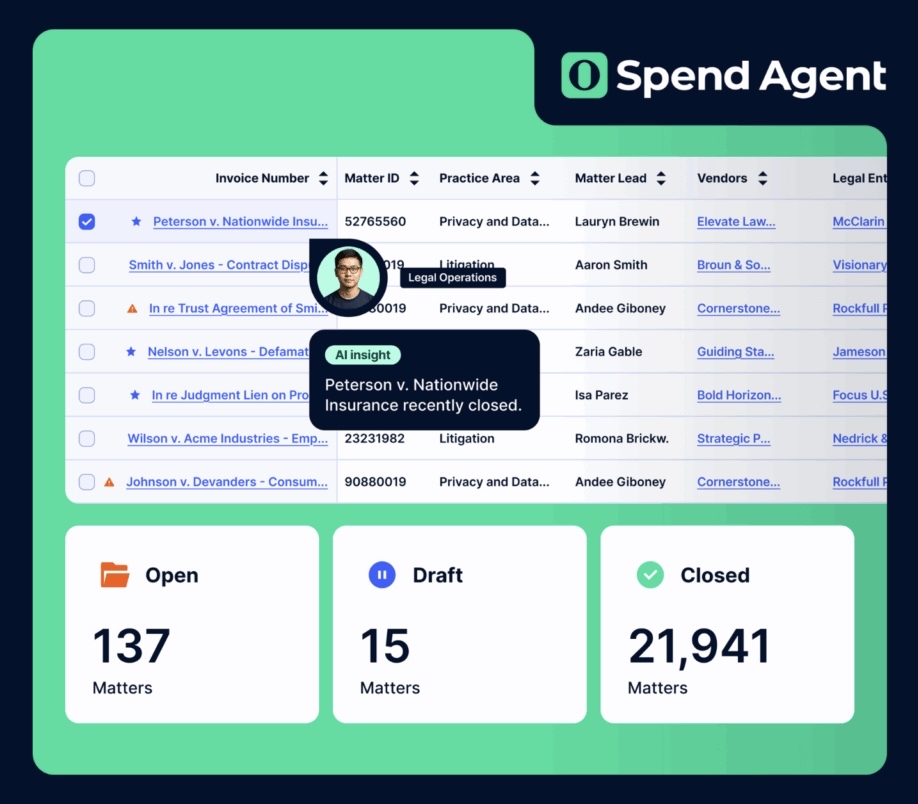
Connected legal workflow management creates the conditions where AI can contribute something genuine. AI can identify anomalies in spend patterns before they become budget problems. It can surface trends across matters—flagging vendor performance issues or unusually long cycle times—that would take a skilled analyst hours to find manually. It can highlight relationships between operational data points that are not obvious when each system is viewed in isolation.
The right framing is AI as analytical support, not analytical replacement. Legal judgment, strategic prioritization, and stakeholder communication remain human responsibilities. AI assists the analysis that informs them. That distinction matters, particularly in legal contexts where the stakes of a wrong conclusion are high.
The legal reporting problem is a workflow problem
Legal teams that are frustrated with manual legal reporting are often solving the wrong problem. The issue is rarely the report itself. It is the disconnected systems and workflows that make accurate data expensive to assemble.

When legal workflow management connects the operational environment—intake to matters, matters to spend, spend to contracts—data stops being something that has to be retrieved and starts being something that is simply there. Reports reflect work in progress rather than work reconstructed after the fact. Insights arrive when they are useful, not after the deadline has passed.
For legal operations managers and general counsel looking to move from reactive to strategic, this shift is foundational. Reliable data does not come from better spreadsheets. It comes from workflows designed to generate it.
Take the next step toward eliminating manual work
If the reporting challenges covered here resonate, they are likely part of a broader pattern. Manual intake, disconnected matter tracking, fragmented spend visibility, and labor-intensive contract management tend to compound each other.
Ready to unlock the power of structured legal reporting. Download our whitepaper, “The 101 on a Structured Approach to Legal Reporting and Analytics,” and learn how to transform your data into actionable insights. Download Now
Struggling to get your legal spend under control? Watch our on-demand webinar on how to break “The Legal Spend Spiral” and discover actionable strategies to optimize your budget and drive efficiency.