

Tag: spend agent

Business Rules, AI, or Human Review? A Decision Framework for Legal Invoices 

Two professionals reviewing a document with pens, overlaid with a digital network graphic representing connected data and technology.

The best legal invoice review process does not force every decision through the same layer. Use deterministic e-billing rules for objective checks with no contextual exception, contextual AI when the answer depends on written billing or engagement terms and requires interpretation, and human judgment when a finding is material, ambiguous, or sensitive to an outside counsel relationship. 

That division of labor creates a more practical operating model. Each layer does the work it is best suited to perform, while the legal team remains responsible for governance and the final business decision with greater accuracy and less manual effort than before. 

This framework builds on the discussion in The Right Invoice: Rethinking Legal Invoice Review about assigning business rules, AI, and human judgment to the work each handles best. 

Type of decision Best review layer Examples 
Objective, with no contextual exception Deterministic rule Duplicate invoice number, budget threshold 
Depends on written engagement context / requires interpretation Contextual AI review Appropriate level resource, fee arrangements, daily hour threshold 
Material, ambiguous, or relationship-sensitive Human judgment Review/Act on findings, worked performed in alignment with goal 

1. Use deterministic rules for fixed, objective checks 

Conventional e-billing rules remain an important first layer of legal invoice review. They are well suited to binary checks that should produce the same answer every time and do not change based on the matter, vendor, or surrounding documents. 

A duplicate invoice number is the clearest example. If two invoices carry the same number, the system does not need to interpret a narrative, compare negotiated terms, or weigh an exception. A deterministic rule can identify the condition efficiently and consistently. 

The practical test is simple: Could valid context change the answer? If the answer is no, use a business rule. This keeps stable controls stable and avoids adding complexity where interpretation offers no benefit. 

2. Use contextual AI when written terms can change the answer 

Not every billing decision is binary. General outside counsel guidelines may prohibit a charge, while a matter engagement letter permits it. An approved rate agreement may supersede a standard rate. A negotiated fee arrangement or travel exception may apply only to one engagement. 

These decisions require the reviewer to read multiple sources, understand which terms apply, and resolve conflicts between general and matter-specific guidance. That is where contextual AI review can add value. It can evaluate invoice lines against the relevant written context and surface an explanation for review and is also best positioned to interpret a line item where the coding is not necessarily accurate. 

The source hierarchy matters. Matter-specific terms should take precedence when they conflict with general billing guidelines. Relevant engagement documents must also be captured in a supported file, uploaded to the matter, and associated with the applicable vendor. Contextual AI should not be described as automatically retrieving terms from a user’s mailbox. 

3. Keep people in control of material and sensitive decisions 

Finding a potential variance is not the same as deciding what to do about it. A legal team may need to consider the amount at issue, the clarity of the supporting language, the strategic importance of the matter, and the relationship with outside counsel. 

Human judgment belongs at this decision point. Reviewers can determine whether to accept a recommended adjustment, request more information, make an exception, or address a broader pattern with the firm. This is especially important for high-value invoices, ambiguous guidance, and sensitive vendor relationships. 

Governance should reflect those differences. For example, Spend Agent gives legal teams vendor-level choices for automated action, human confirmation, or no AI review. Those choices are not maturity rankings. They are controls that should align with risk tolerance, billing guidance, and the relationship involved. 

Build a layered legal invoice review model 

The goal is not to choose business rules, AI, or people as a single answer. It is to route each decision to the right review layer. 

Keep deterministic e-billing rules for objective controls. Use contextual AI to interpret applicable written guidance and engagement terms. Reserve human attention for the findings that require materiality, discretion, or relationship judgment. 

Spend Agent is designed to complement established e-billing controls and support this layered approach. Deterministic rules handle fixed controls, contextual AI evaluates complex line-item descriptions against applicable written terms, and people make the decisions that require discretion. Together, those layers give legal teams a more governed and practical approach to invoice review.

Legal Spend Just Got Its Groove Back 

Legal Spend Groove Back Blog Image

There was a time when managing legal spend was supposed to transform the way legal teams worked. But what they actually got were clunky interfaces, disconnected tools, and manual workflows disguised as “digital solutions.” 

That ends now. 

Onit’s 2025 summer release marks a new era for legal operations, one where legal spend is easier to control and optimize.  

Introducing Unity, the AI-native framework built from the ground up to bring legal’s most critical workflows — spend, vendors, and data — within a more unified and intuitive experience. And yes, it actually does the work. 

This is what legal looks like, on your terms. 

Legal Ops Revolution - Legal Spend Just Got It Groove Back

What Makes Unity Different? 

With Unity, legal teams get a more connected interface. It’s designed to bring together work across legal spend, vendors, and data over time. And it offers AI agents that automate tasks and understand legal context, along with configurable workflows that scale. 

Say Hello to Unity e-Billing 

The first spend management pillar launched on Unity is our new ELM e-Billing experience. This was designed to help you manage outside counsel spend with precision, speed, and total control. 

ELM e-Billing centralizes all your spend management in one place. So this brings vendor data, invoice review, and budget tracking together for a clear, real-time view of legal spend. AI-powered automation speeds approvals and enforces billing guidelines. While flexible reporting and budgeting tools help you track performance, forecast accurately, and make smarter spend decisions as your team grows.  

Meet Spend Agent: Your First AI Assistant for Legal Spend 

Manual rule coding? Over. Vague invoice rejections? Gone. 

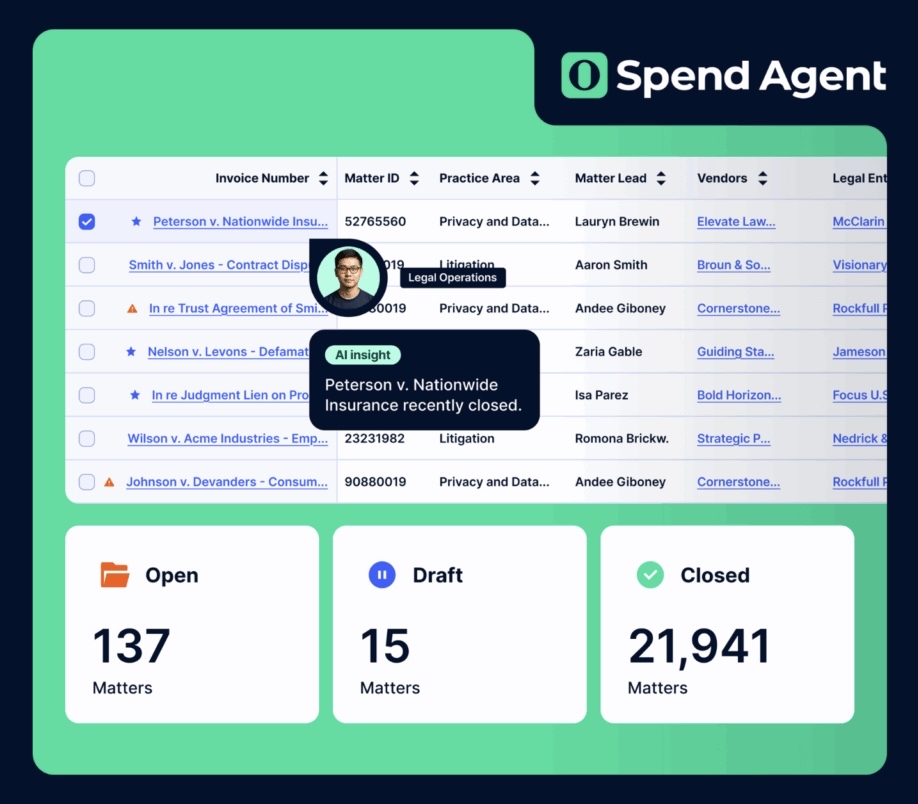
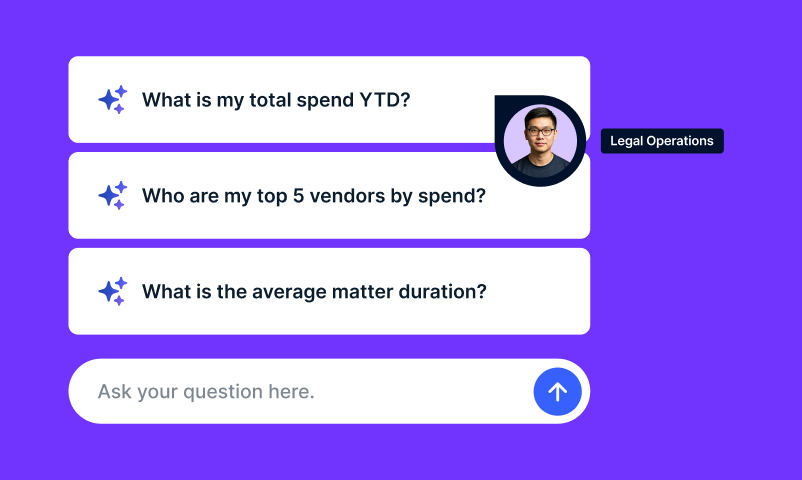
Spend Agent is your new AI-native reviewer for legal spend invoices. It interprets billing guidelines in plain language, flags issues on incoming invoices, and generates crystal-clear justifications. It even helps vendors understand and fix issues faster. 

Spend Agent offers instant compliance without the complexity; audit-ready transparency; smarter decision-making with less manual effort. 

Legal spend - Spend Agent by Onit

CounselMatch: Find the Right Firm, Fast 

When outside counsel selection feels like guesswork, CounselMatch steps in. With access to more than 400,000 attorneys and 5,800+ firms, it lets you filter by performance, billing model, diversity, and practice area, then integrates your choice. 

Faster selection. Smarter partnerships. Better results. 

And That’s Just the Beginning 

In addition to Unity, this release brings major upgrades across the broader Onit ecosystem: 

SimpleLegal now keeps internal and external budgets in sync with matter-specific rate settings that put you in the driver’s seat. And the redesigned budget view makes it faster to filter, sort, and take action because budgeting should move as fast as the rest of the team.  

Legal Ops and Spend Management

ContractWorks now offers folder-level auto-tagging (Beta) for instant metadata capture, Retry AI Processing to refresh legacy contracts, and self-service tag activation for faster implementation and value. Contracts API adds e-signature support, enabling packets to be sent from external systems with fewer steps for quicker execution and a smoother path from draft to done.  

BusyLamp now allows users to track invoice revisions; automate WIP archiving; simplify dropdowns; tighten access controls to protect sensitive data. 

Built for Scale and Designed for Legal, by Legal 

Unity is more than a product. It’s a signal that legal tech software is finally evolving and that it’s evolving on legal’s terms. 

With Unity, legal departments gain more control over legal spend across your department; improved workflows across every part of the legal lifecycle; real-time visibility into vendors, matters, and contracts; automation that speaks legal’s language; a connected experience that replaces siloed systems. 

legal spend with onit elm ebilling spend agent and counselmath

Why Legacy ELM Fell Short 

For years, enterprise legal management software made promises it couldn’t keep. Legacy systems were built for a different era, before AI, before flexible workflows, and certainly before legal ops became the strategic driver it is today. They were hard to configure, harder to adopt, and forced legal teams to work around technology instead of with it. 

The result? Fragmented systems, manual workarounds, and limited visibility. Innovation stalled because the software didn’t move at the speed of legal

Unity changes that.  

Moving Legal Workflows Toward Connection and Scale  

Many legal ops teams struggle with time-consuming invoice reviews, vendor management spread across spreadsheets, and point solutions that do not connect. Unity is being built to address these challenges by bringing core legal workflows closer together in an AI-native environment that can scale over time.  

With Spend Agent reviewing invoices in real time as an add-on to Unity e-Billing and OnitX ELM, and contract data extracted in seconds via ContractWorks, legal teams are gaining back time and putting it toward higher-impact work. They’re spending less time fixing broken workflows and more time driving strategy. 

Who Unity e-Billing is Built For 

Unity e-Billing is designed for legal teams that want a lightweight, simple, and fast legal spend management solution. It’s built for in-house teams looking to enforce billing guidelines, accelerate approval workflows through automation, and gain clear insights into vendors and legal spend.  

Whether you’re a GC looking for visibility across departments, a legal ops lead managing complex budgets, or a contract manager streamlining workflows, Unity e-Billing was built with you in mind. 

Legal Ops on your terms. Spend management. Onit ELM ebilling. CounselMatch. SimpleLegal.

Why Onit Built Unity 

At Onit, we’ve always believed legal should lead, not follow. That’s why we built Unity from the ground up: to deliver a truly AI-native solution that’s powerful enough for enterprise scale but flexible enough to meet teams where they are. 

Unity combines intelligent automation, hands-on support, and a modular structure that adapts to each customer’s needs. It’s more than software. It’s a commitment to helping legal teams modernize on their terms with trusted intelligence, connected tools, and expert guidance at every step.  

Ready to See Unity in Action? 

Whether you’re rethinking spend management, centralizing vendors, or ready to use an AI spend agent, Unity gives you the tools to move faster, smarter, and with more confidence than ever before. 

Ready to see it in action? We’ll show you. 

Book a demo to explore how Unity can workon your terms.