

Tag: legal spend management

Not Every Outside Counsel Decision Needs an RFP. It Still Needs Better Data.

A formal RFP can bring transparency, structure, and competition to outside counsel selection. But not every matter calls for one. 

Some engagements are significant enough to justify a competitive sourcing process. Others need counsel selected quickly. Some involve work a trusted firm already knows well. Others simply do not warrant the time and effort of a formal RFP. 

Just because you’re not running an RFP doesn’t mean you’re skipping the evaluation. 

Whether a legal team is running a formal sourcing process or deciding which firm should handle the next matter, the same fundamental question remains: Why is this the right firm for this work? 

Too often, the answer comes down to familiarity, relationships, or whoever handled something similar last time. Those factors can matter, but legal departments already have another source of evidence available to them: their own matter, spend and vendor performance data. 

The opportunity is to use that information not only during an RFP, but every time outside counsel is selected. 

When does an outside counsel RFP make sense? 

There is no reason to force every matter through the same sourcing process. 

Formal RFPs can be particularly valuable when a legal department is selecting counsel for high-stakes work, evaluating multiple firms for a significant engagement, refreshing a broader panel, or simply getting an update on firms’ evolving capabilities. A structured process gives the team a consistent way to gather information, compare approaches to managing a case, and evaluate firms on more than familiarity or hourly rates. 

But a formal RFP also requires time from the legal department and the participating firms. For many routine or lower-risk matters, the process may be more than the decision requires. 

The goal should not be to run more RFPs. It should be to make better outside counsel decisions. That starts with a clear view of when an outside counsel RFP makes sense and when a lighter-weight process will serve the matter just as well. 

What should you evaluate when you aren’t running an RFP? 

A legal team may decide not to issue an RFP, but you can still evaluate your options. 

Before assigning a matter, consider what your existing data can tell you about the firms you already work with: 

Which firms have handled comparable matters? 

Past matter records can show which firms have experience with similar types of work, jurisdictions and levels of complexity. 

That provides a more useful starting point than simply asking which firm is top of mind. 

What did similar work actually cost? 

Historical spend can help legal teams understand what previous matters cost and how different firms performed against expected budgets. 

The question is not simply which firm has the lowest rate. It is which firm has demonstrated value on comparable work. 

How did the firm staff the work? 

Two firms may approach the same matter very differently. 

Historical staffing data can help show whether previous engagements used the right mix of partners, associates and other resources for the work involved. 

Did the firm stay within budget? 

A proposed budget is useful. A history of how a firm performed against budgets provides another layer of evidence. Does one firm tend to be more accurate in their initial case assessment, and therefore expected costs, while another typically has multiple budget revisions for each engagement? 

Consistent budget performance can help a legal team assess predictability before assigning new work. 

Were there recurring billing or compliance issues? 

Invoice history may reveal patterns that are easy to overlook when matters are considered individually. 

Repeated guideline violations, staffing issues or billing adjustments can provide useful context when deciding whether a firm is the right choice for another engagement. 

What happened after the matter was assigned? 

Assigning outside counsel to a matter is just the beginning, not the end.  Having a governance process based in effective communication to manage and evaluate performance throughout the engagement is a critical metric of success. 

Where legal teams capture relevant outcome and performance information consistently, that data can help inform the next matter, the next panel review and the next RFP. In fact, matter and spend data can reveal how firms actually performed long before a formal RFP ever enters the conversation. 

Relationships still matter. Data makes them more useful. 

Legal work is not a commodity, and outside counsel selection should not become a spreadsheet exercise. 

A general counsel may know that a particular partner understands the business exceptionally well. An in-house attorney may have years of experience working successfully with a specific firm. A legal operations team may know that certain firms collaborate better with internal teams than others. 

Those are meaningful inputs. 

The problem comes when relationship knowledge is the only input or when important experience lives only in the memories of individual team members. 

Structured matter and vendor data gives legal teams a way to complement that judgment with evidence. 

Instead of asking, “Who do we usually use?” the conversation can become: 

  • Who has done this type of work before? 
  • How did they perform? 
  • What did it cost? 
  • Did they meet expectations? 
  • What have we learned from working with them? 
  • Has another firm’s capabilities evolved where they warrant consideration? 
  • Are the lawyers who typically do the work at our preferred firm still there, or have they moved on? 

That creates a more informed decision without requiring a formal sourcing event every time work needs to be assigned. 

Outside counsel selection should be a continuous cycle 

One of the biggest limitations of treating RFPs as standalone events is that the selection process can become disconnected from everything that happens afterward. 

A firm is evaluated. A decision is made. Then the actual matter, invoices, budget performance and vendor relationship move into other workflows. 

The better model is a continuous cycle: 

Select → engage → manage → measure → select again 

Each engagement should create information that improves the next decision. 

Matter history builds a record of experience. Spend data shows what the work costs. Invoice information reveals compliance and billing patterns. Performance information adds context around how the relationship actually worked. 

Over time, legal teams can build a more complete view of their outside counsel relationships instead of starting from scratch every time they need to make a sourcing decision. 

That same information becomes valuable when a formal RFP is warranted. Rather than relying only on what firms say in their proposals, the legal department enters the process with its own history and evidence: structured vendor performance data that reflects what actually happened, built on systems that connect matter, spend and vendor information instead of leaving it scattered across inboxes and spreadsheets. 

Make the process fit the decision 

The answer is not to require an RFP for every outside counsel engagement. 

It is also not to reserve structured, data-informed decision-making only for the handful of matters that receive a formal sourcing process. 

Legal teams need both. 

For significant engagements, a structured RFP can help teams compare firms, evaluate value and create a defensible record of the decision. For matters that do not need an RFP, historical matter, spend and performance information can still provide the evidence needed to make a thoughtful choice. 

The process may change depending on the matter. 

The standard for making an informed decision should not. 

Ready to rethink your outside counsel sourcing process? 

Explore The Modern Outside Counsel RFP Playbook for a practical framework to determine when an RFP earns its keep, evaluate firms on total value and build a more structured approach to outside counsel selection. 

Manual legal reporting in Legal Ops: Why the effort exceeds the output

Manual reporting in Legal Ops

Legal operations teams are often excellent at producing reports. They pull data from matter management systems, cross-reference it with spreadsheets, reconcile numbers from outside counsel invoices, and manually update status fields before a leadership meeting. The final output looks polished. But the process that built it? It’s exhausting… and unsustainable.

Manual legal reporting persists not because legal teams lack discipline or the right reporting tools. But because the systems supporting legal work were never designed to share context with each other. When data lives in silos, people become the connective tissue. And when people are the connective tissue, reporting becomes a project in itself rather than a byproduct of work already done.

This is the core challenge that legal workflow management is built to address. Not by adding another dashboard, but by connecting the operational data that reporting depends on.

Why manual legal reporting is still the norm

Ask most legal operations leaders how their team prepares for a quarterly business review, and you will hear a familiar story. Someone spends hours pulling matter status updates. Someone else exports spend data from the billing system. A third person reconciles the two because the numbers rarely match without intervention.

This is not dysfunction. This is rational behavior in a fragmented environment. Legal departments commonly work across matter management platforms, e-billing systems, contract repositories, and intake tools—each holding a piece of the picture, none designed to share it automatically. When systems do not communicate, people compensate.

The result is that accurate reporting requires manual labor every single time. There is no accumulation of insight. Each report is built from scratch, drawing on whatever data can be assembled before the deadline.

manual legal reports from scratch

The hidden costs of building every report by hand

The obvious cost is time. Hours spent reconciling spreadsheets are hours not spent on contract strategy, vendor management, or process improvement. For legal operations professionals who are already stretched, manual reporting competes directly with higher-value work.

The less visible costs are harder to quantify but arguably more damaging. When reports are assembled under time pressure, inconsistencies slip through. One team defines “matter cycle time” differently from another. Spend data reflects what has been invoiced, not what has actually been committed. Status fields reflect when someone last updated them, not where a matter actually stands.

Leadership makes decisions based on these reports. If the data is stale, inconsistent, or incomplete, the decisions built on it carry the same flaws—often without anyone realizing it. The confidence gap is real: many legal operations teams privately acknowledge they are not fully confident in the numbers they present.

Why reporting tools alone cannot close the gap

A common response to reporting problems is to invest in better dashboards. Better visualization, more flexible filtering, and cleaner layouts can genuinely improve how data is consumed. But they cannot improve the data itself.

Reporting tools struggle when legal workflows are disconnected. A dashboard connected to a matter management system that has not been updated in two weeks reflects a two-week-old reality. Spend data that arrives after invoices are approved rather than when work is authorized distorts cost visibility. Intake records that are not linked to the matters they generate create blind spots that no reporting layer can resolve.

The problem is structural. Legal workflow management cannot be improved simply by adding a reporting layer on top of disconnected processes. The foundation needs to be addressed first.

How connected legal workflow management changes the equation

When intake, matter management, spend tracking, and contract workflows are connected, something important shifts: operational data stays current as a natural result of how work gets done.

connected legal workflows and automation

An intake request does not just log a business need—it creates a matter record with context already attached. That matter record tracks activity, associated spend, and contract dependencies as the work progresses. By the time a report is needed, the data is already there. It has been accumulating through the work itself.

This is the promise of connected legal workflow management: reporting becomes continuous rather than episodic. Instead of a team member reconstructing the past several weeks of activity before a deadline, the system reflects what is actually happening. Matter status is current. Spend is visible. Patterns across the portfolio are accessible without manual assembly.

Legal operations leaders gain something more valuable than a faster report. They gain visibility they can trust.

Where AI fits into the picture

AI has a meaningful role in legal reporting, but it is most effective when the underlying workflows are already connected. Applied to fragmented data, AI amplifies the noise rather than reducing it.

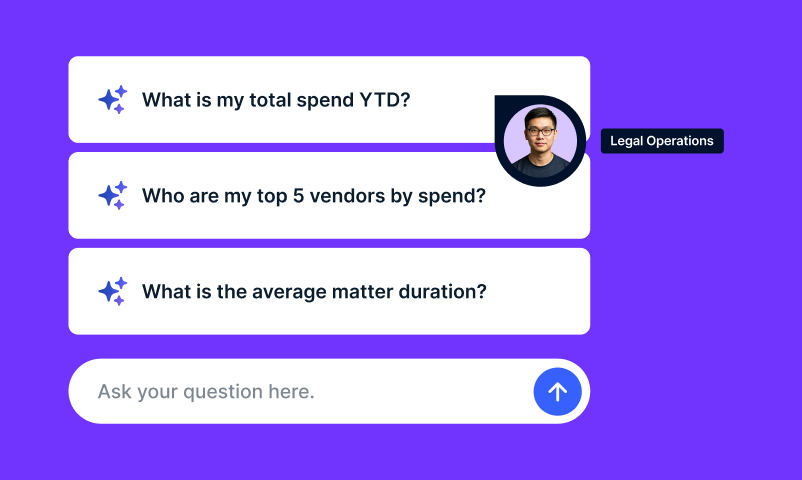
Connected legal workflow management creates the conditions where AI can contribute something genuine. AI can identify anomalies in spend patterns before they become budget problems. It can surface trends across matters—flagging vendor performance issues or unusually long cycle times—that would take a skilled analyst hours to find manually. It can highlight relationships between operational data points that are not obvious when each system is viewed in isolation.

The right framing is AI as analytical support, not analytical replacement. Legal judgment, strategic prioritization, and stakeholder communication remain human responsibilities. AI assists the analysis that informs them. That distinction matters, particularly in legal contexts where the stakes of a wrong conclusion are high.

The legal reporting problem is a workflow problem

Legal teams that are frustrated with manual legal reporting are often solving the wrong problem. The issue is rarely the report itself. It is the disconnected systems and workflows that make accurate data expensive to assemble.

Create a strong legal ops foundation for legal reporting

When legal workflow management connects the operational environment—intake to matters, matters to spend, spend to contracts—data stops being something that has to be retrieved and starts being something that is simply there. Reports reflect work in progress rather than work reconstructed after the fact. Insights arrive when they are useful, not after the deadline has passed.

For legal operations managers and general counsel looking to move from reactive to strategic, this shift is foundational. Reliable data does not come from better spreadsheets. It comes from workflows designed to generate it.

Take the next step toward eliminating manual work

If the reporting challenges covered here resonate, they are likely part of a broader pattern. Manual intake, disconnected matter tracking, fragmented spend visibility, and labor-intensive contract management tend to compound each other.

Ready to unlock the power of structured legal reporting. Download our whitepaper, “The 101 on a Structured Approach to Legal Reporting and Analytics,” and learn how to transform your data into actionable insights. Download Now

Struggling to get your legal spend under control? Watch our on-demand webinar on how to break “The Legal Spend Spiral” and discover actionable strategies to optimize your budget and drive efficiency. 

Legal Spend Just Got Its Groove Back 

Legal Spend Groove Back Blog Image

There was a time when managing legal spend was supposed to transform the way legal teams worked. But what they actually got were clunky interfaces, disconnected tools, and manual workflows disguised as “digital solutions.” 

That ends now. 

Onit’s 2025 summer release marks a new era for legal operations, one where legal spend is easier to control and optimize.  

Introducing Unity, the AI-native framework built from the ground up to bring legal’s most critical workflows — spend, vendors, and data — within a more unified and intuitive experience. And yes, it actually does the work. 

This is what legal looks like, on your terms. 

Legal Ops Revolution - Legal Spend Just Got It Groove Back

What Makes Unity Different? 

With Unity, legal teams get a more connected interface. It’s designed to bring together work across legal spend, vendors, and data over time. And it offers AI agents that automate tasks and understand legal context, along with configurable workflows that scale. 

Say Hello to Unity e-Billing 

The first spend management pillar launched on Unity is our new ELM e-Billing experience. This was designed to help you manage outside counsel spend with precision, speed, and total control. 

ELM e-Billing centralizes all your spend management in one place. So this brings vendor data, invoice review, and budget tracking together for a clear, real-time view of legal spend. AI-powered automation speeds approvals and enforces billing guidelines. While flexible reporting and budgeting tools help you track performance, forecast accurately, and make smarter spend decisions as your team grows.  

Meet Spend Agent: Your First AI Assistant for Legal Spend 

Manual rule coding? Over. Vague invoice rejections? Gone. 

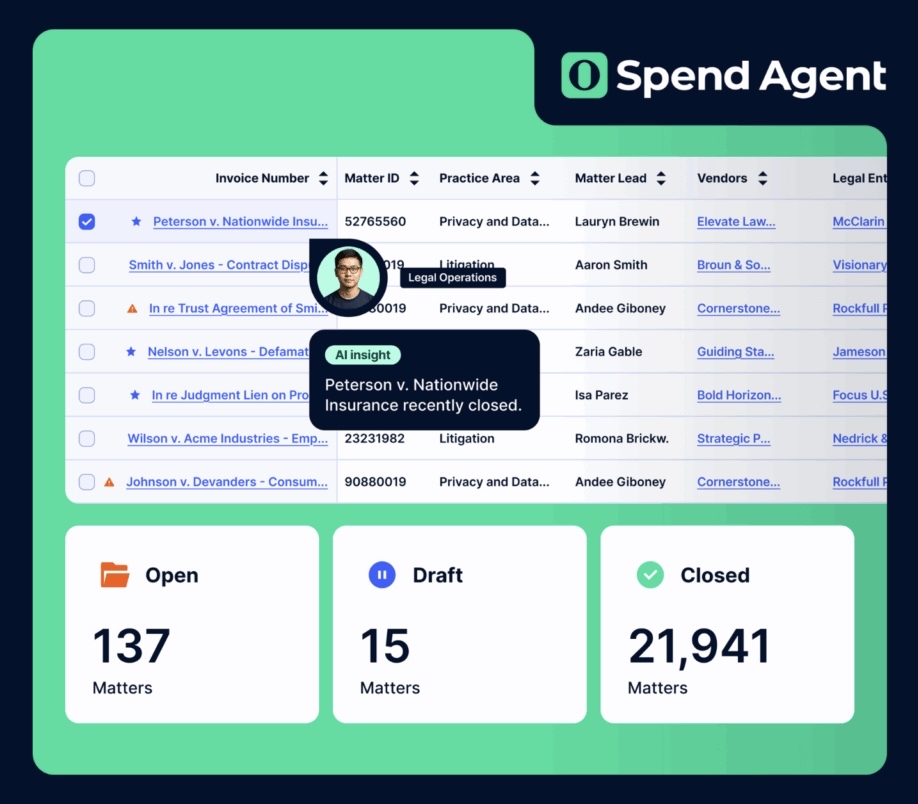
Spend Agent is your new AI-native reviewer for legal spend invoices. It interprets billing guidelines in plain language, flags issues on incoming invoices, and generates crystal-clear justifications. It even helps vendors understand and fix issues faster. 

Spend Agent offers instant compliance without the complexity; audit-ready transparency; smarter decision-making with less manual effort. 

Legal spend - Spend Agent by Onit

CounselMatch: Find the Right Firm, Fast 

When outside counsel selection feels like guesswork, CounselMatch steps in. With access to more than 400,000 attorneys and 5,800+ firms, it lets you filter by performance, billing model, diversity, and practice area, then integrates your choice. 

Faster selection. Smarter partnerships. Better results. 

And That’s Just the Beginning 

In addition to Unity, this release brings major upgrades across the broader Onit ecosystem: 

SimpleLegal now keeps internal and external budgets in sync with matter-specific rate settings that put you in the driver’s seat. And the redesigned budget view makes it faster to filter, sort, and take action because budgeting should move as fast as the rest of the team.  

Legal Ops and Spend Management

ContractWorks now offers folder-level auto-tagging (Beta) for instant metadata capture, Retry AI Processing to refresh legacy contracts, and self-service tag activation for faster implementation and value. Contracts API adds e-signature support, enabling packets to be sent from external systems with fewer steps for quicker execution and a smoother path from draft to done.  

BusyLamp now allows users to track invoice revisions; automate WIP archiving; simplify dropdowns; tighten access controls to protect sensitive data. 

Built for Scale and Designed for Legal, by Legal 

Unity is more than a product. It’s a signal that legal tech software is finally evolving and that it’s evolving on legal’s terms. 

With Unity, legal departments gain more control over legal spend across your department; improved workflows across every part of the legal lifecycle; real-time visibility into vendors, matters, and contracts; automation that speaks legal’s language; a connected experience that replaces siloed systems. 

legal spend with onit elm ebilling spend agent and counselmath

Why Legacy ELM Fell Short 

For years, enterprise legal management software made promises it couldn’t keep. Legacy systems were built for a different era, before AI, before flexible workflows, and certainly before legal ops became the strategic driver it is today. They were hard to configure, harder to adopt, and forced legal teams to work around technology instead of with it. 

The result? Fragmented systems, manual workarounds, and limited visibility. Innovation stalled because the software didn’t move at the speed of legal

Unity changes that.  

Moving Legal Workflows Toward Connection and Scale  

Many legal ops teams struggle with time-consuming invoice reviews, vendor management spread across spreadsheets, and point solutions that do not connect. Unity is being built to address these challenges by bringing core legal workflows closer together in an AI-native environment that can scale over time.  

With Spend Agent reviewing invoices in real time as an add-on to Unity e-Billing and OnitX ELM, and contract data extracted in seconds via ContractWorks, legal teams are gaining back time and putting it toward higher-impact work. They’re spending less time fixing broken workflows and more time driving strategy. 

Who Unity e-Billing is Built For 

Unity e-Billing is designed for legal teams that want a lightweight, simple, and fast legal spend management solution. It’s built for in-house teams looking to enforce billing guidelines, accelerate approval workflows through automation, and gain clear insights into vendors and legal spend.  

Whether you’re a GC looking for visibility across departments, a legal ops lead managing complex budgets, or a contract manager streamlining workflows, Unity e-Billing was built with you in mind. 

Legal Ops on your terms. Spend management. Onit ELM ebilling. CounselMatch. SimpleLegal.

Why Onit Built Unity 

At Onit, we’ve always believed legal should lead, not follow. That’s why we built Unity from the ground up: to deliver a truly AI-native solution that’s powerful enough for enterprise scale but flexible enough to meet teams where they are. 

Unity combines intelligent automation, hands-on support, and a modular structure that adapts to each customer’s needs. It’s more than software. It’s a commitment to helping legal teams modernize on their terms with trusted intelligence, connected tools, and expert guidance at every step.  

Ready to See Unity in Action? 

Whether you’re rethinking spend management, centralizing vendors, or ready to use an AI spend agent, Unity gives you the tools to move faster, smarter, and with more confidence than ever before. 

Ready to see it in action? We’ll show you. 

Book a demo to explore how Unity can workon your terms.