

Author: Onit

Everything Must Go: Legal Bills Mount Over Sears Assets

Creditors and former workers struggle while Big Law firms see the softer side of the Sears bankruptcy.

Over at The Wall Street Journal last week, journalist Soma Biswas illuminated the “tug of war” between former professionals, vendors, and the teams of Big Law firms vying for a piece of the shrinking pie of Sears assets in bankruptcy.

Some of the biggest firms with the biggest price tags have charged more than $200 million in legal bills since Sears went under in late 2018. Sears’ main bankruptcy firm, Weil, Gotshal & Manges LLP, maxes out their billing at $1,695 an hour according to the article, and their total payout has been more than $65 million.

In October, a $50 million estate fund was set up to pay creditors. Akin Gump, who represents unsecured creditors, has so far billed for more than half the funds of that pot, while vendors and creditors were paid $21 million in December.

Meanwhile, more than $3 million in severance to former Sears employees remains unpaid.

While these numbers might sound shocking, it’s a trend we’ve seen growing in the legal industry over the last decade. Last summer, WSJ wrote a groundbreaking piece, based largely on data we provided, that examined the changing nature of law firm partnerships and their interactions with clients. In the span of a few decades, white-shoe law firms have transitioned from a relationship-based model to a system where “data and money rule.”

Bodhala can’t keep you out of the headlines but we can keep the headlines from covering your legal spend. 

We unlock the power of the data you already own to help your corporate legal department make decisions to keep your company’s legal billing under control – and out of the news! Our machine learning algorithms immediately identify patterns in your legal spend to give you the best three-dimensional view of your billing, giving you the confidence to negotiate from a position of strength in every interaction and enhance your relationship with your trusted outside counsel.
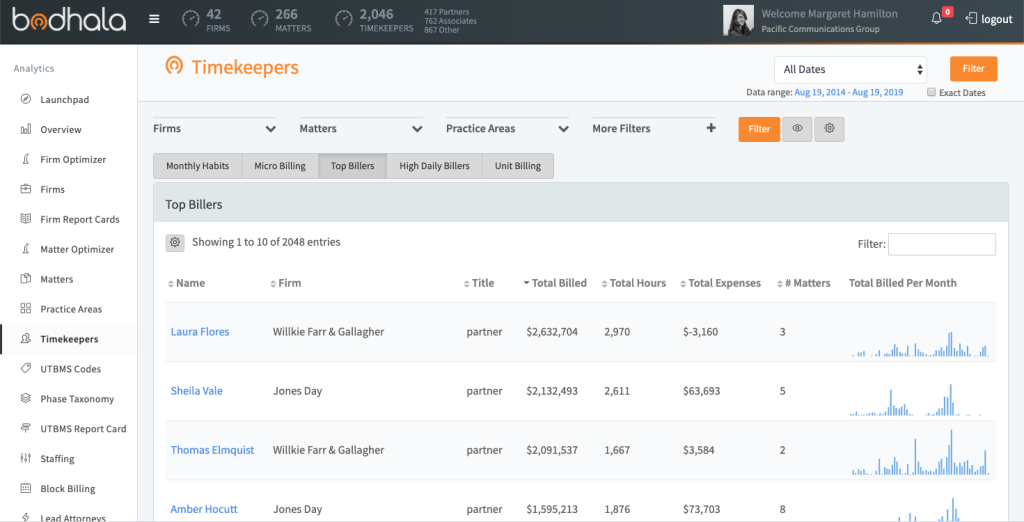
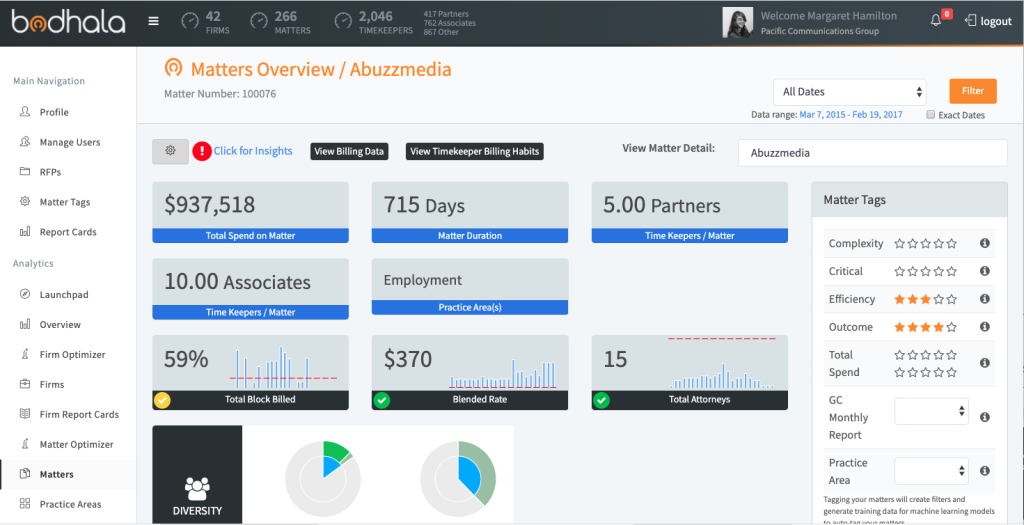
Our platform gives you instant snapshots of every facet in your legal matter, from the number of timekeepers to surfacing the true rate per hour, and staffing diversity.

Bodhala is the leading tech platform enabling corporate legal teams to analyze and optimize their spend. We’re dedicated to helping firms get a handle on their legal spend, regardless of the size and scope of their enterprise, or the matters at hand. 

Using the power of big data and machine learning algorithms, our proprietary system helps corporate legal departments find the right talent, at the right value. We’ve saved our clients millions in negotiation and procurement every year, and we’re eager to get to work for you.

Contact us TODAY to find out how we can help you realize more value in your spend: http://bit.ly/37zaM7X

Like what you’re seeing?

Shoot us an email at [email protected]and let’s talk about how to get started.

LegalOps Highlight: News, Trends and Legal Technology Vol. 6

The LegalOps Highlight is a bi-weekly blog series that features relevant news, market trends and legal technology updates from the legal ecosystem. The content is curated from legal and business trade publications, consulting and analyst firms, and Onit | SimpleLegal partners, customers and subject matter experts. Be sure to subscribe and follow Onit and #LegalOpsHighlight on LinkedIn and Twitter for updates!

Highlights


2020 Vision: A Look Into What In-House Counsel Need to Know for the New YearLaw.com: 2020 Vision: A Look Into What In-House Counsel Need to Know for the New Year
Corporate Counsel magazine reporters spoke to several general counsel about what they say will impact their work and the legal industry. From outside counsel merging with other law firms to the use of artificial intelligence to keep down legal department costs, this article outlines some of the trends in-house counsel may find themselves dealing with in the new year.


First 90 Days Game Plan To Building A Legal Operations FunctionAbove the Law: First 90 Days Game Plan To Building A Legal Operations Function
Olga V. Mack has interviewed Twitter’s Legal Operations director Colin McCarthy and this week they’re sharing a comprehensive take on what employing a legal operations function should look like. According to McCarthy, the main goals of this deployment should be good decision making, future-proof technology solutions, proper spend and scaling and all of this should be recorded for future analysis. These 90 days are critical to a successful legal ops function as they will determine whether your relationships with key stakeholders are solid, which inefficiencies can be eliminated and how to implement your plan under what timeframe.


Could a Legal Operations Role Benefit Your Organization? Here’s How to DecideLaw.com: Could a Legal Operations Role Benefit Your Organization? Here’s How to Decide
Legal operations has been rapidly cementing itself as a cornerstone role in legal departments across the world, but the decision of whether you want to dedicate the resources to that position is a tough one. In the last few years as corporate counsel have noticed their workflows becoming more demanding and requiring more business knowledge, the legal operations position has helped companies like Liberty Mutual, Google and The Gap meet demands with stringent budgets and extensive administrative hurdles. If you’re a general counsel and you feel like you’ve been bogged down by all of business-related tasks you need to tackle, employing a dedicated legal operations role might help you and your department get back to the legal work you’re more specialized in, while also driving efficiencies in critical business-focused areas.


Who’s Afraid Of Machine Learning?Above the Law: Who’s Afraid Of Machine Learning?
Many legal professionals are becoming increasingly nervous about AI and machine learning because of the unknown nature or inherent bias that surrounds them. However, machine learning in its current state is designed to do one ley thing: recognize patterns. These tools are driving serious efficiency in administrative tasks and can help legal professionals gain a deeper understanding of the matters they are assigned.


The Top 9 Legal Tech Investments of 2019Law.com: The Top 9 Legal Tech Investments of 2019
Onit was included in the top nine investments in Legal Tech in 2019, a year that marked significant capital infusion into the legal technology space. This article highlights the investments that were deemed significant enough to reshape the legal tech market. Onit was a recipient of one of the largest capital investments, at $200 million, in the list. That strategic investment is contributing to more robust features in our existing products like Enterprise Legal Management, as well as new product lines like Contract Lifecycle Management. It is also helping to grow the company through acquisition, starting with the addition of SimpleLegal as a subsidiary.


Lawyers Want Easier Technology. But Providers Aren't Sure What That MeansLaw.com: Lawyers Want ‘Easier’ Technology. But Providers Aren’t Sure What That Means
In technology (and especially legal technology), feedback is critical as developers are trying to make their user experiences more friendly for the professionals that rely on them. Everyone wants the tools they use to be intuitive, and bridging the gap between legalese and tech talk might be the key to developing better legal technology. Even though legal is a fast-paced world, legal tech companies would like to see lawyers dwell on their previous matters for just a little longer and give developers proper feedback to hone their tools for what is coming next.


5 Legal Technologies You Thought Were Dead But Aren’tAbove the Law: 5 Legal Technologies You Thought Were Dead But Aren’t
There are good reasons to be wary of adopting cutting edge technologies early before all the kinks are worked out, but at some point you just have to rip the bandage off. According to the ABA 2019 Legal Technology Survey Report, books, CDs, fax machines, BlackBerrys and even WordPerfect are still being used by lawyers all over the country for one reason or another. Even though there have been massive leaps in technology available to lawyers, sometimes the old methods are gold and it’s not worth the billable hour to teach new tricks.


Legal Departments Use 'Moneyball' Approach to Pick Lawyers and Fight Mega VerdictsLaw.com: Legal Departments Use ‘Moneyball’ Approach to Pick Lawyers and Fight Mega Verdicts
For anyone that hasn’t seen the film or are unfamiliar with the Oakland A’s of the early 2000s, the “moneyball” approach entails using predictive analytics to show what methods and tools are undervalued in order to reduce spend and stay ahead of the curve. More law organizations and corporate counsel are employing these predictive measures to get critical information that might completely change the way they choose to run their case. New predictive technologies are giving lawyers information about spend, strategy and personnel. Some lawyers believe these tools will be necessary for practicing law within the next 20 years.

Legal Department Operations Survey 2019 Results are Out

Onit is once again a sponsor of the Legal Department Operations (LDO) Survey. In its 12th year, this survey is the leading barometer for trends in legal operations. Onit Founder & CEO, Eric M. Elfman, contributed an article to the survey results package. Please read that article below and download the full survey results here.

Driving Disruption in the Legal Department: Legal Ops and Technology Lead the Way
By Eric Elfman

Legal operations is all about optimizing the legal department’s ability to grow and protect the company it serves. As such, legal departments are seeking a higher level of operational excellence. This is evidenced by their embrace of innovation, increased demand for automation of repetitive tasks and a workflow-centric approach and understanding of how to use technology to create operational wins.

Driving efficiencies and containing costs are two key reasons that legal operations is important and is growing so quickly. Legal departments were forced to adopt a more operationally focused mindset as a result of the Great Recession. The 2008 downturn was so severe, and efficiency and cost-cutting were considered so critical to the survival of the business at large, that it was no longer acceptable to spend freely. Since then, C-suites have increasingly been making their law departments behave more like other business units. This ultimately led to the rise of a profession dedicated to bringing business discipline to the law department: legal operations.

Legal department operations professionals (LDOs) handle the management of vendors, systems, strategic planning, technology, knowledge, financial issues and the myriad other tasks that plague the legal department. Legal operations are all about optimizing the legal department’s ability to support the business and is a multi-disciplinary function that optimizes legal services delivery by focusing on twelve core competencies. The competencies, developed by CLOC, are divided among three levels: foundational, advanced and mature.

Cost control and cost management have always been among the legal department’s greatest challenges. Economic downturns in recent decades served to exacerbate the “do less with more” mindset. In order to meet these intensifying challenges, many departments began increasing the workload of existing resources or bringing on more in-house lawyers. Others have built and started executing technology roadmaps. Technology has been optimizing legal operations in several key areas. Workflow and automation of processes deserve a spot at the top of the list. Data analytics is also important, as analytics can demonstrate the value of technology in the department and the value of the legal department to the business. Technology is assisting with the competitive bidding process on certain types of cases. Automating many routine tasks can shave hours off any busy schedule. Collaboration using  technology gives a whole new meaning to “working together.”

Today’s state-of-the-art technology allows all stakeholders from anywhere in the world – including legal departments, other service providers, and members of the corporation’s accounting team and business units – to be on a single platform. Technology will increasingly play a prominent role, as more LDOs are discovering they can better fulfill their mission by leveraging well-chosen technology solutions to automate processes, track legal spend and deliver key decision-ready information. The increasingly robust alliance of legal ops and technology is now helping to forge the future of legal operations in amazing ways we could never have imagined a decade ago. Onit purpose-built our technology platform to help drive this alliance and enables customers to execute their technology roadmaps over time.

Interested? Request a demo now!

LegalOps Highlight: News, Trends and Legal Technology Vol. 5

The LegalOps Highlight is a bi-weekly blog series that features relevant news, market trends and legal technology updates from the legal ecosystem. The content is curated from legal and business trade publications, consulting and analyst firms, and Onit | SimpleLegal partners, customers and subject matter experts. Be sure to subscribe and follow Onit and #LegalOpsHighlight on LinkedIn and Twitter for updates!

Highlights


Enthusiasm Gap Persists Between Law Firms and In-House CounselLaw.com: Enthusiasm Gap Persists Between Law Firms and In-House Counsel
While law firms are reminiscing about a year of increased demand during this bonus season, corporate legal department numbers show they are looking toward a future recession and having to cut spending back. Even though law department spend is a concern even outside of the prospect of hard times on the horizon, only 40% of law departments responded to an Altman Weil survey saying they increased their budgets, with 38% of departments saying they’ve cut their budgets in the past year (up from 27%). Despite 2019 being a demanding year for law firms and corporate legal departments, Gretta Rusanow of Citi Private Bank’s Law Firm Group mentions that legal matters will still need to be attended to regardless of how departments and firms configure their budgets.


The Insider Guide To What In-House Lawyers WantAbove the Law: The Insider Guide To What In-House Lawyers Want
As we have mentioned in this blog series before, legal matters are becoming more business-centric and corporate legal departments are increasingly selecting solutions and ALSPs based on how much they fit in with their business’ needs. This Above the Law column says that in-house lawyers don’t just want a service provider that can do the work but want a more full-blown partnership that act on their client’s needs rather than reacting to them. It also asserts that this type of partnership ends up being mutually beneficial as the work providers might be doing could open up whole new revenue streams from previously unknown capabilities. We couldn’t agree more!


In-House Counsel Say They Have Higher Workloads Than Last YearLaw.com: In-House Counsel Say They Have Higher Workloads Than Last Year
According to a report released by alternative legal services provider Konexo, 63% of in-house lawyers report feeling more stressed about their workloads than they did last year, with common pressures being costs, lack of resources and team culture. Even though legal technology has been helping law departments work more efficiently, respondents also cited issues with technology onboarding and the need for them to serve as business partners within their companies. It probably won’t come as a surprise that respondents recommended more holistic approaches than the use of point solutions to make departments more efficient and better equipped for their growing demands. Again, we couldn’t agree more!


Permanent Verification — The Best Blockchain Use Case for LawyersBloomberg Law: Permanent Verification — The Best Blockchain Use Case for Lawyers
We’ve been hearing about blockchain technology and the hype around it since the Bitcoin boom a couple of years ago, but it would be unwise to completely dismiss blockchain as a hype machine without addressing how it can be used for legal contract management. This article says that because blockchain ledgers are especially strong at maintaining authentication the technology has great applications for contract management software and allows lawyers to spend less time on clerical aspects of their contracts. This article contends that as data gets more valuable, blockchain has proven itself to be especially useful for legal records management, and blockchain contract management solutions should definitely be on every lawyer’s radar in the years to come. See what you think!


Penn Law Keeps Its Name — For NowLaw.com: ‘Penn Law’ Keeps Its Name — For Now
In an earlier edition of the LegalOps Highlight Blog, we shared an article about how Penn Law students voiced concerns over the swift change in name to Carey Law. Since then, University of Pennsylvania’s law school has agreed to gradually rebrand to Penn Carey Law by 2022 in efforts to recognize the recent large contribution by the W.P. Carey Foundation. This return from the earlier name change shows that the school’s administration has listened to the hundreds of student and alumni voices and recognizes the prestige of Penn Law.


California’s New Data Privacy Law Bring U.S. closer to GDPRTechCrunch: California’s New Data Privacy Law Bring U.S. closer to GDPR
We’ve been covering the CCPA for a little while now because of its implications on data collection and management. It’s also important to note that the CCPA has different language on what it considers personal information under the law, and the writing also shows what companies could be fined for violations. The new law (and others being proposed by other states) shows that the US is on its way to meeting the standard of privacy legislation set by GDPR and gives lawyers an idea of the information management matters they may have coming to them.

Webinar Recap: Mastering Rate Card Season with Analytics

Bodhala hosted its first live webinar on Dec. 10, 2019

Presented by Bodhala team members across Client Success, Marketing, and Product, legal leaders from around the world joined the live webinar. The webinar covered two hot-button topics: using big data analytics to uncover best practices and pitfalls to avoid when negotiating annual rate card increases with outside counsel. We highlight many of those pitfalls in our two new white papers, The Hidden Staircase and The End Of Excel Hell.

The webinar recording and presentation slides are now available here.

“Big data analytics are revolutionizing how corporate legal departments negotiate with their panel law firms, and we’re glad to share how in this webinar,” said Bodhala SVP & Head of Client Success, John Maloney. “One of the most irritating pain points for our clients is the yearly dread that comes with annual rate negotiations. Bodhala’s free and new rate card RFP platform alleviates that pain by leveraging machine learning to surface the best possible outcome for your legal department.”

Maloney explained that the webinar stemmed from seeing countless clients struggle to negotiate annual rates with panel firms, a process fraught with confusing concepts. Recognizing this universal challenge, Bodhala developed a learning series on RFP rate card negotiation, starting with what we call the “Hidden Staircase” of law firm rates.

Still, several barriers exist to getting the best possible rate, and most of them cannot be easily overcome by legal department staff. Bodhala created a whitepaper to help professionals apply our best practices for rate negotiation and navigate out of “Excel Hell.”

Bodhala’s powerful big data analytics are designed to make these processes easier. Our platform streamlines all of your RFPs in one dashboard, giving your legal department an unparalleled, 360-degree view of past spending and unmatched projection ability for the future. 

“Today’s webinar was a huge success and very exciting for us as a business,” said Kyle Johnson, Head of Marketing. “Our unique ability to pull proprietary information out of the Bodhala platform and share it with our audience proved to resonate – as was shown through the lively conversation throughout the presentation.” 

Among the interesting questions and discussion points, here are three of the top takeaways from this discussion:

  1. On average, organizations allocate 75% of their outside counsel spend to seven firms. When focusing on your rate card RFP process this year, focus the bulk of the work on prioritizing your top seven firms.
  2. According to the audience polls, the majority of companies represented at the webinar did not use a formal rate card RFP process (only 30% did so). Of those that did use a formal process:
    • Over half spend somewhere between 40 – 60 hours per RFP.
    • The majority have 5 – 10 panel firms.
    • The group was split almost evenly between members of the Legal Ops and GC / AGC teams.
    • The average outside counsel spend falls into the $25m – $50m range.
  3. By leveraging Bodhala’s free rate card RFP platform, companies are expected to reduce the time they spend running rate cards by one-tenth (~5 hours) with better results. Those who add on Bodhala’s analytics platform are able to experience even more positive outcomes, keeping their annual spends in check and ensuring compliance by the law firm.

Bodhala is a groundbreaking legal technology platform created by lawyers to transform the half-a-trillion dollar global legal industry. Our platform refines organizational processes by empowering your legal team with deeper insights that allow you to better analyze, interpret, and optimize outside counsel spend, trailblazing a new era of legal market intelligence.

Navigating through confusing concepts like annual rate card RFP negotiations is just the beginning. For more information on how Bodhala can revolutionize your relationship with outside counsel, and how to optimize your legal spend, set up a demo today at https://www.bodhala.com/demo-bodhala.

Like what you’re seeing?

Shoot us an email at [email protected], and let’s talk about how to get started.

5 Common Challenges Facing Contract Lifecycle Management: How to Overcome Them

Businesses that implement a seamless contract lifecycle management (CLM) process compress their time to revenue, mitigate risks by having fewer contractual exceptions and increase customer satisfaction. But managing the lifecycle of a contract – from request and creation, review and approval, to execution and renewal — involves a lot of departments, and those departments often don’t have access to the same systems. But there are other hurdles to overcome, such as these five common contract lifecycle management challenges:

  1. Speed vs. Control
    The biggest source of friction in the contract lifecycle comes from the balancing act between speed and control. Because contracts are so critical, legal’s preference is to examine contracts in extreme detail. Sales often has a different interest, pressuring legal to get out of the way so deals can close faster. The main business challenge becomes moving contracts through quickly but with enough oversight to effectively manage company risk.
  2. Lack of Visibility
    Part of what exacerbates the speed vs. control dilemma for legal is a general lack of visibility into contract terms, obligations and value. If you can’t see it, you can’t control it. This becomes a major pain point because agreements outline the terms of the value exchanged, and if you can’t ensure you are getting the right value for your deals, money is slipping through your company’s fingers. Lack of visibility is an especially serious problem for expiring contracts and renewals.
  3. Inconsistent Legal Language
    It’s important to be consistent in the use of terms and language in your contracts. Gaps in standardized language can introduce risk or confusion. If you can’t determine if your contracts contain accurate language, or what is different between contracts, lawyers might have to get involved in every single deal. This is not only inefficient but also increases the risk of being non-compliant or leaving revenue on the table.
  4. Information Silos and Manual Processes
    Managing all of the necessary steps in your contract process is hard enough internally across several departments. The complexity of managing contracts increases exponentially when you have to manage contracts across several office locations, time zones or languages. The ability to have everything centrally located with changes tracked in real time becomes critical. Human error, bottlenecked contract cycles and limited process control can increase risk dramatically when contracts are managed manually. Automating contract management helps companies improve control and visibility and significantly shortens contract creation time.
  5. Inability to Manage Changes
    It’s important to have a mechanism for managing changes over time. You need to be up to speed on renewal dates, pricing changes, emerging legal requirements and other events that will require you to speak to your customer/vendor specifically about your contractual relationship. Your ability to manage the contract, particularly changes over time and the renewal process, will have a direct impact on your customer retention rate.

So what can we do to meet these contract lifecycle management challenges head-on and with limited resources? You guessed it: technology is the clear winner in this category. The profound impact of technology on CLM is gaining momentum globally as more companies are realizing its extensive benefits as a business value driver. These cloud-based solutions offer painless integration, user-friendly interfaces, increased workflow and reduced costs across the board. Collaboration in handling projects is becoming more prevalent and sought-after, and CLM software companies have responded in kind by injecting more collaborative functionality into their products, another benefit of the SaaS model.

The best CLM solutions offer an array of features and benefits to fit organizations of all sizes and needs. A contract lifecycle management solution should offer complete control and visibility of your customer contracts, in all stages from review to approval to execution to renewal. The best CLM solutions simplify the submission, review, approval and management of contracts in one easy to use tool. Team members should never have to search their inbox or hard drive for the latest version or keep an Excel spreadsheet to manage their contracts. Powerful business analytics and reporting engines are additional hallmarks of the best CLM solutions, and are crucial in helping team members with their reporting, configuring notifications and other tasks.

Another important consideration in the value of CLM is how high the cost of non-compliance with regulations can be, and CLM is well-prepared to assist with this. Efficiency and transparency in reporting is another much-welcomed feature of these solutions, as well as the ability to flag possible problematic contracts before they reach the execution stage. Collaboration is a key ingredient in any operation involving many people, and contract management is a good example. Oftentimes, solution providers miss the mark (or ignore it altogether) on collaboration ability in their software. The interaction of multiple stakeholders such as legal professionals, attorneys and accountants requires that the CLM solution enable and encourage collaboration from inside and outside of the organization. Team members are then able to leverage knowledge from one another, and in turn be more productive and conserve the amount of time spent on projects.

If you’d like to see a demo of Onit CLM, click here.

A Busy October and November for Onit

Onit has been quite busy the last couple of months (which is nothing new for us). Besides our daily mission of creating cutting-edge enterprise workflow solutions, here are a few other things we’ve been up to.

Onit and SimpleLegal Host a Webinar

Onit and SimpleLegal hosted a webinar, The Future of Legal Operations: Market Trends, Change Management and Predictions.  As a part of this webinar, legal industry leaders Eric M. Elfman, CEO of Onit, and Nathan Wenzel, CEO of SimpleLegal, and leading Legal, Risk and Compliance Analyst, Ryan O’Leary of IDC presented on the evolution and future of legal operations and discussed how chief legal officers and legal operations professionals are digitally transforming the industry with process efficiencies, technology and change management.

Strategic Alliance Between PERSUIT and Onit

Onit partnered with PERSUIT, a process automation platform for engaging outside legal counsel, following the launch of Onit’s Strategic Alliances Program. Read the Press Release

Onit Claims Position #249 on Deloitte’s Tech Fast 500

Onit again ranked on Deloitte’s Technology Fast 500™, a ranking of the 500 fastest growing technology, media, telecommunications, life sciences and energy tech companies in North America. Onit recorded growth of 441% percent during this period and came in at #249. Read the Press Release

Onit Moderates Session at Corporate Legal Ops Forum

Onit moderated a session titled Emerging Trends in Legal Operations at the Consero Corporate Legal Ops Forum in Florida. Panelists included legal operations professionals from Prudential, McDonald’s, Morgan Stanley, Bio-Rad Laboratories and Jabil Circuit. Read More

Strategic Alliance Between Duff & Phelps and Onit

Duff & Phelps has become Onit’s first Strategic Alliances partner with level 4 certified resources. A global advisor that protects, restores and maximizes value for clients, Duff & Phelps has 22 Onit-experienced resources, 16 of which are Onit certified. The Onit and Duff & Phelps relationship extends beyond the United States into EMEA, where they are one of Onit’s leading implementation partners. Read the Press Release

Strategic Alliances Program Launch

Onit unveiled its new Strategic Alliances Program. This program is Onit’s premier initiative to establish and support external alliances that promote growth and success for our clients and partners; the principles of which are strategy, transparency, accountability and rigor. This remarkable new program addresses the needs of not only Onit’s trusted partners, but of our clients as well. Read the Press Release

Onit CEO Eric M. Elfman Wins the Rice Business Alumni Award

Onit CEO Eric M. Elfman won the Rice Business Alumni Award. This prestigious honor was bestowed on just six individuals this year. Eric won in the category of Industry Excellence in Technology. Read More

Onit Participates in the ACC Annual Meeting

Onit participated in the ACC Annual Meeting in Phoenix, October 27 – 30th. There were opportunities to see demos of our solutions, and learn more about the recently launched Onit Contract Lifecycle Management product. Subscribe to the Blog for Alerts about Future Events

Onit Holds Second Customer Forum of 2019

This year’s second Onit Customer Forum was held November 5-7 in Houston. This is a bi-annual event designed to foster collaboration and learning among peers. Onit’s customer community is focused on sharing best practices and driving innovation. Attendees heard case studies from customers in a variety of industries and received the latest updates on product roadmaps and strategy. Request an invitation to the next forum by emailing [email protected]


Onit’s CEO Eric M. Elfman Wins Rice Business Alumni Award

We are excited to announce that Onit’s CEO and co-founder, Eric M. Elfman, has won the Rice Business Alumni Award! This prestigious honor was bestowed on just six individuals this year. Eric won in the category of Industry Excellence in Technology.

Eric’s award profile reads in part “His career shifted to a focus in technology and he founded DataCert, Inc., a spend management software and services company. Under his leadership, DataCert grew from a small, entrepreneurial organization to a leading provider of corporate legal technology. Eric also co-founded Onit, a legal project management software company that specializes in solutions that simplify business process automation and productivity. Over his career, Eric and his companies have been recipients of numerous high-profile awards and distinctions, such as the 2002 Ernst & Young Entrepreneur of the Year for Emerging Technology, Four-time Inc. 500 Listing, and Multiple-year Inc. 5000 Listing. In addition, Eric currently serves as a member on the Rice Alliance for Technology & Entrepreneurship Advisory Board.”

Established by the Jones Graduate School Alumni Association (JGSAA), the Rice Business Alumni Awards annually recognize alumni for outstanding achievements in their professional fields and exemplary leadership. Recipients of these awards embody our four pillars of alumni engagement: community, philanthropy, volunteering and life-long learning. This means that when reviewing nominations, the selection committee took into special consideration those alumni who exemplify and consistently engage in supporting their communities through networking, philanthropy, volunteering and a demonstrated passion for learning.

Read more about Eric’s win.

CLM Management Software: Is Yours Driving Business Value?

The rising need to reduce, eliminate, or mitigate risks related to legality, financing, and procurement is driving the contract lifecycle management (CLM) market growth. Additionally, CLM software allows users to maintain documentation related to pricing, dates, and information regarding internal & external entities involved and signatories. The growing demand for a central repository for efficient contract lifecycle management software among enterprises across various sectors is proliferating CLM market growth. The profound impact of technology on how contracts are managed is gaining momentum globally as more companies are realizing its extensive benefits as a business value driver.

We need a CLM solution that goes far beyond the basic necessities. We need a solution that offers a number of ways to drive business value. CLM should help organizations maximize the value from their core contract assets. In our new white paper, A Roadmap to Evaluating Contract Lifecycle Management Technology, we offer some useful insights about:

  • CLM Market Trends
  • Sources of Business Value
  • Features and Benefits of the Best CLM Solutions

The market for best of breed contract lifecycle management solutions has grown significantly in recent years and all signs indicate that this momentum will only increase in magnitude in the near and long term. Companies now expect more than just the basics in a CLM solution; they want a system that not only handles all the workflows involved in contract management, but also a solution that drives business value. Learn how to identify the most important business value drivers to look for in a contract lifecycle management solution in our white paper.

Download our new white paper, A Roadmap to Evaluating Contract Lifecycle Management Technology.

Bodhala Rate Card Negotiation Series- Part 2: Escape Excel Hell This Rate Card Season

At this point, you have lined up your annual rate card notices from your panel law firms. Now it’s time to make sense of what’s there and make it work in your favor.

As we discussed in the first part of this series on RFP rate negotiations, every year, clients face complex rate schedules with budget implications that are often unclear. Starting from the street rates down to relationship discounts and write-offs, we call this process for arriving at a final yearly rate the “Hidden Staircase” of legal billing.

Even if you completely understand the Hidden Staircase, the entire process can quickly fall apart and cost you serious money if you can’t analyze the rate cards to ensure you’re getting the most bang for your buck.

And let’s face it: human analysis falls short when you’re seeking an apples-to-apples, market-based approach to the responses you receive. Even getting the data itself causes confusion – some numbers live in multiple Excel files, some arrive via PDF, and others are sent in the body of an email to one colleague, but not another. It’s a mess for legal operations to handle, but that’s where Bodhala can help. With our proprietary Rate Card RFP platform, your team can quickly collect and organize all rate cards in one place. We collect the data in minutes, giving you transparency on your past spend and the visibility to compare the rates of your panel firms. It’s the best way to ensure you’re getting market value for services.

To fully understand the rate responses from your firms, you must consider the factors that can affect your company’s spend throughout a given year:

  • Practice areas – For any business, the mix of work is an important variable in understanding the impact of rate card increases. An M&A increase may have a disproportionate impact on the budget of a PE firm compared to a litigation increase – and vice versa for an insurance carrier.
  • Matter complexity – Which of your corporate matters are seen as routine, like drafting a tech licensing agreement, versus more complex M&A?
  • Timekeepers used – Are partners and associates being matched to their appropriate skill level or seniority across firms?

These factors are the biggest drivers of rate fluctuation. They disproportionately cause billing spikes as the year moves forward.

Historically, in-house legal teams have tried to analyze these factors on their own, losing hundreds of hours of staff time, causing headaches galore, and suffering from diminished eyesight due to countless hours staring at Excel sheet after Excel sheet.

At this point, negotiation is nearly impossible if a company is not empowered by a data-backed solution. Forward-thinking general counsels focused on corporate and legal innovation capable of meeting challenges in the market, recognize the need for a shift in the process. They understand the importance of using analytics to make reviewing rate card RFPs more efficient and to enable running accurate simulations against historical spend.

Spreadsheets and PDFs have clear and immediate limitations. When you consider the resources required to have just one staff person assigned to this endeavor plus one salaried employee – it becomes clear that the cost impacts can be alleviated with data analytics.

TAKING STEPS TOWARD TRANSPARENCY

If your team is still stuck in Excel Hell this rate card season, don’t worry, there is still light at the end of the tunnel. We’ve compiled a set of guidelines to help you understand what you need to look out for when you and your staff review law firm rate responses: 

  • Practice area consumption
  • Timekeeper consumption
  • Rate changes
  • Normalizing partner & associate definitions
  • Partner & associate matriculation
  • Discount normalization
  • “Special” volume-based discounts

PRACTICE AREA CONSUMPTION

  • Understanding the rate changes in the context of consumption of practice areas from previous years
    • Rate cards (within a firm and across comparable firms in the space) need to be applied to the volume of expected services (M&A, litigation, funds, broken deals, etc.) to understand the impact of law firm proposals.
    • In order to determine the volume expected, review the historical spend from previous years. Do you plan on this remaining consistent? Can you model known changes?

WANT TO KEEP LEARNING?

Download our free white paper to understand the rest of our data-backed and time-tested guidelines for understanding your RFP responses. You’ll also see a real-life example where our data saved a global bank millions on their rate negotiations.

Download The Full Guide

Shoot us an email at [email protected], and let’s talk about how to get started.