


Author: Onit

2017 Hyperion Research Enterprise Legal Management Benchmarking Survey

10 Minutes of Your Time Can Benefit a Charity for Life

Hyperion’s Survey Program helps contribute broad and on-going empirical data and analysis to legal operations managers and decision makers about the current trends, activities and best practices you and your peers are most concerned with.

As part their work on the Enterprise Legal Management (ELM) research agenda, Hyperion is currently circulating a benchmarking survey to law department operations managers, analysts and attorneys to gain perspective on their use of ELM technology and their attitudes about a number of legal operations and related functional competencies.

Corporate law departments are in the midst of an active period of transformation. Driven in large part by the new demands on the general counsel, today’s law departments are expected to serve a business function as much as they are traditional legal roles. Since 2010, when Hyperion first endorsed the term Enterprise Legal Management, ELM has become a recognized management discipline and a strategic objective for corporate law departments. Today, ELM and the operational capabilities that comprise it present an acute set of both challenges and opportunities for legal practices worldwide.

This survey is focused on understanding the prevailing trends in legal operations, including values, priorities and investment in Enterprise Legal Management (ELM) capabilities. Hyperion is looking at how legal operations professionals and attorneys are implementing, using and getting the most out of ELM, and what capabilities they value and prioritize most.

But there’s an added incentive in completing their survey. Hyperion Research honors your investment of time with a deeper investment in our communities with their Donations for Data program. For every survey completion they receive, Hyperion will donate $10 to accredited charities benefiting youth and education.

Please click this link to begin the 10 minute survey:  http://www.hgpresearch.com/ELMSurvey

Paradigm Shifts Shouldn’t Be Ignored: The Case for Enterprise Legal Management

For quite a few years, enterprise legal management (ELM) has focused on matter management and legal spend management. It’s fair to say that effective ELM platforms were, and still are, good at what they do best – only matter and spend management. But many of these platforms were designed solely for storage and access of data; not a whole lot more than that. This is the problem and these systems need to be laid to rest.

Have a look at our new article in Corporate Counsel Magazine, An Evolutionary Paradigm Shift in Enterprise Legal Management. This article highlights the importance of using state-of-the-art ELM platforms that:

  • Empower a better way to work
  • Offer an environment where user experience is key
  • Are focused on process
  • Can be augmented to manage other legal processes

Thought leaders across the country understand there has been a distinct paradigm shift and evolutionary branching off from those older e-billing and matter management systems. More importantly, they’ve taken action to optimize their ELM processes to the extent possible.

If you haven’t already, isn’t it time to make the move to a cutting edge ELM system? Your team and bottom line will thank you.

Avoid the “Black Hole” at All Costs: Revive Your Ailing Contract Management Process

Contracts are the lifeblood of all business agreements – whether it’s buying or selling products, services or consulting agreements. As part of this process, someone must create a contract, negotiate the terms and ultimately store it where it can be accessed by other team members.

Unfortunately, most professionals do not adhere to a consistent process – which can lead to unnecessary company risk exposure and unenforced or unmet contract terms. While there are a variety of methods to manage contracts, companies of all sizes can benefit by centralizing their contract data and taking steps toward standardizing the way contracts are processed, approved and managed.

Contract Lifecycle Management (CLM) is an integrated system that applies business rules to manage an enterprise’s contracts on a worldwide basis. A CLM system typically manages the request through the entire contract lifecycle, including negotiation, execution and storage in a central repository. CLM systems allow people within an organization to access, analyze and act on contract-related information to improve efficiency, consistency, reporting and control.

Our new white paper offers the following insights:

  • What a CLM system is
  • Key features of a CLM system
  • How to avoid the “black hole” where information is disorganized or lost
  • Benefits of implementing an efficient CLM system
  • How to solve problems instead of creating new ones
  • How enterprise solutions can be quickly developed and scaled to your business

Download our new white paper, Simple Contract Management to learn how to find a better, process-driven way to run and optimize your contract management process.

Dear GCs: The Business Thinks You’re Throwing Away Its Money

Admit it — GCs have few friends when the company budget is being discussed. Everyone thinks the GC is giving money away to his or her former law firm.

When the legal department is seen as a cost center, even GCs who are lawyer’s lawyers spend too much of their time playing defense on costs. This reputation as a cost center is an impediment to the GC’s ability to perform her job and a blow to her status in the C-Suite.

Legal is not recognized as a full business partner. Legal spends its time defending costs diluting its message on the value it brings and how its substantive advice supports the business goals.

As the industry rapidly moves away from the misconception that higher and higher legal costs are unavoidable and unquestioned, the risk to the GC’s job is rapidly rising.

GCs need to play offense and show that they are running their department in a business-savvy way by gaining control of the data.

Top GCs have introduced accountability and competition to their management of the legal budget by commanding a full 360 degree view of data on outside counsel spend, giving them the data to defend choice and management of counsel.

Through that control, GCs can demonstrate:

  • That legal has the data and business tools to drive improvement;
  • How certain costs may be driven by choices of the business rather than legal;
  • That legal has the data to pursue business cases for success and improvement.

A legal department that is seen as a full business partner receives less blowback. According to former Sabre Corporation General Counsel, Sterling Miller,

“Being able to demonstrate that you are paying close attention to costs and that you are thoughtful in what you are spending and why, will make conversations with Finance (and the CEO) go much easier. In-house lawyers who run their matters, teams, or department like a business have more credibility at budget time –-and during those really tough times when the business is looking for more difficult cost cutting measures.”

Dread Managing Legal Service Requests? Not Anymore.

In our new eBook, “Streamlining Legal Service Requests” we explore the problems and headaches associated with processing legal service requests (LSR), the importance of allowing the legal department to focus on “real” legal work, and strategies to not only fix the problem but to supercharge your LSR process.

Today’s legal departments are oftentimes inundated, and sometimes overwhelmed, with the myriad of issues that crop up daily. Legal service requests should be relatively simple affairs to handle, but in reality they are a frequent and major contributor to a legal department’s organizational chaos. Business partner requests for legal services are often tossed into the legal department sporadically by email, text or informal conversations from various departments.

With no standard legal service intake process, tracking and assigning these requests is nearly impossible. To complicate matters, business partners typically do not include all the resources or documents in the initial request. Often, an email or phone conversation must ensue to obtain the relevant materials before the “actual” legal work can even begin.

Fortunately, there is one solution that can relieve a large portion of this angst. By implementing an intelligent, self-service portal to initiate legal service requests, the first phase of the battle is already won. The company will also be able to leverage their new system, since information can be shared across departments and systems. Fewer staff members will need to spend time entering data for the same client and matter, which saves money. All of this will allow the legal department to spend more time focusing on the needs of business consumers – not following up on paperwork and other purely administrative and time-consuming tasks. Optimizing the LSR process is crucial to the legal department’s success and to the organization’s bottom line.

Legal departments are often understaffed and have limited resources and legal service requests simply add more to their already stressful workload. But there is another problem that can be easily overlooked, unless you are the one needing legal assistance. The scenario often plays out like this: a business consumer of legal services needs assistance, but doesn’t know where in the organization to go, or the best way to initiate the request. This is where problems begin for the legal department.

As mentioned previously, requests for legal services are sometimes thrown at the legal department as a hodgepodge of emails, texts, phone calls, and informal conversations. Trying to sort through such an assortment of “requests” would prove daunting under any circumstance. And all of this before the “real” legal work even begins.

Another factor that may be troublesome is simply forming a good, old-fashioned relationship between the business consumer and the legal service provider. For legal assistance matters, the intake process is where the relationship often begins.

Recent legal market trends can be highly revealing not only for what’s happening now, but also as extraordinary indicators for future developments as well. We’ve discussed the serious problem of corporate legal departments getting bogged down in routine administrative tasks, with LSRs placing high on the list of troublesome processes. If organizations are not driving and implementing positive changes to eliminate such problems, the problems won’t go away.

It’s crucial that the legal department be allowed to focus more on the real legal work, without sinking deeper into the administrative quagmire. In most cases, a well-chosen and effective technology solution is the best answer. But driving and implementing change is another key element in the solution. Keeping up to date with the latest technology is always good, but to implement technology changes requires buy-in from leadership and IT, as well as an unwavering commitment to see the project through.

According to Blickstein Group’s 9th Annual Law Department Operations Survey, we discover some enlightening statistics. 81% of respondents agree that corporate law departments will be the primary driver of innovation and change in the legal sector. This is an encouraging number.

But when we drill a bit deeper into the survey, we learn that the top challenge facing law department functions is driving/implementing change. Taking a close second place is “identifying opportunities for business improvement and cost savings.”

When asked, “Do you have a plan to develop a legal department technology strategy or three-year road map which addresses how you integrate, evolve and replace your systems to support the legal department’s processes and needs?” only 18% of respondents answered “yes.”

In light of these facts, a compelling question arises:

If corporate law departments are expected to be the primary shakers and movers of innovation, shouldn’t they be equipped with the proper technology to do so?

Onit’s Legal Service Request solution simplifies this intake process and provides a simple portal that allows business partners to interact and engage with the legal department. In doing so, the legal department obtains a more holistic view of the legal portfolio and the ability to better serve their clients. The legal department also gets a comprehensive view of all legal service requests and can report on request types (i.e. by department, region, phase, due date, etc.)

Client requests can be directed to the appropriate legal practitioner, even if the requester is not aware of the most appropriate recipient of the request. Clients can also self-serve to keep track of status and resolution of legal service requests. In fact, the requestor of legal services gets an automated email that allows them to track the status of their request directly from the email. The built-in feature to generate automated notifications exemplifies the very best in legal process solutions.

The chaotic world of emails, phone calls, and informal conversations to initiate legal service request is now gone and business process automation has ushered in a new era of cutting-edge customer service and efficiency. It’s worth reiterating that optimizing the LSR process is crucial to the legal department’s success and to the organization’s bottom line.

For organizations that already have other automated processes, that’s a good head start. Now it’s just a matter of implementing an effective LSR solution to complement their existing automated business process arsenal. For companies new to business process automation, a LSR platform is an excellent first choice since legal service requests are literally the “front line” where most legal matters begin.

Download this new eBook to learn how a premier, user friendly legal service request solution can streamline and optimize this process in your department.

Our new eBook offers the following insights:

  • The problem of using outdated or inappropriate legal service request processing tools
  • Current market trends concerning legal service requests
  • Best practices of managing legal service requests
  • A logical and powerful solution that can be quickly deployed

It’s time to let the legal department do what it does best – the “real” work of handling legal matters. And they can’t do this if they’re spending endless hours on day-to-day tasks that could be handled in seconds via an intelligent, self-service portal for legal service requests.

Life at Corporate Legal Just Got Easier with a Legal Service Request Solution

Imagine working in the legal department trying to keep up with the flood of “real” legal work. On top of that, you have legal service requests coming at you in no real organized fashion. They could be in the form of an obscure, confusing email, a phone call, an informal conversation in the break room, or an abrupt text message. In any case, you’ll likely have to follow up with these requestors just to get all the preliminary required information. And that’s just to get started. It’s frightening to think just how much time you’ve spent on this purely administrative drill, all the while taking your time from real legal work (which, of course, you’ll need to catch up on later).

Onit’s Legal Service Request (LSR) solution provides a legal department with an intelligent and user-friendly method for engaging with business partners. Oftentimes, business consumers of legal services don’t know where to go in the organization to obtain the assistance they need. By providing the business with an intelligent, self-service portal to initiate a request for the legal department, legal can reach more of the organization’s needs and provide better legal service to the business.

Client requests can be directed to the appropriate legal practitioner, even if the requester is not aware of the most appropriate recipient of the request. Clients can also self-serve to keep track of status and resolution of legal service requests. In fact, the requestor of legal services gets an automated email that allows them to track the status of their request directly from the email. The built-in feature to generate automated notifications exemplifies the very best in legal process solutions.

The chaotic world of confusing emails, garbled phone calls, and informal conversations to initiate LSRs is now gone and business process automation has ushered in a new era of cutting-edge customer service and efficiency. It’s worth reiterating that optimizing the LSR process is crucial to the legal department’s success and to the organization’s bottom line.

For organizations that already have other automated processes, that’s a good head start. Now it’s just a matter of implementing an effective LSR solution to complement their existing automated business process arsenal. For companies new to business process automation, a LSR platform is an excellent first choice since legal service requests are literally the “front line” where most legal matters begin.

Download this new eBook to learn how a premier, user friendly legal service request solution can streamline and optimize this process in your department.

Our new eBook offers the following insights:

  • The problem of using outdated or inappropriate legal service request processing tools
  • Current market trends concerning legal service requests
  • Best practices of managing legal service requests
  • A logical and powerful solution that can be quickly deployed
  • A company’s success story using Onit’s intuitive, agile and user friendly solution

It’s time to let the legal department do what it does best – the “real” work of handling legal matters. And they can’t do this if they’re spending endless hours on day-to-day tasks that could be handled in seconds via an intelligent, self-service portal for LSRs. In our new eBook, “Streamlining Legal Service Requests” we explore the problems and headaches associated with processing legal service requests, the importance of allowing the legal department to focus on “real” legal work, and strategies to not only fix the problem but to supercharge your LSR process.

Law Firm Discounts: If Everyone Gets One, Do They Really Exist?

The changing business model of law has focused attention on certain key metrics that capture the economic pressures that legal providers face. Now, we turn our attention to a metric — discounts on law firm rates — that is misleading as a signal of legal department efficiency.

Prior to the rise of legal spend analytics, corporate clients often relied on “discounts” from their law firms to prove to business leaders that they were getting “value” from their firms. Today, however, non-legal business units are relying extensively on analytics to show value. Consequently, legal departments are under increasing pressure to show real value with data analytics, rather than merely stating that their law firm gave them a “discount.”

Indeed, savvy in-house counsel and legal operations professionals know all too well that all law firms give corporate clients “discounts.” For example, The Wall Street Journal reported that large firms typically discount their rates by 17%, with “sophisticated” law firms using annual rate increases to make up for such discounts. As the WSJ reported, the aggregate discount increased from 8% a decade ago. Similarly, the ubiquity of law firm discounts was covered by the Economist, which noted that law firm discounts are now common even among the most prestigious of law firms. Many law firms have stayed ahead of this discounting by raising their general rate card at a higher rate than the discounts.

Thus, savvy in-house counsel and legal operations professionals are asking: if everyone is getting a “discount,” isn’t my discount illusory?

Additionally, savvy in-house counsel and legal operations professionals have realized that law firms who provide “discounts” often make up the lost profits in other ways. For example, many law firms who discount their rates will staff additional timekeepers on a matter to the point that the additional hours have erased any “discount” that the client negotiated.
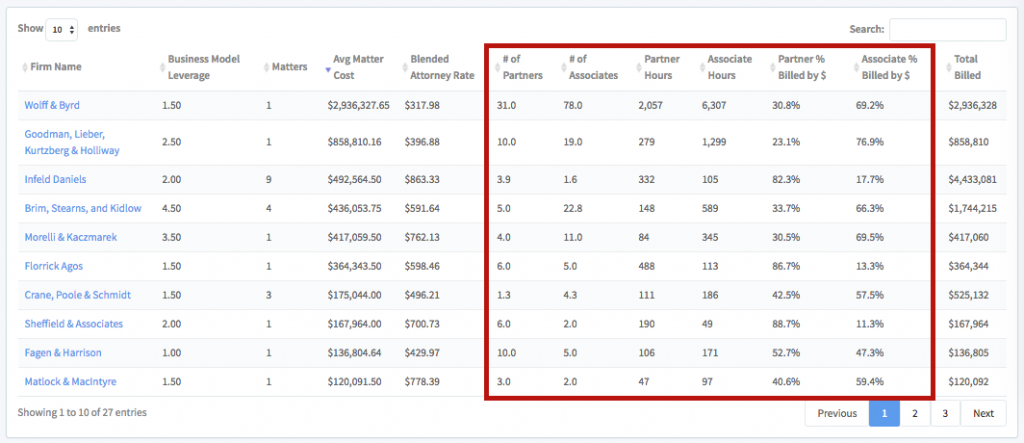
Likewise, many law firms who provide discounts may work less efficiently to the point that the same work may be handled less cost-effectively. Indeed, clients who use data analytics often find that there are systematic differences in how law firms and individual partners handle legal matters.

As a result, many savvy legal departments and CFOs have concluded that while discounts are helpful, they are hardly an indication that a law firm is truly providing value.


Show Me the Data! Why GCs Need Real Data

In speaking to legal departments, a common theme is fear of falling behind as innovators in legal department management — from General Electric to Google to the legal operations innovators at CLOC — come up with creative approaches to demonstrate data-driven approaches to legal spend. 

Specifically, the features of the new legal landscape pressuring legal departments are:

  1. Data is Redefining Legal Management: Leading legal departments are breaking old norms of managing legal work — where few constraints were imposed on outside counsel — with creative approaches using data and other tools to get the most for their money while also increasing the quality of the legal services provided
    to them.
  2. As a Result, There is a Widening Gap in Performance Between Leaders and Laggards: A big gulf in results is beginning to separate these modern legal departments who use data and legal operations tools with those doing it the old way.

forthcoming paper in the Fordham Law Review by Professor Morris Ratner discusses this widening gap in the litigation market.  

Data-Driven Management Example: Breaking Litigation Into Phases

Ratner highlights how data is allowing clients to break up single matters into manageable phases with tools including data and procurement principles.
Instead of looking at litigations as a whole, clients are attaching different fee structures to different phases –whether motion practice, discovery, trial preposition, or other elements of litigation.

This approach can save a legal department millions of dollars a year by removing unfettered discretion from counsel in smart strategic ways.
Professor Ratner says:

“Clients looking to control legal spend, supported by changes in information and project management technologies and competition among law firms, are unbundling legal work to assign tasks rather than cases to individual lawyers or firms, applying procurement principles to source legal projects to the most cost efficient providers.

These same forces have increased the prevalence and commitment to litigation budgets and have pushed flat and other “value-based” pricing into a variety of litigation settings.

Both mechanisms better align the financial interests of lawyers and clients and facilitate client input into the tasks undertaken to achieve litigation aims.”

By breaking up the matter, clients can successfully focus their counsel on tasks that create value by aligning economic incentives and move away from the traditional approach where the client handed over the keys on how a legal matter was handled and awaited a final bill.

Consequence: Legal Departments Falling Behind

Professor Ratner worries that many clients are falling behind and consequently achieving worse results in cost and quality from their legal providers.

He says that currently, only sophisticated clients have the tools, knowledge, and manpower to use such techniques currently. He notes that it is imperative that all clients benefit from such techniques:

What we need to cultivate is a shift in legal ethics that requires all lawyers to pay as much attention to value as sophisticated clients demand.

Indeed, we hear from GCs that they are increasingly being asked by their colleagues on how they are implementing “value-based” systems. Consequently, GCs are doing what they can to catch up.
In a forthcoming post, we will explain how the approach of breaking matters into phases extends well beyond litigation using examples from Bodhala’s work.

E-Billing, Matter Management and Beyond: 2017 is The Year of Change

From our many awards and accolades to meeting so many great people at tradeshows and events, Onit had a fantastic 2016. We want to thank all of our valued customers. We appreciate you trusting us to help you with your business process automation needs.

We started last year strong with recognition in Gartner’s February 4, 2016 Market Guide for Enterprise Legal Management Solutions1 report. As stated by Gartner, “purpose-built enterprise legal management solutions can improve legal department efficiency and lower overall enterprise risk.”

Mid-year was also when Onit was recognized by multiple publications for our innovative technologies. Onit was featured in TechnoLawyer NewsWire (TL NewsWire), outlining our Contract Management Suite in an exclusive report.

One of our proudest achievements of 2016 was making the Inc. 500 list. Every year Inc. 500 puts out their ranking and it’s a list we are proud to be a part of for the first time. Onit ranked 387 with three-year growth of 990%.

It was also an incredible honor to be recognized by the Houston Business Journal on both the Fast 100 and Fast Tech list.

We added two major players in the Enterprise Legal Management space to the Onit team. It’s been a pleasure to have both Cole Morgan and Matt DenOuden join the Onit executive team.

All of this hard work helped us raise $8.25 million to expand in 2017. Read more about our big funding news here.

2017 The Year of Change

2017 is already zooming by and we want to make sure your company is running at maximum efficiency. Many corporate legal departments are still using outdated processes and we want to help bring them up-to-date. Whether it’s contract management or legal service requests – we can configure our solutions just for you.

We also want to hear from YOU more this year. Your feedback is vital in making our solutions the best they can possibly be.

Connect with us on social media (Facebook, Twitter, Linkedin) and let us know business process pain points. If you are a current customer that is finding success utilizing Onit’s solutions please share your thoughts with others via a Capterra review. Your engagement means the world to us. We truly love to hear from you!

Onit is the industry leader when it comes to Enterprise Legal Management (ELM). We work hard to consistently innovate our solutions and tailor them to the needs of busy law departments.

Our solutions are flexible, lightweight, and easy-to-use. We’d love to have a one-on-one conversation about how we can help your legal department save time and resources.

Click here to learn more or feel free to reach out and schedule a demo with us.

Onit Achieves Momentous 2016 Milestones in its Pursuit of Revenue Acceleration, Strategic Growth and New Client Wins

Onit announced today that it has achieved significant milestones in 2016, validating the company’s strategic growth plans and corporate vision and further setting the stage for continued success in 2017. These milestones include new capital funding, notable client wins, strategic management hires and prestigious awards and nominations.

“2016 was an impressive year for Onit; our milestone achievements far exceeded our original expectations,” said Eric M. Elfman, CEO and founder of Onit. “Our team’s innovation, drive and dedication to our clients were critical to our growth and success in 2016. Last year’s funding and appointment of key management hires validates our commitment to client-driven innovation and client success,” added Elfman.

Key 2016 Milestones

  • Raised $8.25 million, led by a New York growth equity firm, to fuel its expansion
  • Bookings grew 78% and revenues 75% compared to 2015, significantly exceeding planned growth
  • Pipeline growth of 177%, nearly tripling compared to 2015
  • Client base grew to more than 80 in 2016, an increase of 46% compared to 2015, 32 of which are Fortune 500 companies

Management Team

Onit’s commitment to thought leadership and legal domain expertise was a contributing factor to its aggressive growth with the hiring of two key management positions in 2016. Matt DenOuden joined Onit as the vice president of global sales with nearly 30 years of industry experience and was a seasoned leader at TyMetrix (now part of Wolters Kluwer) for nearly 13 years. He has been on the front lines of the Enterprise Legal Management (ELM) revolution for decades.

Cole Morgan was appointed Vice President of Enterprise Legal Management (ELM) in 2016. With more than 20 years of management experience in the legal technology and legal operations sectors, Cole works with corporate legal department clients to help develop strategies that define the value of legal services within the corporation.

Awards and Nominations

Onit was recognized by various software, legal industry and financial publications and organizations for its innovation, thought leadership and entrepreneurship in 2016. This commitment to its unsurpassed technological excellence and user experience has garnered the company several distinctions in 2016:

  • Ranked #387 on Inc. 500’s Fastest-Growing Private Companies List with three-year revenue growth of 990%
  • Recognized in Gartner’s Market Guide for Enterprise Legal Management Solutions
  • Ranked fifth on the Inc. 5000’s Houston’s Top 10 Fastest Growing Businesses of 2016
  • Ranked #2 on theHouston Business Journal Houston Fast Tech list of 2016
  • Won the Enterprise Champion Award and ranked #8 on the Houston Business Journal Fast 100
  • Nominated by Corporate Counsel Magazine as one of the Best Matter Management Vendors of 2016
  • Recognized by Capterra as a Top 20 Contract Management vendor for four consecutive years