

Category: Legal Operations

Introducing Bodhala’s New Legal Benchmarking Solutions

Rate benchmarking overview graphic showing cost impact, average partner rates, and insights for legal operations, focusing on M&A practice areas for 2021.
Matter benchmarking overview displaying overall cost, hourly rates, and staffing efficiency metrics for legal operations, highlighting cost above market and staffing hours below market.

Are you overpaying your law firms? What should your upcoming matter cost? Are your law firms delivering the value their rates warrant?

Historically, in-house teams have lacked the transparency and insights needed to answer these questions.

Until now.

Meet Bodhala’s new Benchmarking Solutions — the easiest way to compare your rates and matters against your panel and the market at large. 

With significant improvements to Rate Benchmarking and our brand new Matter Benchmarking solution, corporate legal teams can finally access the market insights necessary to budget smarter, negotiate harder, and save money on outside legal counsel.

Let’s take a look at what’s new!


Rate Benchmarking

Rate benchmarking overview graphic displaying 2021 cost impact of $900,000 - $1,200,000, total spend of $7,123,123, and insights on legal spend management strategies for M&A practice areas.

Our new and improved Rate Benchmarking delivers what corporate legal leaders have been waiting for – accurate benchmarks coupled with usable insights. Get ready legal ops folks — budgeting, rate negotiation, and internal reporting just got a whole lot easier! 

We enhanced our rate benchmarks by adding named timekeeper benchmarks, cost impact analysis, projected ROI on increase mitigation, and more. 

Compare Your Benchmarks from Firm to Firm

Rate benchmarking overview table displaying law firm names, practice areas, yearly costs, average associate and partner rates, and historical cost impacts, relevant to legal operations and contract management insights.

We added an overview of all of your benchmarks, enabling you to easily find and compare your firm benchmarks. This comprehensive view highlights how each firm stacks up against one another and the rest of the market — plus, it makes all of your benchmarks easier to access.

Ratings in red, yellow, and green make it simple to identify where you’re getting a good deal and where you may want to focus your negotiation efforts. 

Historical Impact Analysis

Cost impact analysis for 2021 showing high financial implications, indicating an excess of $900,000 to $1,200,000 compared to market-appropriate rates, relevant to legal operations and contract management.

Ever asked yourself, “How much could we have saved if we paid more market-appropriate rates?” 

We thought so. Well, it’s time to stop wondering because Bodhala’s new Rate Benchmarking crunches those numbers for you. 

We analyze your spend with a firm across practice areas, calculating how much you would have saved if your rates were closer to market standards. Seeing those numbers in black and white (or red…) really puts things in perspective, helping you decide if any rate mitigation effort is worth your time.

Named Timekeeper Benchmarks

Named Timekeeper Benchmarks and Cost Analysis table showing average effective rates, billed rates, and market ranges for legal professionals from Hamlin, Hamlin & McGill, relevant to legal operations and contract management insights.

All timekeepers are not created equal. Sure, you’re willing to pay the big bucks for those star players, but does every partner deserve that “star treatment”? 

Just think of how easy rate review will be when you can simply pull up the benchmarks for all of your individual timekeepers. And when it comes time to select counsel for that big upcoming matter? Break out those named timekeeper benchmarks and quickly identify the highest value player on your roster. 


Matter Benchmarking

Matter benchmarking dashboard displaying overall cost, hourly rates, and staffing efficiency metrics for legal operations, emphasizing cost analysis and recommendations for contract management improvements.

With Bodhala’s Matter Benchmarking you’ll get unparalleled insights into what a matter costs, how many hours were worked, and a deep analysis of staffing and rates – down to the individual task or document. 

Matter benchmarks will simplify your budgeting process and help you refine your outside counsel guidelines to ensure you’re never paying more than you should for your matters.  

Get Market and Panel Benchmarks

Bar chart displaying percentage of hours worked by legal professionals, comparing actual, internal, and market metrics for partners, associates, and paralegals, relevant to legal operations and contract management insights.

Matter Benchmarking compares your matters not just against similar matters from similar firms across the market, but also to your own internal panel. 

Having both internal panel and market benchmarks provides you with a unique perspective on your current panel of firms. You can not only improve matter allocation on future matters but also make smarter decisions about how you manage your entire panel. 

Detailed Look at Rates & Hours

Bar chart displaying average legal rates: blended rate, partner, associate, and paralegal/other, with actual rates in black, internal rates in yellow, and market rates in blue, relevant to legal spend management insights by Onit.

Every report breaks down both rates and hours by timekeeper level, comparing those rates and hours to both the market and your panel. Rates are only part of the picture so understanding how the matter was staffed, in addition to your rates, delivers true cost analysis. 

Drill Down Into Tasks & Documents 

Subscription agreement dashboard showing legal cost analysis, including rate benchmarks and staffing efficiency metrics for legal operations and contract management.

Say you’re doing a fund formation and you’re curious how many hours a subscription agreement should really take. Look no further. 

You can stop wondering how many hours that document or task should take – Matter Benchmarking gives you the answers. With benchmarks for hours and staffing ratios, you can keep current matters on track, and budget more effectively for the next one. 

We’re here to help

Bodhala’s Client Success Team offers full white-glove service, from highlighting key savings opportunities to consulting on tactical strategies for rate negotiation or matter staffing — and everything in between.

Ready to start running legal like a business?

When it comes to managing your outside counsel spend, you have more leverage than you realize. You just don’t have the data yet. 

Bodhala’s Benchmarking Solutions put insights at your fingertips, enabling you to make strategic decisions across your legal department – from rates to matters and everything in between.

Ready to give it a spin?

TRY RATE BENCHMARKING FOR FREE!

2021: Bodhala’s Year in Review

Colorful squares arranged in a grid with the bold red numbers "2021" above, symbolizing a year in review for Onit, a company focused on legal operations and management solutions.

2021…where do we begin?! This was a monumental year for our business. Awards were won, bigger and bigger deals were closed, new products were released — and we were acquired by a company that you may have heard of (more on all that later!).

While we’re still working remotely, we did get to come together in person on several occasions for meetings, workshops, and dinners — plus one rooftop party for the books. We got to physically meet the faces we see on Zoom every day, reconnect with colleagues we haven’t seen since our office shut down, and finally find out how tall some people really are.

Our people are the foundation of our business. Having all of our brilliant minds together has been nothing short of invigorating.

Now, let’s dive into some of the highlights from the last twelve months!

Acquired by Onit!

It’s no surprise that our biggest news of the year was being acquired by Onit. We officially joined the Onit family of companies as an independent subsidiary in September. 

Onit is the indisputable market leader in enterprise legal management, contract lifecycle management, and business process automation solutions — and we’re looking forward to continuing to usher in a new exciting phase of legaltech together in the years ahead.

With this exciting culmination of many years of hard work, we had to celebrate appropriately. We gathered with nearly all Bodhala employees, as well as many new teammates from Onit, in New York City for an amazing rooftop celebration. It was a great feeling to not only get our team back together after 18 months, but also to meet many of our new Onit family members. It was an apt celebration of success, as well as a strong kick-off to our next chapter!  

We Iterated & Improved

We continued to invest in our product, iterating where necessary and building where we saw the need. Our platform is the lifeblood of our business and we remain devoted to making our user experience better by the day. We’re proud to serve some of the largest companies in the world, helping them achieve their strategic spend priorities.

Thanks to the remote nature of our current work environment, we’ve expanded our talent pool, hiring new Bodhalians from not just around the country but around the world. We’ve grown our Client Success and Product/Data teams this past year, understanding the critical role these two functions play in serving our clients. 

Bodhala was founded to transform the legal industry and be the single source of truth for actionable insights on outside counsel spend. We’re proud to not only be a category creator but be the indisputable leader in this space. 

Released New QBR Program 

Corporate legal departments are increasingly acknowledging the importance of data but don’t exactly know how to get started — and we wanted to help.

We launched our Quarterly Business Review Program in October as an easy way for corporate legal departments to get their feet wet in legal data analytics. Our QBR program gives in-house teams the clarity on their legal spend that’s necessary to make more strategic decisions, impacting both their outside counsel spend and management.

All We Do is Win, Win, Win…

We’re both honored and humbled to see our hard work recognized. In 2021, Bodhala was named:

Overall Legal Analytics Solution of the Year by LegalTech Breakthrough Awards

101 Most Innovative New York Based Machine Learning Companies by Futurology

A New York City Company to Watch in 2021 by Built in NYC

Hot Off the Press

We can’t lie — we love the limelight. 

We’re proud to be a consistent thought leader for the industry, being featured in many mainstream and industry publications, including The Wall Street Journal, Business Insider, Nasdaq’s World Reimagined Podcast, Reuters, VC News Daily Podcast, PE Hub, and many more. You can check out all our press here.

Looking Back

2021 was a transformational year not only for our business but also for the entire legal tech industry. We could not be more excited to carry our momentum into 2022 and continue to drive this major wave of legal tech innovation. But we’re not finished yet! Big goals lie ahead in 2022 but we’re fortunate to have the best and the brightest on our side to help tackle our mission. 

We look forward to bringing you more exciting news in 2022!

Wishing you and yours a happy & healthy holiday season!

– Your friends at Bodhala

What To Expect in 2022: Your Legaltech Oracle

Business professional holding a crystal ball, symbolizing predictions and insights in legal technology trends.

It’s no secret that until recently, the word “technology” — or even worse, “AI” — could make in-house teams shudder, perpetuating the industry’s reputation as laggards in terms of technology innovation and adoption. But doing more with less means optimization of daily tasks is no longer a nice-to-have — it’s critical.

So what exactly can we expect to see from the legaltech industry in 2022? Here are some of our predictions:

A Rising Tide Lifts All Ships

Demand for solutions that automate frequent, repetitive tasks and enable workflow and process efficiency continues to fuel significant growth across the sector. 

And because of this growth, 2021 was a monumental year for legaltech. 2021 saw three legaltech unicorns go public, with many others reaching or coming dangerously close to unicorn status. Couple that with growing investment across the industry topping $1B and you’ve got all the makings of a major industry breakout. 

Just a decade ago, you’d be hard-pressed to find any private equity firm with a legaltech company on their balance sheet. Now? They not only have them on their balance sheets, but many have specialized verticals focused on legaltech. If that’s not a harbinger of growth, then what is? 

“The Business of Legal”

2021 was a transformative year for businesses across the board. With some companies still reeling from the economic effects of 2020, many corporate legal departments set out to do more with less in 2021 — with new technologies playing a key role in enabling their success. 

That theme — doing more with less — will drive a bigger trend across the industry: operationalizing and optimizing “the business of legal”. 

What will that mean? Sure, it will definitely lead to software adoption and increased use of analytics, but it will also be the driver of many other trends. 

“The Great Unbundling” 

2021 will continue to accelerate new approaches to getting things done. From ALSPs to other types of providers, alternative solutions for accomplishing tasks will continue to emerge and grow — and there’s an increasing focus on what corporate legal departments can do to allow lawyers to be lawyers. This will be true for both in-house and law firms.

We’re still in the early innings of the legaltech revolution, but the current notion of how certain types of work are executed is under increasing scrutiny. Does an in-house attorney really need to spend their time on discovery work when there are great alternative solutions for that? Nope. 

From states like Utah softening the rules on legal services ownership to the proliferation of ALSPs — both independent and captive — you can expect the “great unbundling” to continue in 2022.

Solution Platformification & Verticalization 

Corporate legal departments know they need to start leaning on technology but the plethora of solutions out there can be overwhelming. Buyer fatigue is real, and organizations don’t want to devote countless hours or resources to onboarding a multitude of vendors.

Leading legaltech organizations are taking note of this and leading the charge on platformification — and acquisitions are playing a major part in that. Just look at our parent company, Onit, who acquired five companies within the past few years — four of them in the past two years alone! Being a “one-stop-shop” for a buyer will continue to be incredibly valuable in 2022.

Aside from platformification, you can expect to see some verticalization in the legaltech space as well. Birds of a feather flock together and organizations want to follow in suit of their peers when it comes to the technology they use. Expect to see legaltech providers honing in on specific verticals as they find their niche market — especially in PE as high finance continues to boom.

The Rise of Legal Ops

So what do all the trends we just mentioned have in common? They create a distinct, and undeniable need for legal operations. 2021 presented corporate legal departments with the need to determine what’s a “nice-to-have” versus what’s a “need-to-have” — and a legal operations function has fallen into the latter. 2022 will solidify that, as more companies bring on legal operations in-house, or outsource it to consultancies or other white-glove services. 

Whether it be to improve the efficiency of the legal department, manage process automation and onboarding, or rein in inflated legal spend — legal operations teams will continue to be an invaluable asset to organizations across the globe. And as businesses continue to be tasked to do more with less, we can expect to see more legal ops professions, departments, and solutions in 2022.   

Here’s to 2022!

Legal services — both in-house and at law firms — is changing rapidly. 2020 presented many new challenges, accelerating the adoption of technology and changing the way the industry works. Innovation is disrupting the status quo, pushing legal departments and firms to take a hard look at how they operate. 2022 will double down on that trend, pushing teams to new heights of operational excellence. 

2021 was a turning point – and 2022? It will solidify legal operations — and the technology behind it — as a driving force of innovation across the industry. And we are extremely excited to help drive the industry into a bright new future! 

5 Ways Smart Legal Ops Teams Use QBRs

Executive summary infographic displaying total spend of $59,561,000, block billed percentages, and hours worked by timekeeper level, with visual data on blended rates and average hourly costs for partners and associates, relevant to legal operations insights.

Managing outside counsel can sometimes feel like herding cats. There, we said it. Phew. Glad that one’s out in the open.

Maybe you believe one firm is overcharging you on rates, while another is going to town on block billing, and another is staffing partners on tasks a first-year should definitely be doing. You know these things are happening, but do you have hard evidence? Figuring out how to drive meaningful change with your firms can be tough — even simply knowing where to begin is a challenge. 

Smart legal ops teams use, you guessed it, data (!) to manage their outside counsel — and their first stop on the road to crushing department priorities is quarterly business reviews, better known as QBRs. 

QBR meetings give them a platform to discuss performance and rate trends, successes, as well as opportunities for improvement. While it’s of course critical to meet about the meat of your matters, setting aside time to review your business relationship sets you up for success both with your firms, as well as with your internal stakeholders (budget season is coming, amirite?). 

So, what can you expect to get out of a well-prepared QBR? Here are five ways innovative legal ops teams are using their QBRs: 

1. Rate Review

Rate review shouldn’t be a once-a-year task — especially with the sly pricing tricks law firms are known to deploy to rack up their billings. Regular analysis of your law firm’s activity and rates by timekeeper level can ensure that you don’t overpay unnecessarily. 

By surfacing critical data across practice areas and analyzing rates on a quarterly basis, QBRs unearth important trends that can eliminate increases — sometimes even leading to reductions or discounts. QBRs provide the venue to negotiate fair market rates and manage your discounts, regardless of if they’re practice area-specific, volume-related, or otherwise. 

With clear and objective insights under your belt, you can easily open up a data-driven dialogue with your law firms to address any concerns, then start — and win — rate negotiations.

2. Panel Review

Without data on your side, value can be in the eye of the beholder. Consider what you’re paying your firms. Now think about what they’ve done for you in the past year. Are they congruent? Did you truly get what you paid for? How did they stack up against other firms you use in the same practice areas?

We’re guessing you might be feeling a slight wave of regret washing over you. Shake that right off. QBRs are a great fix.

By taking key metrics into account like total outside counsel spend, average hours per matter, and percentage of time block billed, QBRs surface insights on the value your firms deliver and opportunities for value to be maximized. By lining up those metrics against other firms working across the same practice areas — or the same panel — you can begin to see trends that may impact how you allocated work in the future, or even prompt you to change the panel composition.

3. Performance Management 

If you’re like most corporate legal departments we work with, you’re probably paying a partner for something a first-year associate should be doing. We emphasize “probably” because it’s nearly ubiquitous — Bodhala sees this behavior across nearly every firm. We like to call it “partner hoarding”. Some firms are more egregious than others, but it truly impacts your budget when it’s happening on a regular basis. 

With cost-cutting a constant priority for corporate legal departments, QBRs are a great way to easily help correct this problem.

Digging into activity across your practice areas can highlight key metrics, such as average partner hours, average associate hours, and your partner to associate ratio. By clearly highlighting key trends, such as partners logging significant hours on routine work or firms exceeding their associate ratio, you can determine where exactly you need to course-correct and rein in the unnecessary dollars being spent.

4. Reporting to Internal Stakeholders

Many legal departments are feeling the heat from the C-suite to cut costs and run their departments more like a ‘business’. We all know that reporting to internal stakeholders can become a real pain in the…you know what. For many corporate legal departments, reporting capabilities are stuck in the 1990s, leaving them to conduct manual analysis and pore over spreadsheets.

QBRs place all the data that in-house teams need at their fingertips — often in a format that they can pass along to internal stakeholders without any edits or changes. 

Your QBRs should deliver in-depth analysis and actionable recommendations – which can be tough without appropriate software or a robust legal ops team. Setting yourself up with a top-tier legal analytics platform (cough, cough…Bodhala…!) can be the difference between easy-breezy and hours of work. That said, the work is worth the impact and the ability to pass a nice, neat package to the finance department. 

5. Gut-Checking Large Matters

Law firms often claim forecasting a budget for upcoming matters is an impossible feat, citing a lack of precedent or the “unique nature” of every matter. Sure, not every matter is cookie-cutter, but there are absolutely trends. Just like you can dig into historical legal precedent, you can also dig into historical cost precedent. 

A great QBR will drill into top matters from the past quarter and highlight key metrics that you should watch in the future. Even without a sophisticated legal billing analytics engine, keeping a record of such historical analysis can be incredibly helpful in projecting costs — everything from setting expectations around hours and tasks to rates.  

Having this information on hand helps in-house teams gut-check future matters of similar volume and complexity. Not only that, but great QBRs should offer the opportunity to make the appropriate changes needed to rein in extraneous expenses and keep your budget in check, such as revisiting how work is allocated, renegotiating your practice area discount, or updating your outside counsel guidelines to eliminate unreasonable billings. 

Sophisticated Reporting + White Glove Service = Better Business Outcomes

Data-driven conversations are foundational to the success of not only your law firm relationships but your entire legal department. 

QBRs are a great opportunity for in-house teams to get their feet wet in legal data analytics and see how transparency — and even just incremental change – can drastically reduce your legal spend and eliminate budget overages. Transparency itself can often be a major catalyst. Ever notice that when someone knows you’re watching, they start acting differently? QBRs can produce that same effect, known as the Sentinel Effect — let them know big brother is in the building, and they’ll clean up their act. We wrote a whole piece about it — check it out.

If you’re resource-constrained or you don’t have a legal ops team, don’t worry. We got you. You don’t have to be a data scientist for QBRs to transform your legal department — that’s our job :). 

Ready to learn more? Get in touch with our team to discuss our QBR Program and the savings that await!

Bodhala Wins 2021 LegalTech Breakthrough Award: Top Analytics SolutionBodhala Named Winner in 2021 LegalTech Breakthrough Awards for Second Consecutive Year

Legal Tech Breakthrough Award 2021 graphic highlighting Overall Legal Analytics Solution of the Year, featuring colorful hexagonal design.

The annual awards program recognizes Bodhala as Overall Legal Analytics Solution of the Year

Bodhala, the leading provider of AI-powered legal spend analytics, benchmarking and market intelligence, today announced the company has been named winner of the “Overall Legal Analytics Solution of the Year” award in the second annual LegalTech Breakthrough Awards.

Bodhala is at the forefront of creating better technology services to improve the legal market. Bodhala’s platform optimizes buy-side legal spend while also creating the transparency necessary to drive competition and foster innovation across the legal industry.  

With over $20 billion dollars worth of invoice data as well as publicly available and proprietary third-party data, Bodhala’s machine learning engine delivers actionable insights informed by the market. Bodhala’s solutions give corporate legal departments an unparalleled grasp on the legal work being performed so they can determine the value their law firms provide for the rate they’re being paid.

General counsels and their legal ops teams, spanning from mid-cap to Fortune 500s, can tap into digestible data and benchmarks to accurately compare and contrast their outside legal work while also evaluating work within individual firms and across panels.

“We founded Bodhala with the belief that great legal talent should come at market-driven prices, and we’re incredibly proud to have built the most powerful solution on the market for legal spend analytics. This award from LegalTech Breakthrough reinforces our role in tackling the longstanding, unchallenged and one-sided marketplace,”  said Raj Goyle, CEO and co-founder of Bodhala.


The mission of the annual LegalTech Breakthrough Awards program is to conduct the industry’s most comprehensive analysis and evaluation of the standout technology companies, solutions and products in the legal technology industry today. This year’s program attracted more than 1,300 nominations from over 12 different countries throughout the world. In 2020, Bodhala was recognized by the awards program as “Legal Spend Management Innovation of the Year.”

“The legal industry’s lack of transparency has been a huge elephant in the room. Legal teams need deeper insights that allow them to better analyze, interpret and optimize outside counsel spend at competitive and market-driven rates,” said Bryan Vaughn, Managing Director of LegalTech Breakthrough Awards. “Bodhala is the first tech company to apply machine learning and AI to legal billing data to bring clarity to the billable hour and real economics to the market. 

Bodhala recently announced that it has been acquired by Onit, the leading provider of enterprise workflow and artificial intelligence platforms and solutions. By joining forces, the businesses create the most complete enterprise legal management solutions on the market, allowing corporate legal departments to evolve analytics into actionable intelligence to optimize outside counsel spend.

About Bodhala

Bodhala, the leading legal spend analytics and management platform, provides corporate legal departments with in-depth analytics and spend optimization solutions based on real-time market intelligence. Powered by machine learning and AI, Bodhala transforms messy data into actionable, high-impact insights to help companies save up to 20% on their outside counsel spend. The company, an independent subsidiary of Onit since 2021, serves clients across the Fortune 500 and critical services economy industries. Bodhala was named a LegalTech Breakthrough Award Winner for Legal Spend Management Innovation in 2020 and 2021, and One to Watch in Legal Technology by the Financial Times. For more information, visit bodhala.com.

About LegalTech Breakthrough
Part of Tech Breakthrough, a leading market intelligence and recognition platform for global technology innovation and leadership, the LegalTech Breakthrough Awards program is devoted to honoring excellence in legal technologies, services, companies and products. The LegalTech Breakthrough Awards program provides a forum for public recognition around the achievements of LegalTech companies and solutions in categories including Case Management, Client Relations, Data and Analytics, Documentation, Legal Education, Practice Management, eDiscovery and more. For more information visit LegalTechBreakthrough.com

Introducing Bodhala’s QBR Program

Top practice areas infographic displaying total spend in litigation and M&A, including financial figures, percentage changes, and block billed hours by timekeeper level, relevant to enterprise legal management insights.

Data-driven conversations are pivotal to successful law firm management and relationships — and for many smart legal departments, it all starts with quarterly business reviews (or QBRs).

That’s why we are launching the Bodhala QBR Program: to simplify the process for those already doing it and jumpstart a critical best-practice activity for those who aren’t. 

Using data to make better, more strategic decisions on key management issues, like rate review and panel review, has become table stakes for many corporate legal departments — and the trend is growing. Bodhala’s QBR Program will turn a cumbersome, seemingly never-ending task into a piece of cake, from start to finish. 

And the best part? It’s a completely white-glove service. By leveraging our advanced machine learning and AI, coupled with detailed analysis from our team of data scientists and legal industry experts, Bodhala QBRs deliver deep analysis and actionable recommendations, giving you the tools you need to effectively manage your objectives. 

So what do you get with Bodhala QBRs? We’re glad you asked.

1. Full Transparency & Trend Spotting 

Top practice areas infographic displaying total spend in litigation and M&A, including financial figures, percentage changes, and block billed hours by timekeeper level, relevant to enterprise legal management insights.

By surfacing critical data and analyzing it across practice areas and firms on a quarterly basis, QBRs unearth important trends across important metrics like partner and associate rates, work allocation, and block billing. Detailed insights provide detailed insights on your law firms’ performance over time, highlighting areas you need to keep an eye on. 

2. Actionable Insights & Improved Reporting

Key trends infographic displaying top legal metrics: average partner hourly cost ($1,034, 52.4% increase), average associate hourly cost ($956, 12% increase), overall spend change ($598,659 more than last quarter, 23.4% increase), percent partner hours (1.3% decrease), and percent associate hours (1.3% decrease).

Our QBR Program surfaces critical insights and provides you with clear recommendations for how to improve your desired outcome – whether it be negotiating a better rate, improving task-to-talent alignment, and everything in between. 

3. ROI Projections

Next Steps Actions & Impact infographic detailing specific recommendations for legal cost management, including decreasing M&A BPI, eliminating partner hoarding, and reducing block billing, with projected savings totaling $2,318,000.

Specific ROI estimates accompany each QBR recommendation. Designed to be easy to execute, with a clear associated value, you have a direct line of sight to the impact of your actions. 

You can be confident in the results – and the knowledge that you will be able to manage your budget more strategically. 

As pressure for accountability and proactive budget management continues to trickle down from the C-suite, data is no longer a nice-to-have but a need-to-have for corporate legal departments. Regular, data-driven conversations with your key stakeholders and law firms will not only set the foundation for stronger partnerships but will be a catalyst for better results. 

The Bodhala QBR Program will give you the tools you need to not only save time, money, and improve your outside counsel management. You will also be completely prepared to “wow” the internal stakeholders demanding visibility into your spend. 

So what are you waiting for? 

Book a demo with our team of legal experts to get started!

3 Times You Should Be Benchmarking Your Firms

Hand holding a pen pointing at a printed report with bar graphs and line charts, illustrating data analysis relevant to legal operations and enterprise management.

Corporate legal departments are increasingly expecting more from their firm relationships. In-house teams are now feeling executive pressure to effectively manage their budgets, save where possible, and demonstrate the value their firms deliver for the prices they’re paying. 

So how are they doing that? Innovative in-house teams are using analytics and sophisticated benchmarks. Armed with “smart benchmarks” that are informed by market data and purpose-built to establish apples-to-apples comparisons, corporate legal departments are leveraging AI-backed benchmarks to influence their law firm relationships for the better — and you can too.

But when do benchmarks give you the leverage you’re looking for? 

Here are three ideal opportunities, and some simple tactics to help you get started with benchmarking: 

1. Rate Negotiations

Rate negotiations can be uncomfortable — but with data, they don’t have to be. Though your firms may describe your rates as “great”, is that actually the case? Are they in alignment with the going market rates for similar firms doing similar work? You’re not going to get the answer from your firms — they’re inherently biased. It’s important you look to trusted third-party sources for market data. 

A smart benchmark will provide you with actual market rates for similar work from similar firms — which is critical. Comparing claims litigation rates to complex litigation rates, or an AmLaw 25 firm with a hyper-regional firm won’t result in usable data. They’re not meaningful comparisons. Make sure your benchmarks leverage contextually relevant competitors executing on similar matter-types and practice areas. 

Benchmarks also help you know when it’s worth the effort to negotiate at all. If it’s clear that the firm you used for all complex litigation matters is charging marginally more than similar firms handling similar matters, then perhaps the juice isn’t worth the squeeze.  

If you don’t have access to smart benchmarks from trusted third-party sources, you can still drive value by conducting a rate card RFP. That can help you at least benchmark firms’ bids against each other, and give you leverage with individual firms based on other firms’ bids. 

But be aware that the bids you receive are only telling you your law firms’ self-evaluated price — what they think they’re worth — not what they should cost. 

Benchmarks, on the other hand, are clear, objective, irrefutable data. Armed with that kind of data you’ll have the negotiation leverage you need to get the rate reduction you want.

2. Measure Outside Counsel Value & Effectiveness 

It’s no secret that law firms can be expensive and it can be hard to determine the value you’re getting for the rates you’re spending. But benchmarks are a great starting place for ascertaining law firm value. 

It’s understandable to want to work with a firm you like and trust, but your legal department should evaluate law firm relationships through a mix of qualitative and quantitative factors, like benchmarking. 

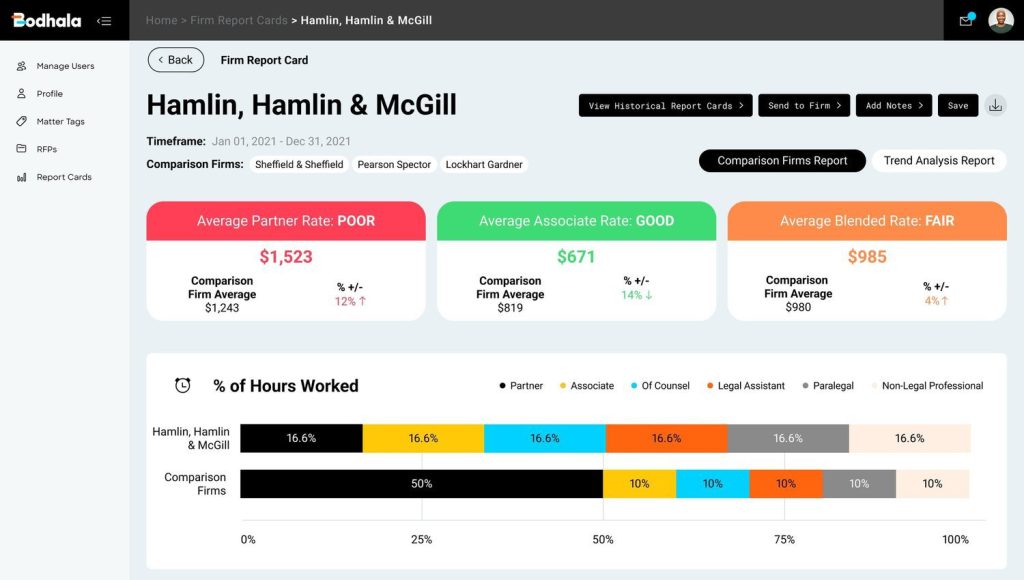
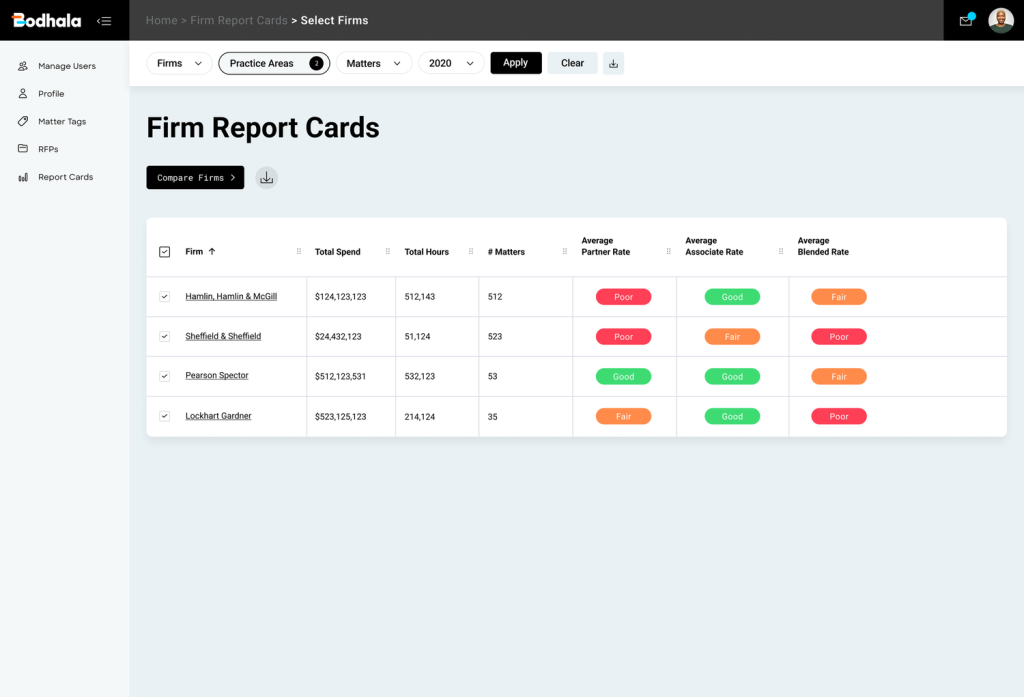
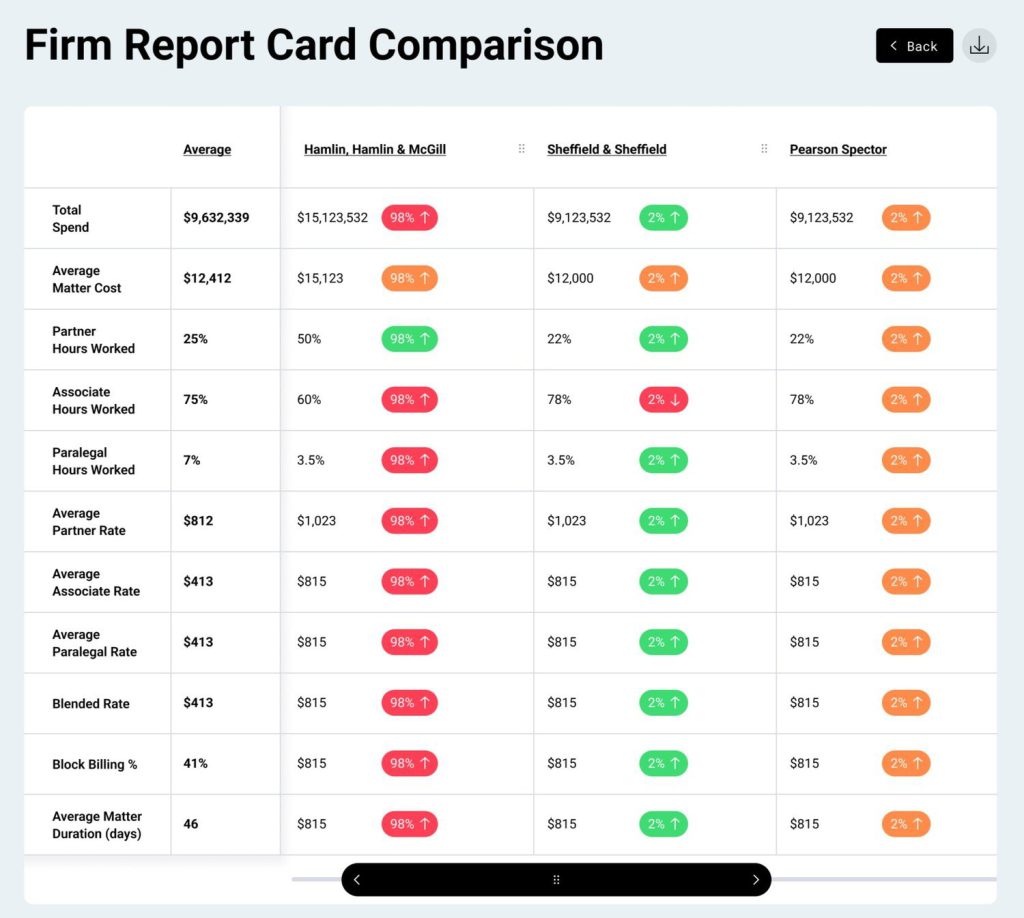
Beyond smart benchmarks, Firm Report Cards are another way to do basic benchmarking. Firm Report Cards allow you to drill down by practice area, matter type, timekeeper level, and even tasks to analyze the firms in your panel. From there, you can benchmark your panel firms against one another to determine who will deliver the most value to your organization and do so efficiently.  

Leading a data-driven discussion with your law firms will enable you to incentivize improvements — or even reward your top-performing firms by paying them more (yes, paying more isn’t always a bad thing).

3. Determining a Matter’s Should-Cost 

Law firms are notoriously vague when scoping costs for upcoming matters. Like many elements of the law, it’s not always clear upfront how complex a matter may be or how contentious your opponent will be. That said, law firms have the data to give you estimates – otherwise, how would they be able to make bids for large matters? They have the data – they’re just not sharing it. 

Having your own benchmarks for matters — estimated hours, allocation of tasks, and rates — is an incredibly valuable tool. By combining a smart market benchmark with historical data on similar matters, you can make a reasonable estimation of the expected cost — within a tolerance of course.

Market benchmarking will help your legal department set realistic and competitive expectations for your matters. With this knowledge, you can make data-driven, strategic decisions when it comes to matter allocation, ensuring you’re retaining counsel that delivers maximum value and acts in your best legal and financial interests. 

Benchmarking is critical to more strategic, informed decisions.  

Organizations are increasingly leaning on General Counsels and their teams to not only mitigate risk for the business but also act as a strategic partner. To be a true strategic partner, you don’t just need data — you need insightful, smart benchmarks.

Relevant benchmarks based on your own historical data, or third-party sources are indispensable and are a key ingredient for strategic success. The insight gleaned from benchmarks is the required ammunition to enable effective negotiation, improved firm management, and more accurate forecasting to keep your department on budget and be the strategic partner the business demands.

3 Ways You Should Be Using Benchmarking Data

Golden scales of justice beside a laptop on a glass desk, symbolizing legal operations and enterprise legal management.

Smart rate benchmarks offer corporate legal departments a wealth of knowledge — but just knowing the benchmark only gets you so far. To truly make the most of your rate benchmarks, you have to draw insights, develop a strategy, and then action it. 

Here are three key ways to strategically leverage rate benchmarks (and make sure to check out our recent post on when you should benchmark!): 

1. Improve Performance with Data-Driven Discussion 

Working with law firms can be tricky, especially when it comes to conversations about rates or performance. Many in-house teams have a hunch when their law firms aren’t operating as efficiently or effectively as they could be, but lack the evidence to prove their suspicions

Benchmarks — both amongst your panel and against the market — are a valuable starting place for meaningful discussion with your firms. Data doesn’t lie — which immediately negates many tired arguments. With quantitative analysis like benchmarks, it’s simple to highlight areas where improvements could be made — and indisputable. 

Plus, the data lends itself to actionable insights. It’s easy to spot outliers and ask the right questions about why their numbers are so far off from the pack. They may have perfectly acceptable explanations — or they may have to make changes to how they work to fall more in line with norms.

If there’s one thing your law firms do not want, it’s to lose your business. Using benchmarks will help you to drive transparency through data-driven conversations. 

2. Make More Strategic Decisions on Law Firm Selection & Matter Allocation

Firm selection and matter allocation are other areas where benchmarks can make a huge difference in cost, value, and quality of service. It’s no secret that law is a relationship-driven business. Hiring decisions are often colored by old work relationships or law school friendships. Having a history with a person — or a firm — doesn’t necessarily mean they’re right for an upcoming matter, or for your business in general.  

One easy way to improve firm selection is to leverage benchmarks during your annual rate card review process. Conduct a Rate Card RFP, asking firms to re-submit rates across all or specific practice areas. Then benchmark the firms to establish the bid’s relationship to market prices — but make sure the benchmarks are contextually relevant and level-specific. Your market benchmarks must only compare a firm against similar firms for similar work, and that you’ve got specific benchmarks for each timekeeper level. 

Comparing the rates from the different bids, along with the market rate, will help you understand which firms deliver the most value. For example, certain practice areas may have very complex casework or subject matter and therefore require more specialized (and expensive) expertise. Regardless of the practice area, benchmarks and bids will put you in the driver seat to get the best firm at the best rate for your panel or matter.  

3. Negotiate Fair Market Rates

When it comes to rates, law firms are always adamant that you’re receiving a “really good” rate — even “lower than what other clients pay!”.

But we all know that seeing is believing — or as Cuba Gooding Jr. put it in Jerry McGuire — “Show me the money!”.

The apples-to-apples comparisons gleaned from smart benchmarks enable in-house teams to analyze exactly how their rates stack up against other firms that handle similar matters for similar clients within the same domain. 

As we all know, law firm objections are commonplace throughout rate negotiations. With this information, you have all the ammunition you need to lead data-driven conversations with your law firms and justification as to why you should pay a lower rate.

After all, competition is healthy. If your law firms really value your business, they will see the indisputable logic in your data and adjust their pricing to reflect a more fair market rate in order to keep you as a client.

Benchmarks Fuel Better Business Decisions

You cannot effectively manage what you do not measure. Benchmarks should play an integral role in your legal department’s operations — from relationship management to firm selection to rate negotiations and more. 

Bodhala is now part of the Onit Family!

Bodhala joining Onit, featuring vibrant orange background, bold text announcing the news, and Onit logo with Bodhala logo.

The startup journey is tumultuous, full of highs and lows, sometimes scary – but always exciting. From raising our A round in April 2020 to growing over 400% in a matter of months, the last 18 months have been quite a ride. 

But today, I have the honor of announcing our most exciting news yet: Bodhala has been acquired by Onit, a long-time friend of the company and true innovator in legal technology. We are now an independent subsidiary of the market leader in legal technology. 

Like Bodhala, Onit is committed to innovation and disruption. They share our vision for the business of legal – where data, machine learning, and actionable intelligence drive better strategic decisions and create a transparent market for legal services. 

From day one we believed that legal business data – from rates to hours to outcomes – would be the key driver of decisions in the future. It will not only allow legal leaders to operate their departments like a business, but it will also level the playing field and force innovation. 

Onit is the indisputable market leader in enterprise legal management, contract lifecycle management, and business process automation solutions. Bodhala’s analytics and legal business intelligence solutions not only complement their products, together we create the most complete solution for corporate legal business needs, ushering in a new exciting phase of legaltech: the era of legal business intelligence. 

I want to take a minute to thank everyone who has helped us along the way. So to our investors, families, and every member of the Bodhala team: We didn’t do this alone. Your support, advice, and hard work is what got us here today. You made this possible. 

So, what’s next? From new teammates to new features – Bodhala’s journey is just beginning. We couldn’t be more excited to create the future of legaltech with Onit. 

Below is some additional information about the acquisition, Onit, as well as top FAQs.

Sincerely,

Raj Goyle, CEO & Co-Founder

Why Savings Isn’t Always About Money: How to Reinvest Your Bodhala ROI

ROI graphic with upward trend chart and digital analytics, representing investment return in legal operations and management solutions.

When procuring new technology, one of the first things prospective buyers want to know is — “What kind of ROI can I expect?”

Bodhala’s market intelligence has helped corporate legal departments around the world save hundreds of millions of dollars on their outside counsel spend by identifying inefficiencies and opportunities to save. But one of our key learnings along the way has been that for many GCs and legal ops leaders, ROI isn’t just about dollars and cents. Sometimes streamlining operations to save time or resources is the number one goal or reallocating spend for an important (and expensive) matter. Ultimately, it’s about each department’s goals, which can run the gamut from financial to operational — and everything in between.

Here are the top four benefits of a quality legal spend management system (beyond just banking the savings): 

1. Operational Efficiency

Ever find yourself wishing there were more than 24 hours in the day? Manual reporting and analysis – digging through spreadsheets – can be extremely timeconsuming when it comes to legal data. From aligning data to consolidating various file formats, it wastes incredibly precious time and resources.

Sophisticated legal spend management systems allow in-house teams to run reports and analyses with ease. The best ones (ahem, Bodhala) also clean and structure the data as it enters the system, ensuring you get the most accurate data and best analytics possible. 

The right software can streamline your department’s internal reporting – everything from QBRs to panel analysis – saving your team hundreds of hours (or more). 

Crunching numbers doesn’t have to take all day — you just need the right tools.  

2. Investing in Key Players

Without data, in-house teams have long struggled to effectively allocate work and make the appropriate staffing decisions, like whether to hire internally or use outside counsel. 

But data is changing this narrative.

A smart, sophisticated legal spend management solution will illuminate the granularities of your outside counsel spend, enabling you to dig into the key metrics that influence budget allocation.

Armed with these insights, you can analyze key metrics, such as average practice area spend or average partner rate, to identify areas where you’re spending a significant amount of your budget. As a result, you can determine if it’s a more financially sound decision in the long run to make an internal hire in the relevant domain rather than continue outsourcing work.

Digging into other key metrics, like top lead partner or average partner hours per matter, can highlight your top performers. Knowledge of who’s billing hours on the most pivotal portions of your matters will enable you to identify partners who are highly specialized and critical to your success – and who should be compensated accordingly. Yes, that’s right — you should actually pay your “Lebrons” more. But you will want to know where to get those extra dollars – and the data can tell you that. 

3. Investing in New Technology

It’s no secret that the legal industry has long shied away from technology. And even when there is a need or desire to onboard a new tool, there’s no technology budget — it’s a lament in-house teams share far too often.

That’s why actively and effectively managing your outside counsel spend is critical. In-house teams are throwing precious dollars out the window each year by assuming they have zero leverage in pricing negotiations with law firms. But that couldn’t be further from the truth when you have data on your side!

Data gleaned from a sophisticated legal spend management solution will highlight areas where your spend can be reined in. For example, are you paying above-market rates for the partners or associates handling your matters? Did an esteemed partner log hours on a task that really should have been handled by a first-year associate? Did you unnecessarily blow budget dollars on a matter that should have cost you far less?

Armed with these insights, you can make strategic and data-driven decisions that will not only yield savings but also enable you to invest in the technology you need. 

Of course, you’ll want to understand the ROI you can expect from the next solution you onboard, but in the case of a legal spend management software investment, it will be a catalyst for savings and long-term benefits.

4. Rainy Day Fund

Although savings isn’t always about money, having some extra cash set aside never hurts. You never know when the economy might take a turn for the worse, or when you’ll get hit with an unexpected expensive lawsuit.

It’s a smart, strategic move to set aside some of the ROI realized from your legal spend management technology towards a “rainy day fund”. Having some cash set aside can provide you with peace of mind when the unexpected gets thrown your way.

Going Beyond the Dollars

Data should play a critical role in your budgeting and forecasting processes. Although data cannot account for everything, the ROI realized from data-driven spend management should provide you with a safety blanket of savings. 

A good legal spend management solution will save you money. But a great legal spend management solution will allow you to identify opportunities to streamline processes, improve law firm relationships, invest in new tools, and save you money.

With data and a smart, sophisticated legal spend management solution on your side, you can run your legal department like a business and meet your management goals — whatever they may be.