

Category: Legal Operations

Legal Professionals Say Goodbye to Spreadsheets: Switching to the Cloud is a Must in 2023    

When it comes to software tools that help you calculate, sort and analyze data—there is one platform that always comes to mind—Excel. It has historically been the go-to solution for legal professionals who want to create reports and organize information. In fact, almost 750 million people use Excel every day. 

While there is no doubt that this Microsoft-created tool is valuable, it is not the only tool available for legal professionals, especially those who are looking for a way to easily adhere to best practices and increase productivity and efficiency. 

If you are looking for ways to do more with less in the new year, then it’s time to explore cloud-based software designed specifically for legal professionals. 

What is Cloud-Based Legal Matter Management Software?

legal matter management software system takes all the legal activities you do every day—expenses, time tracking, reporting, email, case document management and assembly and more—and organizes them in one location for easy access and collaboration with team members and clients. Since the software is cloud-based, it can be accessed via an Internet browser, no matter where you or your team are located. 

What is the Difference Between Cloud-Based and On-Premise Software?

A cloud-based legal software system is a computer system whose resources are available on-demand (via an Internet-connected web browser), including data storage and computing power, without being actively managed by the user. This differs from traditional on-premise-based software, where data is stored locally in an office and is managed by the user.  

Here’s a quick overview of the differences between on-premise and cloud-based software:

On-Premise Software:

  • Software costs are paid up-front 
  • No internet connection is required
  • Data is stored in the physical location you determine 
  • You are responsible for managing and updating software.

Cloud-Based Software:

  • Software costs may be spread out (subscription-based)
  • Access data anytime, anywhere
  • Data can be stored anywhere
  • Quicker, lower cost for deployment 
  • No hardware maintenance
  • Dedicated team for training and support provided.

Why Switching to the Cloud Makes Sense for Legal Teams

Numerous reasons exist to switch to the cloud which can lead to an immediate impact on your organization. Here are several reasons switching to the cloud is the best thing you can do for your organization this year. 

  1. Decreased Up-Front Costs.

We live in a time where cutting costs is essential and waste is top of mind. By moving to the cloud, you can eliminate expenses associated with hardware that on-premise solutions usually come with. In addition, the ability to do more with the system increases productivity, which can lead to two important things for legal teams: better profitability and customer service. And who doesn’t want that? 

  1. Scalable Framework. 

You want a platform that can grow with you, and cloud-based software offers just that. As your organization changes, the cloud offers flexible server space to accommodate whatever your needs may be, which is helpful since you can’t predict the future. This flexible framework puts an end to costly system downtime and performance issues because of a rigid platform. The ability to integrate with other platforms also provides an even wider avenue for growth and scalability needs. 

  1. Improved Security. 

Cloud-based software is generally considered more secure than on-premise software because your data is stored on remote servers that are independently managed and maintained by expert security providers. This means your data has 24/7 protection from professionals who are well-versed in physical and cyber-security attacks and are constantly employing measures to guard against them. On-site software is more prone to physical and cyber breaches because of the lack of an expert security team that most cloud-solutions offer. 

  1. Better for the Planet.

    By moving to the cloud, you can significantly reduce energy consumption and greenhouse gas (GHG) emissions. According to a recent report, cloud computing is 93% more energy-efficient and has 98% lower GHG emissions than on-premise data centers. And since data services are shared over a network, the organization will naturally be more efficient and effective in reducing energy consumption.

So-Long Spreadsheets: Managing Legal Data Completely in the Cloud

While many legal organizations have resisted moving to the cloud for various reasons, there is increasing evidence that to stay current in today’s world, it is required. With benefits such as better security and increased flexibility for remote work as well as reduced errors and the ability to scale makes the decision to move to the cloud a no-brainer for most operations. Cloud-based legal matter management software is the solution for legal professionals who are finally ready to take the plunge into a new, better way to work.

With more than 30 years of experience supporting organizations across a number of industries, Legal Files gives teams the centralized platform, support, training and upgrades needed to stay relevant in the changing legal landscape; and offers both on-premise and hosted solutions to meet your unique needs..

Strategically Negotiate Rates and Build Better Budgets with Rate Proposal Analyzer

As we find ourselves nearing the end of another year, how confident do you feel in the rates you’ve negotiated for 2023?

C-suite executives are increasingly holding their corporate legal departments accountable for their spend. The Enterprise Legal Reputation (ELR) Report found that 37% of corporate legal departments feel this pressure from their CFO, while 30% feel it from their CEO, and 10% from their Board of Directors.

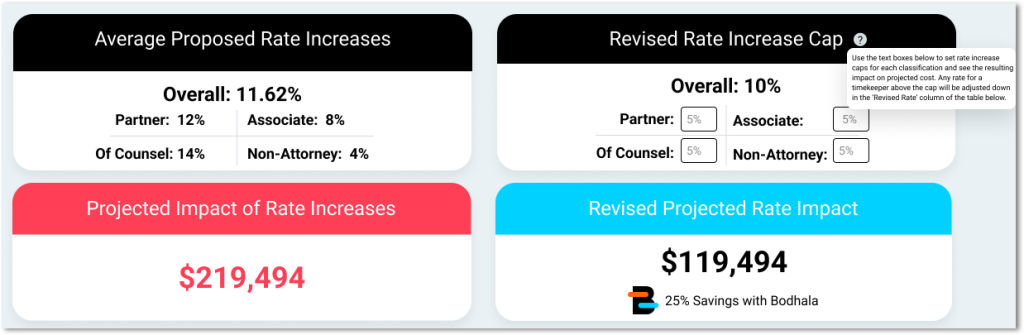
With mounting pressure to contain costs, your law firm rates are a great place to identify quick savings opportunities. That’s why we launched Rate Proposal Analyzer, the easiest way to collect, compare, and analyze your annual rate proposals. 

With a centralized view of your law firms’ rate proposals, you can finally say goodbye to the days of accepting above-market rate increases due to a storied law firm relationship or increasing caseloads. Rate Proposal Analyzer makes identifying savings opportunities quick and easy!

One Centralized Dashboard

Consolidating law firm rate proposals hasn’t been easy for corporate legal departments. 

Rates from one firm are submitted via email, while another is submitted via snail mail. And to make matters worse, you’re drowning in spreadsheets trying to keep track of everything.

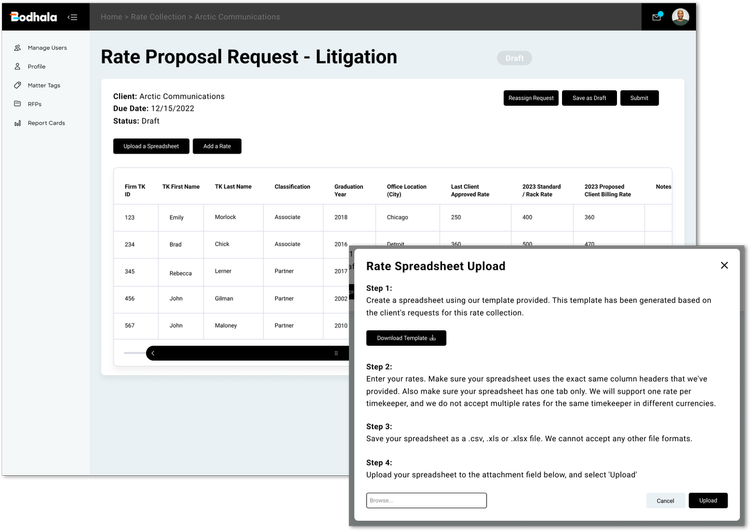
From rate request to approval, our Rate Proposal Analyzer centralizes and streamlines your 

entire rate proposal process. 
Law firms can upload their rate proposals directly to the dashboard through manual submission or a spreadsheet.

Unprecedented Analysis & Internal Benchmarking

Collecting rate proposals is only half the battle–now, you have to determine which rates will or will not get approved.

Historically, this has been a headache for corporate legal departments. But the good news is rate proposal comparison and analysis just got significantly easier. 

With Rate Proposal Analyzer, corporate legal departments can now:

  • Simplify rate proposal requests, including simultaneous submissions from multiple law firms
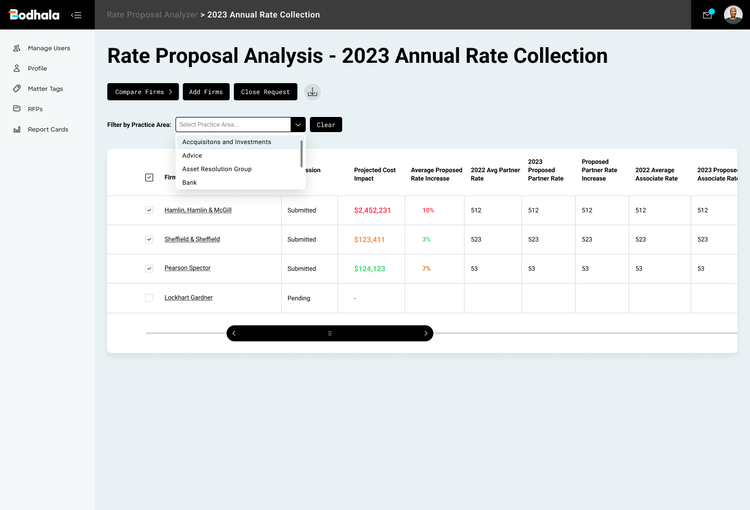
  • Aggregate completed proposals in one place for easy review and comparison
  • Request diversity information on timekeepers for specific projects

No more wondering where you’re overpaying–Rate Proposal Analyzer puts these insights at your fingertips.

Align Negotiations to Budget Goals

We’ve said it before, and we’ll say it again–rates cannot be accepted blindly. 

And we don’t just mean reviewing your rates before approving them. You have to go one step further and consider the impact these rates will have on your budget. 

Your budget is your North Star, so the rates you approve should align with your budget goals for the year. 

Rate Proposal Analyzer enables corporate legal departments to analyze cost impact with scenario forecasting. 

Now, you can easily assess the impact of your proposed rate increases with clear cost projections based on your historical spend from the previous year. 

Rate Proposal Analyzer offers unparalleled forecasting capabilities that you won’t find anywhere else in the market. 

Strategic Spend Decisions Await…

As organizations continue to prioritize cost optimization, you can’t afford to overpay on your law firm rates.

Our Rate Proposal Analyzer provides a holistic, centralized view of your law firm rate proposals, empowering your corporate legal department to budget smarter, negotiate harder, and make more strategic spend decisions.

Ready to take the next step in your spend optimization journey? Get in touch with a member of our team to get started.

Understand Law Firm Performance with Firm Report Cards

Law firm relationships have long been measured with gut rather than metrics.

But should you really work with a certain firm just because a partner is your GC’s law school buddy? (Hint: the answer is no!)

While your law firms are trusted business partners to your organization, C-suite executives are holding legal departments accountable for understanding the value law firms deliver. To ensure you partner with the right firms on your matters, you must leverage a mixture of qualitative and quantitative metrics. 

But how can you determine if your law firms are making the grade without poring over spreadsheets for hours?

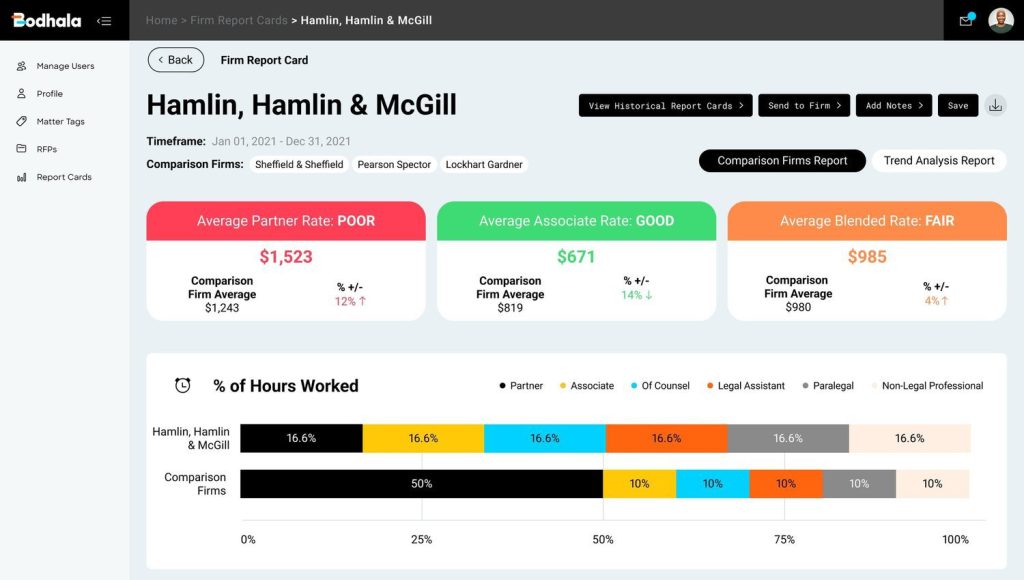
Introducing Bodhala’s new and improved Firm Report Cards, the best, most holistic view of how your law firms stack up against one another.

Now, you can get a detailed look at your firm’s rates and key performance indicators in one concise report–all in just one click. 

Let’s take a look at what’s new!

Unprecedented Analysis & Internal Benchmarking

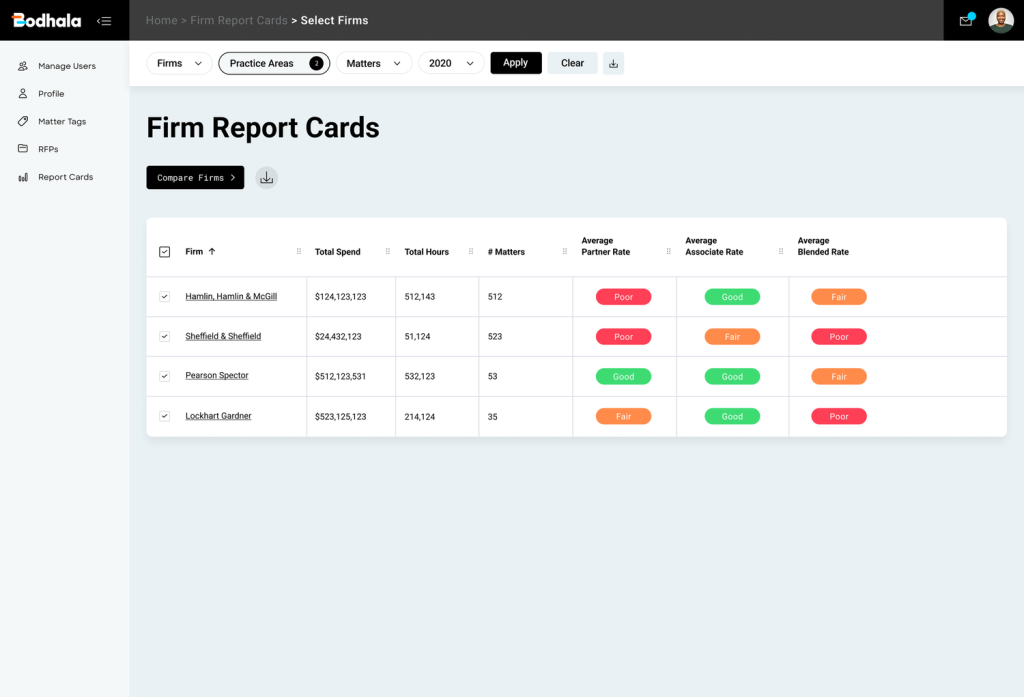
Firm Report Cards leverages Bodhala’s reporting and analytics capabilities and presents it in a concise and easy-to-digest view for each firm. 

Customizable cohorts of firms are selected for comparison against one another to aid in panel management and potential consolidation.  

Full Transparency

Effective relationship management requires transparency and full transparency requires data. 

Firm Report Cards empower you to manage with metrics, not gut.

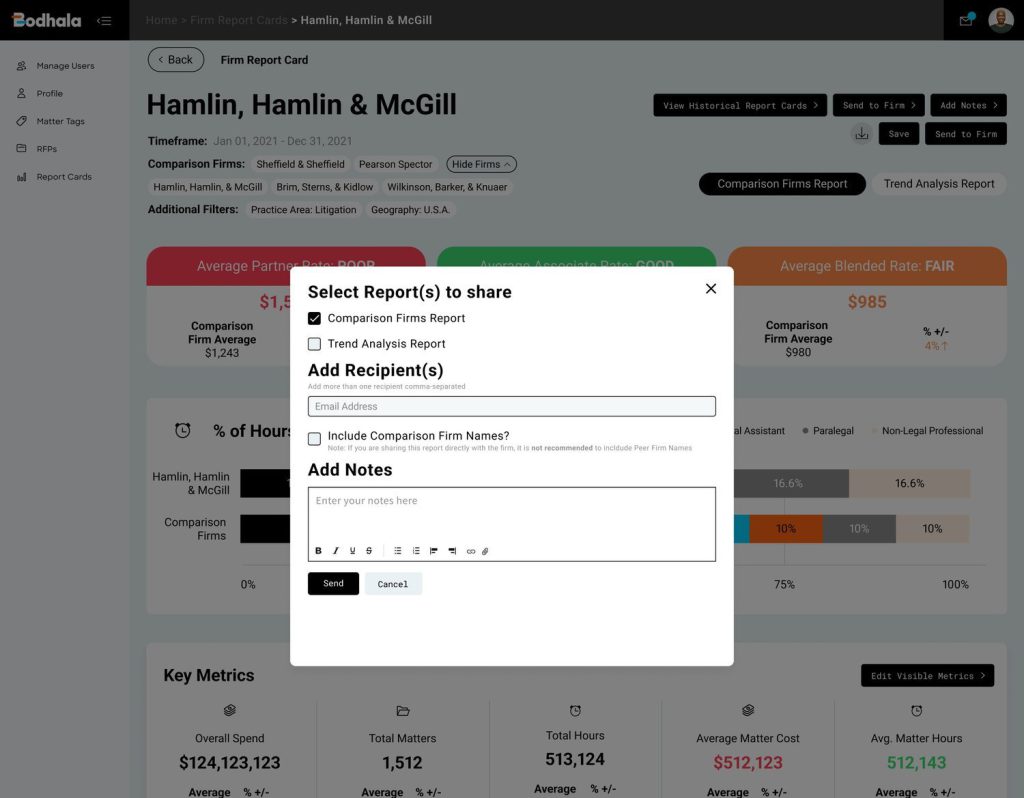
Flexible, customizable reporting can be shared directly with your firms, dramatically simplifying vendor management and increasing transparency.

Sharing Firm Report Cards with key internal and external stakeholders lets them know you’re paying attention and makes it easier to justify your spend decisions and display where you’re getting value. 

Instant Comparisons 

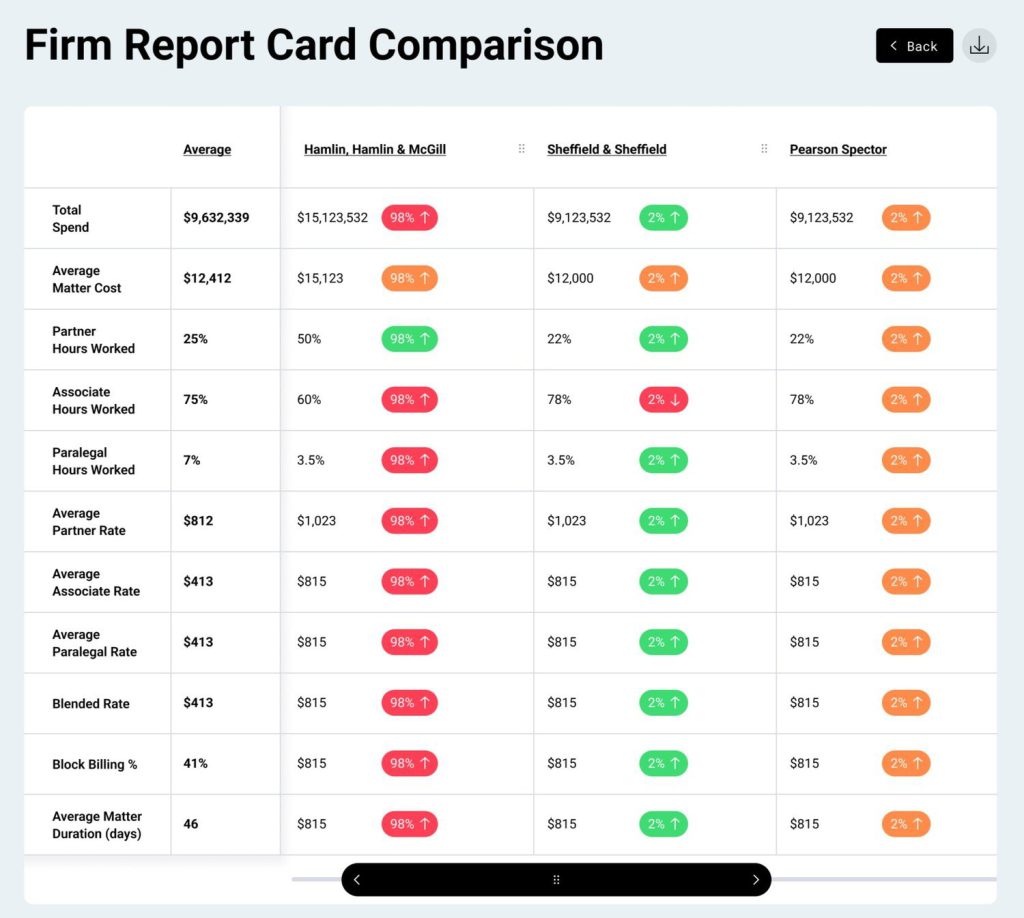
The Comparison Report shows how a firm stacks up against the rest of your panel across key metrics–such as overall spend, average partner and associate rate, average matter cost, and more. 

Need different metrics? No problem. Customize the Comparison Report to fit even the most unique needs.

Historical Trend Analysis 

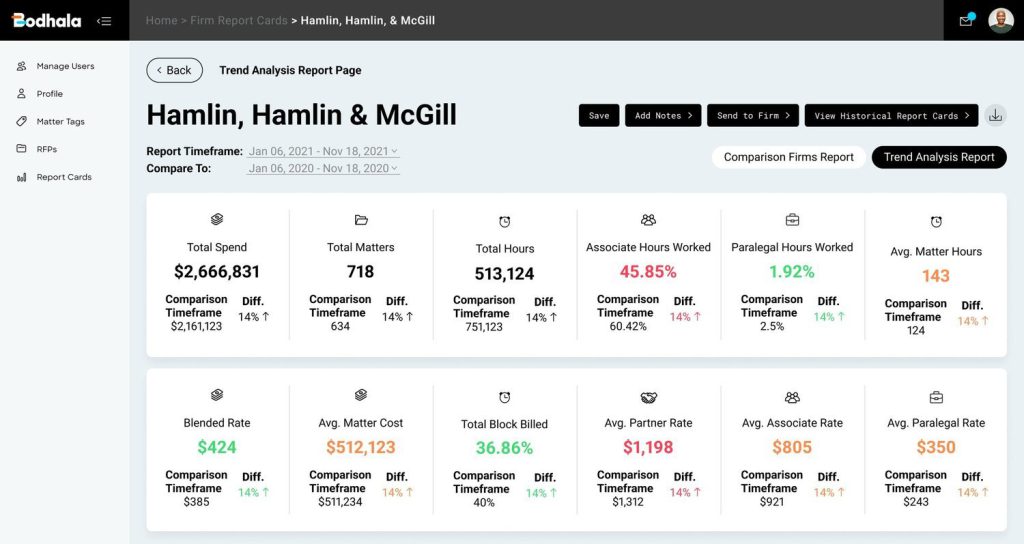
The Trend Analysis Report shows how a firm has been trending over time, making it easy to see how well your law firms are managing your business. 

With this information under your belt, you can instantly prioritize your areas of focus in your next QBR or conversation with your law firm. 

Customizable & Shareable Scorecards

The KPIs included in Firm Report Cards are completely customizable to ensure that your legal department can score your firms on metrics you care about. 

The Report Cards can also be exported to PDF and shared directly with the firm for a line of sight into how you are monitoring firm performance. 

Repetitive Value Over Time

Firms are aware of the metrics they are being monitored on and where they sit relative to the other firms your corporate legal department is using. 

With the help of a dedicated Bodhala Client Success representative, you’re can monitor trends in firm behavior and leverage data to increase firm efficiency and drive continuous value over time. 

The Key to Successful Law Firm Relationships

Data sets the foundation for successful law firm relationships. After all, you can’t manage what you don’t measure.

Firm Report Cards put data-driven insights at your fingertips, making law firm relationship management that much easier. 

So, what are you waiting for? Get in touch with our team to learn how you can simplify your vendor management with Firm Report Cards. 

Harnessing the Power of Data: 3 Reasons It Is Imperative for Increasing Legal Ops’ ROI

Data analysis is crucial to understanding market trends and your business. Here are the keys to why legal leaders must capitalize on critical data to increase visibility, improve forecasting, and create continuous competitive advantage — ultimately transforming Legal from a cost center to a strategic, materially impactful powerhouse.

Data, it has often been said, is the new oil as it is a commodity of immense worth. It is a resource that must be protected, and if left unrefined, it holds no true value. But when mined, data can illuminate our lives, our businesses, and our world.

In the third and final chapter of the Enterprise Legal Reputation (ELR) Report, the multinational study* showcases the untapped potential of legal operations to be a change agent in driving meaningful business results. While the report determined that eight in ten (79%) enterprise employees do not see Legal as a modern operation, it also uncovered that technology acts as a catalyst for evolution for businesses and practitioners who wish to differentiate and grow.

Data can be like oil. Yet unlike oil, data has the potential to be infinite, shared to every corner of the planet literally at the speed of light. And, far from crude, data is a sophisticated tool available to everyone in the form of transformative digitalized technology, like artificial intelligence (AI), predictive analytics solutions, and business process automation (BPA).

Why data matters for Legal

Traditionally, Legal has not been required to quantify key performance indicators (KPIs) and return on investment (ROI) with the same rigor as other functional groups. However, the ELR Report revealed that two in three (64%) legal respondents are unable to track all outside counsel spend and one in 25 (4%) cannot track it at all. In fact, the average department can track just three-fifths (60%) of outside spend at most; in Germany, this figure rises to two-thirds (66%), and in the United States and United Kingdom, it drops to less than half (53%).

Now is the time for Legal to become a true business driver. But to create greater operational wins, accelerate revenue acquisition, and function in an efficient and modern capacity that demonstrates market intelligence, Legal must develop transparent quantitative metrics and report regularly, just like Sales may conduct weekly pipeline calls or Finance faces quarterly reviews. Legal must quantify its performance – and that requires its own systems of record that capitalize on critical data to increase visibility, improve forecasting, and assist in decision-making.

Here are three essential ways harnessing data can assist in your legal department’s evolution:

1. Data optimizes wiser cost containment.

The ability to maintain and monitor total visibility of your legal spend data in real time and to make changes instantly and agilely, based on ever-changing industry trends is vital, principally in our current macroeconomic climate.

Benchmarking cannot reel in inflation, but integrating state-of-the-art matter and rate benchmarking solutions can identify waste and streamline budgeting and rate reviews. Although less than one in two (48%) legal professionals use e-billing and spend optimization solutions at this time, data solutions that track specific, high-level metrics can calculate projected savings automatically and the insights gleaned can provide not only a complete overview of financial data now, but also ensure upcoming hiring decisions and forecast spend are cost-efficient.

2. Data solidifies partnerships, today and tomorrow.

Every business is, first and foremost, a collection of people. Without inherently human vision, ingenuity, and expertise, there could be no corporate success.

The ELR Report showed that four in five (80%) of employees believe Legal excels at procuring vendors and services. Analyzing data via business intelligence software takes this to the next level, creating “big picture” awareness for comparison of partners juxtaposed against each other, as well as collated with wider legal industry data in order to establish performance evaluation standards and highlight areas requiring change. That way, Legal can initiate more honest, fact-based conversations about what it needs to strengthen collaboration, productivity, and growth moving forward.

3. Data can uncover a gold mine of revenue leakage.

Though critical for risk mitigation, contracts tend to be overwhelmingly time-consuming. According to the ELR Report, most legal respondents spend at least half their time (4 to 5 hours each day!) reviewing and managing contracts. But AI-powered contract lifecycle management (CLM) can redline a contract in under two minutes, automatically escalating issues if needed.

While only half (54%) of legal professionals say their contract processes are currently automated, by exploring all data avenues and molding data into actionable information Legal will find themselves with more free time to do the type of high-level, client-based, and intellectual work that matters most to businesses: extracting novel opportunities for material growth via innovation and competitive differentiation.

Legal in the spotlight

Simply put, one cannot effectively manage what one does not measure. Data might be perceived as “the new oil” in various ways, but one vast difference emerges in particular: Oil is a limited asset, whereas the more data is utilized, the more advantageous it can become.

Knowing how to harness data can elevate Legal’s value throughout the enterprise, bolstering the department’s brand image as a business partner and corporate rainmaker. Unleashing insights and actions derived from that data builds a lasting foundation, predicting paths for what lies ahead: Legal making its mark materially across every aspect of business, from topline revenue generation to bottom-line cost and operational efficiencies, with an eye firmly on the future.

Read the ELR Report to learn more about how legal professionals view their relationships with internal clients in comparison to the image enterprise employees have of their legal departments and how Legal can evolve to prove material impact and improve efficiencies across the business.

*The ELR Report is a third-party, multinational study of 4,000 enterprise employees and 500 corporate legal professionals across the United States, United Kingdom, France, and Germany intended to showcase relationship dynamics and perceived image between corporate legal teams and enterprise organizations.

Business First, Practitioner Second: 3 Keys to Improving Legal Ops’ Speed and Spend

With the world in constant flux and macroeconomic trends influencing companies to increase scrutiny on operational and cost efficiency, a dual challenge has been created for Legal. Here’s why both speed and spend matter – and what you can do to execute gains in efficiency, revenue generation, and transformation across the enterprise

As President Harry S. Truman once famously said, “The buck stops here.”

The nature of accountability has long been considered an essential component of leadership. Taking ownership of the choices we make emboldens transparency and empowers collaboration — which, in turn, elevates trust and enhances productivity. Accountability is also a proven baseline for measuring legal operations’ impact on its business.

In the third and final chapter of the Enterprise Legal Reputation (ELR) Report, the multinational study* spotlights the unlimited potential of legal operations to be a transformative agent in driving meaningful business results with technology.

But while internal clients are most concerned with Legal’s operational efficiency, such as responsiveness, speed of execution and resolution, the ELR Report revealed that executive leadership and C-suite members concentrate most on cost efficiency. And with a 2022 priority initiative on the reevaluation of outside counsel providers and spend, nearly two in five (37%) legal respondents say chief financial officers (CFOs) hold Legal accountable for outside counsel spend, as well as legal expenses in general. While this is hardly surprising, what is eye-opening is that accountability is not necessarily tied to the CFO, CEO, or even internal management teams: One in 10 (11%) say it is their board that also holds Legal accountable for spend.

The price of accountability

In many companies, general counsel (GC) and even chief legal officers (CLOs) do not have a seat at the boardroom table. So to execute gains in efficiency, cost-justify, and demonstrate the value of its operations and impact on business, Legal must share accountability and collaborate more strategically.

Three in four (75%) U.S. and nearly seven in 10 (68%) German respondents feel their departments are cost-efficient, whereas just half (52%) in France and less than half (44%) in the United Kingdom do. With many enterprises holding operations in more than one nation, this variability can be startling, leading to questions about operational management and cost structures.

The bottom line is that the legal departments that not only track legal spend but drive the best possible commercial bargain with outside counsel are the ones who show the greatest market intelligence and who will accelerate their own bottom-line efficiency, as well as topline revenue recognition.

3 Keys to Improving Legal Ops’ Speed and Spend

1. Acknowledge the periodic hidden factory.

Sometimes Legal can be perceived as a hidden factory – a concept coined by statistician Armand Vallin Feigenbaum referring to the potential of a department, activity, or process to create roadblocks and work against efficiency.

It has never been Legal’s intention to put the brakes on business. However, for Legal, the devil is in the details; that is literally Legal’s job as protector of the business to deliberate over contracts and deals with a fine-toothed comb of compliance and risk mitigation. Add to this that the average legal ops professional is required to support 23 other employees, according to the Corporate Legal Operations Consortium (CLOC). But contract lifecycle management (CLM) solutions that offer self-service portals to automate contract review can not only shrink sales cycles by 24%, but also give Legal back 30% of their time.

2. Evolve your legal spend management strategy.

In an ever-changing macroeconomic market, “unexpected” budget changes can become the norm — so being proactive when it comes to managing spend, rather than reactive, is crucial. Modern legal operations can catapult efficiency on every level, however, by creating systems to track spend and identify opportunities to sustainably control outside legal counsel.

Utilizing a cloud-based platform and centralized database with spend management solutions will permit legal ops professionals and GCs to gain oversight of matters and spend as well as optimize costs, manage vendor performance, and save up to 26% on accrual or unbilled estimates for work in progress.

3. Invest in a silver bullet.

Today’s climate of instant gratification can lead to clients, both internal and external, expecting (even demanding) both accountability and speed. While it could be advantageous to introduce an intuitive timekeeping solution to monitor how much time is spent on various legal tasks, operational efficiency doesn’t always require the same level of formal tracking that cost efficiency does.

When it comes to matters of spend, though, it is imperative. Yet less than half (48%) of legal respondents worldwide currently utilize AI-integrated e-billing solutions — even though implementing software to expedite invoicing and replace paper billing is proven to not only improve revenue flow, but to also mitigate unauthorized charges and surprise fees, contributing to 8.4% annually in legal spend savings.

Putting the business first

Legal need not be a cog that slows the wheel of the enterprise. In fact, with a dual focus on speed and spend, Legal can drive efficiencies, control costs, and demonstrate it understands specific business needs to achieve success, now and moving future-forward.

By improving operational and cost efficiency, Legal will also contribute to faster revenue generation, competitive differentiation, margin control, and corporate change — delivering value and operational wins that materially impact its businesses in innovative, game-changing ways.

Read the ELR Report to learn more about how legal professionals view their relationships with internal clients in comparison to the image enterprise employees have of their legal departments and how Legal can evolve to prove material impact and improve efficiencies across the business.

*The ELR Report is a third-party, multinational study of 4,000 enterprise employees and 500 corporate legal professionals across the United States, United Kingdom, France, and Germany intended to showcase relationship dynamics and perceived image between corporate legal teams and enterprise organizations.

Future-proofing Legal: 4 Ways AI Drives the Business of Law Forward

The potential for legal departments to positively impact every aspect of business, from revenue growth to operational efficiency to corporate innovation, has been uncovered – and artificial intelligence (AI) and automation are proving to be Legal’s catalysts for evolution.

“Siri, remind me to make that call at 3 pm.”

“Alexa, play ‘Bohemian Rhapsody.’”

From the fingerprint and facial recognition that unlocks your phone to the live chat inquiring when your latest online order or rideshare will arrive, automation and artificial intelligence (AI) have become sidekicks in the beautiful chaos of modern life – even in legal operations.

Corporate legal departments have, historically, been a little late to the digital transformation party. However, chapter two of the Enterprise Legal Reputation (ELR) Report, a multinational study spotlighting how legal professionals perceive their interactions with internal clients, reveals that half of legal respondents voice an urgent need for modernization, deeming their technology both insufficient (47%) and outdated (46%). This technology lag is particularly prevalent in France, where nearly three in five (58%) desire an upgrade.

Some global legal departments do have a running head start integrating AI to manage contracts (51%), matter management initiatives (51%), and eBilling and spend (48%). But what is holding back the rest of Legal from evolving into a more service-minded, modernized, “work smarter, not harder” function?

According to Legal respondents, the department admittedly can be averse to change (44%). One in four respondents (25%) says they simply do not have time to learn new technology. Other obstacles include a lack of budget (39%) and the disenfranchising belief among two in three legal practitioners (67%) who feel executives are unsupportive in endorsing modernization.

But for legal departments continually expected to do more with less, modern tech can define a new era of operational and cost efficiency, especially in a macroeconomic market featuring inflationary risk, rising interest rates, and geopolitical conflict. Bringing automation to legal operations minimizes risk while boosting productivity, streamlining workflows, and freeing up time for legal teams to focus on business-critical tasks of higher value, complexity, and billability.

Legal can leverage AI and automation to help drive efficiency and material growth by:

1. Improving invoice accuracy.One of the most effective ways to manage outside counsel is to develop and maintain billing guidelines. While only 48% of ELR respondents currently utilize eBilling, an AI-powered system can simplify the billing of productive invoiceable hours and improve accuracy, flagging common errors and enforcing guidelines that might otherwise disrupt budgets – and contributing to up to 10% savings in outside counsel spend.

2. Accelerating contract workflows. About half of legal departments (54%) use automation in their contract lifecycle management (CLM), but to wildly varying degrees: 79% in Germany do, while only 31% in the United Kingdom can say the same. (The U.S. and France fall in-between, with 55% and 49%, respectively.) But that means that many legal professionals are practically being buried beneath an avalanche of contracts, on which 58% spend four to five hours or more daily. Still, it doesn’t have to be this way: AI solutions can quickly sift through thousands of contracts, uncovering risks, replacing language, and redlining them in less than two minutes – and accelerating approval by up to 70%.

3. Creating documents faster. Document drafting and analysis are a major part of any legal process. Supervised machine learning (ML), a subfield of AI that mimics controlled intelligent human decision-making, allows document automation to populate form fields of AI-assisted templates to expeditiously produce contracts, agreements, and invoices. This not only saves time dramatically – often reducing legal document drafting to less than five minutes! – but also increases precision, as AI tools are more likely to pick up questionable details humans might have missed while repeatedly reading so many pages.

4. Harnessing the power of data. Sifting through piles of data can take weeks, even months. But AI-driven tools – which can review up to 500 data points organized by relevant criteria, then extract high-quality data in just seconds, even compiling and synthesizing data in storytelling mode – can identify precedents, confirm completeness of data, and keep track of ever-changing regulations while bringing vital clarity, slashing time and spend, and finding leakages that could otherwise affect business opportunities and materiality.

The future of AI  in Legal

This is real life, of course, not a sci-fi movie. Introducing and incorporating AI into legal operations will not unleash a wave of robot lawyers. What it will do is make legal ops’ work a little easier by giving lawyers and legal professionals back their time to map key investments, foster deeper partnerships, drive forward-thinking innovation, and influence meaningful business outcomes, from topline revenue generation to bottom-line cost and operational efficiency.

The future for Legal is more than just unlocking the latest in technology. But evolving to embrace that tech will provide the modern digitalization, optimized workflows, and requisite collaboration to prove Legal’s image moment of impact is here – to transform the department’s brand image, grow the enterprise materially, and elevate the future business of law.

Read the ELR Report to learn more about how legal professionals view their relationships with internal clients in comparison to the image enterprise employees have of their legal departments.

*The ELR Report is a third-party, multinational study of 4,000 enterprise employees and 500 corporate legal professionals across the United States, United Kingdom, France, and Germany intended to showcase relationship dynamics and perceived image between corporate legal teams and enterprise organizations.

Elevating the Efficiency of Your Contract Management

Contracts play an essential role in the success of any business but guiding them to execution can be an uphill battle for many internal functions. Fortunately, the era of technology birthed solutions built for contract management – and implementing the right solution can cut spend, reduce review time, and positively impact material growth across the enterprise.

From the Magna Carta establishing control of royal power to a young America’s Louisiana Purchase from France to superstar athlete Lionel Messi’s colossal deals, contracts are everywhere in business.

In fact, the Enterprise Legal Reputation (ELR) Report* disclosed that nearly half (43%) of legal departments globally handle up to 1,000 contracts each year — a towering number that leaps even higher in the United Kingdom, where one in four (25%) legal professionals process at least 2,000 contracts yearly.

The main source of friction in contract lifecycles comes from balancing speed and control. Sales and procurement professionals get paid to close deals — and the faster, the better, so they can close more deals — whereas Legal must assess every deal for compliance and to mitigate risk. While legal professionals in the United Kingdom have the fastest contract execution with nearly two in five (38%) reporting an average of less than three months, the highest percentage of contracts (35%) in the United States are finalized in four to six months, and in Germany (49%) and France (45%), execution generally takes seven months or more.

It may be the norm, but slowly executed contracts can impact business adversely, negatively affecting everything from deal closure and revenue generation (44%) to mergers and acquisitions (23%). Contract lifecycle management (CLM) provides a major opportunity for every internal department to work together better and more expeditiously, to grow their influence on revenue generation and operational and cost efficiency, and to achieve greater material success for the business. 

Time is money… and too much of both are spent on contract review

According to the ELR Report, two in five legal respondents (40%) spend four to five hours — at least half of every business day — reviewing and managing contracts. That means half of their work weeks, quarters, and fiscal years are spent manually reviewing contracts. In Germany, as many as one in five (19%) spends six to eight hours daily. And in France, one in 10 (10%) spends more than eight hours each day reviewing and managing contracts leaving them with little time to dedicate to higher-value work.

Let’s take a moment to calculate this. Say a legal professional earns an annual salary of $150,000 USD. If half their hours are unavailable for anything but reviewing contracts, that equates to $75,000 each year going to contract management. If there are 10 members of the legal team, that’s three-quarters of a million dollars every year processing contracts.

The ELR Report also revealed that as many as one in 10 respondents (and as many as one in five in the United States and United Kingdom) is concerned that Legal lengthens the time to close and win deals. Now imagine if this study was a corporation of 4,000 employees, in which most engage Legal at some juncture — whether for hiring an employee, signing a partnership, or finalizing a deal. If 500 of those employees are salespeople, 10% equates to 50 salespeople experiencing delayed deal cycles. Consider that impact on the company’s forecast, stock ratings, and even its ability to retain salespeople and prevent churn.  

Automated contract management means more time for higher-value work

What’s more, throughout what tends to be a labor-intensive and non-cost-effective process for Legal, other functions — such as sales, procurement, HR, and IT — may be left wondering what stage their contracts are in, what the next steps are, and when they can expect to move forward.

The process of contracting doesn’t have to feel overwhelming and seemingly endless, however. Implementing state-of-the-art CLM technology can eliminate contracting roadblocks and skyrocket the efficiency and productivity of contract management by:

1. Facilitating collaboration. Every department creates and manages contracts. But not every internal function uses the same system for contract management. Global enterprises deal with the added challenges locations, time zones, and languages. CLM technology can automate workflows and unify processes, providing the same data on all web browsers and devices for every department. This can help Sales, Procurement, and other departments manage their contract tasks as well as hasten the process for Legal by breaking down silos, significantly shortening contact execution times across the enterprise.

2. Advancing visibility. Despite the benefits of CLM, only 54% of legal respondents globally acknowledge their contract processes are automated. But with CLM solutions, every function can have a comprehensive view of the entire contracting cycle. Legal will have a library of up-to-date contract-generation clauses that can lessen risk and ensure consistency, and Sales, Procurement, HR, and IT can be aware of the status of their contracts with full transparency. CLM tools have also been shown to boost productivity by more than 51%, so every team can spend less time working on contracts and focus more on higher-value work.

3. Accelerating revenue recognition. When it comes to contracts, artificial intelligence (AI) takes things to the next level. On average, 51% of legal professionals use AI in managing contract lifecycles. Germany (60%) and the United States (57%) are most likely to have integrated AI, whereas only 43% in France and 34% in the United Kingdom have. But CLM powered by AI can identify and escalate potential issues for every enterprise function. By extracting necessary data for commercial and regulatory changes and allowing Legal to redline in less than two minutes, Sales, Procurement, and other customer-facing roles can close cycles up to 24% faster — which also has been proven to save most companies at least nine percent annual revenue.

Every department hires people, negotiates with clients, and makes agreements that ultimately lead to contracts. By taking control of the contract management process with end-to-end automated CLM, your business will catapult its cost and operational efficiency as well as topline revenue generation and evolve into a truly connected, materially impactive, future-proof enterprise.

Read the ELR Report to learn more about how legal professionals view their relationships with internal clients in comparison to the image enterprise employees have of their legal departments.

*The ELR Report is a third-party, multinational study of 4,000 enterprise employees and 500 corporate legal professionals across the United States, United Kingdom, France, and Germany intended to showcase relationship dynamics and perceived image between corporate legal teams and enterprise organizations.

3 Ways Legal Can Accelerate Sales Cycles

Legal operations already has a strong foothold as Sales’ hidden advantage. But there is even more the department can do to shorten sales cycles, close deals faster, and positively influence revenue generation and material growth. Here’s how.

Collaboration — the collision of diverse talents and instilled trust that inspires shared-goal achievement as a team — can elevate innovation and lead to immense success. When the legal department and sales teams are on the same, the outcome is more deals secured and quickly won.

Chapter two of the Enterprise Legal Reputation (ELR) Report, a multinational study spotlighting how legal professionals perceive their interactions with internal clients, reveals Legal has a remarkable foundation for supporting the sales team and the overall revenue acquisition process. Nearly three in four (74%) legal respondents believe they share positive collaborations with their sales team, and seven in 10 (68%) are confident they help effectively close deals; in Germany, those jump to an impressive 82% and 84%, respectively.

These are substantive figures when validating Legal as a meaningful contributor to leading topline revenue and business growth. But is being effective the same as being efficient?

Why the need for speed

Accelerating deal cycles carries a multitude of wins: uncovering best-in-class sales processes, enabling faster evaluation of new sales candidates’ performances, and hastening roadmap feedback for ongoing product improvement.

Sales velocity speaks most to establishing momentum for financial forecasting, better bookings, and a greater impact on materiality and revenue expansion across the enterprise. And to excel in today’s ever-evolving, increasingly competitive landscape, it is essential that a business moves quickly.

A look back at ELR chapter one shows that almost half (48%) of enterprise employees acknowledge Legal plays a part in accelerating deal cycles. To further drive that urgency, here are three ways Legal can work with and support Sales to speed up sales cycles:

1. Revving up the time to sign “on the dotted line”

Contracts are at the nucleus of any business. In fact, according to the ELR report, reviewing and signing contracts is the number-one interaction internal clients have with Legal. But the process of contracting can frequently create a division between legal and sales teams: 44% of global respondents – and 75% in Germany — say deal closures and revenue generation is the top area impacted by inefficient contract lifecycle management.

Sales wants to close deals ASAP to meet targets and generate revenue, while it is Legal’s inherent responsibility to carefully ensure every line in a contact is accurate. Determining exactly when and how Legal will join the “mission” and optimizing consistent workflows for both standardized and personalized contracts can cut back on bottlenecks while also improving Legal control, visibility, and markedly shortening the time necessary for contract drafting and delivery.

2. Encouraging clear, lightning-fast communication 

Although enterprise employees fully believe that Legal is a rockstar when it comes to the power of negotiation, that skill can lengthen sales cycles. Still, more than half of legal professionals feel they positively impact sales negotiations (58%), a sentiment that is similarly echoed by enterprise employees (56%).

Legal can up those numbers and closing times by conducting pipeline reviews with the sales team at regular intervals. Introducing a contract playbook with straightforward language outlining contracting terms, non-negotiable matters, and potential workarounds can also take the guesswork out of the process and lessen the need for Legal to get deeply detailed with every deal, significantly decreasing the length of the overall sales cycle.

3. Making tracks to drive CLM integration

By now it’s been thoroughly established: There can be no revenue recognition until contracts are signed. And the more time it takes for contracts to be reviewed and approved, the more time it takes to close a deal.

Two in five legal respondents (40%) say they spend four to five hours reviewing and managing contracts. And one in 10 (10%) in France spends more than eight hours daily reviewing and managing contracts!

However, automated contract lifecycle management (CLM) software has the ability to speed up every contracting phase end-to-end, from capture to document creation through redlining, e-signature, and execution. This can not only reduce Legal’s workload, giving the department back more time to focus on other matters, but pilot faster decision-making through review cycles, renewals, and negotiation; cut back on manual errors and overall risk; and shorten the average sales cycle by as much as 24%.

A surefire accelerant

What it ultimately comes down to is one simple truth: The fastest key to unlocking the “secret” of shorter sales cycles is collaboration.

When legal and sales teams view each other as partners and utilize effective and efficient contract management processes and tools, the time between initial lead and closing handshake will drop and sales velocity — and both your business’ top and bottom-lines — will have the opportunity to grow.

Read the ELR Report to learn more about how legal professionals view their relationships with internal clients in comparison to the image enterprise employees have of their legal departments.

*The ELR Report is a third-party, multinational study of 4,000 enterprise employees and 500 corporate legal professionals across the United States, United Kingdom, France, and Germany intended to showcase relationship dynamics and perceived image between corporate legal teams and enterprise organizations.

Legal Operations: 3 Ways to Materially Influence the Enterprise

Although certain perceptions between Legal and enterprise employees may seem fathoms apart, that only speaks to the remarkable opportunities to deeply connect, materially grow, and further protect your business.

Tucked within an 18th-century ode to transformation penned by historian and scholar Thomas Gray is a familiar saying: “Ignorance is bliss.”

Many of us, however, are not aware of how that famous poem ends: “ …where ignorance is bliss / ‘tis folly to be wise.” Read in its entirety, this line is not so much an excuse to avoid the truth for the sake of happiness, but rather a reflection on embracing the unexpected. Because ready or not, change will come knocking.

Recently released, chapter two of the Enterprise Legal Reputation (ELR) Report, a multinational study spotlighting how legal professionals perceive their interactions with internal clients, revealed that while 73% of Legal cites positive relationships with its internal clients, only 60% of enterprise employees feel the same. Similarly, Legal reported greater connections with every department than employees did: IT (78%), Procurement (76%), Sales (74%), and Marketing (73%) for Legal as opposed to just 38% for IT, 37% for Procurement, 43% for Sales and 37% for Marketing for employee respondents. And though nearly every legal professional (95%) considered their department efficient in managing service requests, three in five employee respondents (59%) characterize Legal as “inefficient.”

What accounts for these incongruities? This perception predicament — where what one sees does not necessarily match what exists — presents an undeniable Iceberg Effect.

Sometimes, what we don’t know can hurt us. But while Legal may only be seeing part of the equation, the ELR report also uncovered untapped potential and opportunities glittering below the surface for legal operations to shine a beacon on everything from topline revenue and innovation to competitive differentiation, brand image, and corporate culture.

Here are three ways Legal can melt the Iceberg Effect and connect more deeply across the enterprise:

1. Spark faster sales cycles.

Nearly seven in 10 (68%) legal professionals feel they excel at helping Sales effectively close urgent deals, and more than half (56%) of enterprise employees acknowledge that Legal jumpstarts sales and revenue operations.

Legal, by its very nature and trade, is directed by precedents. Its main purpose is to provide risk mitigation and enterprise stability. However, as an authority figure and natural business protector, Legal also has the power to be an extraordinary change agent. Time, as they say, is money. And by examining processes and developing optimized, forward-thinking policies, Legal can accelerate business growth and revenue generation by securing deals faster so that more can be made.

2. Ignite an inclusive culture.

People are the heartbeat and lifeblood of an enterprise. Innovation and intelligent solutions require creativity, communication, and the collaboration that comes from clever and varied voices.

The right competencies on a team are also required for true and lasting accomplishment, but in this era of “the Great Resignation,” employee retention is proving a major issue. Half of all legal professionals (49%) believe recruitment and talent retention require improvement (49%), and more than one in three (35%) respondents point to a need for better workload planning for the sake of operational efficiency.

Diversity, equity, and inclusion (DEI) initiatives have consistently been linked to stronger work quality and competitive differentiation, and three in 10 legal professionals (29%) believe their companies are making DEI a priority in 2022. More than half (52%) also say they are increasing diversity via vendor partnerships, and in the United Kingdom especially, hiring practices are beginning to show incredible diversity. A more connected, values-driven culture can thaw the Iceberg Effect in a truly meaningful way.

3. Navigate the latest in tech.

In addition to hiring and retaining talented people, another necessary transformation for Legal to melt the Iceberg Effect and achieve material success is the integration of innovative technology, including contract lifecycle management (CLM), eBilling, and matter management tools that embrace automation, machine learning (ML), and artificial intelligence (AI).

However, half of all legal teams globally deem their current technology insufficient (47%) and outdated (46%) – despite the desire to streamline inefficiencies and boost productivity.

So, what’s holding up Legal’s tech revolution? Nearly half (44%) of legal professionals admit their department is averse to change, 39% blame a lack of budget, and 25% say they simply do not have time to learn new technology. Perhaps most surprising, and simultaneously concerning, two-thirds (67%) feel executives are unsupportive of Legal’s modernization, even if it means providing better client service and customer experience.

Although finding and incorporating the right tech can be a challenge, identifying recurring pain points and wish lists, devising an enterprise-wide implementation plan, and working with an experienced partner — as well as ensuring data security, privacy compliance, and a best-practices cybersecurity response plan — can provide tremendous operational cost savings and efficiency.

Steering your enterprise towards greater success

Ignorance is rarely bliss. In the end, it is knowledge that is power.

By banking on collaborative partnerships and insights to accelerate sales cycles and generate topline revenue, procuring diverse service providers and vendors to build an inclusive culture, and dissipating the gap between “old school” legal practices with the introduction of modern digitalization, Legal can demonstrate a distinct impact on materiality and efficiency and further protect, promote, and elevate its brand.

Even more, Legal will melt the Iceberg Effect once and for all, extracting new opportunities to connect more deeply throughout the enterprise, delivering exceptional business acumen and innovation, and evolving into a true leader to support and inspire the next generation of law.

Read the ELR Report to learn more about how legal professionals view their relationships with internal clients in comparison to the image enterprise employees have of their legal departments.

5 Ways Legal Can Connect More Deeply Throughout the Enterprise

Now is the perfect time to evolve Legal’s role and brand image for the path ahead. Here’s how to boldly do so, for the future of Legal and the growth of your business. 

When it comes to the relationship dynamic between Legal and the enterprise as a whole, an irrefutable Perception Paradox exists: While nearly four in five (78%) enterprise employees around the world* view Legal as stellar business protectors and good advisors, only one in four (27%) view Legal as a good business partner.

Corporate employees understand that Legal is just doing its job — and they believe Legal is doing it quite well. In the end, however, true success cannot be attained without inclusivity and collaboration.

Here are five opportunities for Legal to bridge gaps, improve alliances within the enterprise, and jumpstart greater overall impact on material growth, topline revenue generation, and bottom-line efficiency:

  1. Evolve the Department of “No”: Although 22% ELR Report respondents consider Legal the “no” police, 48% believe that the department is actively trying to cut red tape, minimize bureaucracy, and help accelerate deal cycles. Legal can capitalize on this perception by making the conscious effort to modernize processes in ways that cultivate further flexibility and adaptation. By challenging legacy paradigms and replacing them with new structures and optimized processes, Legal can find itself asking “How can we help?” far more often than having to say no.
  2. Spark Efficiency with Tech: The mainspring and linchpin of a modern legal department is its state-of-the-art technology. By working with corporate IT to drive the implementation and adoption of comprehensive enterprise legal management (ELM) and contract lifecycle management (CLM) solutions, Legal will not only maximize savings, increase operational efficiency, and enhance collaboration, but also introduce and leverage forward-thinking tools that can serve the entire enterprise.
  3. Solve the Need for Speed: Artificial intelligence (AI) can provide this impact Legal needs to work both smarter and faster. With automation, Legal can help streamline workflows and integrate data-driven decision making into standard processes, distilling complex and lengthy tasks and enhancing speed by at least 25%. A bonus: When combined with ELM solutions, process automation was found to cut business operating costs by as much as 90%!
  4. Bear the Torch for DEI: Most CEOs will tell you that diversity, equity, and inclusion (DEI) is of utmost importance to their organization. However, the perception among employee respondents is that much of what is said may not be translating to what is done as only 50% believe DEI is treated as a priority, and barely 25% believe that vendor diversity matters to the enterprise. But if Legal is a protector —and there is no greater purpose in the role of protector than sheltering the heartbeat of an enterprise, its people— this is a distinct advantage to embolden the department with new initiatives of respect, communication, and cooperation. That way, Legal becomes an advocate for empowering the outlooks and opinions of many divergent others, both in the workplace and world at large.
  5. Bring the Insight: More than three out of four (76%) enterprise employees feel that Legal manages data security governance well. However, when it comes to security, there is no such thing as half secure or almost secure. Security needs to be 100%, or it simply isn’t secure. With Legal’s involvement in countless confidential and sensitive matters, and with most legal professionals being inherently strategic thinkers, it is a natural leap that this an opportunity for Legal to become more contributory to the company’s data analytics and protection. In doing so, Legal will become a more visible and even more valued business partner, ensuring both the physical protection and cybersecurity of its constituents.

Become the Hero Your Enterprise Needs

As poet Langston Hughes once remarked, “The only way to get a thing done is to start to do it, then keep on doing it.” By aligning and partnering with corporate functions and anticipating how to meet ever-evolving needs, Legal will pivot the Perception Paradox. By championing open communication, resetting expectations, and holding the enterprise to forward-facing standards, Legal can transform its brand and perception on the way to creating a better future, having greater material impact for its businesses, and standing out not for the old reasons but the right ones.

Spark your revolution of evolution today by downloading ELR Report Chapter 1.

*The ELR Report is a third-party, multinational study of 4,000 enterprise employees and 500 corporate legal professionals across the United States, United Kingdom, France, and Germany intended to showcase relationship dynamics and perceived image between corporate legal teams and enterprise organizations.