
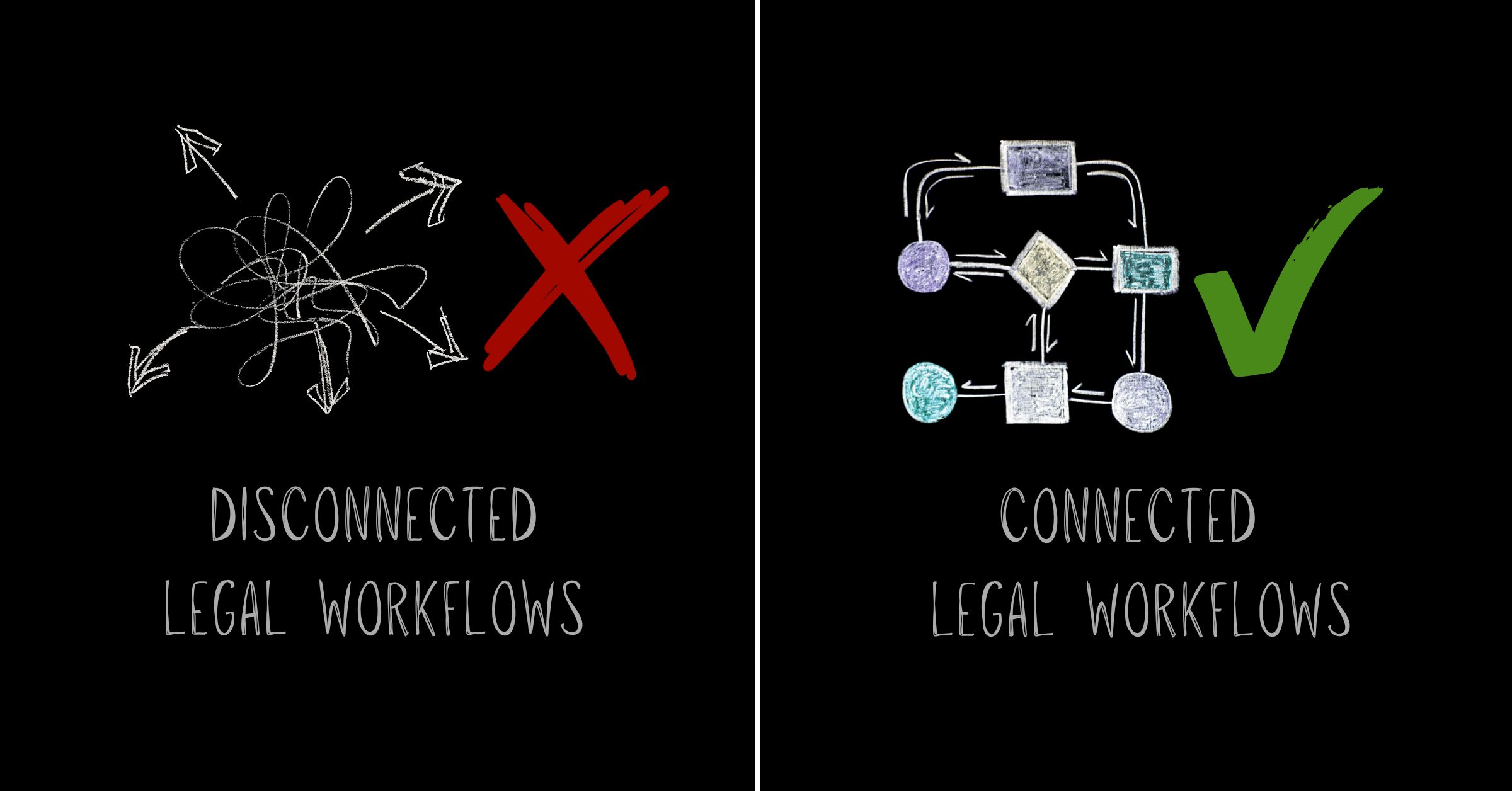
Spreadsheets break. Emails get buried. Approvals stall. For most Legal teams, these aren’t occasional problems, they’re the daily reality of working with disconnected legal workflows.
Legal departments manage more complexity than ever: outside counsel billing, contract lifecycles, matter tracking, vendor performance and compliance oversight. Yet many rely on fragmented tools that force teams to manually bridge gaps between intake, execution and reporting. The result isn’t just inefficiency. It’s operational friction that compounds over time, creating blind spots in spending, duplicated effort and missed opportunities to demonstrate value.
Disconnected legal workflows don’t just slow teams down. They undermine the strategic role Legal departments are expected to play.
When systems don’t talk, people fill the gaps
Manual work shows up everywhere when legal workflows operate in silos. Invoice data lives in one system. Matter details sit in spreadsheets. Contract approvals happen over email. Vendor performance exists only in someone’s memory.
Teams spend hours copying information between platforms, reconciling inconsistencies and chasing updates that should be automatic. Requests enter through intake, but the context doesn’t carry forward. Budget details require re-entry when opening a matter. Spend data demands manual exports to align with finance reports.
Industry benchmarks show Legal departments using disconnected tools waste 12-18% of their time on administrative rework. Skilled professionals do work that modern legal operations software should handle automatically.
Every handoff becomes a risk point without integration. Details get missed. Priorities shift without visibility. Manual intervention replaces status updates that should flow naturally through the workflow.

What are disconnected legal workflows?
Disconnected legal workflows occur when legal teams use separate systems for intake, matter management, spend tracking, contract management and reporting, forcing manual data transfer between each stage. This fragmentation prevents information from flowing automatically, creating gaps in visibility and requiring constant human intervention.
Visibility gaps create control problems
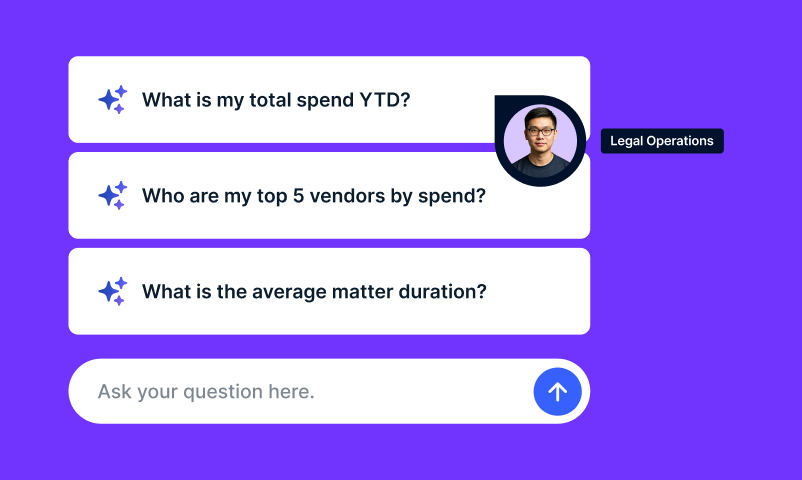
Real-time visibility becomes nearly impossible with disconnected workflows. When matter data, spend tracking and contract status live in separate systems, Legal leaders can’t answer basic questions without significant effort.
Which matters are trending over budget? What’s the current approval status across active contracts? How are vendors performing against billing guidelines? These questions should have instant answers. Manual reporting cycles deliver outdated information instead.
The 2025 Association of Corporate Counsel (ACC) Chief Legal Officer (CLO) Survey found that most Legal leaders now rely on technology and data for strategic decisions. But when legal workflows disconnect, that data either doesn’t exist or requires extensive manual work to compile.
Teams lose the ability to spot trends early without connected workflows. Cost overruns surface after damage occurs. Compliance gaps appear during audits instead of automated checks preventing them.
How do disconnected legal workflows affect legal operations?
Disconnected legal workflows force legal operations teams into reactive modes, spending valuable time on manual coordination instead of strategic planning. Billing data doesn’t connect to matter budgets, so invoice approvals slow down. Approval status remains invisible across departments, extending contract cycles. Performance metrics aren’t tracked in a unified system, turning vendor decisions into guesswork.
Fragmentation drives inconsistency
Manual processes breed variability. Enforcement becomes selective when billing guidelines aren’t embedded in review systems. Some invoices face scrutiny while others slip through. Over time, outside counsel learns which rules actually matter and which ones don’t.
Approval workflows suffer the same fate. Email-based routing means requests get handled differently depending on who’s available and what’s in their inbox. No standard path exists. No predictable timeline emerges. No reliable audit trail forms.
Inconsistency plagues matter management when teams track work across disconnected tools. One attorney uses a spreadsheet. Another relies on email folders. A third keeps notes in a document management system. Institutional knowledge disappears when someone leaves or workload shifts.
This fragmentation doesn’t just create inefficiency. It introduces risk. Missed deadlines, overlooked obligations and non-standard terms slip through because no single system provides comprehensive oversight.

Why do disconnected legal workflows persist?
Legacy systems built for single functions weren’t designed to work together. Many legal departments inherited point solutions purchased at different times by different stakeholders, each solving one problem but creating integration challenges. Technical debt, limited IT resources and fear of disruption keep teams locked into manual workarounds.
Data silos limit strategic impact
Legal departments face growing expectations to operate like other business functions: with clear metrics, predictable outcomes and evidence-based decision-making. Disconnected workflows make this nearly impossible.
Legal teams can’t analyze cost drivers by practice area, vendor or matter type when spend data lives separately from matter information. Reporting on cycle times requires manual reconstruction when contract metadata doesn’t connect to approval workflows.
Finance asks questions Legal can’t answer without days of data gathering. Leadership requests forecasts that require guesswork because historical patterns aren’t accessible. Business partners lose confidence because Legal can’t demonstrate the value being delivered.
Modern legal management software addresses this by creating a single source of truth. Matter details, spend tracking, vendor performance and contract status flow into one connected environment. Updates happen automatically. Reports reflect real-time data.

Integration eliminates redundant work
Copying data between systems ranks among the most expensive invisible tasks in legal operations. Every re-entry introduces error risk. Every manual update takes time away from strategic work.
Connected legal workflows solve this through integration. Information entered during intake flows directly into matter records. Invoice data syncs automatically with spend tracking. Contract approvals update status across all relevant dashboards without human intervention.
This approach does more than save time. It builds confidence in the data. When systems integrate, teams know that budget figures, matter status and vendor performance metrics are accurate because they come from the same operational record.
Collaboration with other departments improves through integration. Finance sees the same spend data Legal uses. Procurement accesses the same vendor insights. Compliance reviews the same contract terms.
How can legal teams fix disconnected legal workflows?
Fixing disconnected legal workflows requires unified legal operations software that connects intake, matter management, spend tracking and contract management in one platform. Teams should start by identifying where manual handoffs create the most friction, then prioritize integration points that deliver immediate visibility improvements.
Automation turns workflows into assets
Disconnected systems can’t support automation, so manual legal tasks persist. Invoice review stays manual when billing guidelines live in a document instead of being embedded in the approval process. Matter tracking stays manual when updates don’t trigger automatically based on workflow status.
AI-native legal operations platforms treat workflows as configurable assets. Billing rules become enforceable logic that flags violations before approval. Matter milestones become triggers that update status, notify stakeholders and generate reports without manual intervention.
According to Onit’s AI Center of Excellence research, AI-powered contract review using Large Language Models (LLMs) can complete tasks 70x faster than manual methods. But that speed only matters when the workflow connects. Manual handoffs erase efficiency gains if contract data doesn’t flow into matter records or spend tracking.
Exception-based review becomes possible through automation. Teams focus on flagged items that violate guidelines instead of checking every invoice line by line. Teams respond to alerts about delays or budget variances instead of tracking every matter update manually.
The strategic case for connected workflows
Legal departments can’t prove value when their operations remain invisible. Disconnected workflows keep legal work hidden from the metrics that matter to the business.
Connected legal workflows generate operational intelligence as a byproduct of daily work. Every invoice processed reveals spend patterns. Every matter tracked shows resource allocation. Every contract executed provides cycle time data.

This visibility transforms how Legal departments engage with leadership. Teams present data-backed analysis instead of defending budgets with anecdotal evidence. They offer predictive insights instead of reactive explanations about overspend. And teams show objective metrics about capacity and efficiency instead of justifying headcount requests through workload claims.
The shift from disconnected tools to unified legal operations isn’t just a technology upgrade. It’s a strategic repositioning of Legal as a data-driven business partner.
Making the move from chaos to clarity
Disconnected workflows don’t fix themselves. They worsen as Legal departments take on more complexity, adopt more tools and face higher expectations from the business.
Understanding where disconnection creates the most friction starts the move to connected legal workflows. Does it occur between intake and matter management? Between spend tracking and vendor oversight? Between contract execution and compliance reporting? Identifying the highest-cost gaps helps prioritize where integration delivers immediate value.
Modern legal operations platforms eliminate these gaps by design. They connect intake to execution, matters to spend, contracts to compliance and operations to insight, all within a single environment designed for how Legal teams actually work.
Legal teams don’t need more tools. They need their tools to work together.
Explore our comprehensive guide if you’re ready to escape disconnected legal workflows and start operating on your terms: Make Your Move: A Strategic Guide to Escaping the Manual Maze of Modern Legal Work. It outlines practical steps legal teams can take to reduce manual work, increase visibility, and build momentum without disruption.