

Tag: ai in legal

Why Matter Context in Legal AI Makes or Breaks AI Contract Review

contract review matter context

AI contract review tools promise speed, accuracy, and scale. Legal teams that deploy AI to extract clauses, flag risk, and accelerate review cycles quickly discover something uncomfortable: the output is only as useful as the context surrounding it. Matter context in legal AI is the critical factor that determines whether these tools deliver real value or simply create new blind spots.

Clause extraction is not contract intelligence. Contract intelligence, without integration into how your legal department actually manages matters, is not transformation. This is the gap that costs legal ops teams the most, not in licensing fees, but in blind spots that compound quietly across your portfolio.

What AI contract review actually does well

AI contract review tools have matured significantly. They can identify nonstandard clauses, compare language against playbooks, flag missing provisions, and surface obligations that require tracking. For high-volume, routine work such as NDAs, vendor agreements, and standard MSAs, they reduce review time and minimize the risk of human oversight fatigue.

Research from Onit’s AI Center of Excellence found that AI-powered contract review using Large Language Models can complete reviews 70x to 270x faster than human reviewers, with top models completing work in under 5 minutes compared to a junior lawyer’s average of 56 minutes. The cost differential is equally significant: AI models perform the same task for as little as $0.02 to $0.25 per contract, compared to roughly $74 for a junior lawyer. These are legitimate efficiency gains, and legal ops teams are right to pursue them.

But there is a ceiling to what clause-level AI can achieve when it operates in isolation.

manual review of contracts

The blind spot: Contracts without matter context

Every agreement is connected to a matter, a relationship, a business objective, and a risk profile that extends well beyond what lives in the four corners of the document. When AI review tools operate outside your enterprise legal management (ELM) platform, they analyze contracts without knowing:

  • Which matter the contract is associated with
  • What the current litigation or regulatory exposure looks like for that counterparty
  • How much spend has already been allocated to matters involving similar risk
  • Whether the same clause language has already triggered disputes elsewhere in your portfolio

Without that matter context in legal AI, the tool can tell you what a contract says. It cannot tell you what that contract means for your organization right now. The more contracts you process, the larger those blind spots become.

What is matter context in legal ai contract review?

Matter context refers to the legal, operational, and financial information associated with the matter a contract is connected to. This includes ongoing litigation, regulatory exposure, counterparty history, and related spend. AI tools that lack access to this context can only evaluate contracts in isolation, producing output that legal teams must then manually reconnect to what they already know.

That manual reconnection step is exactly the kind of friction that AI is supposed to eliminate. As Onit’s research into agentic AI in legal operations makes clear, the goal of AI is not to automate judgment away, but to ensure legal ops workflow management supports people in making decisions, not reconstructing information the system already has.

contract review with legal ai

Contract risk lives within the legal matter lifecycle

A limitation of liability clause carries low risk in a routine software agreement and high risk when the vendor is already the subject of a regulatory inquiry. An auto-renewal provision is an administrative nuisance in one context and a significant budget exposure in another.

Contract risk does not sit in the contract alone. It sits within the legal matter lifecycle, the full arc of activity that begins before a contract is signed. It continues through disputes, renewals, audits, and eventual termination. When your AI review tool is disconnected from that lifecycle, it flags risk in the abstract.

Integrating contract review into your ELM system means AI-identified risks can be evaluated against live matter data, automatically, at the point of review, not after the fact.

Why AI contract review fails without ELM integration

Without enterprise legal management integration, AI review tools operate without visibility into the broader matter lifecycle. Risk flags cannot be evaluated against live data. Legal teams lose the ability to correlate contract exposure with matter spend, a critical gap for departments managing large portfolios.

This is a problem that shows up consistently in disconnected legal tech stacks. When legal software becomes yet another system to navigate rather than a tool that supports how your team works, it slows you down. AI contract review without ELM integration is a version of that same problem, more sophisticated in its surface-level output, but equally limited in its strategic usefulness.

How to correlate contract exposure and matter spend

One of the most practical arguments for connected contract review is the ability to correlate contract exposure and matter spend. Consider what becomes possible when AI contract review is integrated with your matter management system:

  • Spend visibility: You can see, in aggregate, how much your department is spending on matters connected to contracts with high-risk clause profiles. This turns contract risk from a legal abstraction into a quantifiable budget factor.
  • Pattern recognition: If certain contract types, counterparty categories, or clause variations consistently generate disputes or cost overruns, that pattern becomes visible across your portfolio. Standalone AI review cannot surface this because it lacks the historical matter data needed to identify it.
  • Proactive risk management: When a new contract comes in for review, your team can see whether similar agreements have generated matters in the past and at what cost. That context changes how you negotiate, what you escalate, and where you invest review time.
  • Budget forecasting: Legal departments under pressure to demonstrate ROI need more than efficiency metrics. Correlating contract exposure to matter spend gives you the data to show leadership how contract quality directly affects legal costs.

This kind of analysis is only possible when your contract review tools and your ELM platform share data. Without integration, you are producing two separate records that your team has to reconcile manually. This is precisely the kind of manual legal task teams need to stop doing.

Why AI authority in legal requires connected systems

Authority comes from usefulness. An AI system earns trust when its outputs reliably improve decisions, not just when it processes documents quickly. For legal ops professionals, that means AI needs to operate within the systems and workflows where decisions are actually made.

A standalone AI contract review tool is a productivity layer. An AI system integrated into your matter management, contract lifecycle, and spend analysis workflows is infrastructure. The difference is not incremental. It is the difference between automation and insight. As noted in Onit’s research on AI in legal operations, high-performing teams are not just purchasing AI tools. They are building new ways of working, with connected data at the foundation.

The question is not only “what can this tool find?” It is “what can this tool tell us, given everything else we know?”

ai in legal

Building toward connected contract intelligence

Abandoning AI contract review is not the answer. The efficiency benefits are too significant to ignore. The goal is to close the gap between what AI extracts and what your team actually needs to know.

Prioritizing integration between your contract review tools and your ELM system is the first step. Building workflows that carry matter context in legal AI into the review process, rather than importing extracted data after the fact, is the second. Using that connected data to drive contract exposure and matter spend correlation is what makes legal operations genuinely strategic.

Start by auditing where your current AI tools output data and where that data goes next. If the answer is a spreadsheet or back to the attorney, you have an integration gap that is limiting your return on investment. Connected contract intelligence is not a future state. Legal departments are building it now, and the operational and financial advantages are measurable.

Where to go next

Legal ops teams managing large contract portfolios often miss the early signals of rising costs. Until they show up in a budget review. The Legal Spend Spiral guide walks through the three stages of spend escalation, the patterns most teams overlook, and how matter context connects directly to catching cost drift before it compounds. It is a practical read for any team trying to build earlier visibility into contract-related spend.

For teams who want to see how AI is being applied to legal spend management in practice, the AI legal spend review on-demand webinar is a useful next step. It covers how connected AI systems, rather than standalone tools, are what allow legal departments to move from reactive reporting to genuinely strategic spend management. Which is exactly the shift this blog has been building toward.


Lessons from a Legalweek conversation with Legal Ops leaders

legalweek converation

Innovation Is Easy. Execution Is Hard. 

Legal departments have never had more technology available to them. 

AI tools. Workflow automation. Advanced analytics. Unified legal platforms. 

And yet transformation still stalls. 

At Legalweek, Onit’s Jeffrey Solomon sat down with two legal operations leaders who know this problem well: 

Jasmine Sims, VP, Global Legal Ops at IBM  

Kim Wolfe, Senior Vice President – CAO for Legal and Head of Legal Operations, Contracts, and Innovation at State Street

The conversation wasn’t about the next tool. It was about something harder: executing innovation. 

The Problem Isn’t Technology 

Legal teams are investing heavily in systems designed to modernize operations, but many of those initiatives struggle to gain traction. 

  • Adoption slows. 
  • Workflows revert to old habits. 
  • The new platform becomes another system people work around. 

Not because the technology is flawed. Because the organization wasn’t ready. 

As the panel made clear, the biggest barrier to transformation in legal operations is rarely technical- it’s operational. 

legal operations

The Leaders Who Succeed Ask Different Questions 

Most teams begin transformation the same way. “What technology should we buy?” 

But the most effective legal ops leaders start somewhere else. They ask: “Is our organization ready to use it?” 

That question changes everything. It forces leaders to understand: 

  • Where work breaks down. 
  • Where decisions slow down. 
  • Where legal and the business fall out of sync. 

Before any automation happens or any platform goes live. 

Start With Listening 

Kim Wolfe explained that transformation in legal operations begins with understanding people. Every legal organization is different. 

Different GCs. Different priorities. Different risk tolerances. 

Solutions built without that context rarely stick. The work starts with listening. 

  • Where are the real friction points? 
  • Where does legal spend too much time? 
  • Where do business partners feel the pain? 

Only once those answers are clear does technology become useful. 

Fix the Process Before the Platform 

Another mistake legal teams often make: automating a broken process

Jasmine Sims put it plainly during the discussion. 

When budgets are tight, the fastest way to unlock technology investment is to fix inefficient processes first. 

Because good technology cannot repair a bad process. 

Legal ops leaders who understand this sequence focus on operational clarity first. Then they automate. 

Where AI Actually Helps 

There’s another assumption that slows progress in legal departments. That AI will replace lawyers. 

It won’t. 

The legal profession runs on judgment. 

Lawyers interpret context. Assess risk. Make decisions with accountability. 

AI does something different. It removes the low-judgment work. 

  • Reviewing standard clauses. 
  • Scanning large contract portfolios. 
  • Identifying patterns across thousands of documents. 

That’s where AI shines. Humans define the decisions, AI helps them get there faster while still allowing them the oversight that keeps them comfortable. 

Build the Foundation First 

The biggest takeaway from the Legalweek conversation was simple. 

The organizations that benefit most from AI will not be the ones that deploy it first, they will be the ones that prepare for it. 

That preparation looks like operational maturity: 

  • Asking better questions about processes and workflows. 
  • Governing how decisions are executed. 
  • Automating the work that slows teams down. 

When those elements come together, legal operations stops being a reporting function and becomes something more powerful – a system of execution. 

And that’s where real transformation begins. 

Why Legal Departments Keep Losing Control of Spend, Contracts, and Workflows

Legal departments losing control of spend, contracts,

Legal departments are being asked to do more with less. More contracts, tighter budgets, shorter timelines, and yet the tools many teams rely on were not built to handle that kind of pressure. The result is legal departments that spend more time maintaining systems than running them.

This is not a technology problem. It is a structural one. And it shows up in predictable ways: invoices reviewed line by line, contracts tracked in spreadsheets, approvals chased over email, and intake requests arriving through every channel except a standardized one. Each of these habits looks manageable in isolation. Together, they add up to a legal department that is constantly reacting instead of planning.

The cost of disconnected work

When legal workflows are fragmented, small gaps compound quickly. Requests get approved without a clear understanding of downstream effort. Matters start without budgets or timelines attached. Spend issues surface late because intake context never carried forward. Contracts stall because urgency or ownership was never clear. Reporting becomes reactive because intake data never became part of the operational record.

What teams experience as chaos is really disconnected workflow management showing up early. The fix is not adding more structure to intake. It is connecting intake to everything that follows: matters, spend tracking, contract workflows, and reporting. When that connection exists, context moves with the work. Status updates happen automatically as tasks progress. Visibility improves before bottlenecks form.

The spend problem nobody talks about early enough

Legal spend spikes rarely happen suddenly. They are the result of unnoticed, compounding signals that accumulate over time. By the time leadership is asking questions, the spiral is already in motion.

The early stages often look like stability. Budgets seem intact. Teams feel busy but not alarmed. The signals are subtle:

  • Outside counsel rates increasing through one-off exceptions that quietly become routine
  • Matter scoping done at a high level to avoid slowing intake
  • Intake volume growing without clarity on complexity or downstream costs

As pressure mounts, teams respond by adding structure: more invoice review steps, more approval layers, more reporting. On the surface, this creates a sense of control. In practice, it often shifts effort without improving visibility. Legal teams end up spending more time on line-item reviews than on analyzing patterns. ELM systems function as repositories rather than sources of insight.

disconnected legal workflows

By the time leadership and finance are asking hard questions, the focus shifts from understanding to urgency. The underlying issues developed over months. The response is expected in days.

Recognizing the spiral early requires more than manual reviews or dashboards. It requires connecting intake, matters, and invoices so that cost drivers are visible before work begins, and so that behavior patterns can be identified before they become habits. Onit’s Legal Spend Spiral Guide breaks down exactly how this drift happens and what early signals to watch for.

Invoice review is not a strategy for modern legal departments

Manual invoice review is one of the most persistent drains in legal operations. A junior lawyer averages around $74 per contract review. The process is slow, inconsistent, and prone to missing issues that repeat across matters.

Beyond cost, manual review creates compliance risk. Billing guidelines only work when applied consistently. When enforcement happens after the fact, it leads to disputes, write-offs, and uneven application. Over time, firms learn where guidelines bend, which undermines both cost control and credibility.

Automated systems flag violations before they reach a reviewer’s desk. Billing rules applied proactively shift conversations with outside counsel away from retroactive corrections and toward shared expectations. That shift matters. It reduces friction, improves compliance, and eliminates recurring manual cleanup.

Legal eBilling is not just about paying invoices faster. It is about gaining the clarity and control that makes smarter decisions possible. With clean, reliable data, legal departments can forecast budgets, monitor trends, and show measurable value to the business. Legal ops teams that adopt eBilling typically see faster invoice turnaround, fewer disputes, and greater alignment with finance.

Contract management that actually moves the business

Contracts fuel both revenue and risk. According to the World Commerce & Contracting organization, effective contract management can boost a company’s profitability by up to 9% of its annual revenue. Without a structured system, cycle times drag, obligations get missed, and opportunities slip away. The five most common signs a company needs a better approach to contract management are:

  • Inability to make changes: Processes and technologies that cannot accommodate renewal data, pricing changes, and evolving legal requirements create compounding risk over time.
  • Information silos and manual processes: A lack of a centralized, accessible location for contract information that tracks changes in real time leads to human error, bottlenecked contract cycles, and limited process control.
  • Inconsistent legal language: Gaps in standardized language introduce risk and confusion. If contracts consistently have language consistency issues, the door opens to unexpected legal challenges.
  • Struggles between timeliness and risk: Legal teams prefer to review contracts thoroughly. Sales teams need to close deals quickly. When that friction becomes chronic, it signals a need for better contract management processes.
  • Lack of insight into contract processes and variables: When Legal does not have visibility into contract terms, obligations, and value, it cannot ensure the business is getting the right value for deals.

Effective contract lifecycle management (CLM) addresses all five of these gaps. It captures key metadata, enforces approvals, and maintains audit-ready records so teams can spot and address risks before they escalate. Intelligent alerts and obligation tracking help teams stay ahead of critical dates, reducing revenue leakage and strengthening supplier and customer relationships.

The seven stages of a sound CLM process are:

  1. Planning
  2. Implementation
  3. Pre-contract
  4. Handover
  5. Contract
  6. Pre-renewal
  7. Post-contract
contract bottlenecks for legal departments

Each stage carries distinct risks when managed manually. The pre-renewal stage is particularly high-stakes. Missed renewals, overlooked obligations, and renegotiation opportunities lost to inattention all have real financial consequences.

AI has a role, but it starts with people and data

AI is changing how legal work gets done, but the teams that see the most benefit are not the ones that deployed the most tools. They are the ones that prepared their data, aligned their teams, and chose the right problems to solve first.

Research from Onit’s AI Center of Excellence found that large language models are now performing contract reviews with a level of precision that rivals professional legal service providers. The speed gap is significant:

  • Junior lawyers: approximately 56 minutes per contract
  • LPOs: approximately 201 minutes per contract
  • GPT-4: approximately 4.7 minutes per contract
  • Claude 2.0: approximately 1.63 minutes per contract

The cost difference is equally striking. A junior lawyer averages around $74 per contract. Top LLMs perform the same task for between $0.02 and $0.25.

This is not an argument for removing humans from the process. It is an argument for using AI to handle repetitive work so that legal professionals can focus on exception handling, negotiation, and strategic analysis. When AI handles the tedious, humans can lead with insight and creativity.

Generative AI also addresses the bottleneck in contract management by automating drafting and review processes. It can flag non-compliant clauses, propose alternative wording, and reduce the time needed for contract approvals by up to 70%. For legal departments managing large volumes of work, that kind of capacity shift is meaningful.

But AI relies on data that is clean, structured, and accessible. Without it, models return unreliable results and adoption stalls. The most effective teams embed data governance into their operations, assign owners to critical data sets, and create rules that keep information accurate as new matters, vendors, and invoices enter the system. For a practical framework on where to begin, the AI Legal Ops Playbook offers a useful starting point for teams ready to move from experimentation to execution.

What the right tech stack actually needs to do

Legal operations tools that claim AI functionality need to do more than generate summaries. They should automate approval workflows, intelligently triage legal intake, and reduce manual touchpoints. The best AI does not just respond. It anticipates and learns. It works in the background to keep things moving so your team can focus on legal strategy, not software management.

legal tech stack

Beyond AI, the four functions that matter most in a modern legal operations platform are:

  • Spend management and invoicing: Tracking spend is not enough. Tools should help control it by flagging billing violations before they reach a reviewer’s desk and surfacing which vendors are overspending.
  • Automated workflow: The right workflow engine centralizes intake, automatically assigns tasks based on priority or matter type, and gives full visibility into what is moving and what is stuck.
  • Analytics built for legal ops: Reporting should take a few clicks, not days. A legal operations platform should give real-time visibility into the health of matters, spend, vendor performance, and internal resourcing.
  • Integration with existing systems: Legal systems should operate as part of a connected environment. Matter, spend, and vendor data should flow automatically across legal and finance without re-entry or reconciliation.

When these functions work together, legal departments stop reacting and start planning. Visibility improves without additional reporting effort. Work moves faster without sacrificing control.

The real question for legal departments

Legal departments that can demonstrate the value of their operations with accurate data shift conversations with finance from cost justification to opportunity identification. The teams that get there are not the ones with the most tools. They are the ones that made deliberate choices about where to start, what to fix, and how to keep momentum going.

If your current processes are costing more time than they save, that is your signal. Download the Legal Spend Spiral guide to learn how to identify the early warning signs of rising legal costs and break the spiral before it becomes a budget conversation you are not prepared for.

Join the conversation

The OnPoint community is where legal ops professionals connect, share what is working, and build the skills to lead through change. If you are looking to sharpen your AI fluency, the community’s AI literacy resources are a strong place to start. Come find your people.

Contract Bottlenecks: Early Warning Signs of Deeper Operational Risk

contract bottlenecks early warning signs

Contract bottlenecks signal more than scheduling conflicts. They expose systemic problems that quietly undermine legal operations, business velocity and strategic decision-making.

Most legal departments measure contract cycle time as a performance metric. Fewer treat it as a diagnostic tool. When contracts stall repeatedly, the issue extends beyond individual agreements. Bottlenecks point to fragmented workflows, missing data, manual handoffs, and disconnected systems that compound over time.

Contracts don’t just slow business down. They reveal exactly where legal operations break.

Where contract bottlenecks actually start

Delays rarely begin at the negotiation table. They start earlier, during intake, routing and initial review. Requests arrive through email, chat or informal channels without essential context. Legal teams spend days gathering information that should have been captured upfront.

Without structured intake, contracts enter the queue incomplete. Missing details force multiple rounds of clarification. Business partners grow frustrated. Legal teams lose time they could spend on substantive review.

Manual routing creates the next layer of delay. Teams forward agreements based on availability rather than expertise. Contracts land with the wrong reviewer, requiring reassignment and starting the cycle over. No one has visibility into who’s handling what or where approvals stand.

These early-stage problems multiply downstream. By the time a contract reaches negotiation, it’s already behind schedule. The perception becomes that Legal slows deals down. The reality is that broken intake and routing processes create the friction.

Disconnected systems hide operational problems

Contract management tools often operate in isolation from other legal systems. Contract data lives in one platform. Matter information sits in another. Spend tracking exists somewhere else. Business context remains trapped in email threads.

This fragmentation forces manual work at every handoff. Contract details require re-entry when creating matter records. Budget information needs separate input even though the contract already specifies terms. Vendor performance data doesn’t connect to contract execution, so evaluation happens from memory instead of evidence.

Legal teams spend hours reconstructing information that should flow automatically. Every manual transfer introduces error risk and every disconnected system creates a gap in visibility.

When contracts stall because information doesn’t move with the work, the problem isn’t capacity. It’s infrastructure. More headcount won’t solve what broken systems create.

manual contract approvals

Manual approvals become invisible chokepoints

Email-based approval workflows turn contracts into black boxes. Stakeholders send agreements into inboxes and wait. No one knows whether the contract is under review, stuck in someone’s queue, or lost entirely.

Requests sit unanswered not because people ignore them, but because they disappear into crowded inboxes. Urgent contracts look identical to routine ones. Business partners resort to follow-up messages, phone calls and hallway conversations just to determine status.

Manual routing creates inconsistency. Some contracts move quickly because the right person happened to be available. Others languish because someone is traveling, overloaded, or unaware the request exists. No standard path means no predictable timeline.

This opacity damages credibility. Legal appears unresponsive even when teams work constantly. Business partners lose trust not because Legal fails to deliver, but because they can’t see progress or predict outcomes.

Centralized approval workflows replace guesswork with structure. Requests route automatically based on contract type, risk level or business unit. Status updates happen in real time. Stakeholders see exactly where agreements stand without asking.

Budget surprises trace back to contract bottlenecks and disconnect

Contracts define financial commitments, yet those commitments often fail to connect with spend management systems. Legal teams approve agreements without visibility into how terms will affect budgets. Outside counsel begins work before matter costs are tracked. Invoice review happens separately from the contracts that authorized the work.

This disconnect creates retroactive problems. Spend appears unexpectedly because contract terms weren’t captured in matter records. Budget forecasts miss the mark because commitment data lives in isolated systems. Finance asks questions Legal can’t answer without manually reconstructing contract details.

When contract management operates separately from spend tracking, teams lose the ability to enforce billing guidelines proactively. Approved rates don’t flow into invoice review. Scope definitions don’t connect to matter budgets. Compliance becomes reactive instead of preventative.

Contract lifecycle management platforms address this by connecting execution to downstream operations. Contract terms populate matter records automatically. Budget data flows into spend tracking without re-entry. Vendor commitments link directly to invoice review processes.

This integration doesn’t just prevent errors. It creates operational intelligence. Teams can analyze spending by contract type, vendor or business unit. They can forecast based on actual commitments rather than estimates. They can demonstrate value through data that already exists in their daily work.

Missing data turns contract review into archaeological work

Contract review slows dramatically when historical context doesn’t exist. Legal teams face new agreements without access to previous versions, negotiated positions, or vendor performance. Every review starts from scratch because institutional knowledge lives in individual memory rather than connected systems.

Teams spend time searching for information that should be instantly available. What terms did we accept last time? How did this vendor perform? What risks did we identify during prior negotiations? These questions require digging through email archives, old documents, or asking colleagues who might remember.

This inefficiency compounds when personnel change. When someone leaves or shifts roles, their knowledge disappears with them. New team members start with no baseline, repeating research and analysis that’s already been done.

Modern contract repositories solve this by making data searchable and connected. Previous agreements with the same vendor surface automatically. Risk flags from earlier reviews carry forward. Performance data informs current decisions without requiring manual lookup.

Contracts move faster when context moves with them. Teams review with confidence because relevant history is accessible. Negotiation positions stay consistent because past decisions inform current ones. Risk assessment improves because patterns become visible across agreements.

contract bottlenecks and budget data

Compliance gaps emerge from siloed contract data

Contract obligations often fail to connect with compliance monitoring systems. Renewal dates, delivery commitments, and performance requirements live in contracts but don’t trigger proactive oversight. Legal teams discover missed deadlines after they occur rather than receiving advance warning.

Manual tracking of contract obligations doesn’t scale. Spreadsheets require constant updates. Calendars depend on someone remembering to check them. Important dates slip through when workload increases or attention shifts elsewhere.

This reactive approach creates unnecessary risk. Automatic renewals occur without review. Contractual deadlines pass without delivery. Performance commitments go unmonitored until problems surface.

Automated compliance tracking changes this by treating contract data as operational triggers. Renewal dates generate alerts weeks before action is required. Delivery commitments populate task lists automatically. Performance requirements connect to vendor scorecards without manual input.

This shift from reactive to proactive compliance reduces risk while eliminating busywork. Teams focus on addressing obligations rather than tracking them. Business partners gain confidence that commitments will be met. Audits become simpler because oversight is systematic rather than ad hoc.

Contract velocity reflects operational health

Contract cycle time serves as a proxy for how well legal operations function overall. Fast contract execution doesn’t just mean efficient negotiations. It indicates properly structured intake, connected systems, clear workflows, and accessible data.

When contracts consistently stall, the underlying issues extend beyond contract management. Bottlenecks signal fragmented tools, manual handoffs, missing integration, and insufficient visibility. These problems affect everything legal teams do, from matter management to spend control to compliance oversight.

Addressing contract bottlenecks and other issues requires looking beyond individual agreements to the systems that support them. Quick fixes like additional reviewers or escalation processes treat symptoms rather than causes. Sustainable improvement comes from connecting workflows, automating routine tasks and ensuring information flows with the work.

Modern legal operations platforms approach contract management as part of a unified system. Intake connects to execution. Execution connects to matter management. Matter management connects to spend tracking. Spend tracking connects to vendor oversight. All of it flows into reporting without requiring manual compilation.

This integration doesn’t just speed contracts. It creates the foundation for legal departments to operate strategically. Teams gain visibility into workload and capacity. They can forecast accurately because commitments are tracked systematically. They demonstrate value through metrics that reflect actual operations rather than anecdotal evidence.

operational efficiency by eliminating contract bottlenecks

Moving from reactive to strategic

Contract bottlenecks don’t fix themselves. They worsen as legal departments handle more complexity, adopt more tools and face higher expectations from business partners. Treating delays as individual problems rather than systemic signals allows operational gaps to widen.

Legal teams need to examine where contracts stall most consistently. Does it happen during intake when information is missing? During routing when no one knows who should review? During approval when visibility disappears? During compliance when obligations aren’t tracked?

Identifying the highest-cost bottlenecks helps prioritize where changes deliver immediate impact. Structured intake eliminates early delays. Automated routing ensures contracts reach the right reviewer immediately. Centralized workflows provide visibility throughout the process. Integrated systems carry contract data forward without manual transfer.

Contract management isn’t separate from legal operations. It’s a window into how well legal operations work. Teams that treat contract velocity as a diagnostic tool gain insight into where their infrastructure needs strengthening. They move from reacting to problems toward preventing them systematically.

Eliminating contract bottlenecks requires more than process improvement. It demands connected systems that support how legal teams actually work. When intake flows into execution, execution flows into matter management, and matter management flows into spend control, contracts stop stalling. Work moves predictably. Data stays accurate. Legal operates strategically rather than reactively.

Addressing contract bottlenecks through connected operations

If your team is ready to address the systemic issues behind contract bottlenecks and delays, explore our comprehensive guide: Make Your Move: A Strategic Guide to Escaping the Manual Maze of Modern Legal Work. It outlines practical steps legal departments can take to reduce manual work, increase visibility, and build connected operations that support business velocity.

For teams specifically looking to accelerate contract review cycles, our research Better Call GPT: Can AI Contract Review Outlaw the Traditional Legal Reviewer? demonstrates how AI-powered contract review delivers 70x-270x faster turnaround times while improving accuracy. The findings reveal how legal departments can eliminate review bottlenecks that compound operational delays across the entire contracting process.

The Hidden Cost of Disconnected Legal Workflows

Hidden costs of disconnected legal workflows

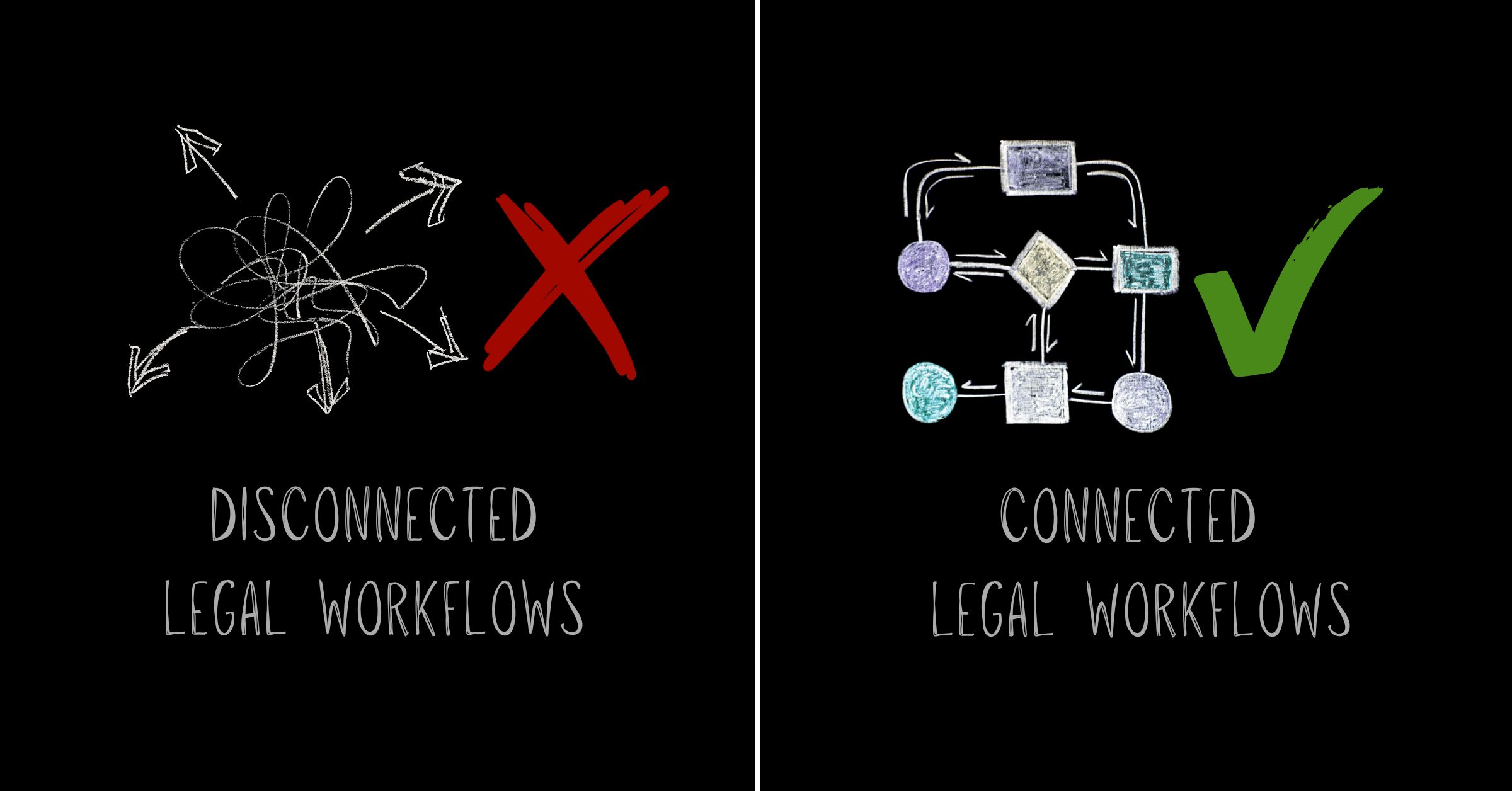
Spreadsheets break. Emails get buried. Approvals stall. For most Legal teams, these aren’t occasional problems, they’re the daily reality of working with disconnected legal workflows.

Legal departments manage more complexity than ever: outside counsel billing, contract lifecycles, matter tracking, vendor performance and compliance oversight. Yet many rely on fragmented tools that force teams to manually bridge gaps between intake, execution and reporting. The result isn’t just inefficiency. It’s operational friction that compounds over time, creating blind spots in spending, duplicated effort and missed opportunities to demonstrate value.

Disconnected legal workflows don’t just slow teams down. They undermine the strategic role Legal departments are expected to play.

When systems don’t talk, people fill the gaps

Manual work shows up everywhere when legal workflows operate in silos. Invoice data lives in one system. Matter details sit in spreadsheets. Contract approvals happen over email. Vendor performance exists only in someone’s memory.

Teams spend hours copying information between platforms, reconciling inconsistencies and chasing updates that should be automatic. Requests enter through intake, but the context doesn’t carry forward. Budget details require re-entry when opening a matter. Spend data demands manual exports to align with finance reports.

Industry benchmarks show Legal departments using disconnected tools waste 12-18% of their time on administrative rework. Skilled professionals do work that modern legal operations software should handle automatically.

Every handoff becomes a risk point without integration. Details get missed. Priorities shift without visibility. Manual intervention replaces status updates that should flow naturally through the workflow.

workflows and manual checklists for legal ops teams

What are disconnected legal workflows?

Disconnected legal workflows occur when legal teams use separate systems for intake, matter management, spend tracking, contract management and reporting, forcing manual data transfer between each stage. This fragmentation prevents information from flowing automatically, creating gaps in visibility and requiring constant human intervention.

Visibility gaps create control problems

Real-time visibility becomes nearly impossible with disconnected workflows. When matter data, spend tracking and contract status live in separate systems, Legal leaders can’t answer basic questions without significant effort.

Which matters are trending over budget? What’s the current approval status across active contracts? How are vendors performing against billing guidelines? These questions should have instant answers. Manual reporting cycles deliver outdated information instead.

The 2025 Association of Corporate Counsel (ACC) Chief Legal Officer (CLO) Survey found that most Legal leaders now rely on technology and data for strategic decisions. But when legal workflows disconnect, that data either doesn’t exist or requires extensive manual work to compile.

Teams lose the ability to spot trends early without connected workflows. Cost overruns surface after damage occurs. Compliance gaps appear during audits instead of automated checks preventing them.

How do disconnected legal workflows affect legal operations?

Disconnected legal workflows force legal operations teams into reactive modes, spending valuable time on manual coordination instead of strategic planning. Billing data doesn’t connect to matter budgets, so invoice approvals slow down. Approval status remains invisible across departments, extending contract cycles. Performance metrics aren’t tracked in a unified system, turning vendor decisions into guesswork.

Fragmentation drives inconsistency

Manual processes breed variability. Enforcement becomes selective when billing guidelines aren’t embedded in review systems. Some invoices face scrutiny while others slip through. Over time, outside counsel learns which rules actually matter and which ones don’t.

Approval workflows suffer the same fate. Email-based routing means requests get handled differently depending on who’s available and what’s in their inbox. No standard path exists. No predictable timeline emerges. No reliable audit trail forms.

Inconsistency plagues matter management when teams track work across disconnected tools. One attorney uses a spreadsheet. Another relies on email folders. A third keeps notes in a document management system. Institutional knowledge disappears when someone leaves or workload shifts.

This fragmentation doesn’t just create inefficiency. It introduces risk. Missed deadlines, overlooked obligations and non-standard terms slip through because no single system provides comprehensive oversight.

legal workflows and automation - less manual work

Why do disconnected legal workflows persist?

Legacy systems built for single functions weren’t designed to work together. Many legal departments inherited point solutions purchased at different times by different stakeholders, each solving one problem but creating integration challenges. Technical debt, limited IT resources and fear of disruption keep teams locked into manual workarounds.

Data silos limit strategic impact

Legal departments face growing expectations to operate like other business functions: with clear metrics, predictable outcomes and evidence-based decision-making. Disconnected workflows make this nearly impossible.

Legal teams can’t analyze cost drivers by practice area, vendor or matter type when spend data lives separately from matter information. Reporting on cycle times requires manual reconstruction when contract metadata doesn’t connect to approval workflows.

Finance asks questions Legal can’t answer without days of data gathering. Leadership requests forecasts that require guesswork because historical patterns aren’t accessible. Business partners lose confidence because Legal can’t demonstrate the value being delivered.

Modern legal management software addresses this by creating a single source of truth. Matter details, spend tracking, vendor performance and contract status flow into one connected environment. Updates happen automatically. Reports reflect real-time data.

legal finance reporting and data

Integration eliminates redundant work

Copying data between systems ranks among the most expensive invisible tasks in legal operations. Every re-entry introduces error risk. Every manual update takes time away from strategic work.

Connected legal workflows solve this through integration. Information entered during intake flows directly into matter records. Invoice data syncs automatically with spend tracking. Contract approvals update status across all relevant dashboards without human intervention.

This approach does more than save time. It builds confidence in the data. When systems integrate, teams know that budget figures, matter status and vendor performance metrics are accurate because they come from the same operational record.

Collaboration with other departments improves through integration. Finance sees the same spend data Legal uses. Procurement accesses the same vendor insights. Compliance reviews the same contract terms.

How can legal teams fix disconnected legal workflows?

Fixing disconnected legal workflows requires unified legal operations software that connects intake, matter management, spend tracking and contract management in one platform. Teams should start by identifying where manual handoffs create the most friction, then prioritize integration points that deliver immediate visibility improvements.

Automation turns workflows into assets

Disconnected systems can’t support automation, so manual legal tasks persist. Invoice review stays manual when billing guidelines live in a document instead of being embedded in the approval process. Matter tracking stays manual when updates don’t trigger automatically based on workflow status.

AI-native legal operations platforms treat workflows as configurable assets. Billing rules become enforceable logic that flags violations before approval. Matter milestones become triggers that update status, notify stakeholders and generate reports without manual intervention.

According to Onit’s AI Center of Excellence research, AI-powered contract review using Large Language Models (LLMs) can complete tasks 70x faster than manual methods. But that speed only matters when the workflow connects. Manual handoffs erase efficiency gains if contract data doesn’t flow into matter records or spend tracking.

Exception-based review becomes possible through automation. Teams focus on flagged items that violate guidelines instead of checking every invoice line by line. Teams respond to alerts about delays or budget variances instead of tracking every matter update manually.

The strategic case for connected workflows

Legal departments can’t prove value when their operations remain invisible. Disconnected workflows keep legal work hidden from the metrics that matter to the business.

Connected legal workflows generate operational intelligence as a byproduct of daily work. Every invoice processed reveals spend patterns. Every matter tracked shows resource allocation. Every contract executed provides cycle time data.

legal contract review and contract management

This visibility transforms how Legal departments engage with leadership. Teams present data-backed analysis instead of defending budgets with anecdotal evidence. They offer predictive insights instead of reactive explanations about overspend. And teams show objective metrics about capacity and efficiency instead of justifying headcount requests through workload claims.

The shift from disconnected tools to unified legal operations isn’t just a technology upgrade. It’s a strategic repositioning of Legal as a data-driven business partner.

Making the move from chaos to clarity

Disconnected workflows don’t fix themselves. They worsen as Legal departments take on more complexity, adopt more tools and face higher expectations from the business.

Understanding where disconnection creates the most friction starts the move to connected legal workflows. Does it occur between intake and matter management? Between spend tracking and vendor oversight? Between contract execution and compliance reporting? Identifying the highest-cost gaps helps prioritize where integration delivers immediate value.

Modern legal operations platforms eliminate these gaps by design. They connect intake to execution, matters to spend, contracts to compliance and operations to insight, all within a single environment designed for how Legal teams actually work.

Legal teams don’t need more tools. They need their tools to work together.

Explore our comprehensive guide if you’re ready to escape disconnected legal workflows and start operating on your terms: Make Your Move: A Strategic Guide to Escaping the Manual Maze of Modern Legal Work. It outlines practical steps legal teams can take to reduce manual work, increase visibility, and build momentum without disruption.

9 Manual Legal Tasks Your Team Needs to Stop Doing Immediately

9 Manual Legal Tasks Stop Doing

Manual legal tasks slow teams down and quietly cap their potential. Legal departments are handling more matters, more invoices, and more scrutiny than ever before, all while being asked to do more with the same resources.

And yet, a surprising amount of legal work is still done by hand.

Not because legal teams don’t know better. But because manual processes tend to stick around long after they stop serving anyone. They feel familiar. They feel manageable. Until volume increases and the cracks start to show.

The result is slower workflows, frustrated professionals, and hours lost to manual legal tasks that technology could handle in minutes.

The teams moving ahead are not working longer hours. They are deliberately shedding the manual work that no longer makes sense. If your team is serious about scaling smarter, these are the manual legal tasks you need to stop doing now, and what to replace them with.

1. Reviewing invoices line by line

If invoice review still means scrolling through PDFs and eyeballing every line item, you have a scalability problem.

Manual invoice review is slow, inconsistent, and heavily dependent on individual judgment. Even experienced reviewers miss issues as volume grows. Over time, this leads to uneven enforcement, missed savings, and unnecessary friction with finance and outside counsel.

What to do instead: Move to exception-based review

Modern legal operations shift routine enforcement to systems and reserve human judgment for true exceptions. Policy-driven compliance checks can automatically surface billing guideline violations, duplicate charges, and unusual patterns before an invoice is approved.

This ensures consistent enforcement across every invoice while allowing reviewers to focus on decisions that actually require context. The result is faster review cycles, clearer insight into spend behavior, and less time lost to repetitive validation.

2. Tracking matters in spreadsheets

Spreadsheets feel flexible until they become fragile.

Manual matter tracking quickly leads to version control issues, missing information, and limited visibility. As matter volume grows, spreadsheets stop functioning as a source of truth and start introducing operational risk.

What to do instead: Create a connected system of record

Matter data should live in a centralized environment where status, documents, spend, vendors, and outcomes are connected. Real-time updates give legal leaders immediate visibility into workload and exposure without chasing updates or reconciling files.

This approach also protects institutional knowledge. When matter intelligence lives in a shared system rather than individual spreadsheets, teams remain resilient through growth, reorganization, and turnover.

spreadsheets representing manual legal tasks

3. Chasing approvals over email

Approval workflows built on email threads slow everything down.

Requests get buried, stakeholders miss messages, and legal ops teams spend time nudging instead of advancing work. These manual legal tasks create friction without improving outcomes.

What to do instead: Standardize policy-driven workflows

Centralized approval workflows replace inbox chaos with structure and accountability. Requests route automatically based on defined rules, status is visible at every stage, and approvals leave a clear audit trail.

This reduces turnaround time, lowers compliance risk, and gives leadership confidence that decisions follow consistent governance rather than ad hoc judgment.

4. Manually enforcing billing guidelines

Billing guidelines only work when they are applied consistently.

Manual enforcement after the fact leads to disputes, write-offs, and uneven application. Over time, firms learn where guidelines bend, which undermines both cost control and credibility.

What to do instead: Embed billing rules directly into review

Digitizing billing logic makes enforcement proactive instead of reactive. Issues are flagged automatically before approval, creating a predictable and neutral process.

This shifts conversations with outside counsel away from retroactive corrections and toward shared expectations. Consistent enforcement reduces friction, improves compliance, and eliminates recurring manual cleanup.

data privacy doing manual legal tasks

5. Re-entering the same data across systems

Copying data from one system to another is a quiet drain on productivity.

Manual data entry introduces errors, wastes skilled time, and undermines confidence in reporting. These tasks are often invisible, but their impact compounds quickly.

What to do instead: Eliminate data silos

Legal systems should operate as part of a connected operating environment, not in isolation. Matter, spend, and vendor data should flow automatically across legal and finance without re-entry or reconciliation.

When information is entered once and shared everywhere it is needed, teams gain accuracy, trust, and speed. This turns fragmented tools into a cohesive foundation for decision-making.

6. Managing vendors through inboxes and memory

Too many vendor decisions rely on anecdotal knowledge.

When performance, rate history, and outcomes are tracked informally or not at all, legal teams lose leverage and consistency. Strategic decisions become reactive instead of evidence-based.

What to do instead: Capture vendor intelligence through real work

Vendor insight should be derived from how firms actually perform across matters, not from separate scorecards or scattered notes. Structured data tied to outcomes, responsiveness, and spend patterns provides a factual basis for staffing and negotiation decisions.

This allows legal teams to reward firms that consistently deliver value and course-correct when performance falls short.

7. Pulling reports by hand every month

Manual reporting is one of the most expensive recurring tasks in legal operations.

By the time reports are compiled and formatted, the data is already outdated. Highly skilled professionals end up reporting on past activity instead of shaping future decisions.

What to do instead: Rely on real-time operational insight

Automated dashboards provide immediate answers to questions about spend, workload, and risk. Reporting becomes available on demand rather than as a monthly exercise.

This positions legal operations as a strategic partner to the business, providing insight that informs planning instead of simply documenting history.

legal front door legal intake

8. Handling legal intake manually

Email-based intake creates confusion from the start.

Requests arrive incomplete, urgency is unclear, and tracking progress becomes difficult. Legal teams spend time clarifying instead of resolving issues.

What to do instead: Make intake the front door to your operations

Standardized intake workflows capture the right information upfront and route work intelligently. Routine requests can move quickly, while complex matters are escalated with the right context.

This improves responsiveness for the business while protecting legal teams from constant interruption and rework.

9. Relying on people to remember process

Processes that live in someone’s head are fragile by definition.

They break when someone is unavailable, slow onboarding, and make improvement difficult. Over time, this creates operational risk that is hard to see until it causes disruption.

What to do instead: Automate for continuity and scale

Documented, system-driven workflows ensure consistency regardless of who is managing the work. They also generate data that can be used to identify bottlenecks and continuously improve performance.

This is how legal teams scale sustainably without burning out their best people or relying on heroics.

Ready to escape the manual maze?

Manual legal tasks are not a badge of honor. They are a signal that your systems are working against you.

You do not need to automate everything at once. But you do need a clear path forward.

If your team is ready to escape the manual maze and start operating on your terms, explore our newest and most comprehensive guide, Make Your Move: A Strategic Guide to Escaping the Manual Maze of Modern Legal Work. It outlines practical steps legal teams can take to reduce manual work, increase visibility, and build momentum without disruption.

Make your move. The work that matters is waiting.