

Tag: AI contract review

Why Matter Context in Legal AI Makes or Breaks AI Contract Review

contract review matter context

AI contract review tools promise speed, accuracy, and scale. Legal teams that deploy AI to extract clauses, flag risk, and accelerate review cycles quickly discover something uncomfortable: the output is only as useful as the context surrounding it. Matter context in legal AI is the critical factor that determines whether these tools deliver real value or simply create new blind spots.

Clause extraction is not contract intelligence. Contract intelligence, without integration into how your legal department actually manages matters, is not transformation. This is the gap that costs legal ops teams the most, not in licensing fees, but in blind spots that compound quietly across your portfolio.

What AI contract review actually does well

AI contract review tools have matured significantly. They can identify nonstandard clauses, compare language against playbooks, flag missing provisions, and surface obligations that require tracking. For high-volume, routine work such as NDAs, vendor agreements, and standard MSAs, they reduce review time and minimize the risk of human oversight fatigue.

Research from Onit’s AI Center of Excellence found that AI-powered contract review using Large Language Models can complete reviews 70x to 270x faster than human reviewers, with top models completing work in under 5 minutes compared to a junior lawyer’s average of 56 minutes. The cost differential is equally significant: AI models perform the same task for as little as $0.02 to $0.25 per contract, compared to roughly $74 for a junior lawyer. These are legitimate efficiency gains, and legal ops teams are right to pursue them.

But there is a ceiling to what clause-level AI can achieve when it operates in isolation.

manual review of contracts

The blind spot: Contracts without matter context

Every agreement is connected to a matter, a relationship, a business objective, and a risk profile that extends well beyond what lives in the four corners of the document. When AI review tools operate outside your enterprise legal management (ELM) platform, they analyze contracts without knowing:

  • Which matter the contract is associated with
  • What the current litigation or regulatory exposure looks like for that counterparty
  • How much spend has already been allocated to matters involving similar risk
  • Whether the same clause language has already triggered disputes elsewhere in your portfolio

Without that matter context in legal AI, the tool can tell you what a contract says. It cannot tell you what that contract means for your organization right now. The more contracts you process, the larger those blind spots become.

What is matter context in legal ai contract review?

Matter context refers to the legal, operational, and financial information associated with the matter a contract is connected to. This includes ongoing litigation, regulatory exposure, counterparty history, and related spend. AI tools that lack access to this context can only evaluate contracts in isolation, producing output that legal teams must then manually reconnect to what they already know.

That manual reconnection step is exactly the kind of friction that AI is supposed to eliminate. As Onit’s research into agentic AI in legal operations makes clear, the goal of AI is not to automate judgment away, but to ensure legal ops workflow management supports people in making decisions, not reconstructing information the system already has.

contract review with legal ai

Contract risk lives within the legal matter lifecycle

A limitation of liability clause carries low risk in a routine software agreement and high risk when the vendor is already the subject of a regulatory inquiry. An auto-renewal provision is an administrative nuisance in one context and a significant budget exposure in another.

Contract risk does not sit in the contract alone. It sits within the legal matter lifecycle, the full arc of activity that begins before a contract is signed. It continues through disputes, renewals, audits, and eventual termination. When your AI review tool is disconnected from that lifecycle, it flags risk in the abstract.

Integrating contract review into your ELM system means AI-identified risks can be evaluated against live matter data, automatically, at the point of review, not after the fact.

Why AI contract review fails without ELM integration

Without enterprise legal management integration, AI review tools operate without visibility into the broader matter lifecycle. Risk flags cannot be evaluated against live data. Legal teams lose the ability to correlate contract exposure with matter spend, a critical gap for departments managing large portfolios.

This is a problem that shows up consistently in disconnected legal tech stacks. When legal software becomes yet another system to navigate rather than a tool that supports how your team works, it slows you down. AI contract review without ELM integration is a version of that same problem, more sophisticated in its surface-level output, but equally limited in its strategic usefulness.

How to correlate contract exposure and matter spend

One of the most practical arguments for connected contract review is the ability to correlate contract exposure and matter spend. Consider what becomes possible when AI contract review is integrated with your matter management system:

  • Spend visibility: You can see, in aggregate, how much your department is spending on matters connected to contracts with high-risk clause profiles. This turns contract risk from a legal abstraction into a quantifiable budget factor.
  • Pattern recognition: If certain contract types, counterparty categories, or clause variations consistently generate disputes or cost overruns, that pattern becomes visible across your portfolio. Standalone AI review cannot surface this because it lacks the historical matter data needed to identify it.
  • Proactive risk management: When a new contract comes in for review, your team can see whether similar agreements have generated matters in the past and at what cost. That context changes how you negotiate, what you escalate, and where you invest review time.
  • Budget forecasting: Legal departments under pressure to demonstrate ROI need more than efficiency metrics. Correlating contract exposure to matter spend gives you the data to show leadership how contract quality directly affects legal costs.

This kind of analysis is only possible when your contract review tools and your ELM platform share data. Without integration, you are producing two separate records that your team has to reconcile manually. This is precisely the kind of manual legal task teams need to stop doing.

Why AI authority in legal requires connected systems

Authority comes from usefulness. An AI system earns trust when its outputs reliably improve decisions, not just when it processes documents quickly. For legal ops professionals, that means AI needs to operate within the systems and workflows where decisions are actually made.

A standalone AI contract review tool is a productivity layer. An AI system integrated into your matter management, contract lifecycle, and spend analysis workflows is infrastructure. The difference is not incremental. It is the difference between automation and insight. As noted in Onit’s research on AI in legal operations, high-performing teams are not just purchasing AI tools. They are building new ways of working, with connected data at the foundation.

The question is not only “what can this tool find?” It is “what can this tool tell us, given everything else we know?”

ai in legal

Building toward connected contract intelligence

Abandoning AI contract review is not the answer. The efficiency benefits are too significant to ignore. The goal is to close the gap between what AI extracts and what your team actually needs to know.

Prioritizing integration between your contract review tools and your ELM system is the first step. Building workflows that carry matter context in legal AI into the review process, rather than importing extracted data after the fact, is the second. Using that connected data to drive contract exposure and matter spend correlation is what makes legal operations genuinely strategic.

Start by auditing where your current AI tools output data and where that data goes next. If the answer is a spreadsheet or back to the attorney, you have an integration gap that is limiting your return on investment. Connected contract intelligence is not a future state. Legal departments are building it now, and the operational and financial advantages are measurable.

Where to go next

Legal ops teams managing large contract portfolios often miss the early signals of rising costs. Until they show up in a budget review. The Legal Spend Spiral guide walks through the three stages of spend escalation, the patterns most teams overlook, and how matter context connects directly to catching cost drift before it compounds. It is a practical read for any team trying to build earlier visibility into contract-related spend.

For teams who want to see how AI is being applied to legal spend management in practice, the AI legal spend review on-demand webinar is a useful next step. It covers how connected AI systems, rather than standalone tools, are what allow legal departments to move from reactive reporting to genuinely strategic spend management. Which is exactly the shift this blog has been building toward.


Is it time for Contract Lifecycle Management (CLM)? 7 signs you need modern CLM software

Updated March 2026

Manual and fragmented contract processes create real business drag: slow deal cycles, hidden risk, compliance blind spots, and reactive renewals. Modern CLM solutions unite contracting into one automated system so teams can move faster, reduce risk, and gain real contract visibility at scale. Low-touch, automated workflows and centralized data mean you spend less time fixing broken process and more time driving value.

This article helps you answer, “Do we need CLM?” with tangible signals that your organization is ready for a better (and more modern) approach.

Why contract management matters more than you think

Improved contract development and management can increase annual revenue by up to 9%. Yet for most organizations, contract management still relies on manual processes spread across email threads, shared drives, and disconnected spreadsheets. The cumulative impact of these habits costs organizations an immense amount of time and money.

The good news: CLM software exists precisely to close these gaps. Before exploring what modern CLM does, it helps to recognize whether your current process actually needs it.

7 signs your contract process needs modernization

1. Contracts sit in silos and manual tools

If Legal, sales, procurement, and finance all keep contracts in different places, including emails, shared drives, and spreadsheets, you lack a single source of truth. Teams waste time chasing versions, reconciling duplicates, and second-guessing whether a document is current.

  • Legal: struggles with version control and audit trails
  • Sales: loses deal momentum searching for the right template or approval
  • Procurement: cannot confirm whether a vendor agreement is final or still under negotiation
  • Finance: cannot reconcile contract terms with actual performance data

Centralization is core to what CLM software solves. Without it, every team is operating on incomplete information.

CLM software manual

2. You cannot make changes easily or consistently

Contracts have lifespans. Pricing changes. Regulations shift. Clauses get updated. When your process for managing those changes is a manual chase across departments, you introduce inconsistency and risk at every step. Gaps in standardized language open the door to unexpected legal challenges.

If your contracts consistently have language consistency issues, or if updating one clause means hunting down every contract where it appears, that is a workflow problem, not just a documentation problem.

3. People rely on manual follow-ups

If your team constantly chases signatures, approvals, renewals, or milestones via email or chat, your workflow is working against you. Bottlenecked contract cycles and limited process control increase risk dramatically.

  • Legal: waits on business partners to return redlines without visibility into what changed
  • Sales: cannot tell where a contract sits in the approval queue
  • Procurement: misses renewal windows because no automated alert existed
  • Finance: receives invoices that do not match agreed terms because obligations were never tracked

Manual follow-up is a symptom of a process that has no automation underneath it.

4. You lack visibility into contract performance

When performance against obligations, renewals, or compliance is opaque, your team is stuck reacting instead of planning. Without visibility into contract terms and obligations, Legal teams cannot ensure the business is getting the right value from its deals.

Running customized reports on contracts based on specific criteria, such as commission rates, renewal term lengths, or business territory, gives organizations valuable insight into how contracts are actually performing. If generating that kind of report requires significant manual effort, visibility is the problem.

reporting clm software

5. Risk and compliance are hard to track

Missing termination clauses, auto-renewals, or regulatory requirements expose the business to real consequences. A single overlooked clause can mean significant financial and legal impact. When compliance tracking depends on individuals remembering to check, rather than a system designed to flag it, risk compounds quietly over time.

  • Legal: compliance reviews happen after the fact, not before obligations are triggered
  • Procurement: auto-renewals activate on vendor contracts that should have been renegotiated
  • Finance: audit requests surface contracts that were never properly stored or tracked

Structured, auditable contract controls are not a luxury. They are a baseline requirement for organizations managing any meaningful volume of contracts.

6. Legal and sales are in constant tension over speed vs. risk

Lawyers, who work to reduce risk, prefer to review contracts in detail. Sales professionals, who have the job of closing deals, want contracts through quickly. If your organization experiences friction like this regularly, it likely needs a better approach.

The tension itself is not the problem. The problem is a process that has no mechanism for resolving it efficiently. When Legal slows deals and sales finds workarounds, both sides lose. Automated policies and configurable workflows help balance speed and compliance without forcing a choice between the two.

7. You are losing value from renewals or performance issues

Missed renewals, poor terms, or unexpected penalties mean contract data is not working for your organization. When there is no system actively tracking key dates and obligations, value leaks quietly out of every contract.

Contracting delays impact the entire enterprise, stalling revenue generation, new services, and valuable partnerships. If your team is not proactively managing renewals, renegotiations, and performance benchmarks, you are leaving real money on the table.

CLM software contracts

What a modern CLM software actually does

Once the signs above resonate, it helps to understand what modern CLM software brings to the table:

  • Centralizes contract data and documents in one secure, searchable repository
  • Automates intake, workflows, approvals, and deadline reminders
  • Tracks obligations, compliance, key dates, and renewals with intelligent alerts
  • Provides dashboards and analytics for performance and risk insights
  • Integrates with CRM and ERP systems to connect contract data to revenue and operations

The goal is not just to store contracts digitally. It is to make contract data usable, visible, and actionable across the business.

CLM trends in 2026 you should know

CLM is no longer just about automation. AI-assisted insights, natural-language search, and intelligent clause extraction are reshaping how contracting works. Integrations with CRM, ERP, and analytics platforms are turning contracts into strategic data assets rather than static documents filed away after signature. Remote and hybrid work environments have also accelerated the demand for cloud-native, collaborative contract workflows that do not depend on anyone being in the same room or on the same email thread.

Organizations that treat CLM as infrastructure, rather than a one-time implementation, are the ones building durable advantages in how they manage risk, relationships, and revenue.

The business case for acting now

The CLM software market has grown significantly in recent years, and for good reason. Companies using contract management software find advantages across the board: self-service contract creation using approved templates, easier access to contracts stored in one repository, reduction in duplicative work, greater visibility into risk and compliance, and faster turnaround through automation.

CLM software 7 signs

When AI is added to CLM, the impact compounds. Research from Onit’s AI Center of Excellence found that AI-powered contract review can dramatically outperform manual review in speed and cost. A junior lawyer may take nearly an hour to review a single contract, while AI-powered tools complete the same task in minutes at a fraction of the cost. For teams managing high contract volumes, that difference is not marginal. It is transformational.

If your organization is experiencing three or more of the signs outlined above, the cost of staying on your current process is likely higher than you realize.

Frequently asked questions

What problems does CLM software solve?

CLM addresses fragmented contract storage, manual approval workflows, missed renewal deadlines, inconsistent contract language, compliance tracking gaps, and a lack of visibility into contract performance and obligations.

How do I know if my contract process needs CLM?

If your team regularly chases approvals by email, cannot quickly locate the current version of a contract, misses renewal windows, or struggles to report on contract performance, your process is ready for a more structured approach.

What does a modern CLM solution include?

A modern CLM solution typically includes a centralized contract repository, configurable workflow automation, integrated e-signature capabilities, AI-driven clause tagging and extraction, obligation tracking, and real-time dashboards for reporting and compliance.

If your contract process is creating more drag than it should, explore how Onit’s contract management and automation solutions help teams move from fragmented to connected. Or, if you want to see the financial impact of a better approach, Onit’s ROI Calculator can help you quantify what improved contract management could mean for your organization.

Originally published August 2020

What is Contract Lifecycle Management (CLM)? A Practical Guide for Legal Ops, Procurement, and Sales

Updated March 2, 2026

Contracts power revenue and risk for every organization. Yet manual contract processes drag deals, cause compliance gaps and create revenue leakage. Contract Lifecycle Management (CLM) solves this by giving you a single system to streamline creation, collaboration, execution, performance tracking, renewals and compliance so teams work faster, reduce risk and drive measurable value from every agreement.

What is contract lifecycle management?

Contract lifecycle management is the end-to-end practice and technology for managing contracts from request through renewal or expiration, helping organizations reduce risk, improve compliance and accelerate outcomes. CLM spans initiation, negotiation, execution, performance tracking and renewal or close-out.

Modern contract lifecycle management isn’t just methodology. Software enables it by automating workflows, centralizing storage, alerting on milestones and driving visibility. Traditional approaches focused on document repositories. Today’s contract lifecycle management software transforms contract data into intelligence that informs decisions, flags risks and supports business velocity across departments.

The stages of contract lifecycle management

Contract lifecycle management unfolds across five core stages. Each stage presents challenges that modern CLM software addresses through automation and integration.

Request and creation

Teams request and draft agreements. Manual intake creates confusion because requests arrive incomplete and context gets lost. Legal teams waste time gathering basic information that should have been captured upfront. Contract lifecycle management software standardizes intake through configurable forms and ensures the right details flow forward from the start.

Negotiation and approval

Internal and external review workflows move contracts toward finalization. Negotiation cycles extend when teams email documents back and forth or lose track of redlines. Manual approval workflows rely on email chains and scattered sign-offs. Modern CLM software centralizes collaboration, tracks changes with version control and automates routing based on contract value, type or risk profile.

Execution

Signing and formal contract launch happen at this stage. Printing, scanning and mailing documents delays execution by days or weeks. Integrated e-signature capabilities allow contracts to move from final approval to signed agreement in minutes, accelerating revenue recognition and reducing administrative overhead.

Performance and compliance

Teams track obligations and milestones after signature. Payment terms, deliverables, compliance requirements and renewal dates must be monitored. Manual tracking fails when workload increases. Contract lifecycle management software automates alerts, flags upcoming deadlines and ensures teams fulfill obligations before they trigger penalties or missed opportunities.

Renewal and close-out

Organizations evaluate and renew or close contracts at this stage. Contracts expire or auto-renew without warning when tracking happens manually. Teams miss opportunities to renegotiate unfavorable terms or terminate agreements that no longer deliver value. Modern CLM software surfaces renewals in advance and provides performance data to inform decisions.

Why CLM matters today

Contract lifecycle management delivers measurable business outcomes that matter to leadership. Organizations implementing modern CLM software see results across multiple dimensions.

Faster deal cycles emerge when automation removes approval bottlenecks and integrated e-signature eliminates manual signing delays. Reduced risk comes through audit trails that document every change, alerts that prevent missed deadlines and governance workflows that enforce policy consistently. Improved compliance happens when CLM software monitors regulatory obligations embedded in contracts and flags issues before they escalate.

Centralized visibility transforms operations. Legal, procurement and sales teams work from the same data instead of maintaining parallel records. Contract intelligence flows into enterprise legal management systems, connecting agreements to spend tracking, matter management and strategic reporting. This visibility allows departments to spot trends, optimize vendor relationships and demonstrate value through data rather than anecdotes.

What’s changing in contract lifecycle management

AI and automation are making CLM software smarter. Automated risk scoring identifies problematic terms as they appear in negotiations. Clause extraction captures key information such as parties, dates, obligations and financial terms without manual tagging. Proactive insights surface patterns across contract portfolios, helping teams negotiate better terms and avoid recurring issues.

Market momentum continues despite early predictions that basic contract management would decline. CLM platforms keep growing because AI augments workflows rather than replaces them. Organizations recognize that contracts represent strategic assets requiring sophisticated management. Modern contract lifecycle management software meets this need by combining human expertise with machine intelligence, creating systems that scale without sacrificing control or oversight.

How modern contract lifecycle management software works

Modern contract lifecycle management software operates differently than legacy systems. AI-native platforms treat contracts as structured data sources rather than static files, extracting intelligence automatically and surfacing insights that inform strategic decisions.

AI-assisted drafting accelerates contract creation by recommending clauses based on contract type, jurisdiction or business requirements. Clause libraries maintain pre-approved language so teams draft faster without sacrificing compliance. Automated risk flagging identifies problematic terms during negotiations, allowing reviewers to focus on exceptions rather than reading every line.

Contract data extraction happens automatically. Advanced search capabilities allow users to locate contracts by any field, clause or condition in seconds. Analytics dashboards provide visibility into cycle times, approval bottlenecks and contract performance across the portfolio. Cross-functional collaboration improves when sales, procurement, finance and Legal work within the same platform.

Integration with enterprise legal management systems ensures contract data flows into matter records, spend tracking and compliance reporting without re-entry. Updates happen automatically. Reports reflect real-time status. Configurability allows organizations to tailor workflows, approval rules and metadata fields to match their specific processes.

Role-specific CLM benefits

Contract lifecycle management delivers distinct value across departments. Legal teams reduce risk and improve governance with automated audit trails that document every contract decision and change. Compliance workflows enforce policy consistently. Risk scoring flags terms that deviate from standard language. These capabilities protect organizations while reducing manual review time.

Procurement teams speed vendor onboarding and compliance tracking through standardized intake and automated obligation management. Vendor performance data becomes accessible in one system rather than scattered across spreadsheets. Contract intelligence informs sourcing decisions, helping procurement negotiate better terms based on historical patterns and market benchmarks.

Sales teams shorten contract cycle times and accelerate revenue by eliminating approval bottlenecks. Automated workflows route contracts based on value and risk profile. Integrated e-signature closes deals faster. Real-time visibility into contract status helps sales leaders forecast accurately and identify deals at risk of stalling.

How CLM supports enterprise legal management

Contract lifecycle management functions as a core pillar of enterprise legal management strategy. Structured contract data supports legal spend visibility by connecting vendor agreements to invoice records, enabling teams to enforce rate cards and detect billing anomalies. Matter alignment improves when contract milestones trigger updates in matter management systems.

Compliance oversight strengthens when CLM software monitors regulatory obligations embedded in contracts and alerts teams before deadlines pass. Strategic reporting becomes possible when contract intelligence feeds into dashboards that leadership uses to assess risk exposure, vendor concentration and operational efficiency. Legal departments that integrate contract lifecycle management into their broader operations gain the visibility, control and insight necessary to operate as strategic business partners.

What to look for in contract lifecycle management software

Evaluating contract lifecycle management software requires clarity about current pain points and future operational goals. AI-native architecture ensures the platform can extract data, identify risk and automate routine tasks without heavy manual configuration. Configurability allows organizations to adapt workflows, fields and approval rules as business needs evolve.

Usability determines adoption. Software that feels intuitive and requires minimal training gets used. Software that adds friction gets abandoned. Integration capabilities matter because contracts don’t exist in isolation. CLM software should connect seamlessly with CRM, ERP, document management and enterprise legal management platforms.

Scalability ensures the system grows with contract volume and organizational complexity. Reporting depth allows teams to analyze performance, identify trends and provide data-backed recommendations to leadership. Cross-department collaboration capabilities ensure sales, procurement, finance and Legal can work together without duplicating effort or losing context. Security and compliance features protect sensitive contract data through role-based permissions, encryption and audit trails.

From static documents to strategic assets

Modern contract lifecycle management transforms how organizations create, manage and derive value from contracts. Speed increases when automation removes bottlenecks. Visibility improves when AI extracts intelligence automatically. Control strengthens when workflows enforce governance without slowing the business.

Contracts represent commitments, obligations and opportunities. Managing them effectively requires more than storage. It requires a system designed to support legal operations at the speed and scale modern organizations demand.

Ready to see how contract lifecycle management software brings speed, visibility and control to your operations? Explore Onit’s CLM solution to discover how AI-native technology transforms contract management across Legal, procurement and sales teams.


This blog was originally published in September 2024.

Contract Bottlenecks: Early Warning Signs of Deeper Operational Risk

contract bottlenecks early warning signs

Contract bottlenecks signal more than scheduling conflicts. They expose systemic problems that quietly undermine legal operations, business velocity and strategic decision-making.

Most legal departments measure contract cycle time as a performance metric. Fewer treat it as a diagnostic tool. When contracts stall repeatedly, the issue extends beyond individual agreements. Bottlenecks point to fragmented workflows, missing data, manual handoffs, and disconnected systems that compound over time.

Contracts don’t just slow business down. They reveal exactly where legal operations break.

Where contract bottlenecks actually start

Delays rarely begin at the negotiation table. They start earlier, during intake, routing and initial review. Requests arrive through email, chat or informal channels without essential context. Legal teams spend days gathering information that should have been captured upfront.

Without structured intake, contracts enter the queue incomplete. Missing details force multiple rounds of clarification. Business partners grow frustrated. Legal teams lose time they could spend on substantive review.

Manual routing creates the next layer of delay. Teams forward agreements based on availability rather than expertise. Contracts land with the wrong reviewer, requiring reassignment and starting the cycle over. No one has visibility into who’s handling what or where approvals stand.

These early-stage problems multiply downstream. By the time a contract reaches negotiation, it’s already behind schedule. The perception becomes that Legal slows deals down. The reality is that broken intake and routing processes create the friction.

Disconnected systems hide operational problems

Contract management tools often operate in isolation from other legal systems. Contract data lives in one platform. Matter information sits in another. Spend tracking exists somewhere else. Business context remains trapped in email threads.

This fragmentation forces manual work at every handoff. Contract details require re-entry when creating matter records. Budget information needs separate input even though the contract already specifies terms. Vendor performance data doesn’t connect to contract execution, so evaluation happens from memory instead of evidence.

Legal teams spend hours reconstructing information that should flow automatically. Every manual transfer introduces error risk and every disconnected system creates a gap in visibility.

When contracts stall because information doesn’t move with the work, the problem isn’t capacity. It’s infrastructure. More headcount won’t solve what broken systems create.

manual contract approvals

Manual approvals become invisible chokepoints

Email-based approval workflows turn contracts into black boxes. Stakeholders send agreements into inboxes and wait. No one knows whether the contract is under review, stuck in someone’s queue, or lost entirely.

Requests sit unanswered not because people ignore them, but because they disappear into crowded inboxes. Urgent contracts look identical to routine ones. Business partners resort to follow-up messages, phone calls and hallway conversations just to determine status.

Manual routing creates inconsistency. Some contracts move quickly because the right person happened to be available. Others languish because someone is traveling, overloaded, or unaware the request exists. No standard path means no predictable timeline.

This opacity damages credibility. Legal appears unresponsive even when teams work constantly. Business partners lose trust not because Legal fails to deliver, but because they can’t see progress or predict outcomes.

Centralized approval workflows replace guesswork with structure. Requests route automatically based on contract type, risk level or business unit. Status updates happen in real time. Stakeholders see exactly where agreements stand without asking.

Budget surprises trace back to contract bottlenecks and disconnect

Contracts define financial commitments, yet those commitments often fail to connect with spend management systems. Legal teams approve agreements without visibility into how terms will affect budgets. Outside counsel begins work before matter costs are tracked. Invoice review happens separately from the contracts that authorized the work.

This disconnect creates retroactive problems. Spend appears unexpectedly because contract terms weren’t captured in matter records. Budget forecasts miss the mark because commitment data lives in isolated systems. Finance asks questions Legal can’t answer without manually reconstructing contract details.

When contract management operates separately from spend tracking, teams lose the ability to enforce billing guidelines proactively. Approved rates don’t flow into invoice review. Scope definitions don’t connect to matter budgets. Compliance becomes reactive instead of preventative.

Contract lifecycle management platforms address this by connecting execution to downstream operations. Contract terms populate matter records automatically. Budget data flows into spend tracking without re-entry. Vendor commitments link directly to invoice review processes.

This integration doesn’t just prevent errors. It creates operational intelligence. Teams can analyze spending by contract type, vendor or business unit. They can forecast based on actual commitments rather than estimates. They can demonstrate value through data that already exists in their daily work.

Missing data turns contract review into archaeological work

Contract review slows dramatically when historical context doesn’t exist. Legal teams face new agreements without access to previous versions, negotiated positions, or vendor performance. Every review starts from scratch because institutional knowledge lives in individual memory rather than connected systems.

Teams spend time searching for information that should be instantly available. What terms did we accept last time? How did this vendor perform? What risks did we identify during prior negotiations? These questions require digging through email archives, old documents, or asking colleagues who might remember.

This inefficiency compounds when personnel change. When someone leaves or shifts roles, their knowledge disappears with them. New team members start with no baseline, repeating research and analysis that’s already been done.

Modern contract repositories solve this by making data searchable and connected. Previous agreements with the same vendor surface automatically. Risk flags from earlier reviews carry forward. Performance data informs current decisions without requiring manual lookup.

Contracts move faster when context moves with them. Teams review with confidence because relevant history is accessible. Negotiation positions stay consistent because past decisions inform current ones. Risk assessment improves because patterns become visible across agreements.

contract bottlenecks and budget data

Compliance gaps emerge from siloed contract data

Contract obligations often fail to connect with compliance monitoring systems. Renewal dates, delivery commitments, and performance requirements live in contracts but don’t trigger proactive oversight. Legal teams discover missed deadlines after they occur rather than receiving advance warning.

Manual tracking of contract obligations doesn’t scale. Spreadsheets require constant updates. Calendars depend on someone remembering to check them. Important dates slip through when workload increases or attention shifts elsewhere.

This reactive approach creates unnecessary risk. Automatic renewals occur without review. Contractual deadlines pass without delivery. Performance commitments go unmonitored until problems surface.

Automated compliance tracking changes this by treating contract data as operational triggers. Renewal dates generate alerts weeks before action is required. Delivery commitments populate task lists automatically. Performance requirements connect to vendor scorecards without manual input.

This shift from reactive to proactive compliance reduces risk while eliminating busywork. Teams focus on addressing obligations rather than tracking them. Business partners gain confidence that commitments will be met. Audits become simpler because oversight is systematic rather than ad hoc.

Contract velocity reflects operational health

Contract cycle time serves as a proxy for how well legal operations function overall. Fast contract execution doesn’t just mean efficient negotiations. It indicates properly structured intake, connected systems, clear workflows, and accessible data.

When contracts consistently stall, the underlying issues extend beyond contract management. Bottlenecks signal fragmented tools, manual handoffs, missing integration, and insufficient visibility. These problems affect everything legal teams do, from matter management to spend control to compliance oversight.

Addressing contract bottlenecks and other issues requires looking beyond individual agreements to the systems that support them. Quick fixes like additional reviewers or escalation processes treat symptoms rather than causes. Sustainable improvement comes from connecting workflows, automating routine tasks and ensuring information flows with the work.

Modern legal operations platforms approach contract management as part of a unified system. Intake connects to execution. Execution connects to matter management. Matter management connects to spend tracking. Spend tracking connects to vendor oversight. All of it flows into reporting without requiring manual compilation.

This integration doesn’t just speed contracts. It creates the foundation for legal departments to operate strategically. Teams gain visibility into workload and capacity. They can forecast accurately because commitments are tracked systematically. They demonstrate value through metrics that reflect actual operations rather than anecdotal evidence.

operational efficiency by eliminating contract bottlenecks

Moving from reactive to strategic

Contract bottlenecks don’t fix themselves. They worsen as legal departments handle more complexity, adopt more tools and face higher expectations from business partners. Treating delays as individual problems rather than systemic signals allows operational gaps to widen.

Legal teams need to examine where contracts stall most consistently. Does it happen during intake when information is missing? During routing when no one knows who should review? During approval when visibility disappears? During compliance when obligations aren’t tracked?

Identifying the highest-cost bottlenecks helps prioritize where changes deliver immediate impact. Structured intake eliminates early delays. Automated routing ensures contracts reach the right reviewer immediately. Centralized workflows provide visibility throughout the process. Integrated systems carry contract data forward without manual transfer.

Contract management isn’t separate from legal operations. It’s a window into how well legal operations work. Teams that treat contract velocity as a diagnostic tool gain insight into where their infrastructure needs strengthening. They move from reacting to problems toward preventing them systematically.

Eliminating contract bottlenecks requires more than process improvement. It demands connected systems that support how legal teams actually work. When intake flows into execution, execution flows into matter management, and matter management flows into spend control, contracts stop stalling. Work moves predictably. Data stays accurate. Legal operates strategically rather than reactively.

Addressing contract bottlenecks through connected operations

If your team is ready to address the systemic issues behind contract bottlenecks and delays, explore our comprehensive guide: Make Your Move: A Strategic Guide to Escaping the Manual Maze of Modern Legal Work. It outlines practical steps legal departments can take to reduce manual work, increase visibility, and build connected operations that support business velocity.

For teams specifically looking to accelerate contract review cycles, our research Better Call GPT: Can AI Contract Review Outlaw the Traditional Legal Reviewer? demonstrates how AI-powered contract review delivers 70x-270x faster turnaround times while improving accuracy. The findings reveal how legal departments can eliminate review bottlenecks that compound operational delays across the entire contracting process.

Better Call GPT: Can AI Contract Review Outlaw the Traditional Legal Reviewer?

Profile of a thoughtful person with glasses surrounded by digital data and graphics, representing insights in legal operations and technology innovation.

Legal departments are under more pressure than ever to do more with less — more contracts, tighter budgets, shorter timelines. For years, contract review tasks were handed off to junior lawyers or sent to legal process outsourcing providers (LPOs). But today, AI contract review using Large Language Models (LLMs) is emerging as a game-changer.

At Onit’s AI Center of Excellence, we set out to answer a bold question: Can Large Language Models (LLMs) outperform human lawyers in reviewing legal contracts? The results aren’t just compelling — they signal a shift that’s already underway.

Here we outline major takeaways from the full research paper conducted by the AI Center of Excellence, available here.

AI Contract Review: LLMs vs. Lawyers – Who Wins?

What are LLMS?
An LLM, or Large Language Model, is an AI system trained on massive amounts of text data to understand, generate, and reason with human language.

To find out how LLMs stack up against Junior Lawyers and LPOs, we benchmarked performance on three fronts: accuracy, speed, and cost. We used real-world procurement contracts and measured every review against the gold standard — senior lawyers’ assessments.

Hand holding a scale symbolizing legal balance, with Onit logo, representing innovative legal operations and spend management solutions.

Here’s what we found:

1. AI Isn’t Just Matching Humans — It’s Elevating Them

LLMs like GPT-4 are now performing contract reviews with a level of precision that rivals professional legal service providers — and in many cases, they’re outperforming junior lawyers.

They’re not just keeping up, they’re raising the bar. While seasoned professionals still have an edge in pinpointing where issues appear, AI is closing that gap fast and already exceeding the capabilities of many junior team members.

Takeaway: This isn’t about humans being replaced. It’s about giving legal teams the superpowers they need to move faster, think bigger, and focus on what matters most. When AI handles the tedious, humans can lead with insight, creativity, and strategy.

2. AI is 70x–270x Faster

Speed is where LLMs leave human reviewers in the dust. While a junior lawyer may take nearly an hour to review a contract, LLMs clock in at just a couple of minutes or less.

  • Junior Lawyers: ~56 mins

  • LPOs: 201 mins

  • GPT-4 1106: 4.7 mins

  • Claude 2.0: 1.63 mins

  • Palm2: under 1 minute

Even with setup and prompt engineering time factored in (averaging about 16 hours), LLMs still provide massive long-term efficiency gains.

Takeaway: LLMs aren’t here to compete with humans — they’re here to boost our capacity. By offloading repetitive work, they help legal teams move faster, take on more, and focus on the strategic work that really matters.

3. AI is 99.97% Cheaper

Cost savings were just as dramatic. A junior lawyer averages around $74 per contract, while top LLMs do the same job for $0.02–$0.25.

ReviewerAvg. Cost Per Contract
Junior Lawyer$74.26
LPO$36.85
GPT-4 1106$0.25
Claude 2.1$0.02
Palm2$0.03

Takeaway: LLMs don’t just save time. They shift how we invest in human talent. Instead of spending hours on repetitive reviews, junior lawyers can focus on higher-value work that demands judgment, creativity, and critical thinking. It’s not about hiring less. It’s about empowering your team to do more meaningful work.

Keyboard with illuminated keys featuring a head silhouette, symbolizing AI and legal operations, branded with Onit logo.

What This Means for Legal Teams

If you’re managing a high-volume legal workload — procurement, compliance, risk — you already know the pain points: too many documents, too few hands. LLMs are ready to fill that gap. They’re fast, cost-effective, and increasingly accurate.

In fact, our research findings suggest LLMs are already strong enough to disrupt the traditional LPO model. And while junior lawyers won’t be replaced anytime soon, we see their roles evolving — moving from routine tasks to higher-value, strategic work.

The Future of Legal Work is AI-Native: Are You Ready?

This research confirms what forward-thinking legal leaders already sense: the future of contract review isn’t just powered by AI — it’s AI-native. Success will belong to those who rethink processes from the ground up with AI at the core, not as an add-on.

This isn’t about replacing humans. AI is redefining how legal work gets done. Whether you’re exploring LLMs to speed up contract review or scale your legal operations, the opportunity is clear.

Early adopters will unlock efficiency, reduce costs, and gain a competitive edge. Those who wait? Risk being left behind.


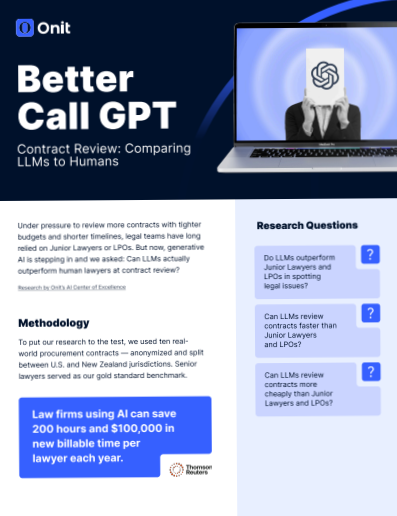
Onit branding with "Better Call GPT" title, laptop displaying AI graphics, contract review theme, emphasizing legal operations and efficiency, relevant to AI's role in legal spend management.

Just Getting Started? Download our Better Call GPT one pager for a quick snapshot of the research — perfect for sharing or bringing to your next team sync.

Ready to Go Deeper? Unlock the full research insights, benchmarks, and legal impact analysis in our comprehensive whitepaper — available for download.

Onit whitepaper cover titled "Better Call GPT," featuring a person holding a document with a logo, discussing large language models in contract review.