
Author: christine.schmidt

Not Every Outside Counsel Decision Needs an RFP. It Still Needs Better Data.

A formal RFP can bring transparency, structure, and competition to outside counsel selection. But not every matter calls for one. 

Some engagements are significant enough to justify a competitive sourcing process. Others need counsel selected quickly. Some involve work a trusted firm already knows well. Others simply do not warrant the time and effort of a formal RFP. 

Just because you’re not running an RFP doesn’t mean you’re skipping the evaluation. 

Whether a legal team is running a formal sourcing process or deciding which firm should handle the next matter, the same fundamental question remains: Why is this the right firm for this work? 

Too often, the answer comes down to familiarity, relationships, or whoever handled something similar last time. Those factors can matter, but legal departments already have another source of evidence available to them: their own matter, spend and vendor performance data. 

The opportunity is to use that information not only during an RFP, but every time outside counsel is selected. 

When does an outside counsel RFP make sense? 

There is no reason to force every matter through the same sourcing process. 

Formal RFPs can be particularly valuable when a legal department is selecting counsel for high-stakes work, evaluating multiple firms for a significant engagement, refreshing a broader panel, or simply getting an update on firms’ evolving capabilities. A structured process gives the team a consistent way to gather information, compare approaches to managing a case, and evaluate firms on more than familiarity or hourly rates. 

But a formal RFP also requires time from the legal department and the participating firms. For many routine or lower-risk matters, the process may be more than the decision requires. 

The goal should not be to run more RFPs. It should be to make better outside counsel decisions. That starts with a clear view of when an outside counsel RFP makes sense and when a lighter-weight process will serve the matter just as well. 

What should you evaluate when you aren’t running an RFP? 

A legal team may decide not to issue an RFP, but you can still evaluate your options. 

Before assigning a matter, consider what your existing data can tell you about the firms you already work with: 

Which firms have handled comparable matters? 

Past matter records can show which firms have experience with similar types of work, jurisdictions and levels of complexity. 

That provides a more useful starting point than simply asking which firm is top of mind. 

What did similar work actually cost? 

Historical spend can help legal teams understand what previous matters cost and how different firms performed against expected budgets. 

The question is not simply which firm has the lowest rate. It is which firm has demonstrated value on comparable work. 

How did the firm staff the work? 

Two firms may approach the same matter very differently. 

Historical staffing data can help show whether previous engagements used the right mix of partners, associates and other resources for the work involved. 

Did the firm stay within budget? 

A proposed budget is useful. A history of how a firm performed against budgets provides another layer of evidence. Does one firm tend to be more accurate in their initial case assessment, and therefore expected costs, while another typically has multiple budget revisions for each engagement? 

Consistent budget performance can help a legal team assess predictability before assigning new work. 

Were there recurring billing or compliance issues? 

Invoice history may reveal patterns that are easy to overlook when matters are considered individually. 

Repeated guideline violations, staffing issues or billing adjustments can provide useful context when deciding whether a firm is the right choice for another engagement. 

What happened after the matter was assigned? 

Assigning outside counsel to a matter is just the beginning, not the end.  Having a governance process based in effective communication to manage and evaluate performance throughout the engagement is a critical metric of success. 

Where legal teams capture relevant outcome and performance information consistently, that data can help inform the next matter, the next panel review and the next RFP. In fact, matter and spend data can reveal how firms actually performed long before a formal RFP ever enters the conversation. 

Relationships still matter. Data makes them more useful. 

Legal work is not a commodity, and outside counsel selection should not become a spreadsheet exercise. 

A general counsel may know that a particular partner understands the business exceptionally well. An in-house attorney may have years of experience working successfully with a specific firm. A legal operations team may know that certain firms collaborate better with internal teams than others. 

Those are meaningful inputs. 

The problem comes when relationship knowledge is the only input or when important experience lives only in the memories of individual team members. 

Structured matter and vendor data gives legal teams a way to complement that judgment with evidence. 

Instead of asking, “Who do we usually use?” the conversation can become: 

  • Who has done this type of work before? 
  • How did they perform? 
  • What did it cost? 
  • Did they meet expectations? 
  • What have we learned from working with them? 
  • Has another firm’s capabilities evolved where they warrant consideration? 
  • Are the lawyers who typically do the work at our preferred firm still there, or have they moved on? 

That creates a more informed decision without requiring a formal sourcing event every time work needs to be assigned. 

Outside counsel selection should be a continuous cycle 

One of the biggest limitations of treating RFPs as standalone events is that the selection process can become disconnected from everything that happens afterward. 

A firm is evaluated. A decision is made. Then the actual matter, invoices, budget performance and vendor relationship move into other workflows. 

The better model is a continuous cycle: 

Select → engage → manage → measure → select again 

Each engagement should create information that improves the next decision. 

Matter history builds a record of experience. Spend data shows what the work costs. Invoice information reveals compliance and billing patterns. Performance information adds context around how the relationship actually worked. 

Over time, legal teams can build a more complete view of their outside counsel relationships instead of starting from scratch every time they need to make a sourcing decision. 

That same information becomes valuable when a formal RFP is warranted. Rather than relying only on what firms say in their proposals, the legal department enters the process with its own history and evidence: structured vendor performance data that reflects what actually happened, built on systems that connect matter, spend and vendor information instead of leaving it scattered across inboxes and spreadsheets. 

Make the process fit the decision 

The answer is not to require an RFP for every outside counsel engagement. 

It is also not to reserve structured, data-informed decision-making only for the handful of matters that receive a formal sourcing process. 

Legal teams need both. 

For significant engagements, a structured RFP can help teams compare firms, evaluate value and create a defensible record of the decision. For matters that do not need an RFP, historical matter, spend and performance information can still provide the evidence needed to make a thoughtful choice. 

The process may change depending on the matter. 

The standard for making an informed decision should not. 

Ready to rethink your outside counsel sourcing process? 

Explore The Modern Outside Counsel RFP Playbook for a practical framework to determine when an RFP earns its keep, evaluate firms on total value and build a more structured approach to outside counsel selection. 

The Questions Legal Leaders Should Be Able to Ask Their Data in Seconds

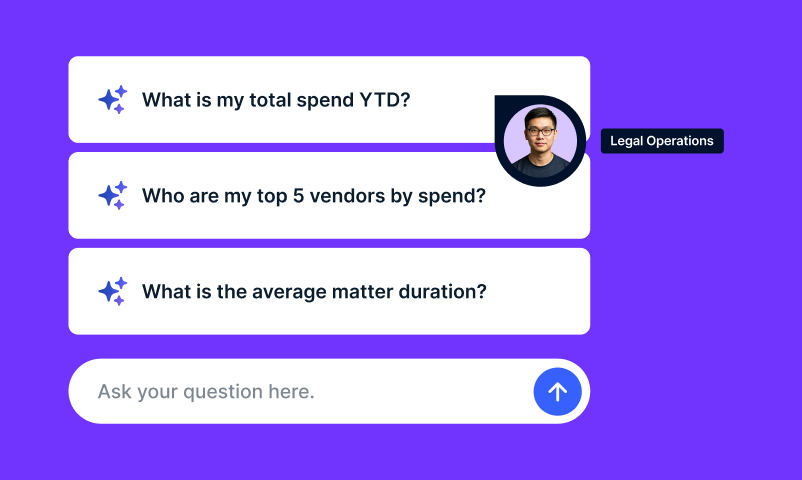
Legal leaders should be able to ask direct questions about spend, budgets, matters, vendors and overall operations, then receive a clear answer while there is still time to act. The standard is not speed alone. The answer should also be accurate – current, grounded in the legal department’s system of record, aligned with the user’s permissions and specific enough to support a decision. 

That expectation changes the role of legal data. Instead of becoming a quarterly reporting exercise, data becomes part of day-to-day leadership. The most useful questions fall into three groups: where money is going, where attention is needed and whether the answer can withstand scrutiny. 

What is happening with legal spend right now? 

Leadership questions rarely arrive on the reporting calendar. Your CFO may ask how accruals are tracking against budget before a forecast meeting. Your general counsel may need to know which matters are driving variance before an executive update. Procurement may want to understand which vendors are associated with the most invoice rejections or adjustments before a review. 

Legal leaders should be able to ask: 

  • How is current legal spend tracking against budget? 
  • Which matters and vendors are driving the variance? 
  • How do accrued amounts compare with final invoice spend? 
  • Which invoices are received, on hold, rejected or approved? 
  • Which business units are represented in current matter allocations? 

These are not unusual analytics requests. They are routine management questions. When each one requires a report request, an export and spreadsheet reconciliation, the answer can arrive after the decision window has passed. Manual legal reporting also consumes time that legal operations doesn’t have or could be better spent applying to any number of other items already on their plate. 

Where should Legal investigate before a problem grows? 

Good legal reporting explains what happened. Better access to legal data helps leaders decide what to examine next. A high-level total may be useful, but the next question often carries the real insight. 

Legal leaders should be able to ask: 

  • Which vendors had the most rejected or adjusted invoices this year? 
  • Which open matters have active purchase orders? 
  • Which open matters had no invoicing activity during the period? 
  • Which invoice reviewer rules apply to a particular vendor? 
  • How are budgets, accruals and final spend comparing across open matters? 

The value comes from connecting financial and operational context. Spend without matter information can hide what is driving the number. Accruals without final spend make reconciliation harder. Vendor totals without rejection or adjustment patterns provide an incomplete view of performance. 

The goal is not to replace legal judgment with an automated conclusion. It is to make the relevant governed data easier to explore, so leaders can identify patterns, ask follow-up questions and decide where human review is needed. 

Can the answer stand up to scrutiny? 

A fast answer is useful only when people understand what it means and where it came from. Legal teams work with sensitive information, different access levels and financial definitions that can change the result. “Spend,” for example, may mean billed spend or final spend after adjustments and taxes. A system should ask for clarification when the request is ambiguous instead of guessing. 

Legal leaders should also be able to ask: 

  • Is this answer based on the current system of record? 
  • Does it reflect the permissions of the person asking? 
  • Can the team review the underlying detail? 
  • Can the result be presented clearly in a leadership update? 
  • If the question is unclear or unsupported by available data, will the system say so? 

These questions establish a practical standard for governed, conversational analytics: current data, permission-aware access, structured answers, supporting visuals and a clear path for validation. They also keep professional judgment where it belongs, with the legal team. 

Make faster answers a leadership expectation 

Legal departments already hold information about invoices, matters, vendors, timekeepers, budgets, accruals, allocations and purchase orders. The leadership opportunity is to make that information easier to question without moving it into disconnected tools or rebuilding the same analysis for every meeting. 

Ask Unity turns governed Unity ELM data into clear, actionable answers and provides guidance on product-related questions. Users can explore legal spend, matters, vendors, budgets, accruals and other operational data through natural-language questions, then review structured responses with supporting charts and tables. When a request is unclear, Ask Unity prompts the user to refine it instead of filling gaps with speculative output. 

Explore the Ask Unity datasheet to see how legal teams can move from a plain-language question to a decision-ready answer inside Unity ELM.