

The pressure to run the legal department like a business has been gaining traction for several years. Driving efficiencies and containing costs are two key reasons that legal operations is important and is growing so quickly. In addition, law departments were forced to adopt a more operationally focused mindset as a result of the Great Recession. The 2008 downturn was so severe, and efficiency and cost-cutting were considered so critical to the survival of the business at large, that the balloon popped. And since it has, C-suites have increasingly been making their law departments behave more like their other business units. This ultimately led to the rise of a profession dedicated to bringing business discipline to the law department: legal operations.
Legal operations professionals handle the management of vendors, systems, strategic planning, technology, knowledge, financial issues and the myriad other tasks that can overwhelm the legal department. Legal operations is all about optimizing the legal department’s ability to help grow the company, and is a multi-disciplinary function that optimizes legal services delivery to a business or government entity by focusing on twelve core competencies. The competencies, developed by the Corporate Legal Operations Consortium (CLOC), are divided among three levels: foundational, advanced and mature. Almost every legal department function is covered, including vendor management, technology and process support, service delivery and litigation support.
Legal operations professionals are now managing outside vendors, implementing technology, overall legal spend and many other aspects of the legal department. And it’s not only happening in the Fortune 500 companies (as it was a few years ago); smaller companies are getting aboard as well. We believe that legal operations will be responsible for some of the biggest changes in the legal ecosystem in years to come.
Microsoft has agreed to join a growing coalition of legal departments looking to standardize legal data for machine learning environments
More and more legal departments are talking about making data-driven decisions with their outside counsel
Bodhala does precisely that with the power of our industry-leading data set and analytics
Over at Bloomberg’s Big Law Business, Roy Strom reports Microsoft has begun rolling out a new standard for legal taxonomy developed by the Standards Advancement for the Legal Industry (SALI) Alliance.
Although now in a pilot program, the move is an effort to standardize all legal matters facing the tech giant in hopes of taking control of legal spend.
Here’s a killer quote that caught our eye:
“We are more and more asked to think about how we enable our teams to make data-driven decisions about how they engage with outside counsel and how they do their work,”
– Rebecca Benevides, Director of Legal Business
Benevides noted that SALI taxonomy will help Microsoft legal teams by creating cleaner data models to leverage.
Preach! We hear this from clients and in discussions with industry leaders every week. And an implementation at this scale will almost certainly lead to greater adoption of a data-driven mentality across the market.
Bodhala is a groundbreaking legal technology platform created by lawyers to transform the half-a-trillion dollar global legal industry. Our platform refines organizational processes by empowering your legal team with deeper insights that allow you to better analyze, interpret and optimize outside counsel spend, trailblazing a new era of legal market intelligence.
We’re built on data – and how we develop it, how we utilize it and how we analyze it for the benefit of our customers sets us apart. Our proprietary benchmarking metrics and rate review algorithms generate detailed insights into every aspect of legal spend. An intuitive dashboard puts the information you need to make more cost-effective decisions about legal service providers at your fingertips, effectively boosting efficiency and reducing your bottom line.
Anyone who works at the intersection of Big Law and Big Business knows there’s a shift underway. Just recently the Wall Street Journal cited our data to show how the legal industry is changing at a lightning pace. Check it out!
We’d love the opportunity to help your company follow Microsoft’s lead. Shoot us a message and let’s talk about how your existing data can make sense of your spend.
We are excited to announce that Onit ranked #963 on Inc. magazine’s annual Inc. 5000 list, the most prestigious ranking of the nation’s fastest-growing private companies. Onit had a three-year revenue growth of 441 percent. This is the fourth consecutive year Onit has made the list.
The list represents a unique look at the most successful companies within the American economy’s most dynamic segment—its independent small businesses. Microsoft, Dell, Domino’s Pizza, Pandora, Timberland, LinkedIn, Yelp, Zillow, and many other well-known names gained their first national exposure as honorees on the Inc. 5000.
The 2019 Inc. 5000 is ranked according to percentage revenue growth when comparing 2015 and 2018. To qualify, companies must have been founded and generating revenue by March 31, 2015. They had to be U.S.-based, privately held, for profit, and independent—not subsidiaries or divisions of other companies—as of December 31, 2018. (Since then, a number of companies on the list have gone public or been acquired.) The minimum revenue required for 2015 is $100,000; the minimum for 2018 is $2 million.
Cost control and cost management have, and continue to be, among the biggest challenges of legal departments around the globe. How have legal departments been handling this? By increasing the workload of existing resources, bringing on more in-house lawyers, and implementing more technology. Increasing the workload? Something employees definitely don’t want to hear. Hiring more in-house lawyers? That’s not really making things “leaner,” is it? That leaves us with technology. Let’s investigate this option a little more by first referring to HBR Consulting’s 2018 Law Department Survey:
“Law departments also continue in their efforts to streamline operations, not only to control costs but also continue to increase efficiency. Legal technology continues to be a focus of many departments and plan implementation of next generation technologies to increase productivity. Law departments continue to be interested in data-related technologies, with 28 percent indicating they plan to implement artificial intelligence technology in the next one to two years, and 26 percent planning to implement legal spend analytics. These were topped, however, by contract management solutions, which 29 percent plan to implement in the next one to two years. These new legal technologies help automate manual workflows and create visibility into workload and spending, allowing organizations to improve operating efficiency and facilitate decision making.”
E-billing, matter management, legal holds and contract management top the list of most implemented legal technology, but there are many others. Interestingly, the top two areas where customers are moving out of their existing deficient systems are e-billing and matter management. This points to an even greater demand for those cutting-edge companies who provide the crème de la crème of legal technology solutions.
Why has it taken so long for some legal departments to see the light and get on board with technology? Understandably, a lean budget is often cited as one of the major reasons for not implementing legal technology. Resistance to change is another common reason. But one of the other major reasons is a reluctance to integrate new technology with existing systems. Here’s a little secret: resistance to change is really the only thing that should be holding up progress – the other issues of budget and integration have changed considerably in favor of organizations seeking new technology. There are technology solutions out there for practically every budget, and integrations are much more seamless than in the past. Gaining the support of leadership is a big step toward solving the resistance to change. Stop dreading the phrase, “do more with less.” Instead, we challenge you to thrive on it and explore the technology solutions out there that will truly help you do more with less.
Leaning heavily on Bodhala data that exposed trends around law firm rates and accelerating shifts in law firm partnership models, a WSJ analysis highlighted the rapid weakening of partnership at Big Law firms. It’s been replaced by a culture where, in the WSJ’s words, “data and money rule” above everything else.
In this “new normal”, Big Law partners are constantly pushed toward revenue maximization as the predominant driver of the attorney-client relationship, like a doctor being judged on how many patients she can see in a day.
With its one-of-a-kind platform, Bodhala’s insights help arm clients with their own data and tools to combat this new dynamic in the legal service market.
The team had a good moment at HQ last week when WSJ reporter Sara Randazzo pinged us.
It really is a fascinating read, made all the more interesting to us here in the office by knowledge that our insight and Bodhala’s data set helped drive the story from start to finish.
Let’s talk about how.
The thesis of the story is based on a trend we’ve seen play out not only anecdotally, but borne out by data measured in our one-of-a-kind Rate Index and our monitoring of firm partnership structures.
After hearing stories about changes in elite law firm partnership practices, we pitched this tip to Sara last year, who took time to develop a fascinating look at rate structures and the changing face of Big Law partners.
By combing through the billions of data points on counsel behavior and billing that Bodhala tracks, we were able to accurately assess and confirm the suspicions of the Journal in its analysis.
I worked at one of these firms, New York-based Simpson, Thacher & Bartlett, and many of the firms that I engaged with on my matters are some of those top-tier targets mentioned in the story.
WSJ frames the shift in an interesting way: trying to transition to build a business in the model of an investment bank-style approach rather than a traditional, and as many say, outmoded, law firm.
While this shift has certainly increased firm’s bottom line and tightened up processes, it changed the nature of the interaction.
A result of this? Our clients would be quick to tell you it’s made interactions less transparent, more frustrating, and certainly more expensive.
Just how expensive?
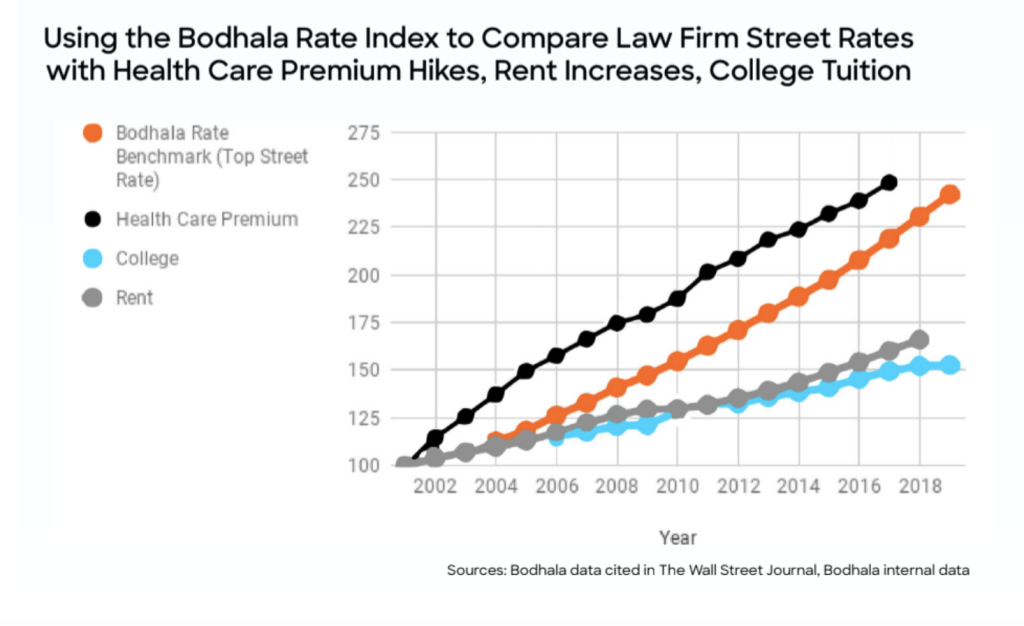
As you can see in the chart above, our data going back to 2000 demonstrates that top hourly firm rates are tracking at almost 4 times the rate of inflation, falling in line with health care cost hikes and outpacing education and housing.
Per our data, top-15-by-revenue firm street rates went from under $700 in 2000 to charging more than $1,650 per hour. Yikes. While one can argue the merits of the shifting focus toward industry profits, no one could argue this is a market-based response.
Now, we’re not suggesting lawyers shouldn’t be profitable, nor do we tell our clients that their firm’s services cannot command a premium. The premise of Bodhala is to use the power of data to make the partnership between a company and their outside firm more transparent, more equitable, and more accountable.
We’ve heard about these issues since the beginning of our company, and so when WSJ called us, we were happy to share our insights and data. We’re glad to be a resource for the Journal, if for no other reason than we hope we can help drive positive change in the industry.
The best result of our findings and investments in data science? This positive change can save a company millions. If you’re interested in learning more about how we came to our findings, or how we can help create more accountability and transparency with your outside firm, shoot us an email so we can get the conversation started.
We’re excited to announce our latest podcast! This episode is even more special since our guest speaker is with HBR Consulting, one of Onit’s key alliance partners. Together with HBR, we’ve worked on 15 projects throughout our years together. This newest podcast features Lauren Chung, practice group leader with HBR’s Strategy and Operations Group.
Lauren begins by telling us a bit about the HBR Law Department Survey, the leading source of benchmarking data for U.S. and global law departments. The survey provides key metrics concerning legal spending, law department staffing, industry trends, diversity, and customized results. The comprehensive nature of the survey is what makes it unique. The survey is crucial in providing participants a detailed look at how they compare with their law department peers. In this way, departments can see areas in which they are strong or lacking. The survey is also a key performance management indicator to justify hiring, spend, and how effectively the department is managing resources. In fact, the survey has proven itself to be an effective tool in driving law departments’ performance management programs.
Lauren closes by explaining how to participate in the survey. The deadline for this year’s survey is mid-August, and those interested in participating may write to [email protected]. Survey results will be published sometimes this fall. The upcoming 2019 survey will reveal somewhat of a hidden surprise for participants – results will be displayed in a dynamic recorded format.
Onit is excited to announce that we were selected as the number one Best Tech Startup in Houston by The Tech Tribune. The Tech Tribune staff has compiled the very best tech startups in Houston, Texas. The selection criteria include:
Revenue potential
Leadership team
Brand/product traction
Competitive landscape
Additionally, all companies must be independent (un-acquired), privately owned, at most 10 years old, and have received at least one round of funding in order to qualify.
“The first rule of any technology used in a business is that automation applied to an efficient operation will magnify the efficiency. The second is that automation applied to an inefficient operation will magnify the inefficiency.”
– Bill Gates
When I was serving in the Marine Corps, we were obsessed with becoming the quintessential lean, mean, fighting machine. It wasn’t the lifestyle for everyone, but it was our passion and we took it very seriously. But think about it: can’t lean, mean, fighting machine be applied to the corporate world? In fact, it’s not a stretch by any means. The Art of War has been required reading for top executives for decades. And everyone is striving to be fitter these days, and leaner. The ‘mean’ and ‘fighting’ part? Our definition here is to aggressively pursue a strategy of driving efficiencies and optimizing the legal department’s ability to grow the company.
The Corporate Legal Operations Consortium (CLOC) was created to help legal operations professionals and other core corporate legal industry players optimize the legal service delivery models needed to support the needs of legal departments of all sizes. CLOC’s 12 core competencies represent areas of focus that every legal operations department must manage to have a disciplined, efficient, and effective legal operations function. These competencies serve as a benchmark to compare a legal operations department’s growth to others in the industry and break down legal operations departments into foundational, advanced and mature in order to improve and grow systemically.
One of the 12 competencies is Technology and Process Support. This is defined as:
“Create a long-term legal operations technology roadmap including tools such as e-billing/matter management, contract management, content management, IP management, business process management, e-signature, board management, compliance management, legal hold, subsidiary management, etc.”
CLOC’s other 11 competencies are equally important to legal operations, but we will be focusing on Technology and Process Support, and how it plays into becoming a lean, mean legal department. This blog series will focus on strategies to achieve these seemingly elusive, but not out-of-reach, objectives.
“Eventually everything connects – people, ideas, objects. The quality of the connections is the key to quality per se.”
– Charles Eames
Life used to be lot easier, right? Well, that depends on who you ask. One thing is for sure – computers were a lot simpler. Databases and other application software usually served their purpose and we would just switch from one application to another when we needed to. But in most cases these programs were virtually separate and were not able to exchange data. We’ve all heard of ‘working in a silos.’ Well, those applications were basically information silos. Connections between programs, if any, were simple point-to-point and set up on an as-needed basis. After a while, this collection of connections would become very difficult to maintain and not very efficient. Essentially, what was missing was unrestricted and seamless sharing of data and business processes among all the application or data sources in the enterprise.
Nowadays, complex systems and programs need to interact with each other even more than in the past. Ideally, we want to connect applications in order to simplify business processes and avoid having to make extensive changes to existing applications. Processing data, requests, confirmations, and messages are just some of the interactions that are happening every second of the day, and it just makes sense to have applications that can share large amounts of data for processing or organization.
Let’s say a company has implemented a new legal technology solution for legal service requests, legal holds, contract management or a complex enterprise legal management system. In addition to their new technology, the company will continue using their existing applications such as AdobeSign, DocuSign, Microsoft Active Directory, ILM, iManage, Salesforce, PeopleSoft, One IBM or a myriad of other applications. All of these can be integrated with their newest technology solution but it needs to be done the right way.
As you’re shopping around for new process automation technology, you may hear fancy terms describing various integration methods. Flat-file integration allows data to be passed between different systems without necessarily connecting directly to them. API integration uses a protocol such as REST or SOAP and is the more modern method of integrating, but not always the best solution. For example, not all applications have available APIs for integration. Native actions are built by the technology provider are another method used. Every customer has a unique integration situation, so it’s extremely important to get it right the first time.
One thing many people overlook when looking for new process automation technology, is the importance of looking at the provider’s ability to use the best integration method for your particular situation. Partnering with a provider who is proficient with more than one integration method is also a big advantage. It’s all too easy to get caught up in all the great features of the new product and what it will do for your company. Just remember to look at how the provider will integrate it. You can implement the best technology available, but without proper and solid integration you won’t be getting the best out of it.
Data, in its raw form, can be a source of true facts; the interpretation and presentation of data allow people to put their agenda across.
Over the years, legal teams will have built up a significant amount of data (through case management systems, document management systems, e-billing solutions, risk registers, law firm reports, emails, legal advice, etc.), which is an extremely valuable but often underrated asset. Not only can legal data support strategic planning and trend analysis, but it is also an invaluable tool for:
Managing external law firms.
Managing internal resources.
Understanding and supporting your business.
Managing legal risk.
Managing legal department finances.
Furthermore, the data forms a key part of the company’s knowledge management, which remains available irrespective of changes in the workforce.
The challenge is what you do with this information, how you keep it clean, and how you pull it together and present it. Some of the critical things to consider are:
TAKEHOLDERS NEEDING THE DATA
You will likely have many stakeholders wanting reports from the legal data, each wanting to use it for a different purpose. These may include:
General Counsel will want to use the data to set the strategic direction of the legal function.
Team leaders will probably use volumetric data to show and manage resource demands and promote their teams.
Team administrators will look to make sure their team data is accurate and up to date.
Procurement will need to support legal spend within the organization.
Finance / Tax will be able to ensure (amongst other things) that provisions are adequate, and that VAT is correctly applied/recovered.
Risk will need to better understand the changes in the risk profile and to support any reporting to regulatory bodies.
PRESENTING LEGAL DATA
Presenting the information clearly and concisely that gets the message across is a challenge, as different stakeholders will often want the same data presented in different formats. Producing a range of reports is both time-consuming and a drain on resources. Online dashboards can make it easier for different stakeholders to slice the data to suit their needs. While each option has its benefits and challenges, you will likely want to work with both reports and dashboards.
Keeping the data clean is essential so that reports and dashboards show accurate and consistent data. Despite best efforts, manual input will inevitably lead to mistakes because of typos or missed fields. A system like Onit’s European legal spend management solution BusyLamp eBilling.space automates invoice review, so data is input consistently. Data validation rules, reporting, and task reminders help legal operations managers maintain data cleanliness. Many Onit clients use data gap reports to highlight and complete missing data. Doing this regularly ensures it is a small, everyday task rather than becoming an unwieldy data clean-up project.
USING THE DATA
Legal department data can help you to:
1. Manage your strategy. This may include areas such as:
Understanding and prioritizing the organization’s legal demand and spend.
Changes in the team’s performance by using KPIs.
What cost savings have been / can be, such as;
Outsourcing vs. doing it in-house.
Removing non-essential tasks.
Understanding your legal team’s risk profile and internal controls by using KPIs.
2. Manage your external law firms through:
Greater transparency of activity and spend, which, in turn, will help future discussions with firms, especially during panel reviews.
Monitoring law firm performance which will help law firm reviews.
Ensuring prompt payment of bills which may support faster-paying discounts discussions with firms.
3. Manage internal resources:
Easily identifying peaks and troughs in work, allowing for better resource planning and allocation (Product design/review, property management, supplier contract renewal, key stages in litigation, regulatory projects, etc.).
Understanding the impact of previous business initiatives will help prepare the department for future initiatives.
4. Understand and support your business. For example:
Awareness of change in the volume of a particular type of work will help ensure you:
Have the proper legal support available (either in-house or through external firms).
Develop training needs for your business contacts and the lawyers.
Visibility of the contracts that will support risk management, especially if there is a change in the legal or regulatory landscape or an economic downturn.
Support product development by learning from previous iterations.
5. Manage legal risk
Change in volumes of a particular type of work or within a business area will help identify emerging risks. These could include:
Frequent changes to standard terms and conditions could indicate that your documents are not keeping up with changes in the market.
Local changes to standard terms and conditions could indicate a lack of awareness or understanding of the documentation.
Can help identify new training needs.
6. Manage legal department finances.
Greater clarity on how much it costs per matter (internal vs. external).
Avoid paying for duplicate advice.
Drive costs down with external firms.
There are many business benefits to integrating your systems and making sense of the legal data that resides within them. Work out your goals and which of the above areas aligns with helping you achieve those core goals, then work backward to identify the data points that will help you have the visibility or measurements you need. Finally, you can create the reports and dashboards you and your stakeholders need.
Request a demo of BusyLamp eBilling.Space today and see our RFP functionality for yourself.