

Category: Enterprise Legal Management

OnitX Legal Holds Management: An Easier Path Through a Challenging Trail

The legal holds process is often a painful one; it’s also a necessary part of doing business, as a critical and extremely visible cornerstone of litigation and e-discovery. Unfortunately, too many legal holds products on the market present a poor fit for legal organizations. Most options for legal holds come built for specialized teams, with complex software, manual processes, and a highly technical focus; they’re built for e-discovery first, with the idea of legal holds as an afterthought (at best).

This presents a massive challenge to mainstream legal departments, as these options lack the accessibility, convenience, and straightforward management required to secure a smooth legal holds process throughout the organization. The good news? There is a better legal holds option out there.

A Simpler Solution for Legal Departments: The Benefits of OnitX Legal Holds Management

Purpose-built for mainstream legal teams, OnitX Legal Holds Management delivers an easy-to-use, easy-to-initiate solution for this vital task. OnitX Legal Holds Management offers a straightforward four-step process for initiating holds:

  • Select the custodians you want to put on the hold. A pre-configured integration works with virtually every HR and back-end system to ensure distribution to the correct parties. One-click options release or restore custodians from legal holds as the needs of the matter change.
  • Draft and review the legal hold notice. Utilize the Legal Holds Management template library to cut down on creation time and use for future holds.
  • Review the legal hold notice with essential parties. Approval steps can be configured and assigned to the appropriate reviewers.
  • Distribute the legal hold. Custom dashboards and reports allow organizations to check in on the status of legal holds and analyze key metrics.

Another benefit of OnitX Legal Holds Management? Significantly improved communication with essential custodians throughout the organization. Instead of a time-intensive administrative task — chasing down non-responsive custodians to secure their involvement – Legal Holds Management provides a streamlined, automated way to communicate the legal hold status to involved parties. Communication features include:

  • Automated custom scheduling of communications to remind custodians of the legal hold status — and alert others to non-responsive personnel
  • Proxy acknowledgment to reduce the burden on key executives, empowering assistants and other proxies to keep the legal holds workflow going
  • Custodian digest emails so custodians can quickly see which holds they are on and what they must do
  • Custodian dashboards to easily resolve all holds in one space

Finally, Legal Holds Management takes the pressure off an organization’s IT department by delivering simplified and comprehensive document preservation through Integration (powered by Workato). Legal no longer needs to coordinate with overworked IT staff to ensure the department secures every must-keep document. Legal Holds Management removes the ask for IT support with easy, fast preservation of all necessary files and includes:

  • Single-checkbox enablement by legal staff, with no IT help required (beyond initial setup)
  • Slack preservation by channel and direct message
  • Google Vault preservation for docs, chat, and/or email on a service level
  • Microsoft 365 email and Teams preservation with the click of a button

Legal Holds Management also delivers organizations complete auditability, getting a complete trail of legal hold activity and complying with Electronically Stored Information (ESI) requests for overseas employees.

Seamless Integration with Matter Management

In an economic environment where the organization expects every department to drive business revenue, Legal must take the initiative to create streamlined processes and make the most out of its resources. Legal Holds Management integrates seamlessly with OnitX Matter Management where the initiation of a litigation matter starts.

The simplified, user-friendly, and accessible Legal Holds Management gives Legal the efficient edge it needs.

Learn more about OnitX Legal Holds Management here.

Introducing OnitX – A Modern Platform for Transforming Legal-Related Workflows

We previously shared how 2023 is the year for every legal department to optimize their operations to deliver critical business outcomes with fewer resources and budget. It is our opinion that Legal needs to adopt a platform model approach to serve the internal demand for legal-related services more efficiently, so the legal team can spend more substantial time on initiatives impacting the entire enterprise.

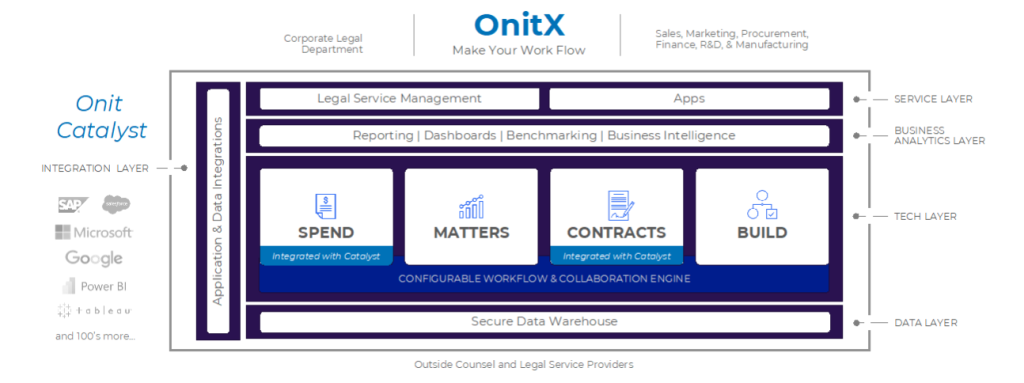
To usher in the era of optimized legal operations, Onit is proud to announce OnitX, the smart workflow platform for sophisticated legal matters and contract solutions that speeds the business. The “X” represents the innovative nature of Onit and signifies how the platform is highly configurable to customers’ unique needs, provides integrations with a broad range of technologies and business applications, and ensures a path to the future with extensibility to support new features and capabilities.

OnitX delivers several key customer benefits. First, it provides better visibility to legal services demand, which can feed an internal quarterly “report card” and give the data needed to forecast future needs. It supports greater operational efficiency for the legal department through user self-service, more seamless collaboration, and intelligent automation of legal workflows. Finally, OnitX enables better management of all legal resources, such as a deeper awareness of the “what and who” of legal operation, an improved ability to balance work done internally versus by outside counsel, and a greater understanding of outside counsel activity and spending so you can proactively manage outside law firm work.

OnitX is the evolution of the Onit Apptitude workflow platform that forms the foundation to many of Onit’s products. It includes the critical layers of a modern SaaS platform and adds several innovations:

  • Smart new rate approval through embedded visibility to rate benchmarking data that includes $47.6B+ in legal billings, 200,000+ timekeepers, and 8,900 law firms.
  • An integrated ELM solution tailored for European legal departments
  • Actionable contract insights provided by risk dashboards and mining contract language
  • An easy-to-use Legal Holds Management capability that streamlines compliance and reduces risk
  • A visual forms builder for the workflow engine that makes it easier to build applications.
  • A new, scalable capability to build third-party application integrations powered by Workato, an industry-leading iPaaS technology provider, as well as better and scalable data integration capabilities with Data-as-a-Service

OnitX also seamlessly integrates with the Onit Catalyst family of AI-enabled products to provide smart solutions for ELM and CLM.

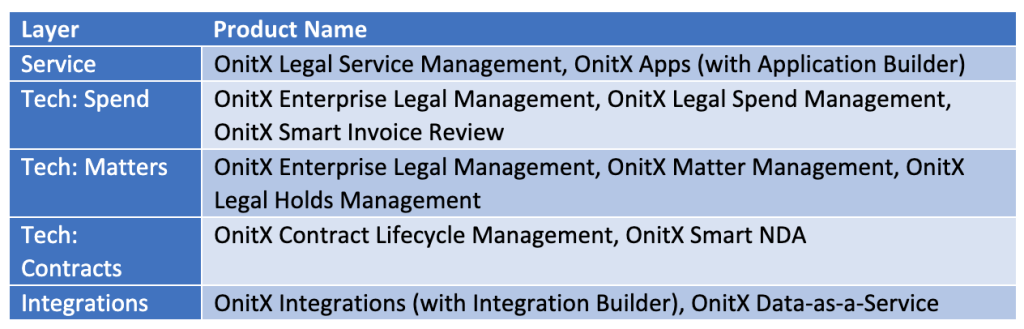
The following products are available within the OnitX platform:

Contact us today to learn how OnitX can be your modern matter and contract solutions platform.

The Future of Legal Technology: A Modern Platform for Success

In previous blogs, we discussed the mandate for corporate legal departments to optimize their operations and how adopting a platform model can help them do so. In this blog, we help technology buyers or evaluators understand the key elements and characteristics of a modern software platform that supports the management of legal matters and legal-related documents such as contracts and agreements.

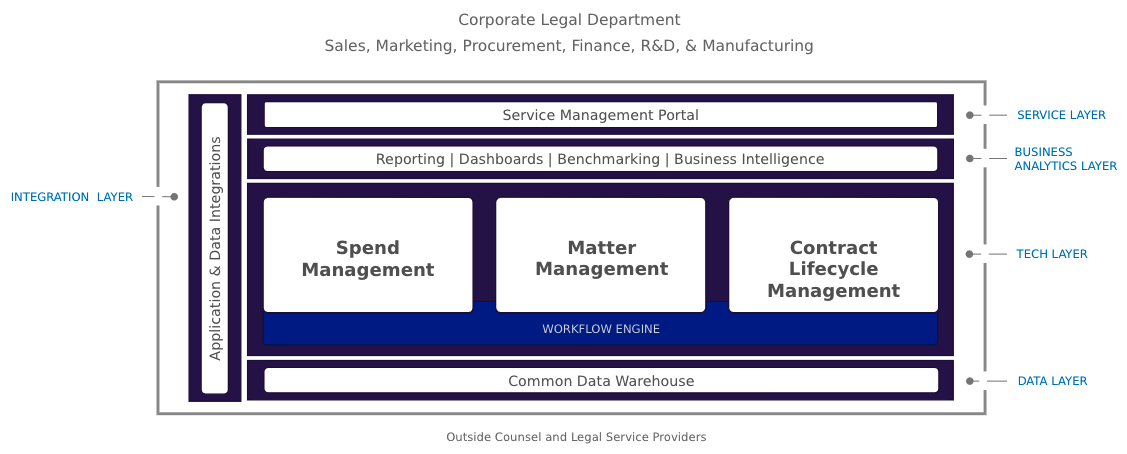
The ideal modern platform has five layers to its architecture: service, business analytics, tech, data, and integration.

A Modern Platform Architecture

A service layer is the critical “front door” to legal services for internal clients. It needs to provide a simplified, consumer-like experience to encourage business users to use it versus sending a one-off email or chat to the legal team. Users can either make a legal service request or directly access technology in a self-service manner that addresses their needs. Legal-related services that could populate the service layer include NDA requests, invention disclosures, trademark or logo use requests, whistleblower submissions, and data breach incident reporting.

A business analytics layer provides users with an embedded capability to derive insights from data. While stand-alone analytics tools like Tableau or Microsoft PowerBI are great at doing ad-hoc analysis and reporting, the average business user wants to use insights at the point of need, i.e., during the performance of a workflow. The ideal business analytics layer provides a range of capabilities, such as reporting, dashboards, benchmarking, and legal business intelligence within the platform.

A technology layer includes the software necessary to fulfill a request or automate a workflow. The service layer can provide a skilled user with direct access to the technology layer. For a platform that addresses legal matters and legal-related document requests, the technology layer should ideally include capabilities for matter management, legal spend management, legal holds management, and contract lifecycle management. It should also include an engine to automate collaborative workflows and business processes with sophisticated, custom requirements.

A data layer allows data sharing amongst the different technology layer components. This avoids the double entry of data and provides consistency across datasets, a single source of truth, and the ability to generate consolidated reports and analyze data holistically and more efficiently.

Lastly, an integration layer is a critical connection between the platform and other business applications such as ERP, CRM, and GRC systems. It should also enable connectivity to other data repositories and analytic tools.

While the ideal platform for legal matters and documents solutions has each of these layers, it should also possess several essential characteristics:

  • Is configurable to address the needs and circumstances of a large, complex enterprise.
  • Provides scalability to support future growth in users and data.
  • Is extensible to accommodate new features and capabilities, including integrations with more business applications.
  • Can be consumed in a modular fashion that does not require monolithic adoption by a customer.
    Addresses security, compliance, and reliability needs.

Please contact us to learn how Onit can provide a modern platform for legal operations.

The Power of Platforms: Why Corporate Legal Leaders Should Take Notice

When corporate legal leaders consider different legal operations technology solutions, they face a world of bland and similar descriptions for various offerings. A case in point is the use of the term “platform.” The technology platform concept has been trendy for several years, alongside cloud computing and artificial intelligence. While a powerful idea, it, unfortunately, has become a throwaway word as most legal technology vendors use it to describe their loose collection of products that are a mix of organically developed and acquired products. 

Firstly, the discussion of a platform does NOT begin with technology. Instead, it is a proven business model technology-based companies repeatedly apply to dominate their markets. Think Amazon, Uber, eBay, Airbnb, and so forth. 

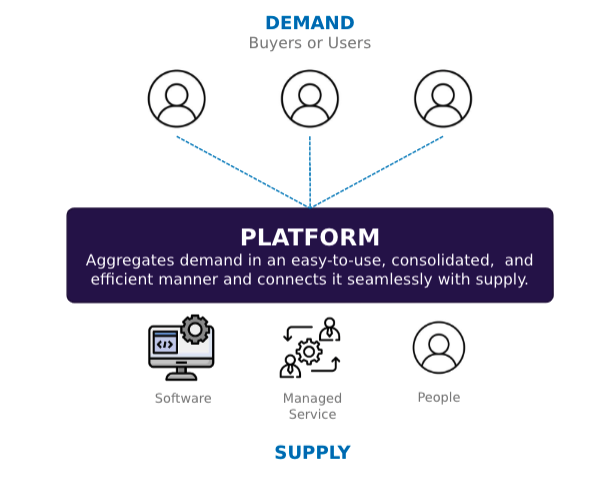
A platform approach consolidates demand for a specific consumer need efficiently and connects it seamlessly with supply – retail goods for Amazon, temporary and localized transportation for Uber, and vacation rental properties for Airbnb. The model was initially developed to serve consumer markets but has also been replicated for business marketplaces. For operationally efficient and agile companies and business functions, it has also been applied to address an “internal” market for corporate services. 


The Platform Model

Two examples come to mind. First, most corporate IT organizations moved to a platform approach starting a decade ago. For example, an employee needs a new laptop, a developer needs access to a database or virtual server, a marketer needs to add a new SaaS tool, and an executive needs desktop support. Solutions from companies such as Zendesk, Jira, and BMC have enabled the CIO to implement a platform approach to aggregate the internal demand for IT services and efficiently satisfy it with a combination of internal hardware, public cloud services, and IT staff and contractors. Second, leading HR organizations offer a similar model. For example, an employee needs a copy of a paystub, wants to change benefits, or needs to make a vacation request. A manager must initiate and manage an annual review process with her team. A Chief People Officer relies on Workday, Ceridian Dayforce, or SAP SuccessFactors to deliver a platform model to address employees’ needs for HR-related services. 

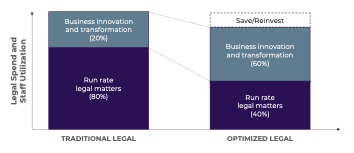
As with other business functions, a platform model does NOT replace the highest value work that the legal department performs that requires deep collaboration and partnership with other business functions, for example, understanding the implications of a pending regulation on a business unit operating model, the development of a new, global chain strategy, or the development of a seamless digital quoting and contracting process for a family of SaaS offerings that is directly accessible by customers. Instead, it creates efficiency for legal and frees the team to focus on these value-add projects. In a previous blog, we shared that ~80% of corporate legal’s time and expense goes towards run rate legal support: contracts, business agreements, IP and trademark requests, legal holds management, real estate agreements, and so forth. A platform model can help reduce this allocation of time and effort so legal can have the bandwidth to focus on making a cross-enterprise impact. Legal leaders have internal references for the model’s effectiveness – their own CIO or Chief People Officer. 

In addition to a better internal customer experience, legal leaders gain greater understating and control of their function: 

  • The visibility to internal demand can feed an internal quarterly legal “report card” and provide the data needed to forecast future demand. 
  • Central aggregation allows managing all work more efficiently, enabling more self-service of legal requests through a combination of established processes and technology. 
  • A deeper awareness of the “what and who” of their operations. 
  • A better ability to balance work done internally versus by outside counsel. 
  • A greater understanding of outside counsel activity and spending so you can proactively manage outside law firm work. 

Back to where we started — given the sameness of how legal technology providers merchandise their “platforms,” what should legal leaders expect when considering a modern technology platform that can support this model? Learn more in our next blog, which outlines the critical elements of a modern platform. 

The Key to Streamlined Legal Operations in 2023

With The Conference Board forecasting that the U.S. economy will formally enter a recession in early 2023, many large enterprises are having flashbacks to the past two significant periods of economic turmoil in 2008 and 2018. Likewise, PwC’s 26th annual global CEO survey highlighted the need for businesses to “evolve or die,” per the 4,410 CEO respondents. Seventy-three percent of CEOs believed that global economic growth would decline in 2023. Moreover, nearly 40% did not think their companies would be economically viable a decade from now if they continued their current path.

Behind this sobering economic backdrop are three other prominent trends driving further business complexity:

For corporate legal leaders, these forces represent two sides of the same coin.  On one side, they represent significant run-rate work for already heavily utilized legal teams. But, on the other side, they represent an opportunity for legal leaders to partner with the C-suite and business unit leaders to provide the best possible business guidance on the legal elements of each of these trends.

Corporate legal departments have their own set of challenges. With corporations expecting to do additional work with fewer resources and less budget, so must legal. An E&Y law survey reveals that general counsels expect workloads to increase 25% over the next three years, yet 75% do not expect budgets to keep pace. Per ALM, 2023 rate hikes are 7% to 8% for many corporations, with high-end firms commanding more than a 30% increase.

So, what is the path forward for the corporate legal department? In discussions with Onit customers, we hear that most of their time and expense goes into daily run rate legal matters and activities: contracts, business agreements, I.P. and trademark requests, legal holds management, real estate agreements, and so forth. Unfortunately, this leaves little time for legal to partner with business leaders and provide the guidance the business desperately needs.

Executives now expect legal to operate like other business functions. This includes delivering higher satisfaction amongst internal clients, providing superior legal outcomes (and thus better business outcomes), improving operational efficiency, and demonstrating ROI on spending. To do so, corporate legal departments must optimize legal operations.

They are not alone. Today, many legal departments connect to the business in more influential, material ways – from impacting revenue generation and growth to EBITDA and operational efficiency. While legal operation has existed for decades, the function is at an inflection point. Forward-thinking organizations represent torchbearers for a new chapter in legal operations’ history – an era of optimized legal operations.

Even for departments that have not established a formal legal operations function or team, the operations of legal still happen every day. Nascent legal ops initiatives should adopt a start-up mentality and embrace a modern operating model versus taking a similar adoption path that more mature legal operations functions took.

Legal’s path to making a more material impact on the business requires a focus on driving down the mix of time and money spent on run rate legal matters, so legal teams are freed to focus more on innovation and transformation initiatives.

The Transformation to Optimized Legal

Such a transformation will rely on the usual combination of people, processes, and technology. Corporate legal leaders must now challenge legal operations technology providers to deliver the technology piece of the equation – a modern software platform for managing sophisticated legal matters and contracts with more intelligence, speed, and efficiency. Such a platform needs to provide a digital self-service capability, automate workflows and collaboration, and apply artificial intelligence to bring insights to bear at the point of decision or need.

Why is a platform the linchpin to this transformation? In this next blog, learn how a platform approach starts with a business model, not technology, that can enable Legal to materially impact the business.

Introducing the 2023 Enterprise Legal Reputation (ELR) Report

This multinational study uncovers the power of legal departments to influence material growth, business value, and every aspect in between, even during periods of economic uncertainty — through better communication, efficient workflows, and more positive interactions with Legal’s internal clients.

The basis of all relationships lies in their interactions. In quantum physics, all properties are relational. Subatomic particles whirl through space, acquiring new properties only when they integrate with other particles.

When it comes to legal operations, interactions are just as fundamental. They are the underlying atomic units that permit Legal to collaborate and directly impact materiality and operational efficiency, even within our current macroeconomic climate.

The 2023 Enterprise Legal Reputation (ELR) Report, a study of 4,000 enterprise employees and 500 corporate legal professionals spanning the United States, United Kingdom, France, and Germany, focuses on the year-over-year (YoY) impressions of Legal’s brand image and its ability to influence every corner of its businesses, from revenue generation and EBITDA to corporate culture.

We are living in challenging economic times. The mantra everywhere, it seems, is “do more with less.” Yet just as there are clues to solving cosmic mysteries, the ELR Report discloses ways in which Legal can repair the energy and dynamics within its own systems: via better interactions.

THE PEOPLE, PROCESS & TECHNOLOGY OF LEGAL

Many organizations have long embraced a business framework called people, process, and technology (PPT). Designed to optimize efficiency and maintain balance, PPT is common across numerous disciplines, from HR and operations to IT and cybersecurity.

People are necessary to provide talent, wisdom, and insight.

Processes are required to accomplish work with productivity, scale, and efficiency.

Technology assists people in executing processes to achieve innovation.

So much has changed across the corporate landscape — and the world — since the 2022 Enterprise Legal Reputation (ELR) Report debuted. Last January’s boom economy is now a bust, besieged by geopolitical conflict, inflation, and devastating layoffs. Cost containment and EBITDA have emerged as major business priorities. However, the principal finding in 2022’s ELR Report continues to echo and is, in reality, magnified now in 2023: Legal can, and should, play a meaningful part in generating and elevating business materiality and growth.

In times like these, managing people, process, and technologies in triangulated fashion enables legal professionals to materially impact their businesses more than they ever have, or have ever been expected to, before. PPT transforms the way Legal is valued, evolving the department’s brand image from a back-office, tactical function to a front-office business driver, material influence, and cultural champion.

The first chapter of the 2023 ELR Report delves into perceptions of Legal’s brand image through the lens of corporate employees. It reveals that while almost four in five (78%) respondents acknowledge the enduring image of the legal department as a trustworthy protector of the business that offers sage advice, less than one in three (27%) considers Legal a good business partner.

Further, relationships with Legal have declined in every department in less than a year. Even interactions with “Legal-friendly” allies, like HR and Finance, have fallen from 62% to 56% and 62% to 51%, respectively. Functions that traditionally mesh less well with Legal — those that perhaps push the proverbial envelope and blur the metaphorical lines — like Sales and Procurement have plummeted even more, from 43% to only 30%, and 37% to just 22%.

That said, functions that interact most with Legal still experience the best relationships. The more Legal collaborates with a department, the stronger its relationship tends to be. And when it comes to measures of materiality, like sales and revenue generation, Legal truly stands out. More than half (56%) of employees acknowledge that Legal positively impacts sales and revenue operations. A similar number (53%) say Legal accelerates deal cycles –- a YoY increase of five percentage points.

LEGAL’S QUANTUM LEAP

A jump between energy levels by electrons orbiting within an atom is known, in the world of physics, as a quantum leap.

As enterprises control costs and overhaul operations, Legal needs to take a true quantum leap into the role of direct material influencer by becoming a more interactive partner that communicates effectively and responds efficiently. In fact, nearly half (43%) of ELR corporate employees specifically state that greater communication and collaboration is the most essential way Legal can support its internal clients, especially amid economic uncertainty.

Fission and fusion are quantum processes by which atoms change. Fission occurs when a neutron smashes into another atom, causing it to split. Fusion occurs when atoms amalgamate and merge. Vast amounts of energy are released by both, but fusion creates the most long-term impact –- as well as greater safety, stability, and sustainablity.

The same can be said of Legal, its internal clients, and executive teams as they continue to search for new strategies to achieve greater EBITDA and drive profitability in a positive and meaningful material way.

People. Process. Technology.

Interacting and collaborating with people.

Streamlining efficient processes.

Bringing people and process together with modern, innovative technology.

This is Legal’s moment of impact. It’s time for Legal to stand out as a business protector and partner in the eyes of its clients –- and these three elements can fuse to create a game-changing, materially successful, and future-proof legal department of tomorrow.

Read Chapter 1 of the 2023 ELR Report to discover new and enduring perceptions of the legal department, how corporate employees view their interactions and relationships with Legal, and ways in which Legal can evolve its brand image to more directly impact revenue generation, growth, and operational efficiency.

What is Legal Spend Management?

Legal spend management is the practice of controlling outside counsel spend. Management of outside counsel spend involves having visibility of spend, identifying and actioning cost-reduction opportunities, and budgeting future spend.

SPECIALIZED LEGAL E-BILLING IS NECESSARY FOR SPEND MANAGEMENT

A typical legal team will receive thousands of invoices a year. Reviewing these invoices manually is time-consuming and prone to error. The first stage in legal spend management is to automate the review of legal invoices, a process known as e-billing. Legal e-billing differs from a generic accounts payable (AP) system in a few ways and is essential for legal spend management:

    • Different billing guidelines – what firms can and cannot invoice for – exist for different firms. Trying to remember and accurately apply these rules when manually reviewing invoices is a daunting task, and mistakes will slip through the net, resulting in overpayment. Legal e-billing functionalities allow the corporate legal team to set up rules; incoming invoices are automatically reviewed, approved, rejected, or flagged for further review.
    • A legal invoice can contain hundreds of line items for different work and task codes. A standard AP system cannot track these effectively. E-billing allows law firms to submit LEDES format invoices, which enables the management and reporting of these task codes and allows the legal team to analyze the costs of different work types, compare value across firms, and budget headcount and spend required for future work.
    • Some legal e-billing solutions allow law firms to submit their work in progress with the corporate legal team reviewing or rejecting the work the firm wants to bill. This means invoices are theoretically approved before they are formally submitted, which removes unexpected invoice amounts, reduces the number of rejected invoices, and speeds up payment to the firm.
    • Legal spend management software integrates with accounts payable solutions (if desired) so the organization’s accounting processes can still be followed; the legal team gains additional visibility and control to manage legal spending effectively.

LEGAL SPEND MANAGEMENT SOFTWARE BEYOND E-BILLING

While legal e-billing reduces costs quickly by enforcing billing guidelines and increasing team productivity, full legal spend management goes further than this. As law firms become better at submitting compliant invoices, the savings from guideline compliance start to stabilize. This tends to happen 1-2 years after implementation. At this point, legal operations will use the accumulated matter spend data to make more strategic spend management decisions.

However, this can be done earlier on in the spend management journey. Legal spend management software enables legal operations to report on legal spend and use spend data to make sourcing decisions, drive negotiations and selection, and create a collaborative, value-driven relationship with firms. Features of legal spend management software, besides e-billing, include spend dashboards and reports, RFP tools, and legal analytics capabilities. Most legal spend management solutions also contain legal matter management features, which would not exist in an AP system. The matter data gives a fuller picture of legal work and its associated cost.

BENEFITS OF LEGAL SPEND MANAGEMENT SOFTWARE

Return on investment (ROI) is very easy to prove with legal spend management, as most benefits are directly related to lowering costs. These benefits include:

    • Significantly reduce legal spend. A fairly typical legal department can save 4 EUR per invoice, 5% of the external legal spend costs in the first year, and 8% of the external legal spend costs after the second year (all data is subject to average empirical values). Download our business case guide to calculate your potential savings.
    • Speed up invoice processing time and take advantage of early pay discounts from firms.
    • Visibility of work in progress and accumulating costs without waiting for the invoice.
    • Track and report on matter budgets, improving the accuracy of forecasts over time.
    • Improve visibility into matters and their associated costs through real-time dashboards and automated reports to stakeholders.
    • Automate manual processes to improve team productivity and free counsel to concentrate on high-value work.
    • Accurate, consistent, comparable, and reliable data across all matters.
    • Improved collaboration internally and with outside counsel that drives better matter outcomes and higher quality firm relationships.
    • Make data-driven strategic legal operations and management decisions, including sourcing, panel reviews, and negotiations.
    • Like-for-like comparison and review of law firm rates and value for money.
    • Fairer, competitive, and comparable proposals from firms

Request a demo of BusyLamp eBilling.Space today.

What is LEDES and the UTBMS?

The first time you hear the acronyms LEDES or UTBMS, you might think, “What’s Ledes got to do with legal spend management? The UTB-em-what now?” These tongue-twisting abbreviations are legal industry standards for coding and submitting legal invoices when using e-billing software. Read on to learn the basics of LEDES and UTBMS.

WHAT IS A LEDES FILE?

LEDES stands for “Legal Electronic Data Exchange Standard” and is a framework for the exchange of legal e-billing information. The LEDES file format specifications are globally recognized as the legal industry standard for recording legal e-billing data. The file formats go beyond e-billing, also providing formats for legal budgeting, timekeeper information, and IP matter information.

WHAT IS UTBMS?

UTBMS stands for “Uniform Task-Based Management System” and is a series of codes used to classify legal services. Outside counsel records their time and classifies the work using the appropriate code from the UTBMS set. UTBMS-coded time entries and invoices show the timekeeper, the tasks (e.g., taking a witness statement), activities undertaken (e.g., drafting a letter), the time spent, and the rate and cost of the item of work. As with the LEDES format, such codes standardize how legal work gets recorded worldwide, with law firms, legal departments, and e-billing vendors using the same codes.

HISTORY OF UTBMS

Before e-billing, paper invoices would contain lengthy descriptions of services that could run for multiple pages. It was difficult to digest the work and determine how much it cost. Driven by the need to digitalize this process, and alongside the formation of LEDES, The American Bar Association, the Association of Corporate Counsel, and PricewaterhouseCoopers formed a group to create a unified electronic billing standard. The UTBMS codes are sometimes known as ABA task codes for this reason. They decided that electronic invoice time entries should be task-based and aggregated by the type of work performed:

  • Task codes are a granular description of the service provided by an area of law. Task codes are organized in sets under their less-granular phases within the law: Litigation, Bankruptcy, Trademark, etc.
  • Activity codes identify the specific service performed or “how “the work is being done.
  • Expense codes were created to categorize expenses on matters. This group eventually morphed into the LEDES Oversight Committee. The LOC has since updated and created several UTBMS standards and codes, but other organizations do so as well. The revision and evolution of the codes continue today.

BENEFITS OF UTBMS FOR CORPORATE LEGAL

For law firms, standard invoice file formats and time entry recording significantly reduce administrative burden since they use the same standards regardless of who the client is or what e-billing software they use. Most law firms, and indeed all the large firms, use the LEDES file format and UTBMS code set as standard, and many have been doing so since the mid-90s. For in-house legal departments, the use of UTBMS also delivers significant benefits:

  • Legal e-billing systems can electronically review invoice submissions before they reach a human reviewer. The system checks the invoice against the billing rules – for example, if a specific task code reaches a pre-defined budget threshold – and can flag or reject the invoice automatically if desired. This saves in-house counsel time reviewing invoices manually, freeing them up to do more high-value work. BusyLamp legal spend management customers notice billing errors missed during the previous process (error-prone, human review).
  • Standard codes allow for easy comparison of work performed across different matters or firms. Cost, efficiency, and quality can all be compared quickly and consistently.
  • This legal spend reporting can be used to negotiate better rates, decide which work to bring in-house/outsource, evaluate which firms to use for which types of work or matters, and to make a business case for additional headcount.

Request a demo of BusyLamp eBilling.Space today.

How Corporate Legal Teams Benefit from RFPs

A Request for Proposal (RFP) is a powerful tool for legal departments to streamline their work and to meet the growing corporate demand to “do more with less.” In our blog “What is a Request for Proposal,” we have introduced some key functions of an RFP tool and summarized the information typically included. If the term RFP is new to you, feel free to read this blog first. Let’s start by exploring the advantages smart RFP tools offer in-house legal teams (and their law firms).

THE BENEFITS FORMAL RFP FUNCTIONS OFFER CLIENTS

Traditionally, law firms would respond to a request for a quotation for legal work in various formats – e-mail, a written document, or even a phone call. Obviously, from a client’s perspective, this has several drawbacks. At the top of the list is that the client has difficulty reviewing the different proposals and identifying the best provider for this legal work. Having an RFP procedure in place, as offered with our legal spend management solution BusyLamp, allows the client to see all the law firms’ proposals together – meaning there is a consistent and single source of truth. Further, the in-house team can have a visual representation of the different quotes – showing things like the resources proposed, the split of partner and associate involvement, the rates and hours for these timekeepers, the average hourly rate, total estimated costs/expenses, and an overall time frame for the matter thus allowing easy comparison and review of the quotes. It will also allow the law firm to propose an alternative charging arrangement if required, including doing the work for a fixed or capped fee.

Crucially from a risk perspective, using a purpose-built RFP application also allows the client to see an audit trail of the process. This point is essential, as using software to support the procurement process enables the client to demonstrate that an “even-handed” decision has been made. This evidence can be used to justify the final decision, offering important safeguards for everyone involved in the proposal/procurement process.

Finally, we should look at some unexpected benefits after seeing law firms use this technology. RFPs allow legal departments to quantify the results of their negotiations with law firms and thus make them visible. For example, they can reduce the time spent by their timekeepers during the RFP process and show the savings later in their reports. One key area is that the client can monitor those firms who are consistently under or over-bidding in their proposals – for whatever reason – and perhaps review why; for example, is the client allowing enough time for the response to be prepared appropriately, or does the law firm lack the necessary resources to present a convincing and detailed proposal? The client can also collect valuable data for each law firm. This will be invaluable in relationship negotiations and allow a sensible conversation with law firms based on accurate data.

As previously noted, using RFP technology means that the client can hold all proposal information in one secure place, retain all previous proposals, and monitor how law firms have performed by comparing actual costs versus estimates. Also, this application allows in-house lawyers to share documents with law firms in a secure and controlled manner and aids the client in building a centralized pricing knowledge repository.

Request a demo of eBilling.Space today and see our RFP functionality for yourself.

Addressing European Matter Management: A Complete, Proven ELM Solution from Onit 

When it comes to European matter management solutions, Legal organizations across the continent know that current options on the market just cannot measure up. As the needs of the legal organization grow into the spend management realm — extending beyond pure matter management for Legal in Europe — departments need a complete, robust ELM (Enterprise Legal Management) solution to match that growth.

Too often, the options for these organizations consist of either disparate systems or “point” solutions for either matter management or spend management with varying levels of sophistication and maturity. These “out-of-the-box” European matter management products offer limited or minimal configurability and require tiresome duplication of data when not integrated with a spend management system. As a result, reporting and analysis of data needs consolidation and exporting from two different places. That’s a mixture that results in significant challenges. Beyond the constant need for synchronization, this process is prone to errors — and requires constant, time-consuming manual data manipulation to ensure accuracy.

The European matter management market deserves a better solution than the ones out there. The good news? That a complete ELM solution is on the way.

Onit Matter Management + BusyLamp eBilling.space Integration

Available in July of 2023, Onit’s Matter Management and BusyLamp eBilling.space integration offers a complete, configurable, and proven ELM solution for European organizations with a single system of records for matter data. It removes the need for data duplication across two systems by offering a single source of truth for users, combining the power of Onit Matter Management with the unique vendor and spend management capabilities of BusyLamp eBilling.space that specifically address the requirements of European corporate legal teams.

The seamless integration provides European legal departments an easy-to-use and complete ELM solution that saves time, reduces errors, and enables streamlined processes. Solution users only enter matter data once; from there, the click of a button synchronizes relevant matters (those related to outside counsel) with the spend management solution. Empowered by Onit Matter Management + BusyLamp eBilling.space, European legal departments can get valuable time back for projects that help to materially grow the organization rather than spending time on the menial tasks of data consolidation, duplication, and proofing.

The comprehensive European ELM solution delivered by Onit Matter Management + BusyLamp eBilling.space will also deliver further innovations in 2023; future additions to the offering will include consolidated reporting and analytics for further organizational insights.

Interested in learning how Onit Matter Management + BusyLamp eBilling.space can help streamline your organization? Schedule a demo here.