

Author: Onit

Three Ways to Reduce Outside Counsel Spend Without Sacrificing Quality

Cutting costs is a never-ending quest and topic of discussion for legal departments. Like accounting, HR, or marketing, Legal is viewed as a cost center and often at the head of the line during cutbacks.

Of course, what makes the quest to bring down costs difficult is striving to do so without sacrificing quality and productivity. While there aren’t any magic tricks to make it happen, some tools and strategies are available to support the effort and help evaluate costs at the end of each period and at budgeting time. After all, the flip side of the cost-saving effort is demonstrating that spending has been carefully considered, determined to be necessary, and thoughtfully allocated and monitored.

1. USING LEGAL TECHNOLOGY TO STAY IN CONTROL OF OUTSIDE COUNSEL SPEND

One of the most effective techniques for controlling spend is establishing and adhering to a monthly budget and individual project budgets. Legal Spend Management software can make this task easier and more beneficial by allowing for input of more detailed information and more complex analysis of data without an unreasonable amount of time and resources needed for processing.

Such software can also support cost monitoring (and savings) by automatically flagging any out-of-policy billing that might pop up. Whether it’s an ignored cap on hours or total spend being busted, inappropriate staffing (why is a partner doing work an associate could do?), or charges for services and expenses that are not approved or reimbursable, a modern system can ensure that improper amounts don’t slip through. This is particularly important for fixed fee arrangements; you need to be able to ensure that you are still getting the proper staff attention on your matters and that not everything is going through junior associates and hidden in a fixed fee.

It also provides a good framework for setting expectations for the next project or period, whether in discussions with the same outside counsel or a potential new provider. A thorough report can point to cost savings, spending trends, and budget-to-actual comparisons during discussions between a general counsel and a CEO or CFO. This frank openness leads to stronger, more strategic relationships inside and outside the business.

2. DETERMINE WHO IS BEST QUALIFIED FOR THE JOB

Certainly, one of the most significant factors in cost control for a legal department is work allocation. Who is the best person, team, or firm for the job? It’s always a matter of assessing the matter and making the cost/benefit decision.

Whatever it takes: For some cases, there’s no alternative to top-dollar outside counsel with the experience and expertise to provide the best support possible in a critical matter. You need them on board, whether it’s the broad range of talent or the niche specialists they can provide. The key, then, is to provide clear parameters upfront regarding scope and expectations — and delegate support tasks as much as possible, to lower the cost-alternative resources.

Second tier: Some cases don’t justify the costs that come with the largest law firms. It’s not a “must-win” for the organization or a relatively straightforward matter with settlement in sight. There’s a reason that smaller firms exist, and it’s essential to utilize them wisely.

In-house option: Insourcing, when possible, is an obvious way to reduce outside counsel spend if the proper resources are available. Unbundling to leverage technology and in-house personnel is commonplace and the intelligent way to do business today, even if it wasn’t the case historically.

Expanding in-house capabilities: There may come a point where the volume and consistency of work requirements indicate that hiring additional resources will be the most cost-effective action. Make this decision when clear data, such as through Onit’s European legal spend management solution Busylamp eBilling.Space legal dashboards, demonstrates a need for particular in-house options in the future.

3. CONTINUOUSLY MONITOR AND MANAGE QUALITY

If you have instructed new law firms or implemented different billing rules for your existing panel, you want to be sure the quality of work and advice you receive stays consistent with the norm.

Modern Legal Spend Management solutions provide surveys or other similar functionality, providing reliable metrics that provide insights to your in-house team for review. This allows them to score and evaluate firms and make data-driven, informed decisions that ensure you get the most value for your money — and secure your return on investment.

Additionally, Legal Spend Management solutions allow you to track the outcome of cases and how compliant a firm was with your billing guidelines. This is a key advantage for budgeting, reporting, and spending. Having proven, verifiable data about law firm performance allows you to make an internal case for spending more on expert counsel when only the best will do. The key is not to reduce costs for the sake of it but to control costs and get the best value for money.

Request a demo of eBilling.space today. 

Legal Spend Management Tools Provide the Base to Build Alternative Fee Arrangements

With an eye toward budget predictability and managing risk, more and more legal departments are looking for opportunities to implement alternative fee arrangements (AFAs) with outside counsel as an element of legal spend management.

While there was a time when any arrangement outside straight billable hours was uncommon, even unheard of, a greater number of outside counsel firms are now open to AFAs. The issue, therefore, has become one of structuring the best fee arrangement for the situation: one that both parties will agree to align to the goals and financial requirements of each and is based upon accurate historical data that gives the legal department confidence that the arrangement is intelligent and appropriate.

INITIAL CONSIDERATIONS

There are numerous types of alternative fee arrangements utilized these days. Still, before deciding which might be most suitable given the circumstances, it is wise to consider the engagement in terms of actual value to the organization and the desired outcome. Is it a “win at all costs” matter or something much less critical in the big picture? Is compromise an option? Is any future relationship with the opposing party involved a non-issue, or does it involve an entity with whom you will need to continue to conduct business for many years to come? Both internal and outside counsel need to understand the situation clearly.

These factors can immediately help decide which is the best outside counsel firm to perform the work if there has been any doubt. It can also lead to the legal department and outside attorneys then analyzing the situation upfront to seriously consider the best approach to achieve the desired goals cost-effectively, beyond simply the appropriate staffing level.

ESTABLISHING THE ALTERNATIVE FEE ARRANGEMENTS

Trying to get work done for less money is not necessarily the sole — or even primary — reason behind opting for AFAs. The legal department may be looking for predictability and to simply keep costs from being open-ended, or there may be interest in allocating costs in a particular fashion, or to giving outside counsel reason to assume greater ownership regarding costs, or to divide the risk so that outside counsel assumes at least some of it. These considerations can drive the decision regarding which type of arrangement is preferable.

In any case, having relevant data to base the pricing on is critical. In the best case, legal spend management technology can provide budgeting, performance, and billing information compiled from previous engagements involving the same outside counsel and/or similar projects involving other firms. There is no reason to go with a “gut feeling” when concrete data is available to guide you with specific measurements.

With that information providing insight, there is a much greater likelihood of arriving at a “win-win” fee structure — where both parties are agreeable and excited about the arrangement and will not second-guess the project as work progresses.

Many types of alternative fee arrangements can be successfully deployed between inside and outside counsel: fixed fees for the entire engagement; phased fees, with a fixed fee for each segment of a project; value-based fees, where an hourly fee gets augmented by a sum to base upon the favorable or unfavorable outcome of the matter; contingent fees, in which outside counsel gets paid only if its work leads to a financial recovery (in which case it would receive a percentage of that total amount); or a blended hourly rate (for all timekeepers or by category).

But the key is ensuring that you are entering the discussion from a well-informed position. Variables and unforeseen circumstances can arise during an engagement, but having historical data from spend management tools to point to when structuring a new alternative fee arrangement can make both parties feel better about it from the outset.

Request a demo of BusyLamp eBilling.space.

Onit to Host Webinar with ADM and Forrester Research on Wednesday, Oct. 14 on Legal Spend Management

Join us on Wednesday, October 14 at 1:00 p.m. CDT for a webinar with Archer Daniels Midland (ADM) and Forrester Research as we talk about market trends and the new e-billing and legal spend management landscape.

E-billing and legal spend management technology has been around for nearly 20 years yet legal departments still think “innovation” means tracking matters and managing legal spend. This decades old technology is at the end of its technology curve – until now.

This webinar will highlight:

  • Why systems of record are not enough to drive operational improvements
  • Why traditional enterprise legal management (ELM) systems fall short
  • Why e-billing and matter management technology only represent a fraction of a legal department’s needs
  • Why process, workflow and collaboration are critical for a legal department to succeed

Guest speakers include:

  • David Cambria, Global Director of Operations, Law, Compliance and Government Relations, Archer Daniels Midland (ADM)
  • Cheryl McKinnon, Principal Analyst serving Enterprise Architecture, Forrester Research
  • Paul Zengilowski, Customer Development Executive, Onit

REGISTER TODAY

To learn more about our e-billing and matter management solution, download our white paper on enterprise legal management

3 Ways to Collaborate More Effectively With Your Outside Counsel

Ask any general counsel what keeps them up at night regarding outside counsel management, what frustrates them, or what makes them want to fire a firm. You’re likely to get some variation on this: unmet expectations.

General counsels are working in a fast-paced world of change, with increasing regulatory complexity and compliance challenges, focus on risk management, and ever-present cost constraints. They want efficient, dependable service from their outside attorneys – and they don’t always feel like they are getting that.

HERE ARE A FEW OF THE SERVICE AREAS AND CHARACTERISTICS THEY VIEW AS MOST IMPORTANT FOR OUTSIDE COUNSEL TO DEMONSTRATE:

  • Be responsive. Being attentive and available at a moment’s notice — or at least within several hours — and excited about the opportunity to serve shouldn’t fade away after the contract is signed.
  • Respect the budget. The budget is there for a reason. Discuss anticipated departures from the agreed-upon plan as soon as feasible. In billing, accuracy, transparency, and compliance with guidelines are expected and critical to working relationships. Inevitably, there are times when the scope increases and the staffing for outside counsel must expand to accommodate the new requirements. But that shouldn’t mean that there will be an unpleasant surprise waiting to be sprung months down the road: Timely communication can allow for a discussion of developments and restructuring expectations regarding staffing and billing.
  • Understanding the business. General counsel expects outside attorneys working for them will know the industry, its complexities, culture, and current trends.
  • Utilizing technology. Outside counsel should be comfortable using basic technology and proficient at leveraging the latest developments to provide the most efficient, effective service they can per billable hour.
  • Be fair, ethical, and responsible. Staff the work appropriately and don’t try to milk a project for more than it is worth.
  • Make it a good relationship. This is less important for a one-off project. Still, it is impossible to undervalue the benefits of a long-term, productive professional relationship of trust and mutual respect.

HOW BEST TO HELP THE RELATIONSHIP FLOURISH AND HANDLE THE TASK OF OUTSIDE COUNSEL MANAGEMENT? HERE ARE THREE KEY WAYS:

  • Communication. It’s a simple concept that is sometimes difficult to execute. Nevertheless, it is a critical investment in time and effort; too often, a simple lack of communication or a missed message leads to a major problem easily avoided or more effectively managed with a timely phone call. And remember, the phone works both ways — it’s not entirely the responsibility of the general counsel or the outside firm to initiate conversations.
  • Technology. As mentioned earlier, leveraging technology is essential for outside counsel to deliver state-of-the-art efficiency. It’s also a way for general counsel to manage the relationship, through real-time e-billing monitoring and collaboration software, for example. It’s a sensible way to track current projects and leverage information to make informed decisions in the future.
  • Mutual respect. If outside counsel is performing admirably, saving money and/or producing exceptional results, they need to be applauded (or rewarded) and, over time, given the appropriate display of earned trust. Similarly, outside counsel should conduct business as if their purse strings were controlling the budget and that the client’s success is their ultimate goal.

Communication and mutual respect are a matter of professional behavior. On the technology front, if you’re a little behind the times, Onit’s European legal spend management solution BusyLamp eBilling.Space can show you how software can be a key team player in collaboration, efficient operations, compliance, and outside counsel management.

4 Ways for Legal Departments to Leverage the Use of Technology

Law firms and legal departments may not typically have a reputation for being early adopters of technological advances. But to add value to the business, it is essential now to be taking advantage of the timesaving, performance-enhancing software that is readily available.

Specifically, we will look at software for e-billing, matter management, collaboration, and contract lifecycle management. These tools allow lawyers and other key people at your business to work more accurately and efficiently, focus more time and energy on high-value activities, and gain insight through data capture and analytics. Furthermore, while cost, capabilities, and design vary by brand and product, there most certainly are technological solutions to fit your department or organization, be it small or large, geographically concentrated or widely dispersed.

E-BILLING

By providing a better overview of your legal expenses, along with accuracy and efficiency through automation, e-billing software can allow legal departments and organizations to save time and money and help in-house counsel with controlling outside counsel costs. Additionally, modern legal spend management solutions, such as Onit’s European legal spend management solution BusyLamp eBilling.space, go beyond e-billing capabilities and provide pre-bill information, real-time fee tracking, and powerful analytics. This can give you an edge by turning billing information into strategically important insight for future planning and management.

MATTER MANAGEMENT

Everyone must deal with matter management, from solo practitioners to attorneys at multinational firms and major corporate entities. Some software types will offer features beyond the essential function of managing case and client information, such as documents, calendaring, communications, and contacts. More is not always better, however. You need to define your needs and consider budget and ease of implementation within your current operations. The best matter management solutions will empower the entire organization to work together on legal matters, sharing knowledge and driving results in a highly collaborative fashion.

LEGAL DEPARTMENT COLLABORATION

The ability to collaborate in real-time, securely, and efficiently is critical. Simple tools such as e-mail, instant messaging, and video conferencing are commonplace examples of technological collaboration. But for legal professionals, creating documents, controlling them, sharing, and collaborating in a secure environment has become an essential capability. Again, the key to which platform is best for you rests on your needs: what you want to be able to do, with how many parties are involved, and in coordination with what other systems. Another important factor to consider? What your future looks like. Look for a platform that can scale with your company, supporting the multitudes of processes and documents that come with growth.

CONTRACT LIFECYCLE MANAGEMENT

Contract Lifecycle Management (CLM) involves the end-to-end automation of the entire legal contract management process, reducing costs, freeing up resources, and increasing profits for the organization. The key to an effective CLM solution? One that supports every element of the contract lifecycle — from capture and creation through negotiation, approvals, execution, and management — with integrated AI features to help augment and organize contract review. Integration into existing processes is also critical; to ensure a seamless transition and uninterrupted workflows, look for a solution that works with features like Word and email and can get up and running in a very short amount of time.

Technology is not something for the legal profession to fear. Yes, there may be areas in which software functionality can now deliver a service quicker, cheaper, and better than a well-educated, trained professional. But more than anything, the legal tech world is here developing solutions that will allow the legal profession to operate quicker, cheaper, and better than before — and allow lawyers to use their training and education in a more focused, effective fashion for their clients.

Request a demo of BusyLamp eBilling.space.

Hierarchies, Holocracies, and Horizontal Thinking

In a 2015 study conducted by Bain & Company on management tools and trends, 75% of executives feel that the ability to adapt to change is a significant competitive advantage. Innovation is also high on most executive’s priority lists, with 74% believing that it’s more important than cost reduction for long-term success.

How are businesses building more adaptable, innovative, customer-centric organizations? Many are rethinking management structure, getting rid of the physical and psychological silos, and investing in technology that both reduces complexity and empowers contributors from all levels of the organization.

Perhaps the most extreme example is illustrated by Zappos. Fast Company recently did a fascinating profile on the online retailer, the poster company for its new “holocratic” management style. What the heck is a holocracy? According to holocracy.org, it’s a flexible organization structure that brings discipline to the peer-to-peer workplace. Holocracies are organized around self-governing teams focused on action versus over-analyzing, empowering individual contributors to solve problems, and clarity around roles and responsibilities. Holocracies are a counterpoint to the old top-down industrial age business hierarchy, which favors accountability and productivity around repeated tasks. The goal of this more fluid management ethos is to remove the bureaucracy that hampers the collaboration and creative problem solving that this current age demands.

While that is one end of the extreme, businesses don’t need to go full “holocracy”; simply flattening your management structure can have profound effects. CEO and co-founder of ShortStack.com, Jim Belosic, explained the benefits of thinking horizontally in a post on OpenForum. One main benefit of less hierarchy in your business, according to Belosic, is that more democracy leads to better communication within the team. Being flat also leads to more visibility into what’s happening across the board and enables quicker decision-making. Less hierarchy leads to a more engaged team, and the ability to take ownership and try new ways of doing things. More people have strategic skin in the game, illustrated nicely by what Belosic looks for when hiring people, “with a manager’s mentality and a producer’s work ethic.”

The term “flattening” perfectly describes what we’re trying to accomplish through technology-enabled workflows. We can’t blame all of the rigidity and bureaucracy in business on management. The complexity of critical business workflows can have the effect of sapping your teams’ autonomy and ability to creatively solve problems – no management needed. We’re big believers in empowering individual contributors through technology. By automating much of the administrative quicksand that otherwise talented, creative people get stuck doing on a daily basis, and by removing the opacity around workflows, you enable the individual worker to contribute in a more meaningful way. Less administrative red tape and more visibility into roles and responsibilities around your critical workflows brings more autonomy to individuals and teams alike, leading to less bureaucracy overall and more innovative problem solving.

To learn more about Onit and how Enterprise Apps can help your business adapt, innovate, and better serve your customers, schedule a demo.

For more on innovation, technology and business, check out our recent blog post:

Collaborative Economy, Meet Enterprise Legal Management

Considering an Enterprise Legal Management System? Four Phrases to Fear

Much of the software labeled as enterprise legal management (ELM) are simply souped-up matter and spend management systems that only effectively tackle one side of the problem: the database. What’s important to note is that these systems don’t address the other side of the problem, what Gartner defines as “the automation of manual processes through methods such as workflow and collaboration functionality.”1 Moreover, how the software addresses workflow and collaboration determines the software’s long-term benefits to your team, department, and larger business.

The database-centric philosophy of enterprise legal management will inevitably be supplanted by intuitive, process-centric Apps that have already become the norm in many other markets. Enterprise Apps address both sides of the enterprise legal management need (matter management and spend management), are simple to deploy, intuitive to use, and evolve with your changing business needs at a fraction of the cost of the “old” ELM systems.

How can you determine if your software is a truly holistic enterprise legal management solution versus a repackaged matter and spend management system?

Here are four key phrases that should make you wary:

1. “Senior management has to champion the idea.”

Translation: People won’t use this software unless they are forced to.

2. “Change management is essential for success.”

Translation: The benefit to your business and legal users is illusory.

3. “Strong training program is critical to adoption.”

Translation: This software is exceptionally hard to use.

4. “We release new versions once or twice a year.”

Translation: Plan to spend a lot of time and money staying current.

More is not always better when it comes to feature-rich ELM systems. Adding new tools and functionalities onto existing database architectures achieves little more than to complicate the implementation and does not support the reality of the way lawyers and law departments work and support their business. This architecture also comes up short in supporting the transactional kinds of legal services requests and processes that are the primary focus of corporate legal departments.

Traditional matter management and spend management solutions, repackaged by marketing departments as “ELM solutions,” simply can’t support the integrated, collaborative workstreams that law departments increasingly are required to achieve their goals and support the overall enterprise’s business goals.

To learn more about the future of spend and matter management, download our new whitepaper: A New Approach to Enterprise Legal Management.

More about enterprise legal management on our blog:

The 4 Axioms of Enterprise Legal Management

Pioneering a New Legal Technology Curve and Modernizing Enterprise Legal Management

Ten Things You Need to Know about Enterprise Apps and How They Relate to Enterprise Legal Management 


1 Gartner: “Magic Quadrant for Enterprise Legal Management,” 23 Oct 2013

Managing Your Company’s Legal Spend by Eliminating Cost Surprises

“Surprise!” is not something you usually want to hear from someone reporting to you on outside counsel billing or the entire spend of your legal department.

Save surprises for a milestone birthday. In the case of budgeted-to-actual billing reports, there is nothing like the sweet sound of just what was promised and expected.

Given many legal matters’ open-ended and unpredictable nature, don’t expect entirely accurate forecasting. However, there are many steps to minimize the variables and help control risk regarding overall spend, including some measures available through legal e-billing.

1. HISTORIC REVIEW

To look to the future, first, start with the past. A comprehensive review should include the legal services performed in-house and outside, by category; which outside firms performed the different types of service; the mix and billing rates of timekeepers; the number of hours budgeted and billed; and any broken guidelines. Estimating becomes more reliable by reviewing past spend and identifying trends and potential or likely areas of change.

2. ESTIMATE, ESTABLISH BUDGETS, AND TRACK YOUR SPEND

With the features and data available from today’s e-billing software, the estimation, budgeting, and tracking process has become simpler as the information accrued has become more detailed and accurate. By mining the data, it becomes clear what costs, staffing, and time can be reasonably expected from similar matters so that initial estimates can be more on-target. Develop an annual budget broken down by month; track it; check mid-month or phase by phase to see if any forecasts need to be revised and, if so, why.

Establish clear expectations with outside counsel and have them generate regular status reports and request unbilled totals, if necessary.

3. ESTABLISH AND MONITOR GUIDELINES

Established guidelines are essential and should cover the full range of service variables: billing rates and staffing expectations; billing formats; reimbursable expenses; and timing. Establish provisions for failure to adhere to the regulations. For example, what if a 90-day limit is in place for filing invoices, and an outside firm sends a bill six months after the fact? (You do not want a holiday surprise like that for work performed in the summer.)

Download “Getting Started with Billing Guidelines” for examples and how to write them.

4. ALTERNATIVE FEE ARRANGEMENTS

Alternative fees can be a means of managing spend, reducing spend, or eliminating surprises. Arrangements can include retainers (an established amount paid for a specific period), blended rates (covering partners and associates), fixed fees for particular projects, a cap on rate hikes, or a volume discount once reaching a certain level of spend with one firm.

With e-billing systems like those in BusyLamp eBilling.Space, you can establish, share, and submit budgets; track projects, progress, and spending; generate reports; and readily and automatically collect and analyze data.

Of course, given the technological advances of recent years, that should come as no surprise.

Learn more about BusyLamp from Onit, our end-to-end legal spend management solution built for European corporate legal departments. 

Onit Apps Reviewed in PC Magazine

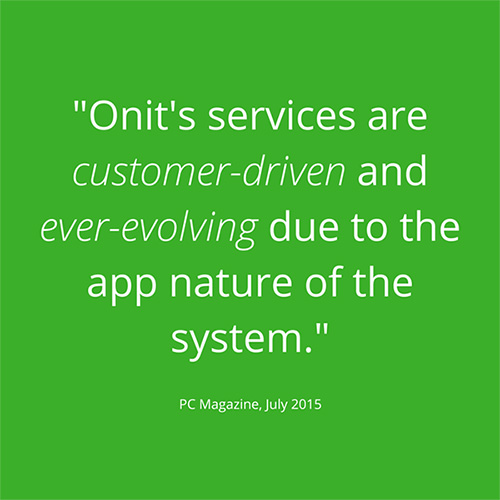
Onit’s “highly tailored approach,” “near limitless scalability,” and “interesting departure from many of the other systems on the market,” are just a few of the things writer Ken Contrata had to say about Onit in a review in the July issue of PC Magazine. We’re delighted to share this review of our ReviewAI and Approval App. 

With regards to pricing and options, Contrata describes our flexible pricing as helpful for companies that have a large number of potential users and/or data to store. Due to the customizable and scalable nature of Onit Apps, customers ultimately get to control the final costs depending on the extent of their needs.

There are many other contract management systems on the market. Onit’s interface and approach is different than most other systems in that our “customer-driven approach of the apps creation and modification is evident from the onset.” Our dashboard interface gets high marks for our activity tracking, colorful display, and that it can be used without specialized knowledge.

As for getting set up with Onit Apps, Contrata highlighted the fact that our Apps are a “mostly no-code solution to app building.” Moreover, for clients that need more customization, Onit can help you custom-build your App to fit your specific business needs. The specific functions, Contrata highlights on our ReviewAI and Approval App, include:

  • Workflow
  • Users & Dependencies
  • Data Collection
  • Communication within the App
  • File Management
  • Approval

One of the strongest features, Contrata points out, is “The app-like mentality gives users limited options over what actions can be performed, which keeps users on track without being overburdened by options.” Onit Apps are intuitive and require little or no training to use.

Unlike many contract management systems on the market, Onit can integrate with many other services in addition to e-signature services. “The nice thing about the Onit system is that the sky is the limit regarding what the apps can do, says Contrata, “Whatever the customer wants can likely be built, either by the customer or by Onit. Onit merely provides the foundation on which to automate the specific needs of the particular client.”

In the end, Contrata says that although Onit’s out-of-the-box functionality is similar to other contract management systems on the market, our App approach makes for a system created from the beginning with the client’s needs at the forefront. “This provides a top-down level of customization that can be achieved without custom programming.”

Read PC Magazine’s full review here.

Interested in speaking with us about your contract management needs? Contact us and schedule a demo today!

Three Ways E-Billing Software Saves Time and Money

In today’s legal world, there are so many compelling reasons for incorporating e-billing technology that it is not so much a question anymore of whether a company should implement it but rather, simply, when (or why not) do it.

While there certainly are features of e-billing that benefit outside counsel in conducting business, we will take a quick look at some of the critical areas in which legal e-billing benefits in-house counsel.

AUTOMATING COMPLEX AND CUMBERSOME MANUAL PROCESSES

Like many technological advances, e-billing automation dramatically improves efficiency and accuracy. E-billing eliminates some of the costly, time-consuming, tedious manual tasks that also run the risk of allowing significant manual errors. Billing information gets immediately routed to a designated approver. In some operations, some task automation allows legal counsel to stay focused on their expertise and real value, not worrying about over-reporting sheet formats or chasing after outside counsel for updates. (A bonus – you will likely find a noticeable reduction in paper costs as well.)

AUTOMATED BUDGET NOTIFICATIONS AND REPORTS

Your company’s specific rules for billing can get embedded for the evaluation and processing of invoices. With approved timekeeper rates and other corporate standards and guidelines (e.g., non-billable items, hourly thresholds, and ceilings, etc. Download our guide for more examples.) for outside counsel locked in, non-compliant invoices that might have previously gone unnoticed can be immediately flagged or rejected. (This, of course, gives in-house counsel a chance to take credit for saving money, too!)

ACTIONABLE LEGAL ANALYTICS AND INSIGHT

With billing information captured with clarity and detail, sophisticated analytics can deliver deep insight into your legal expenditures. This can be a real game-changer. Our clients have found these analytical capabilities to provide valuable information for long-term spend management and a host of year-over-year improvements.

WHY BUSYLAMP?

Sure, other companies are in the legal e-billing marketplace, so why choose Onit’s European legal spend management solution Busylamp.space? Here are a few key elements to consider, features that differentiate our services:

Cutting-edge capabilities: We are at the forefront of legal expense management. We offer an electronic request-for-proposal tool with real-time fee tracking and e-billing. We give you access to outside counsel pre-bill information and real-time tracking compliance utilizing embedded guidelines.

Flexible to fit all sizes: Our scalable SaaS model delivers more value for less money, and our usage-based pricing makes BusyLamp affordable to all businesses. We have seen impressive returns on investment from a broad range of clients. Moreover, our modules are independent, so you can begin reaping benefits even if you are not ready to discard your current software entirely.

Security and privacy: We are as concerned as you are about ensuring that all information remains secure from intentional or accidental mishandling or destruction. We have designed state-of-the-art technical and organizational security measures. We count banks and other major financial institutions among our valued clients, and our specifications have proven compliant with their strict security requirements. Read our checklist and discover why we are one of the safest solutions on the market.

You can contact us for a free analysis to find out how our software solutions can streamline your processes and deliver powerful analytics to help position your legal operations to be efficient and effective for the future.