

Category: Contract Lifecycle Management

Generative AI in Legal: What Are the Opportunities?

Note: originally published on the CLOC.org blog

The rapid growth of generative Artificial Intelligence (AI) promises to fuel seismic changes throughout every aspect of the business world. A quick glance at recent headlines gives a good sense of just how the expanding power of AI-spawned text, images, and media is reverberating:

  • Google added the power of Generative AI to its search engine, allowing users to receive AI-generated summaries to select queries.
  • IBM is launching a new “WatsonX” studio for organizations to create their own generative AI workflows.
  • A Goldman Sachs survey forecast “significant disruption” to labor worldwide from Generative AI — potentially affecting up to 300 million jobs.

The legal industry will be in the middle of the Generative AI revolution. But what will that transformation look like for the legal world — and how can the industry best take advantage of its promises and potential?

Three areas of transformation

These three legal areas will see meaningful opportunities for value from generative AI:

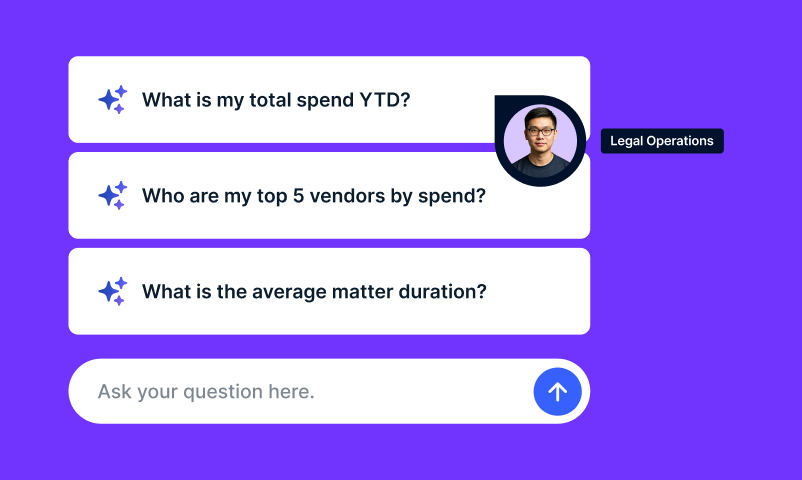
  • SPEND MANAGEMENT. Generated AI can also boost departments’ ability to make sense of their tens of thousands of lines of invoice data by delivering insights into value, helping departments understand exactly what they are paying for. These quick, accessible insights are a powerful way to stop the attorney habit of “rubber-stamping” invoices and address capacity concerns for busy departments. It also increases the quality and speed of invoice review, flagging patterns that can violate billing guidelines (especially for lengthy, complex invoices).

Additionally, generative AI can assist with vendor management — particularly tough conversations around rate, value and performance. When backed by detailed, insightful data, it is easier to have productive, emotion-free, and surprise-free conversations.

EXAMPLE: Invoice summarization
. Onit integration with ChatGPT provides a quick, insightful summary of a contract’s tasks to analyze overall value – allowing users to glimpse into the hours spent per task, the work done by specific timekeepers, and much more.

  • CONTRACTING. With Generative AI’s ability to generate content such as summaries and redlines, Contracting is a natural place where the technology will have significant impact. In fact, contracting is one area where we see more mainstream adoption of AI — for example, most of Onit’s CLM customers use AI in contracting. Fueling this growth? The improvement in legal comprehension by Generative AI; for example, GPT4 passed the bar exam, scoring in the top 90th percentile on one 2023 tryout. These advancements mean the industry can use AI as a co-pilot to run contract playbooks. AI serves as a powerful tool to help reduce some of the repetitive manual work plaguing this part of the process and improve consistency.

What about post-signature? In an era of constant mergers and acquisitions, regulation and compliance demands, companies often find themselves with questions about the contracts in their repository. AI-driven analysis gives a valuable look into these contracts and their clause libraries, allowing the new company to quickly identify risks and remediate them.

EXAMPLE: Contract analysis
. Onit’s AI Co-Pilot sits alongside you as you review your contract. You can ask it to spot issues, suggest redlining, compare against your template language and flag deviations from your standards.

  • LEGAL REQUESTS. This impact is one our CLOC panel and audience were extremely excited about; sometimes, the most beneficial use of AI is to remove manual work (like form filling), remove friction and encourage the adoption of our tools and processes. AI technology can help to kick off the workflow with minimal user intervention, automating legal request creation, determining routing priorities, and establishing tracking — removing significant administrative tasks for attorneys. It can also assist as the “first response,” automating common business requests before they go to Legal.

EXAMPLE: Creating a legal request. Onit’s AI integration can read an email chain and automatically generate a legal request.

This is what our audience at CLOC 2023 said when we asked them about the impact of Generative AI. Do you agree with their thoughts?
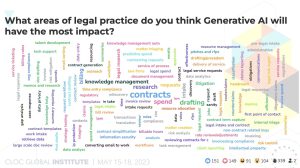
Word cloud of Generative AI's impact on Legal
CLOC Session word cloud

As Legal takes its next steps into the AI world, it’s a good idea to have these general principles in mind:

  • Be future-minded. Seek out vendors with a clear, future-proofed vision and plan for generative AI in their product. Additionally, look to partner with organizations prioritizing privacy and security with AI; they should offer commercial licenses that protect privacy. Once partnerships and processes are in place, layer the technology on top of that solid foundation to ensure successful rollout and implementation.
  • Keep on top of technology. Designate some time for yourself or ask a team to keep up with the possibilities and enhancements of Generative AI. In a world where rapid advancements happen weekly (if not daily), education and knowledge are king.
  • Address the fear of the unknown. The disruptive effects of new technology can be intimidating for many. Don’t rush or push anyone into this new world; encourage them to learn and engage with the space, focus on opportunities and use carefully tested and validated tools.

Learn more about how Onit’s AI-enabled products digitally transform the contract lifecycle.

How AI Enables Legal Teams to Adapt in a Rapidly Changing World 

Between global economic, political, and social unrest, data privacy concerns, regulatory changes, and even the effects of climate change, the world is moving at a dizzying pace — and legal departments are hard-pressed to keep up. The secret to continued success? The rapid insights provided by AI-powered solutions.

Shepherding a legal department has always been challenging; the current business world presents more headaches for Legal than ever. Here are just a few of the things that can keep Legal practitioners up at night:

  • The continuing effects of the global pandemic forcing constant contractual monitoring, revisions, and examination to stay in compliance.
  • A new global focus on privacy concerns, bringing in a host of new rules and guidelines — differing across countries and regions.
  • Continued social and political unrest (along with the effects of climate change), causing disruptions to overseas vendors, supply chains, and more.
  • Ever-changing, constantly updated regulatory revisions at a wide variety of levels, requiring consistent, sharp vigilance.

Any one of these elements would be cause for massive concern. When combined, they create a perfect storm of factors that could easily overwhelm a legal department — a storm that does not look like it will subside anytime soon.

Another complicating factor? The sheer volume of contracts and data can also be overwhelming. For example, the average Fortune 1000 company has anywhere from 20,000-40,000 active contracts at any one time (per the US National Association of Purchasing Managers). For large national banks dealing with the effects of the Libor transition, a calculation of 20,000 negotiation processes at a conservative six hours apiece equals around 17,000 days (about 46 and a half years) of project time and a staggering £15-20 million in costs.

The Power of AI in Contract Management

How can Legal keep up with this rapid change that the fast-moving modern world demands? A Contract Lifecycle Management (CLM) system backed with the power of AI is the key to keeping up with the necessities of today’s speed-of-light business environment. CLM augmented by AI delivers the accessibility, flexibility, adaptability, and accessibility organizations need to thrive.

This combination enables users to:

  • Quickly track down those critical documents that have risk for the organization and require urgent attention, allowing for timely response.
  • Reduce overall risk by improving the accuracy of contract review and cutting down on the chance of human reviewers overlooking critical information.
  • Provide automated redlining, commenting, and critical guidance to reviewers on where to redraft, repaper, and/or renegotiate, speeding up overall work.
  • Make large volumes of documents much less intimidating with AI’s immense scalability features, allowing for the review of thousands of pages of dense contracts in minutes.

Without this edge delivered by a combination of AI and CLM, it is easy for an organization to fall behind in a world where dramatic shifts can happen so suddenly. CLM augmented by AI helps keep up with rapid change for a rapidly changing world.

Onit Catalyst Contract Extraction helps find, organize, and action critical information in large volumes of contracts. Click here to learn more.

Experts Evaluate the Potential of Legal Contract Management Software and AI  

Legal contract management software also referred to as contract lifecycle management, has made significant headway in the world of in-house counsel, racking up impressive stats such as reducing the average sales cycle by 24% and saving 9% on annual average costs. But what happens when you combine legal contract management software with AI?

A panel of legal and AI experts from organizations including Adobe and Onit, presented at Legalweek on just this topic, examining the potential impact of AI on managing contracts and how to start implementing AI into your contract management workflows. The conversation touched on the business value of using AI in legal ops, the efficiencies AI can bring to your business and future trends in AI, among other things.

Here are some of the biggest takeaways for AI and legal contract management software.

How to get started with AI

One of the easiest places for legal departments to start using contract AI and automation is in common use cases like reviewing NDAs and other routine contracts because these are high-value but time-consuming activities. The need to increase speed is high, but the risk is relatively low.

On the applicability of AI to law

AI has strong applications to both the business side of law and the practice of law. From a business perspective, contract AI can help with important, routine tasks like invoice review and billing. As for the practice of law, AI is ideal for tasks like tracking 20 different clauses in the 56,000 NDAs you handle each year, significantly boosting productivity and efficiency.

Do your research

To get the most out of your AI tools, you want your relationship with your technology vendor to be a true partnership, and you want to apply your own judgment to why your solutions are doing what they’re doing. With both your vendor and your solution, you want to retain a certain level of control to ensure you’re getting the results you want.

Have a strategy

When you start implementing AI with your legal contract management software, you don’t want to be thinking just six or twelve months down the road but further down the horizon. When you create a longer-term vision, you’ll be better able to take into account the needs of your various stakeholders and secure their buy-in for your chosen AI solutions.

Laying the groundwork for adoption

Many companies find it easiest to start with a single use case or data set and train their AI models from there. Once you have your first success, it will be easier to roll out your new technology across other business units and the organization as a whole.

AI and compliance

When you use AI for contract lifecycle management, your tools can help you stay on top of the constantly changing federal and state regulatory landscape. AI can assess your legacy contracts against new regulatory changes and ensure that any necessary updates are made.

Contract AI and CLM

AI helps in the pre-signature phase of contracts by creating centralized workflows for contract management and templates that allow your team to draft, review and redline contracts with just a click. AI also assists in the post-signature phase by extracting actionable intelligence from your contracts that can serve as the basis for informed decision-making.

On justifying spending money on AI to the C-suite

According to a recent study, users saw on average a 51.5% gain in productivity after using AI for contract review. That’s an almost immediate gain in productivity, and some use cases saw even better results. Moreover, the efficiency continued to increase over time as users became more familiar with the tools and the tools got smarter. The data extraction capabilities of AI contract tools also help to reduce risk and stop revenue leakage, which has a positive financial impact on the business as a whole.

Future trends in AI

While AI was originally targeted more toward law firms, the focus has shifted to in-house teams. We’re likely to see an even greater emphasis on using AI in contract drafting and CLM this year.

If you’d like to learn more about AI and contract lifecycle management, here are two helpful webinar replays:

  • The Future of Contracting: CLM + AI Transformation at Lenovo – Every company needs a faster and more efficient contracting process that enhances risk and spend management, improves revenue and profit margins, and increases visibility into counterparty relationships. The Lenovo Legal Department’s transformation journey is delivering value to the business by centralizing the global legal transactional support resources, standardizing the contract process across the company and optimizing the process with technology.
  • AI Mythbusters: Deprogramming Misconceptions – Confusion and misinformation around what Artificial Intelligence is and how it works is widespread, particularly in the legal technology space. Watch this webinar to debunk ten common misconceptions and learn how to decipher marketing-speak to separate true AI from just software.

From Manual to Magical: The Power of AI in Contract Management

World Commerce & Contracting states, “Smarter contracting is a new vision for how modern enterprises should experience contracting. A vision that elevates the role of contracts as a source of the real-time data needed to manage the complexity of today’s business environment.”

Contract management is a vital process in any business, and it can be complex and time-consuming. However, contracts are the backbone of any business relationship and must be well-managed to satisfy all parties involved. Contract Lifecycle Management (CLM) software has been around for some time, but the application of Artificial Intelligence (AI) re-introduced innovation to this field. Whether you are part of corporate legal, procurement, or sales operations, you need reliable tools to streamline workflows, reduce manual workloads, and increase productivity. So, what’s required to make this vision a reality?

By 2024, Gartner predicts a 50% reduction in manual effort for contract review % due to the adoption of AI-based contract analytics solutions. While technology is a vital part of this puzzle, it needs to be approached differently. AI-powered CLM is the way businesses go from manual to magical. AI is infinitely more effective when closely interwoven into enterprise functions connecting people, integrating systems and data, and facilitating the flow of intelligence.

Introducing Onit’s Smart CLM Solution

This is why Onit developed Smart CLM. Onit’s Smart CLM solution streamlines the contract management process pre- and post-signature, reducing the time and resources required to manage contracts. The solution uses AI to automate the review of contracts and extract essential data from them, such as key terms and obligations, dates, and other relevant information. As a result, businesses can quickly and easily identify potential risks and opportunities in their contracts, which can help them make informed decisions and negotiate better terms.

Key to Onit’s Smart CLM is the tight integration of OnitX CLM with two new products, Onit Catalyst ReviewAI and Contract Extraction. Catalyst ReviewAI utilizes advanced AI algorithms to analyze and extract key contract data points, such as dates, clauses, and obligations. As a result, you can quickly identify potential risks and issues and prioritize your work accordingly. By using ReviewAI, you can locate misaligned contract terms and missed renewal dates, reducing the risk of errors or misinterpretation. In addition, with powerful analytics and reporting capabilities enhanced by the Risk Analysis Dashboard, you can make informed decisions, negotiate better contract terms, and reduce your organization’s legal risk.

Contracts are only sometimes in a centralized repository, obligations are ambiguous, rules and regulations constantly change, and market trends and business decisions can send you in different directions. The newest addition to Onit’s Smart CLM solution, Catalyst Contract Extraction, solves this challenge and creates structure from unstructured contracts by automating and augmenting contract data extraction to report and act on previously hidden information. Catalyst Contract Extraction uses Natural Language Processing (NLP) to analyze the text in contracts and identify key phrases and clauses. It also uses advanced machine learning algorithms to automate bulk contract migration and accelerate the repapering process; Contract Extraction also locates poor data and contract clauses that may impact your contract’s compliance.

With Contract Extraction, you can reduce the time and resources required for legacy contract migration, manual document review, and management, ultimately minimizing the risk of errors or misinterpretation.

The Benefits of Onit’s Smart CLM Solution

One of the most significant benefits of using AI in contract management is that it can save time and reduce errors. Manual contract review is a time-consuming, error-prone process, especially when dealing with large volumes of contracts. With Onit Smart CLM, businesses can automate much of the review process, significantly reducing the time and resources required. As a result, companies can focus on more strategic activities, such as negotiating better terms and managing relationships with their partners.

Another benefit of using Smart CLM is that it can help businesses identify potential risks and opportunities in their contracts. By extracting essential data from contracts, companies can quickly identify areas of risk exposure, such as non-compliance with regulations or breaches of confidentiality. As a result, you can now proactively mitigate these risks and protect their business interests. Similarly, by identifying contract opportunities, businesses can negotiate better terms and improve their bottom line.

Onit’s Smart CLM, comprised of OnitX, Catalyst ReviewAI, and Catalyst Contract Extraction, is designed to help enterprise business professionals work more efficiently, make informed decisions, increase compliance, and reduce the legal risk for their organizations. By automating much of the contract review process, businesses can save time and resources, reduce errors, and identify potential risks and opportunities in their contracts. In addition, with the help of AI, companies can manage their contracts more efficiently and effectively, ultimately leading to better business outcomes. So why wait? Try Onit’s Smart CLM today and see the difference they can make for your enterprise.

Schedule a call with us today to see how Onit’s Smart CLM can help your organization.

Introducing OnitX – A Modern Platform for Transforming Legal-Related Workflows

We previously shared how 2023 is the year for every legal department to optimize their operations to deliver critical business outcomes with fewer resources and budget. It is our opinion that Legal needs to adopt a platform model approach to serve the internal demand for legal-related services more efficiently, so the legal team can spend more substantial time on initiatives impacting the entire enterprise.

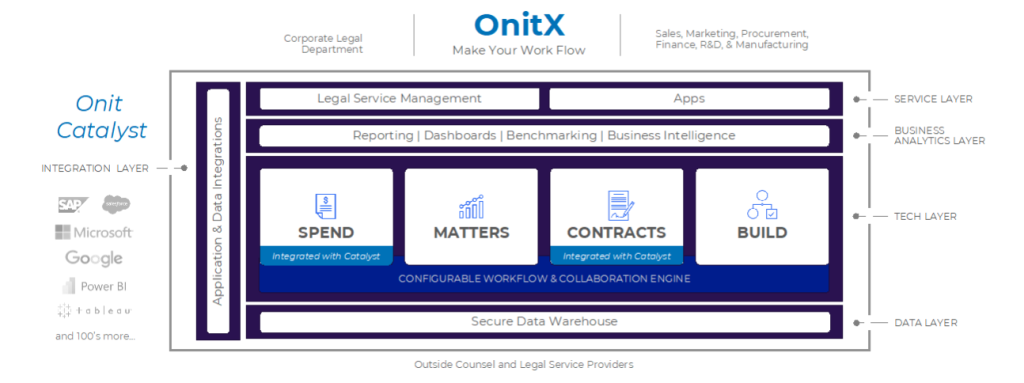
To usher in the era of optimized legal operations, Onit is proud to announce OnitX, the smart workflow platform for sophisticated legal matters and contract solutions that speeds the business. The “X” represents the innovative nature of Onit and signifies how the platform is highly configurable to customers’ unique needs, provides integrations with a broad range of technologies and business applications, and ensures a path to the future with extensibility to support new features and capabilities.

OnitX delivers several key customer benefits. First, it provides better visibility to legal services demand, which can feed an internal quarterly “report card” and give the data needed to forecast future needs. It supports greater operational efficiency for the legal department through user self-service, more seamless collaboration, and intelligent automation of legal workflows. Finally, OnitX enables better management of all legal resources, such as a deeper awareness of the “what and who” of legal operation, an improved ability to balance work done internally versus by outside counsel, and a greater understanding of outside counsel activity and spending so you can proactively manage outside law firm work.

OnitX is the evolution of the Onit Apptitude workflow platform that forms the foundation to many of Onit’s products. It includes the critical layers of a modern SaaS platform and adds several innovations:

  • Smart new rate approval through embedded visibility to rate benchmarking data that includes $47.6B+ in legal billings, 200,000+ timekeepers, and 8,900 law firms.
  • An integrated ELM solution tailored for European legal departments
  • Actionable contract insights provided by risk dashboards and mining contract language
  • An easy-to-use Legal Holds Management capability that streamlines compliance and reduces risk
  • A visual forms builder for the workflow engine that makes it easier to build applications.
  • A new, scalable capability to build third-party application integrations powered by Workato, an industry-leading iPaaS technology provider, as well as better and scalable data integration capabilities with Data-as-a-Service

OnitX also seamlessly integrates with the Onit Catalyst family of AI-enabled products to provide smart solutions for ELM and CLM.

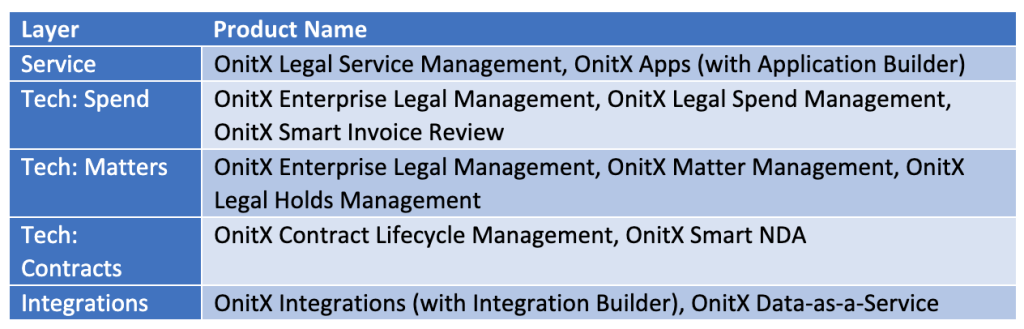
The following products are available within the OnitX platform:

Contact us today to learn how OnitX can be your modern matter and contract solutions platform.

How Corporate Legal Teams Benefit from RFPs

A Request for Proposal (RFP) is a powerful tool for legal departments to streamline their work and to meet the growing corporate demand to “do more with less.” In our blog “What is a Request for Proposal,” we have introduced some key functions of an RFP tool and summarized the information typically included. If the term RFP is new to you, feel free to read this blog first. Let’s start by exploring the advantages smart RFP tools offer in-house legal teams (and their law firms).

THE BENEFITS FORMAL RFP FUNCTIONS OFFER CLIENTS

Traditionally, law firms would respond to a request for a quotation for legal work in various formats – e-mail, a written document, or even a phone call. Obviously, from a client’s perspective, this has several drawbacks. At the top of the list is that the client has difficulty reviewing the different proposals and identifying the best provider for this legal work. Having an RFP procedure in place, as offered with our legal spend management solution BusyLamp, allows the client to see all the law firms’ proposals together – meaning there is a consistent and single source of truth. Further, the in-house team can have a visual representation of the different quotes – showing things like the resources proposed, the split of partner and associate involvement, the rates and hours for these timekeepers, the average hourly rate, total estimated costs/expenses, and an overall time frame for the matter thus allowing easy comparison and review of the quotes. It will also allow the law firm to propose an alternative charging arrangement if required, including doing the work for a fixed or capped fee.

Crucially from a risk perspective, using a purpose-built RFP application also allows the client to see an audit trail of the process. This point is essential, as using software to support the procurement process enables the client to demonstrate that an “even-handed” decision has been made. This evidence can be used to justify the final decision, offering important safeguards for everyone involved in the proposal/procurement process.

Finally, we should look at some unexpected benefits after seeing law firms use this technology. RFPs allow legal departments to quantify the results of their negotiations with law firms and thus make them visible. For example, they can reduce the time spent by their timekeepers during the RFP process and show the savings later in their reports. One key area is that the client can monitor those firms who are consistently under or over-bidding in their proposals – for whatever reason – and perhaps review why; for example, is the client allowing enough time for the response to be prepared appropriately, or does the law firm lack the necessary resources to present a convincing and detailed proposal? The client can also collect valuable data for each law firm. This will be invaluable in relationship negotiations and allow a sensible conversation with law firms based on accurate data.

As previously noted, using RFP technology means that the client can hold all proposal information in one secure place, retain all previous proposals, and monitor how law firms have performed by comparing actual costs versus estimates. Also, this application allows in-house lawyers to share documents with law firms in a secure and controlled manner and aids the client in building a centralized pricing knowledge repository.

Request a demo of eBilling.Space today and see our RFP functionality for yourself.

How Can You Import Contracts to CLM Without Breaking the Bank? 

Upgrading to a contract lifecycle management (CLM) system is an absolute must for modern organizations — saving time and money and providing game-changing insights. However, the actual uploading of contracts to your CLM system can be an exhaustive, expensive process. What’s the secret to getting your contracts into your CLM system without breaking the bank?

If your business recognizes the need to upgrade to a contract lifecycle management (CLM) solution, congratulations – that’s a great first step. However, far too many organizations overlook the importance of legacy contract migration when searching for their new CLM solution. Legacy contracts encompass legal documents that could be scattered in various places around the organization, including:

  • On a shared repository, like a legacy CLM, Google Drive, or SharePoint
  • In digital files on employees’ hard drives
  • In a physical, hard-copy file tucked away in a cabinet or storage bin somewhere

Typically, organizations face significant challenges with their legacy contracts:

First, you must decide how to get the contracts into your system (if at all). Some organizations give up on bringing older contracts into CLM before even getting to this stage, preferring to “start fresh.” By deeming these contracts as legacy and then forgetting about them, organizations are playing with fire. These contracts may possess a ton of value to a business.

An organization gains an enormous amount of insights and data from legacy contract information, helping to better inform decisions and negotiations in the future. For example, legacy contracts could enable organizations to discover the complex nature of relationships between companies (suppliers, customers, and partners) or detail the key financial terms (prices, payment terms, and discounts) between two parties.

Beyond those insights, legacy contracts also contain risks and obligations that organizations need to know; the cost of overlooking even one of these elements can put the business in an uncomfortable legal, financial, and reputational position. After investing time and money in a CLM system, deciding to skip the import of these legacy contracts almost immediately cuts down on the ROI for the entire venture.

Once an organization decides to bring in those contracts (and work to the full value of their CLM investment), they can go one of two ways: subcontracting the job to another resource to bring all that contractual information into the system or designating internal teams to do the same.

Unfortunately, both of those options present the same significant downside.

You face a massive cost — and value — issue. Many organizations have hundreds of thousands of contracts to get into their CLM system; some even have millions. Sub-contracting this work to another company is enormously expensive. The average cost per hour for quality outsourcing of contract migration is around $25 USD; it takes around 22 minutes per contract for review and data extraction.

This time can rise substantially depending on the quality of the contract, its location (and if there is a retrieval process), the number of details needing capture, contract complexity, level of quality assurance, and many other factors. Adding in project management and outsource team training on top of that money, and the real cost per contract import could go as high as $40/hour USD. That’s an enormous expense for a department looking to find value.

Dropping contract migration into the laps of your organization’s resources is another subpar option for a busy legal department. Designating the task to internal teams takes away critical hours that could be spent on higher-value projects, a recipe for department-wide bottom-line disaster.

Faced with two not-ideal options, an organization could quickly find their investment in a CLM solution — one that is supposed to streamline workflows and improve cost efficiencies — blowing up their budget.

The ideal solution: AI-assisted data migration

There is a way for organizations to get the most out of their legacy contracts with their new CLM system without letting costs spiral out of control: AI-assisted data migration. By deploying a dedicated human team augmented by AI-powered insights, organizations can quickly get the most value out of their CLM system (and secure significant investment).

Here’s why the combination of human and AI for data migration is so powerful:

  • It saves time. Get a rapid head start on collecting (and finding) the data you need. With AI-assisted data migration, users can save up to 90% of time finding and extracting vital information from contracts — and internal teams can spend more time on higher-value projects for the organization.
  • It saves money. Secure the bottom line. AI-assisted data migration allows organizations to reduce outsourcing expensive contract upload work to external resources and saves significant money on revenue leakage.
  • It reduces risk. Help protect the overall organization by collecting vital information from within contracts. With AI-assisted data migration, organizations can quickly create structured insights, benchmarks, and risk assessments from chaotic data.
  • It makes project management easier. Cut down on headaches and streamline processes with AI-assisted data migration. Deploy a single environment to collaborate, assign, manage, and automate large-value projects. Ensure greater consistency by reducing human error through automation, and improve quality assurance by incorporating guidelines, examples, and reporting.

AI-assisted data migration is integral to securing the good ROI demanded by any significant software investment. This type of AI-powered technology enables organizations to quickly upload their contracts into an efficient CLM environment — allowing for eye-opening insights, quick searches, key fields, and streamlined management that secures true value for the solution.

Onit’s ExtractAI solution helps find, organize, and action critical information in large volumes of contracts. Click here to learn more.

The Next Steps for DEI in Legal: A Conversation with JusticeBid

Omar Sweiss, founder and CEO of JusticeBid, and Matt DenOuden, Onit’s Senior Vice President of Sales, recently shared an in-depth discussion regarding the need for diversity innovation in legal operations – and how moving the needle requires both personal courage and playing as a team. Here are their insights (view the webinar in its entirety here).

When it comes to establishing a diverse and inclusive workplace where every voice is represented, acknowledged, heard, and valued, change is no longer an option – it is essential. This ideology spurred mission-driven attorney, entrepreneur, and CEO Omar Sweiss to pioneer JusticeBid, a minority-owned diversity analytics and outside counsel selection provider transforming how companies embed diversity, equity, and inclusion (DEI) into their business operations through data intelligence and transparency tools.

Born in Jordan and living in Chicago since the age of three, Sweiss noticed the marginalization of the south and west sides of the city early on. Later, as an MBA candidate, “I wanted to build businesses and bring them up with me,” he told Onit SVP of Sales Matt DenOuden.

It was then that Sweiss, already a passionate champion of DEI, enrolled in law school – and was stunned by the lack of diversity in Legal. Thus, JusticeBid’s groundbreaking analytics platform and RFP/e-auction SaaS technology to source legal services were born.

With a new year upon us, what are the next steps for corporate legal departments in embracing diversity innovation? The answers lie in “giving data points at the right place and time to drive DEI decision-making,” Sweiss said.

Diversity as a team sport

While interest in DEI initiatives has grown in the past decade, both Sweiss and DenOuden agreed: Much evolution remains required.

“In terms of diversity, many more corporate law departments have become like foot soldiers on the front lines, having conversations to effectuate change,” Sweiss noted. They have good intentions, intending to harness data to leverage vendors and overall operations. However, on occasion, this can lead to what Sweiss calls “eye-opening but troubling conversations” regarding companies requesting data solely to meet DEI requirements.

Once, Sweiss says, he got the impression that a company believed there was excellence, and then there was diversity – as if the two were mutually exclusive. This practice, known as “malicious compliance,” is where diversity is pitched but meaningful opportunities not provided.

DenOuden concurred.

“The legal world can inherently be an inside game – you want the best, and the people you know are the people you know. Does this run the danger of having the same loop occur?”
Sweiss’ suggestion? Drive out that attitude with data.

“When I’ve said, ‘What if I show you data that showed there are actually more diverse attorneys who have performed better. Would that change your viewpoint?’ The result was a resounding yes.”

“Diversity is a team sport,” DenOuden concluded. Not only must eyes remain open to origination credit – who is working on matters and what kinds of work they are performing – but to ensure inclusivity, “all hands must be on deck.”

Courage is the key

That said, “I can give you all the data, but if you fear repercussions, what good is data?” Sweiss postulated.

Certainly, having such conversations is underpinned by courage, DenOuden noted, adding how – in a corporate landscape punctuated by privacy issues – gathering data can pose a rock-and-hard-place catch-22.

There has been pushback, Sweiss admitted – but consent, he believes, in embedded in the process. He cited one pharmaceutical company who fired an Am Law 10 firm because they refused to provide data.

“They had a minority GC who was very courageous and stood his ground. Yes, it’s business, but we should be doing this for the right reasons. If you won’t be transparent about data, what that says is that you don’t align with [a company’s] values.” Companies with courage take a stand and only work with firms and vendors that share their values.

What success looks like

Imaging the future of DEI, DenOuden speculated on possible, tangible change in the present.

“Top of mind is for minority communities to offer STEM programs that lead to greater higher education opportunities,” Sweiss articulated. Another focus is arguments for affirmative action and their influence on law schools. “If race can no longer be looked at in admission process, what will this do to our pipeline as we try to solve that pipeline issue?

“This is a moment creating eye-opening effect. We’ve finally seen some progress. What will this do for profession and industry?”

Although goals can be different for every corporate law department, at the end of the day, being on the edge of diversity and achieving DEI success comes down to two principal matters, according to Sweiss:

“Making sure everyone in-house is playing a role in results, and showing diversity in legal operations that is reflective of society and challenges systemic inequality.”

This, in turn, forms a foundation for a more inclusive and just society for all.

The robust relationship between Onit and JusticeBid
JusticeBid is a founding member of the “Operation Empowering Change” (OEC) initiative to facilitate DEI data collection to support change in the legal industry, which exemplifies Onit’s commitment to advancing DEI in the legal ecosystem. This strategic alliance between Onit and JusticeBid will provide clients with cutting-edge tools to achieve deeper understanding of their current diversity climate, as well as an opportunity to scale the diversity of their outside counsel across various matters, including panel refresh, AFAs, consolidation, rate review, and more.

The Power of Intelligent CLM: Leveraging AI to Optimize Contract Management

Intelligent new CLM solutions optimize the contract management process by eliminating siloed business practices, unlocking maximum contract portfolio value, and driving efficiency, cost-effectiveness, and compliance. So what is your team waiting for? It’s time to lead the legal tech evolution, which begins with AI.

Technology has become essential in how we work — and contract lifecycle management (CLM) is no exception. Yet not all CLM solutions are created equal. With recent studies revealing that legal, sales and procurement teams can spend as much as 65% of their time on administrative contracting tasks, it is more urgent than ever to find a solution that can automate contract activity, control legal spend, and improve compliance.

An intelligent CLM solution makes your work flow trailblazing, reducing time spent on contracts, highlighting portfolio value, and transforming collaboration between teams. Here is how AI-powered CLM can solve three top challenges of contract management so that you can get back to doing what you do best – cultivating meaningful partnerships, negotiating forward-thinking deals, and igniting colossal revenue impact.

Pain point: Contract review demands an inordinate amount of company time.

SOLUTION: Intelligent CLM is a proven powerhouse at identifying common delays and information silos. With an intuitive user interface (UI) and the ability to report on all things contracting, it uncovers patterns that human professionals might not accurately quantify, such as average time spent per contract type and how long a contract has been in the “hands” of each department.

AI-powered CLM can even provide data visibility into specific languages and terms. The truth is, if you must create a particular type of contract once, you’ll likely have to do it again (and again). Developing a playbook with up-to-date, purpose-built document templates enables sales teams to generate contracts and finalize non-disclosure agreements (NDAs) and quotes using predefined language, so signing every new client doesn’t necessarily require the legal team to step in. Utilizing a clause library with a modernized digital dashboard can reveal how specific clauses are used and modified by breaking contracts into constituent clauses and autonomously extracting key data points. Because AI comprehends the contract in context, it can recognize clauses and keywords, define new opportunities, and evaluate risks for actionable decision-making — slashing delays and inconsistencies, shrinking cycle times by up to 20%, and speeding time to revenue by up to 24%.

Pain point: Contracts often feel overwhelmingly complex and risky.

SOLUTION: Contracts can indeed be complex (why else do so many fast-forward to “I accept,” ignoring the fine print?). Of course, they are complex for several valid reasons: the relationships, deals, and terms they cover and protect can be challenging, and the legal department exists to mitigate risk. However, intelligent CLM can diminish much of this complexity, translating “legalese” into plain language and enabling legal, sales, and procurement teams to initiate standardized new contracts in compliance with all business policies, as well as offering insights into top-performing vendors and negotiated price breaks.

Taking it even further, intelligent CLM can advance operational effectiveness, cost efficiency, and transparency. When combined with a risk analysis dashboard, CLM software streamlines business processes, leverages AI to assess low, medium, and high-risk contracts, and automatically calculates risk scores for each.

Pain point: The contract portfolio is losing value.

SOLUTION: While revenue leakage can occur at any stage of the contracting process, it tends to happen most frequently during contract creation and post-execution management. That said, intelligent CLM can eliminate revenue leakage at every stage. Not only does CLM with AI accelerate automated renewal productivity by 5%, but it can reduce liability and improve compliance from the time contracts are negotiated. It can also mitigate fees and fines due to missed deadlines and renewal dates on the back end via tracking obligations like milestones and payments.

System integrations that allow departments to sync lead data and initiate the creation of NDAs and master service agreements (MSAs), requisitions, purchase orders, and invoices also capitalize on portfolio value, eliminating the need for expensive custom work. Additionally, they lessen siloed contract management by providing a holistic view of supplier relationships while elevating end-to-end contract collaboration — saving up to 9% annually per contract and 33% in legal spend overall.

CLM with AI: Tomorrow’s tech, here today

There is empowerment in transformation. Intelligent CLM utilizes the best in AI to support the entire contract lifecycle, from document generation to signature (and beyond), with advanced analytics, self-service platform methodology, and impeccable regulatory compliance.

The future of Legal means more than just unlocking the latest in technology. Embracing the latest tech will provide modern digitalization, optimized workflows, and requisite collaboration to prove that Legal is more than just a compliance and risk regulator. Legal is equipped to grow your business materially and continue evolving today, tomorrow, and for future generations.

 Tired of Slow, Manual Contract Reviews?

AI can do the heavy lifting. Onit’s ReviewAI speeds up contract analysis, reduces manual effort, and ensures accuracy—all in minutes.

AI (+CLM): It’s Not Just a Buzzword

Everywhere these days it seems people are talking about artificial intelligence (AI). But it’s more than just a popular tech term — AI can be harnessed to slash contract delays, enhance collaboration, and transform Legal into an efficient and strategic business partner for your business and the future.

When you consider the term AI, what immediately leaps to mind?

Is it the self-checkout kiosks at your local supermarket? Commanding Siri to “Play old-school hip hop” as you’re making dinner? Star Wars’ shiny gold protocol droid C-3PO declaring he is fluent in more than six billion forms of communication — or a far more nefarious Hollywood vision, where sentient machines rise and threaten our survival, like HAL 9000 from “2001: A Space Odyssey”?

While each of these do illustrate some facet of AI — or intelligent automation, of which AI is a foundational component — the reality is that AI is not now, nor will it likely ever be, that. AI will not destroy humanity as we know it. What AI can do, especially amidst a quickly evolving business landscape, is serve as an essential tool to elevate connection, diminish costs, and advance competitive differentiation for your enterprise.

The birth and growth of AI

A common 21st-century buzzword, AI was initially pioneered and named by mathematician and cryptanalyst Alan Turing in 1950 with the question, Can a machine imitate human intelligence?

Today, AI can refer to any machine, tool, or technology designed to act intelligently and mimic human actions and decision-making. While AI ­can make decisions, these decisions are mapped via machine learning (ML) — complex algorithms that amass data patterns to assess correlations, predict behavior, and reach a predefined conclusion. Most of us have been ML test subjects. It’s what’s utilized to supply insights for things like “Movies We Think You’ll Like” on Amazon Prime and other streaming services. Another extensively used business application is natural language processing (NLP), the capability of software to recognize human speech patterns and determine output. “Smart” assistants such as Siri and Alexa use NLP, disseminating language into word stems, parts of speech, and other linguistic features in order to respond. Chatbots who communicate on company websites do the same, but with typed text.

Over the past decade, AI has exploded and emerged as a cutting-edge phenomenon for retail, manufacturing, banking, and healthcare — and legal operations is no exception. More than 90% of new contract lifecycle management (CLM) solutions include AI as a critical functionality as it can catapult operational efficiency and drive revenue generation in game-changing ways. For instance, during the contract drafting stage, ML can suggest, simplify, and organize creation. NLP can be employed to “catch” missing phrases or correct inaccurate terms in new or existing contracts. Both skyrocket accuracy while reducing time spent on contracting — which is highly necessary when the 2022 Enterprise Legal Reputation (ELR) Report revealed Legal can spend half of their workdays reviewing contracts and Sales and Procurement often spend as much as 65% of their time on administrative tasks, like document preparation.

Elevating the power of CLM with AI

Contract management isn’t solely a legal issue — it’s an enterprise issue, inextricably intertwined with both revenue and relationships. Because every function within a company requires contracts, leveraging next-generation CLM proves a golden opportunity to impact and transform the business at large by:

Accelerating contract cycles.

AI is a shortcut to shortening your contract management time, acting (and even thinking and reasoning) like a junior lawyer by reviewing contracts and redlining contracts, often in under two minutes.

Slowing down the speed of the contract review process can increase the riskiness of the contract portfolio. AI-enabled CLM clause libraries can update and make actionable decisions backed by data — and when contract language is standardized and pre-approved and AI-powered playbooks are used, it can speed time to revenue by 24%. That time can then be used to focus on cultivating partner relationships so revenue isn’t left on the table.

Maximizing productivity while minimizing spend.

Intelligent automation that is CLM plus AI dramatically speeds processes, which organically reduces operational costs. By automating contract data extraction, AI can remove significant costs from sizable projects. Further, it can lower the odds of human error.

Eliminating repeat data entry is a simple and effective way to expedite CLM as well as magnify cross-functional collaboration by confirming correct data for every department. In fact, a study found that legal AI contract review software made new users 51.5% more productive and 34% more efficient. AI-aided validation has also been shown to escalate contract data entry and field validation by 400%.

Minimizing overall risk.

CLM solutions infused with AI can substantially increase control over contracting by determining, calculating, and assigning a risk score for each contract within your portfolio. This offers thorough visibility and transparency into an organization’s contracts, identifying non-compliant contracts proactively, verifying compliance, and lowering the odds of missed obligations that lead to penalties, fees, and fines — as much as 9% annually per contract and 15% in additional revenue each year.

Blazing CLM — and business — forward

There is no doubt that AI is metamorphosing digital transformation, driving organizational change, and revolutionizing the world as we know it. However, CLM + AI has proven to be so much more than a mere buzzword.

There is hope in technology, and AI is at the heart of innovation. Being on the forefront of its adoption and integration is certain to help you lead your enterprise into the future in groundbreaking ways.

 Tired of Slow, Manual Contract Reviews?

AI can do the heavy lifting. Onit’s ReviewAI speeds up contract analysis, reduces manual effort, and ensures accuracy—all in minutes.