

Category: Digital Transformation

Perceptions of Legal: A Conversation with PwC

PwC US Legal Business Solutions Consulting Leader and Global Oversight Board Member Jane Allen recently sat down with Onit for an in-depth conversation about the insights gained from 2023’s Enterprise Legal Reputation Report. Here are some key takeaways from the discussion (view the webinar in its entirety here).

For the second year in a row, Onit’s holistic Enterprise Legal Reputation (ELR) report helped deliver keen insight into just how Legal can be perceived by internal clients — surveying over 4,000 enterprise employees and 500 corporate legal professionals around the globe. In this episode of “A Conversation”, PwC US Legal Business Solutions Leader Jane Allen shared her thoughts on some of the conclusions from the Report.

Here are some key takeaways from the discussion:

The overall corporate image of the Legal function remains positive across the globe. Legal is viewed as “protectors of the business, assets, and people” across the United States (55%), France (48%), the United Kingdom (41%), and Germany (33%). This positive image remains even as the current environment can make the job of Legal far more complicated.

“Legal is there to protect the people, the business, the IP, all of it,” Allen says. “I also think that doing this foundational piece has become far more complex and difficult, especially if you look at geopolitical issues and the evolving regulatory landscape – which can resemble a game of whack-a-mole in some places.”

Over the span of one year, the percentage of corporate employees that believe Legal works well with their internal function has declined across all areas:

Allen believes that as companies need to rapidly shift strategies due to changing business conditions and technologies – significant transformations all around – Legal’s responsibilities can become overwhelming.

“Again, everything has become more complex,” Allen says. “Teams have less and less capacity to try to respond to their internal constituents. There is more on the legal function, and frankly, they are not getting much more headcount or budget. I think these numbers are the result of that.”

The first two takeaways can deliver both good and bad news: Legal does have a positive reputation as the protector of the business — however, relationships with other departments across the organization are strained. The next point directs us to where Legal needs to go: 56% of respondents said that Legal can have a “positive effect” on revenue operations.

Allen points to three key takeaways from this statistic:

  • It’s indicative of leadership turnover. “Over the past year, we’ve noticed more turnover in the CLO / GC community,” Allen says. “These new folks want to set strategy, and they are doing a great job about being strategic — not only managing the bottom line but adding to the top line revenue and making sure that the rest of the company sees and feels their efforts.
  • It’s indicative of new Legal organizational leadership. “Another trend is seeing more GCs and CLOs move into C-suite roles,” Allen says. “That cites just how much of the business they know and how companies can see Legal as a revenue driver that knows the organization inside and out.”
  • It’s indicative of Legal’s work in contracting. “Legal helps drive improvements in the contracting process — leveraging data tools, looking at trends, increasing efficiency, and boosting the speed- to market,” Allen says. “The business feels it immediately. They are helping the top line and hopefully leveraging data and insights to see who they should collaborate with — and who they should not. I think that top-of-the-house legal leaders, if they think strategically in that direction, will change the name of the game of how Legal is viewed within the organization.”

Click here to view the rest of the interview.

Empowering Legal Departments: Onit Named as a Leader in IDC MarketScape for Enterprise Legal Management Software 

In a world where businesses face macroeconomic pressures to demonstrate value in new and visible ways, Onit is a dedicated partner in the journey. Legal’s impact is now, and Onit is at the forefront of ensuring that impact is transformative, efficient, and growth oriented. 

As a longstanding provider of enterprise legal management (ELM), contract lifecycle management (CLM), and business process automation tools, Onit is proud to announce its recognition as a Leader in the IDC MarketScape: Worldwide Enterprise Legal Management Software (Doc #US49842023, August 2023).  

“We are honored to be named a leader in enterprise legal management solutions,” commented Eric M. Elfman, CEO and co-founder of Onit. “At Onit, our mission has always been to empower legal professionals to do their best work through more intelligent and efficient workflows. We will continue to invest in innovation to deliver leading solutions that help legal departments drive material impact.” 

A Portfolio of Solutions for Legal Departments of All Sizes  

With solutions for businesses of all sizes, Onit enables legal departments to modernize workflows, improve operational and cost efficiency, and contribute to faster revenue generation and business growth.

Onit’s commitment to empowering legal professionals is reflected in its diverse portfolio of solutions designed to cater to legal departments of all sizes. Onit has continued to enhance its portfolio to include the following: 

  • OnitX: The next generation of Onit’s highly configurable platform for automating complex legal workflows for enterprise legal management and contract lifecycle management  
  • Onit Catalyst: A family of AI-enabled products purpose-built to elevate the impact of ELM and CLM solutions  
  • SimpleLegal: Tailored for the mid-market, this ELM solution brings transparency and management to e-Billing, matters, vendors, and reporting 
  • ContractWorks: A modular, out-of-the-box solution to manage contracts and legal documents at specific contracting stages or across the entire contract lifecycle 

Customer-Driven Innovation 

Onit’s mission extends beyond technology – it’s an organization that values the voice of customers. The naming as a Leader in the IDC MarketScape report follows a period of customer-driven innovation, including: 

  • Smarter spend management: OnitX Spend Management’s integration with Onit Catalyst empowers legal operations teams with external benchmarks for quicker, data-informed decisions on timekeeper rate approvals. 
  • Complete European ELM solution: OnitX Matter Management’s integration with Onit BusyLamp offers European corporate legal departments a flexible and configurable means to manage legal matter workflows, addressing specific currency, regulatory, and tax requirements. 
  • Seamless litigation compliance: OnitX Legal Holds Management streamlines litigation compliance management and reduces the risks associated with pending litigation. 
  • Visual forms builder: Build custom applications powered by the OnitX workflow engine to address simple legal-related requests like invention disclosures, trademark or logo usage and data breach incident reporting. 
  • Smarter contract lifecycle management: Onit Catalyst ReviewAI and Catalyst Contract Extraction help streamline the contract lifecycle pre- and post-signature processes by using AI to review contracts and extract essential data — such as key terms and obligations, dates and other relevant information — to quickly identify contract risks and opportunities. 
  • Application and data integrations: OnitX leverages scalable technology from Workato, an industry-leading iPaaS technology provider, to integrate with applications such as Salesforce, SAP Ariba and Microsoft 365 so users can work in their preferred tools while data flows into other critical business systems that support revenue and operating expense management. 

Elevating Legal’s Role Within the Enterprise  

Legal is most often viewed as a stellar guardian of the enterprise and outstanding advisor — yet its perception as a business partner is not quite as golden. In the 2023 Enterprise Legal Reputation (ELR) Report, four in five (78%) corporate employees perceive Legal’s enduring image as a trustworthy protector of the business that imparts sage advice. Yet even though respondents view Legal as an authority figure and business protector, nearly three in four (73%) do not consider Legal an approachable business partner. In fact, many view Legal as a “bottleneck,” as “adding unnecessary roadblocks,” or “simply expect to experience holdups” when interacting with legal teams. As a result, relationships between Legal and its internal clients have declined year-over-year (YoY) in every department — by almost 10% in HR, 18% in Finance, 30% in Sales, 27% in Marketing, and 41% in Procurement. 

Onit’s mission is to elevate Legal’s stature within the enterprise by automating business-critical workflows that drive material impact,” said Scott Wallingford, President of Onit’s Enterprise Business. “With the next generation of our platform in OnitX and key product updates from Onit Catalyst, customers can optimize legal workflows across their entire enterprise — from ELM functions like matter and spend management to CLM functions like contract management and review. Macroeconomic pressure influences enterprise functions to show value in new and visible ways, and we’re partnering with our customers to do just that. Legal’s moment of impact is now.” 

Additional Resources 

For more company news, industry trends and best practices from corporate legal innovators, read the Onit blog and follow us on LinkedIn

Powering Scalable and Rapid Integrations: Onit’s Partnership with Workato 

A streamlined, scalable, and rapid application integration layer is essential to the success of a SaaS platform. A modern platform must ensure connectivity and communication with business-critical applications and data sources throughout the organization. This makes it easy for users to perform workflows that cross over multiple applications. Integrations also deliver critical connections between the platform and stand-alone analytic tools, enabling powerful insights derived from the platform’s data repository.

If application integrations are seamless and easy to implement, the solution can do what it must without any headaches for vendor or customer — and quickly secure its return on investment. On the other hand, a platform that fails to integrate rapidly with other necessary business applications can be devastating for an organization. Poor integration can bring about a loss in productivity, wasted time and resources, and overall platform failure (not to mention the catastrophic budgetary consequences).

OnitX, a smart workflow platform for sophisticated legal matters and contract solutions, has introduced a scalable and secure integration layer powered by Workato. One of the most honored companies in the space (recognition includes a coveted place on the “Forbes” Cloud 100 list and the “Leader” designation from Gartner five years in a row), Workato delivers simple connections of applications that match business needs and reinforce integrated workflows.

The new OnitX integration layer offers SSO authentication, tailored resources, and custom integrations. It also provides unlimited scalability, a centralized admin console, and high-end security features that allow for future growth, easy management, and complete customer and vendor safety. Powerful auditability features enable IT departments and compliance efforts to track the digital trail of essential documents and communications. Additionally, Workato API abstraction makes it simple to adopt new software versions.

Additionally, the platform makes it simple for organizations to preserve APIs as future versions roll out — keeping integrations up to date, so clients do not have to worry about time-consuming version maintenance.

The OnitX platform provides three integration options:

  • Standard OnitX integrations for typical applications that are part of legal matters and contract workflows
  • Custom integrations built by Onit to support the unique needs of individual corporations
  • Partner or customer-built integrations later this year using the OnitX Integration Builder

Several standard OnitX Integrations are either available today or will be available shortly, including:

  • OnitX Legal Holds Management integrations: Allows for the seamless preservation-in-place of electronic documents through integrations with standard productivity tools such as Google Workspace, Microsoft 365, and Slack.
  • Salesforce integration for OnitX CLM: Gives sales teams the transparency to always know the location and status of their contracts within Salesforce, including agreements coming up for renewal.
  • SAP Ariba integration for OnitX CLM: Enables users to initiate contract workspace creation within SAP Ariba and streamline the flow of supplier data into OnitX CLM, reducing data re-entry and improving efficiency.

To learn more about the OnitX platform, please read this blog.

Introducing OnitX – A Modern Platform for Transforming Legal-Related Workflows

We previously shared how 2023 is the year for every legal department to optimize their operations to deliver critical business outcomes with fewer resources and budget. It is our opinion that Legal needs to adopt a platform model approach to serve the internal demand for legal-related services more efficiently, so the legal team can spend more substantial time on initiatives impacting the entire enterprise.

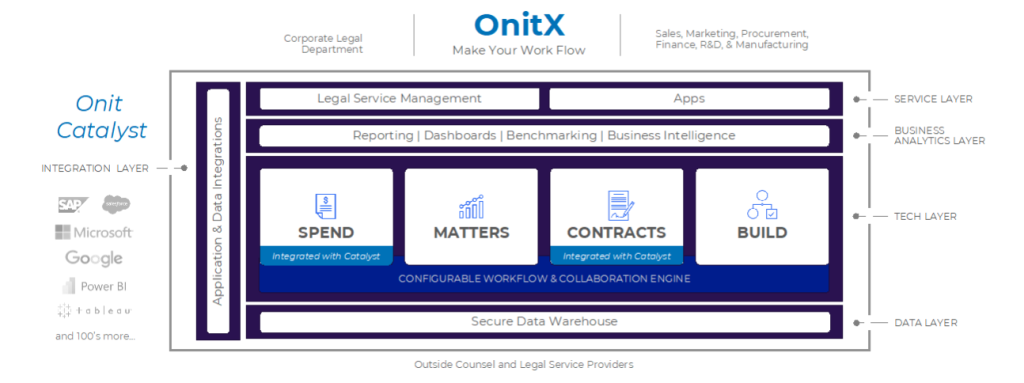
To usher in the era of optimized legal operations, Onit is proud to announce OnitX, the smart workflow platform for sophisticated legal matters and contract solutions that speeds the business. The “X” represents the innovative nature of Onit and signifies how the platform is highly configurable to customers’ unique needs, provides integrations with a broad range of technologies and business applications, and ensures a path to the future with extensibility to support new features and capabilities.

OnitX delivers several key customer benefits. First, it provides better visibility to legal services demand, which can feed an internal quarterly “report card” and give the data needed to forecast future needs. It supports greater operational efficiency for the legal department through user self-service, more seamless collaboration, and intelligent automation of legal workflows. Finally, OnitX enables better management of all legal resources, such as a deeper awareness of the “what and who” of legal operation, an improved ability to balance work done internally versus by outside counsel, and a greater understanding of outside counsel activity and spending so you can proactively manage outside law firm work.

OnitX is the evolution of the Onit Apptitude workflow platform that forms the foundation to many of Onit’s products. It includes the critical layers of a modern SaaS platform and adds several innovations:

  • Smart new rate approval through embedded visibility to rate benchmarking data that includes $47.6B+ in legal billings, 200,000+ timekeepers, and 8,900 law firms.
  • An integrated ELM solution tailored for European legal departments
  • Actionable contract insights provided by risk dashboards and mining contract language
  • An easy-to-use Legal Holds Management capability that streamlines compliance and reduces risk
  • A visual forms builder for the workflow engine that makes it easier to build applications.
  • A new, scalable capability to build third-party application integrations powered by Workato, an industry-leading iPaaS technology provider, as well as better and scalable data integration capabilities with Data-as-a-Service

OnitX also seamlessly integrates with the Onit Catalyst family of AI-enabled products to provide smart solutions for ELM and CLM.

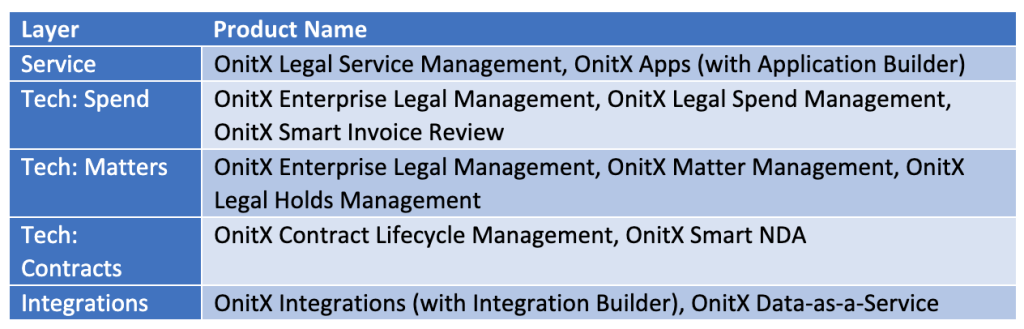
The following products are available within the OnitX platform:

Contact us today to learn how OnitX can be your modern matter and contract solutions platform.

Modern Legal Tech for the Business of Law: A Future-Forward Playbook

Technology is an enabler for businesses and practitioners who wish to differentiate, grow, and succeed. Here is a comprehensive blueprint of the most innovative and essential solutions Legal requires to evolve into a true business partner, impactful revenue generator, and corporate leader — for today, tomorrow, and years to come.

Today, the world seems to move at the speed of light.  Chatbots respond instantaneously to our online queries. True teleportation may not exist yet, but more than 15 million people are shuttled by rideshare companies daily. And somewhere between our first sip of coffee and setting our cell phone alarm for the next morning, over 2.5 quintillion bytes of data are created every single day.

The last chapter of the multinational study* Enterprise Legal Reputation (ELR) Report highlights the remarkable potential for legal operations to be a change agent driving business results with the assistance of technology. While, on average, three in four (77%) legal departments have integrated some level of artificial intelligence (AI) into their day-to-day operations, nearly half admit their department is averse to change, citing budget issues (48%), perceived lack of tech competency (31%), and lack of time for learning new systems (25%) as barriers to tech adoption.

But digital technology is reinventing the way we live, play, and work — and businesses that invest in state-of-the-art tech will remain several steps ahead.

Embedding tech in Legal’s DNA

Fortunately, legal tech investment is at a record high: although none of us has a crystal ball to predict how the current macroeconomic market will affect corporate decision-making, two in three (67%) professionals do see tech budgets increasing.

Investing, however, is only the first step. The true cornerstone to modernized legal operations is ensuring tools are adopted. According to the ELR report, less than three in 10 (28%) respondents describe themselves as early adopters by nature, while another six in 10 (62%) classify as middle adopters.

In many legal departments, though, things simply “get in the way.” But inefficiency can damage both a legal department’s brand image and hold back the enterprise. The message is clear: embrace next-stage tech or get left behind.  

The legal team of tomorrow tool kit 

Here are the four areas of technology integral to the success of forward-thinking legal departments. 

1. Enterprise Legal Management (ELM)

A pioneering digital embodiment of the adage “work smarter, not harder,” the latest ELM solutions have transformed from systems of record to systems of engagement, encouraging true collaboration, operational transparency, and enterprise connection between Legal, its internal clients, and external stakeholders. ELM manages matters, e-billing, spend, and analytics, providing a single source of truth to capture every transaction, project, and matter. By extracting insights, developing metrics, and exposing trends that evaluate performance, ELM establishes benchmarks and streamlines workflows – yet less than half (48%) of ELR respondents currently utilize e-billing and other spend optimization solutions.  

2. Contract Lifecycle Management (CLM)

Contracts are at the core of revenue generation – and one of the biggest time-sucks for legal professionals, with two in five (40%) spending half of every workday, week, and quarter managing routine agreement work. But the latest CLM solutions offer self-service portals that can automate contract review and administer the data required to identify revenue recognition and acceleration opportunities. This enhanced visibility jumpstarts efficiency, reducing the length of the typical sales cycle by 24%, skyrocketing legal spend savings by 50%, and giving Legal up to 30% of its time back to focus on developing business acumen, delivering client advice, and working toward meaningful change. 

3. Data Governance & Cybersecurity

To become a corporate material influencer, Legal must think and act strategically and doing so requires data. Data has emerged as the most instrumental decision-making tool, whether it involves tracking staffing needs, optimizing outside counsel spend, or driving vendor diversity, equity, and inclusion (DE&I) efforts. Having visual analytics dashboards provides reporting fundamentals for initiating data-driven negotiations, rate benchmarking, and forecasting future projects and budgets as cost-efficiently and effectively as possible. Further, as data pools expand for corporations, the security scope and threat landscape will broaden providing an opportunity for Legal to show greater impact as guardian of the enterprise.  

4. Artificial Intelligence (AI)

Imperative for speed and efficiency, artificial intelligence (AI) is not a single tool it is a wide-ranging continuum of technological solutions and applications that can accelerate legal operations, virtualize legal expertise, and automate and augment business processes. AI can apply semantic analysis to find patterns in contracts, provide task recommendations, suggest revisions for standardized agreements like NDAs, and consult the company playbook for MSAs and SOWs, all while flagging any potential issues. AI-enabled invoice review can justify line items and enforce billing guidelines, and AI-assisted research can complete work in record time while elevating accuracy and precision.  

Legal’s eye on the horizon

While it’s true that it has never been Legal’s nature to be cutting-edge — not when the department is one established on being “by the book” and upholding precedents — there is no denying the legal tech revolution is here. With it comes a golden opportunity for Legal to evolve its role as a business protector and create significant impact when it comes to cost and operational efficiency, material growth, and collaborative cultural change.  

Technology is a catalyst for evolution. By seizing the innovative solutions available for legal operations, Legal can change the way it touches business in every realm — from revenue acquisition and EBITDA to competitive differentiation — and not only lead the evolution, but be the future.  

*Read the ELR Report to learn more about how legal professionals view their relationships with internal clients in comparison to the image enterprise employees have of their legal departments and how Legal can evolve to prove material impact and improve efficiencies across the business. 

What is Legal Matter Management?

Legal Matter Management

It’s a term that is regularly used within the legal industry. It’s what lawyers and legal operations professionals want to optimize, and it’s the challenge that legal tech vendors are helping to solve. However, its scope is so broad that it’s easy to get confused as to what “legal matter management” is. To help address any uncertainty, we thought that we’d share our thoughts on the subject and set out what we believe legal matter management means and how technology can play a part. Starting with…

The Components of a Legal Matter

While matter management has received more attention with the growth in legal tools aimed at streamlining the process, it’s important to note that matter management is a discipline that has been around much longer than any software tool.

As the name suggests, matter management is the process of managing a legal matter (with or without technology). But what does this entail? To explain, it’s easiest to first look at the constituent elements of a legal matter.

  • Documents – Lawyers are called “paper pushers” for a reason. Every legal matter involves documentation of some description, from contracts and licenses to emails and letters. All this documentation needs to be centrally and securely stored and managed.
  • Knowledge – While lawyers are smart people, it’s perfectly natural they cannot have all the answers. They need quick access to quality and accurate know-how to support the delivery of any legal matter. Making this knowledge accessible when it is needed is a core component of matter management.
  • Collaboration – Law is a team sport. Every legal matter involves a broad range of different stakeholders – within the legal department and the wider business, as well as external to the organization. Efficient matter management requires seamless communication and collaboration between all parties.
  • Workflow – While many legal matters are complex and have their own nuances, most legal matters are quite formulaic. In other words, they follow a set sequence of phases and stages depending on the facts and circumstances of the matter.
  • Management – Matters are projects, so they need to be managed with the same diligence and attention. From scope, budgeting, and resourcing to task allocation, risk tracking, and status reporting, matters need to be carefully managed like any other to ensure delivery on time and within budget.
  • Spend – Tracking spend against budget is a key component of any matter where outside counsel or other legal service providers are instructed. It’s always vital to monitor how matter spend is performing against budget, keep track of work-in-progress (WIP) and accruals, as well as look out for issues that might adversely impact the budget and matter spend.
  • Reporting – In order to properly manage any legal matter or portfolio of matters, it’s necessary to have access to all the information about the relevant matters. Whether it’s information about status, risk, resourcing, spend, contracts, matters, etc., this information needs to be collated, available, and capable of being easily reportable.

Matter management simply involves the efficient coordination, organization, and delivery of all these core components for legal matters.

Micro vs Macro Matter Management

When people think of matter management, they are usually thinking about it at matter (micro) level, e.g., the management of a single matter. This will normally be the case for participants in particular matters who need visibility over matter activity and have access to matter-related documents and know-how.

However, legal departments are constantly handling large numbers of ongoing matters that also need to be managed and tracked at a portfolio (macro) level. This will particularly be the case for General Counsel, CLOs, and legal operations managers who need visibility, reporting, and insight across all legal matters. Therefore, it’s important to remember that matter management also includes matter portfolio management.

The Rise of Digital Matter Management

Unsurprisingly, digital matter management (DMM) involves the use of technology to support the management and delivery of legal matters. There are many software tools available that will help improve the discreet elements of a legal matter listed above, from contract assembly and document management systems to spend management and enterprise collaboration applications. While it’s a basic approach, even the use of tools like MS Excel and Dropbox is a form of digital matter management that works for many legal teams.

Currently, there is no shortage of software point solutions to help manage and streamline different components of a legal matter. However, the use of separate tech tools presents its own challenges – for example, integration difficulties, data silos, and inefficiency caused by context switching across applications. Legal departments are also under pressure from their organization’s IT teams to simplify and reduce the tech stack. For these reasons, there is a growing trend away from point solutions for matter management and towards single platforms that aim to optimize the full matter lifecycle in one central system. Therefore, in recent years, legal departments have been increasingly adopting full-suite cloud platforms.

What is Driving the Focus on Digital Matter Management?

Optimizing matter management has become a key focus for many legal teams in recent years, and they’re turning to technology to support this initiative. It’s part of a rapid digital transformation trend across legal departments that is being driven by a range of different factors, including, but not limited to:

  • Move to remote working, which requires greater focus and investment in legal productivity and workflow tools and easy access to know-how from anywhere and at any time
  • Pressure to be more cost-efficient as a legal function and deliver more value to their organizations
  • Growing global regulation and uncertainty causing increased legal workloads
  • More work being serviced in-house without legal department headcounts increasing significantly
  • Need to improve internal customer engagement as well as vendor selection and management
  • Maturing of legal operations and rise in dedicated legal technology strategies for corporate legal departments
  • Need for legal departments to demonstrate that they are a net contributor to the business

All these factors are leading many legal departments to seriously explore the adoption of matter management platforms to alleviate these pressures and help boost the value that they are delivering to their businesses.

5 Ways to Make Sure Your Legal Matter Management Implementation is a Success 

So, you have carefully assessed your legal team’s challenges, mapped detailed requirements, completed a thorough assessment process, and selected your preferred matter management platform – now what next? Unfortunately, many legal teams stop here without properly thinking about how they will make the deployment and adoption of the new system a success. Bringing in a new matter management system takes time, money, and effort. Therefore, plans must be made to ensure that the new tool delivers the anticipated value and outcomes for your legal department and the broader organization.  

In the fourth and final part of our matter management blog series (read the first installments here: Part I, Part II, Part III), we explore five ways to ensure that your matter management implementation is a great success.  

1. Start Small, but Aim Big

This is less of a tangible step and more of a mindset. Many legal teams (energized by the selection process) get excited by the potential impact of a new legal matter management tool and want to roll it out as quickly and widely as possible. Other teams are immediately under pressure to prove their value to the organization – even if they are more cautious about the rollout. This leads to overambitious implementations that are almost doomed to failure before they begin. It’s great to have grand plans, but to succeed, it’s essential to build toward that success incrementally. For example, identify a small sub-team for the initial rollout or choose a larger group, limiting the initial deployed functionality. This allows you to put the necessary support in place, take feedback, measure impact, and learn valuable lessons before a broader rollout.

2. Bring Users on a Journey With You and Implement a Solid Training Program

While some users of a new matter management system may have been involved in the procurement process, many will not have been. You should not assume those users will understand the rationale for bringing in the new tool or be as enthused as the project team. One of the main reasons that new software implementations fail is down to end-user resistance or low adoption. Some put this down to people being stuck in their ways or technophobic, but often it is down to a lack of understanding and ‘buy-in’ on the part of the users. Therefore, make sure you explain to users why the new matter management system is being implemented, link it to their daily challenges, and showcase how it will benefit them personally. Users soon get on board when they realize a new tech tool will make their working life easier! Find more insights on how to secure legal technology adoption in this blog.

Another reason why user adoption of a new matter management system is often low has nothing to do with possible skepticism and resistance on – the part of users – it’s simply because users were not instructed on how to use the software. While many newer software platforms are built with an exceptional user experience and are intuitive, there is still a steep learning curve for any new software platform. It’s a simple fix! When looking for a new matter management system, ensure there is good user guidance and support built into the system, ensure you have coordinated thorough training for users, and build an associated knowledge base to deliver learning resources, keep users informed, and support new joiners. Ask your vendor to help support your training program, as any Customer-Success driven vendor will have pre-prepared materials and extensive experience onboarding other clients’ users. Also, consider seeking internal volunteers willing to champion the new system and provide support and training to new users.

3. Measure, Measure, Measure

Doubtless, part of the business plan when requesting a budget for a new matter management system included details about the value such a tool would bring to your team and organization. That value could have been in the shape of lower costs, increased revenues, reduced risk, etc. But once you implement a new system, how do you know if it delivers the desired impact? The answer is that you measure it. To measure the impact, you must see the status quo before implementing the tool. Therefore, make sure you have identified your baseline metrics before implementation. You might also consider them as your Key Performance Indicators (KPIs). For example, if you’re interested in measuring how a matter management system reduces average matter cycle times, then make sure you know what average cycle times were before implementing the tool. After this, you need to track the metric to monitor impact and trends over time. Read more about typical KPIs in legal departments in this article. These steps will help you avoid the ‘implement and hope’ trap many teams fall into.

You also want to make sure you have a functioning feedback loop. No technology implementation is perfect the first time. It’s a very rare thing indeed for software to be deployed seamlessly without any issues or subsequent enhancement requests. To see the full value of a new matter management system, listening to your users and adapting accordingly is critical. Therefore, when implementing a new system, ensure you have created a user feedback mechanism and communicated this accordingly. Seek as much feedback as possible, monitor trends, and share the results amongst leadership and your users. Transparency is key! Treat implementation as the first step in the journey of your new tool – seek to learn and aim for continuous improvement. As a legal operations software provider, we’ve observed this many times; you may find new value from the tool and out-delivering on your forecasted ROI.

4. Create New Roles to Help Drive Success

Legal technology has evolved considerably over the last decade. Read more on the evolution of matter management here. Legal departments are looking beyond the traditional document and contract management tools and are now embracing solutions to support intelligent workflows, contract analysis, document assembly, decision automation, etc. Many new-generation tools are highly configurable and can be crafted to solve challenges or optimize certain processes. This requires people with both the legal and technical knowledge to “engineer” these solutions.

Furthermore, as legal department tech stacks grow, there is a requirement to manage the different solutions, maintain relationships with vendors, look for synergies, engage with central IT departments and ensure the legal team is supported and enabled from a technology perspective. Therefore, when thinking about implementing a new matter management system, why not consider bringing in additional roles, such as legal engineers and legal technology managers, to ensure its success? Don’t think that only lawyers can pick this up – legal technology is now a vocation in its own right! Many legal teams, therefore, increasingly bring experts from alternative professional backgrounds to the table. Use this opportunity to make your legal team even more agile and diverse.

5. Support Your New Users

Upfront training for a new matter management system isn’t enough on its own – it is also critical to make ongoing support available to users so that any technical or usability issues can be addressed quickly to reduce friction. The minute a user runs into friction, they will likely switch off the new system. This friction may be caused by not understanding certain functionality, performance issues, or even bugs in the system. Whatever causes the friction, systems and processes should be in place for a user to report their issue and obtain help and guidance. It’s critical to agree from the outset who within your organization will support your new matter management system. The best practice is not to assume it will be IT – as they only have limited resources and adding a new tool to their list may not be easy. Therefore, ensure you discuss support adequately before implementing a new system and agree on responsibility and internal SLAs, e.g., what issues are supported, by whom, and when support is provided. Then make sure your users know what support is available and how they reach it. Many sophisticated vendors also offer a support area within their application. This can anticipate many issues from the outset and avoid frustration and a high workload for your internal colleagues. Ask about this when selecting a vendor. Also, consider monitoring support data to help identify common issues – this can help improve training and support processes.

Let’s Summarize…

Implementing a new legal matter management system takes work. It takes careful planning and involves putting in place processes and support to ensure everyone is enabled to see the total value of the new tool and ensure that value is continually delivered throughout the lifecycle of the matter management platform. Starting with these five key tips will undoubtedly help keep you focused during your matter management implementation journey.

This is the final entry in a four-part series. Read the prior installments here:
Part I: The Definition of a Legal Matter and its Management,
Part II: 7 Key Components of a Full-Suite Matter Management System,
Part III: 7 Aspects In-House Teams Should Consider When Choosing a Matter Management Vendor

7 Aspects In-House Teams Should Consider When Choosing a Matter Management Vendor 

This article is the third of our four-part blog series, focusing solely on matter management and its various aspects. If you have not yet read the first two articles, click here (Part I, Part II) to catch up. 

In part three, Carina Smolik-Fischer, director of product at BusyLamp (an Onit company) sums up 7 key aspects legal departments should consider when choosing the right matter management vendor. Here, you’ll get guidance on how to proceed once you have decided to purchase matter management software.

The decision has been made! You want to implement a matter management solution that makes your daily work more efficient, lets you work more effectively on matters, documents, legal intakes, and makes internal and external collaboration easier – congratulations on that! But now it’s time to ask yourself who is the right sparring partner for the job. Someone who assists you with scoping the project, supporting you with configuration, and onboarding your legal team to make this project a success. In my professional career, I gained profound experience with various matter management solutions. I found that some rules have proven true regarding finding the ideal matter management solution for a legal department. In the following, I would like to share the most valuable insights with you:

1. Your IT and Technology Matters

First and foremost, you must clarify with your IT and security department which requirements the new application must meet. IT will support you in checking if the matter management vendors meet important requirements like system provider and localization, data privacy, security, and certificates. BusyLamp meets a range of global certifications and regulatory and compliance standards, such as ISO 27001, GDPR, and more. Learn more about it here.

Next to the technical topics, support and provisions are vital, like license model, support model, updated deployment and maintenance, as well as integrations and quick implementation possibilities. Our data security checklist for in-house teams can help you keep the key IT considerations in mind.

And finally, costs and contract considerations like licenses and onboarding costs, contract duration, and payment terms are crucial. Our blog about hidden costs can help you to avoid underestimating the investment and to keep all costs in mind. This way, you can aim to select only the most suitable providers and shorten your vendors list.

2. Is the organization sustainable and scalable?

Besides the hard facts, soft skills should also drive your decision. When evaluating software vendors, take the time to dive into their backgrounds. Find out how long they have been active in the legal industry and whether they are currently growing or downsizing. Do they have a professional product and customer service team? Are they big enough and experienced enough to address your potential questions and concerns? Are they constantly developing the product and thus willing to grow with your future requirements? Make sure other customers are satisfied. Customer satisfaction is the best currency when predicting your project success.

3. Onboard your legal department early in the process

Get your legal department on board to drive user adoption. The project will only succeed if you have your colleagues by your side. This aspect should never be underestimated. We highly recommend you form a team with tech-savvy colleagues who represent your activities and know your department well. These can be lawyers, paralegals, assistants, and/or Legal Operations. Further recommendations on how to secure user adoption can be found within this blog article.

4. Request specific information from your potential matter management vendor

Let the team define its requirements. The best is using specific examples of their daily work and identifying what’s missing. Collect, classify and prioritize challenges and find intersection points. Which “pain points” are most relevant, which aspects are not so important, and which would be “nice to have”? Create a list and make it accessible to the team so that each team member feels included. Add key aspects your IT departments provide and collect all the data you need to make the right decision.

Once you have your list ready, share it with the potential providers and ask them to fill in their details. Use this sheet as preparation for the software presentation meeting.

5. Schedule Software Preparations and Work on a Practical Example

Once the day arrives, and you have invited vendors for the software presentation, it’s time to get down to business. Invite your team (the devil is in the details) and prepare your requirements list. Also, consider inviting a key user from the IT department to clarify all potential IT questions.

Take the chance and ask all the questions you and your team have. Ask the presenter to run through a specific use case completely. Make sure that the whole flow can be mapped within the application. That way, you will receive a realistic idea of whether the software suits your needs.

6. Ask for a Test Drive

Before committing to a new software solution, be sure to kick the tires. Most vendors offer a free trial to test features, benefits, and usability. Make sure the software contains the features you need, as well as the functionality. Use this critical phase to examine the software and put the provider through its paces. This is the only way for you to find out if it is a perfect match.

7. “It Takes Two to Tango”

At the end of the day, the relationship with the software solution representative is very important for mutual success. There must be clear communication and trust on both sides. Make use of a reliable and experienced single point of contact. You and your team spend plenty of effort defining your legal department’s goals and requirements, so it’s important that you don’t rush the last phase of your evaluation process and choose the most suitable matter management vendor wisely.

Read Part IV: 5 Ways to Make Sure Your Matter Management Implementation is a Success

7 Key Components of a Full-Suite Matter Management System 

This article is the second of our four-part blog series focusing solely on matter management and various aspects. If you have not yet read the first article, click here to catch up. In part two, we will focus on the question of how full-suite digital matter management platforms help to optimize and streamline the management of legal matters.

In short, the answer is simple: If we take the core components of a matter, then we can easily deduce the benefits and efficiencies that matter management systems provide for legal departments. This boils down to: 

1. Central and Secure Document Management 

Matter management systems centralize document storage for matters and provide a secure location where important matter documents can be accessed. Essential document management functionality is normally present, including versioning, redlining, custom metadata, tagging, granular permissioning, etc. Integrations with MS Office and Google Workspace are often available, making editing and collaborating on documents quick and easy. Matter management tools also make it simple for documents and their content to be searched and found. Some matter management systems also offer specific contract management capabilities, such as e-signature integration and clause extraction for contract-related matters.

2. Discoverable Know-How

One benefit of managing matters in a single system is that all matter-related information and knowledge is collated in one location, a single source of truth. It also gives structure and taxonomy to that data. Good matter management systems harness this data and make know-how searchable and easily available in context when needed. Some matter management systems are actually utilizing AI to simplify and support knowledge delivery, connect data, help keep it up to date, and put it into context. Some matter management platforms leverage integrations with other systems to centralize data and make multiple sources searchable; others also embed chatbots and decision automation tools to deliver answers to specific questions and circumstances rather than just search results.

3. Efficient Communication and Collaboration

Following the pandemic and the rise in remote working, the best matter management platforms will now integrate with market-leading collaboration tools such as MS Teams. Good matter management platforms will also be systems of engagement (not just systems of record), enabling users from both within and outside the organization to collaborate on the delivery of matters. This is particularly helpful when legal teams are working with outside counsel. Communication should also be possible within the matter management platform, with social collaboration functionality like messaging, comments, and sharing. We are seeing a trend towards the “meet users where they work” model, so expect to see matter management tools integrating with more personal productivity and collaboration tools in the future.

4. Automated Workflows and Self-Service

Automating standardized workflows and reducing manual intervention is the key to making any legal process more efficient. Therefore, matter management platforms often provide workflow automation functionality. Process automation can range from standardized and fixed to fully configurable (often known as no-code automation). It can be used to optimize a wide range of matter processes, including notifications, legal intake, document automation, approval processes, risk escalation mechanisms, and contract lifecycles, to name just a few. One key benefit of automation is that it unlocks greater self-service. Legal teams are busy enough, so the more they can enable others to help themselves, the more they can focus on higher-value work. Matter management platforms are therefore being used to enable stakeholders within the business to instruct the legal team, generate their own documents, and access relevant guidance and know-how.

5. Clear Organization of Work

Delivering a legal matter involves the intricate coordination and management of resources, status, and risk to ensure delivery of the matter on time and on budget. Matter management systems often include tools to help with planning, resource allocation, and scheduling. From task management, work allocation, and project plans to capacity trackers, team calendars, and timelines – matter management tools help map the work necessary for the delivery of the legal matter and support the management of the resource to ensure proper execution of that matter. In some cases, matter management platforms will also include time-tracking features to enable legal teams to record the time they spend working on matters. However, project management isn’t just about resources, it’s about monitoring status changes, tracking risk, and ensuring transparent reporting. Matter management tools, therefore, provide tools that ensure complete transparency over matter activity. 

6. Transparent Spend Management

While many matters are dealt with in-house, a large proportion still require the support and input of outside counsel. Full-suite matter management tools often provide the functionality to help source legal service providers, create budgets, track spend, review invoices, enforce billing guidelines and run approval processes. Since spend is such a large element of any legal matter, it makes sense for spend management to form part of broader matter management systems – after all, it’s possible to derive more valuable insight when spend data is layered against other matter data. For example, comparing a law firm’s spend with its cycle times and outcomes can help determine whether a legal department sees value in its legal service providers.

7. Access to Data

The more matter activity conducted within matter management systems, the more useful data they hold. Whether the data relates to spend, status, resourcing, contracts, risk, or legal intake – it’s important to ensure that the data can be properly accessed and interrogated and that insights can be delivered quickly. Many matter management systems provide sophisticated reporting and analysis tools that enable matter data to be filtered and extracted. Alternatively, data can be visualized in charts and graphs within reporting dashboards or via connectors with tools such as Power BI. It’s important to note that many matter management systems go beyond simple reporting and now use data to predict future outcomes and spot trends. 

Putting it Into Practice

Matter management is a broad discipline that involves the efficient coordination and delivery of all aspects of a legal matter. Optimizing the matter management process is critical in the current landscape but may seem daunting given the scope of many legal matters; however, there are significant gains to be made by deploying technology solutions to streamline and support the management of legal matters. Instead of trying to stitch together different tech tools, look for full-suite matter management platforms that can enhance the entire matter lifecycle. These tools will help you start small but will provide the foundation for your team to scale into an organized, productive, and informed legal function! 

Read Part III of this series: 7 Aspects In-House Teams Should Consider When Choosing a Matter Management Vendor

The Definition of a Legal Matter and its Management

This article is the first of our four-part blog series focusing solely on matter management and its various aspects and best practices. To kick off the series, we will be going back to the basics. In this article, we look at what matter management and legal matters are and why digital matter management is rising in importance.

Matter management is a term that is regularly used within the legal industry. It’s what lawyers and legal operations professionals want to optimize, and it’s the challenge that legal tech vendors are trying to solve. However, its scope is so broad that it’s easy to get confused as to what “matter management” is. To help address any uncertainty, we thought that we’d share our thoughts on the subject and set out what we believe matter management means and how technology can play a part. 

Starting With the 7 Core Components of a Legal Matter 

While matter management has received more attention with the growth in legal tools aimed at streamlining the process, it’s important to note that matter management is a discipline that has been around much longer than any software tool.  

As the name suggests, matter management is the process of managing a legal matter (with or without technology). But what does this entail? To explain, it’s easiest to first look at the constituent elements of a legal matter.

1. Documents

Think of lawyers, and you’ll often conjure up images of huge contracts and files full to the brim with documents. Every legal matter involves documentation of some description, from contracts and licenses to emails and letters. All this documentation needs to be centrally and securely stored and managed.

2. Knowledge

While legal teams are smart people, it’s perfectly natural they cannot have all the answers. They need quick access to quality and accurate data and know-how to support the delivery of any legal matter. Making this knowledge accessible when it is needed is a core component of matter management.

3. Collaboration

Law is a team sport. Every legal matter involves a broad range of different stakeholders – within the legal department and the wider business, as well as external to the organization. Efficient matter management requires seamless communication and collaboration between all parties.

4. Workflow

While many legal matters are complex and have their own nuances, most legal matters are quite formulaic. In other words, they follow a set sequence of phases and stages depending on the facts and circumstances of the matter.

5. Management

Matters are projects, so they need to be managed with the same diligence and attention. From scope, budgeting, and resourcing to task allocation, risk tracking, and status reporting, matters need to be carefully managed like any other project to ensure delivery on time and within budget.

6. Spend

Tracking spend against budget is a key component any matter where outside counsel or other legal service provider is instructed. It’s always vital to monitor how matter spend is performing against budget, keep track of work-in-progress (WIP) and accruals, as well as look out for issues that might adversely impact the budget and matter spend.

7. Reporting

In order to properly manage any legal matter or portfolio of matters, it’s necessary to have access to all the information about the relevant matters. Whether it’s information about status, risk, resourcing, spend, contracts, matters, etc., this information needs to be collated, available, and capable of being easily reportable. 

Matter management simply involves the efficient coordination, organization, and delivery of all these core components for legal matters. 

Micro vs Macro Matter Management 

When people think of matter management, they are usually thinking about it at matter (micro) level, e.g., the management of a single matter. This will normally be the case for participants in particular matters who need visibility over matter activity and have access to matter-related documents and know-how. However, legal departments are constantly handling large numbers of ongoing matters that also need to be managed and tracked at a portfolio (macro) level. This will particularly be the case for General Counsel, CLOs, and legal operations managers who need visibility, reporting, and insight across all legal matters. Therefore, it’s important to remember that matter management also includes matter portfolio management. 

The Rise of Digital Matter Management 

Unsurprisingly, digital matter management (DMM) involves the use of technology to support the management and delivery of legal matters. There are many software tools available that will help improve the discreet elements of a legal matter listed above, from contract assembly and document management systems to spend management and enterprise collaboration applications. Whilst it’s a basic approach, even the use of tools like MS Excel and Dropbox is a form of digital matter management that works for many legal teams. 

Currently, there is no shortage of software point solutions to help manage and streamline different components of a legal matter. However, the use of separate tech tools presents its own challenges – for example, integration difficulties, data silos, and inefficiency caused by context switching across applications. Legal departments are also under pressure from their organization’s IT teams to simplify and reduce the tech stack. For these reasons, there is a growing trend away from point solutions for matter management and towards single platforms that aim to optimize the full matter lifecycle in one central system. Therefore, in recent years, legal departments have been increasingly adopting full-suite cloud platforms. 

What is Driving the Focus on Digital Matter Management?  

Optimizing matter management has become a key focus for many legal teams in recent years, and they’re turning to technology to support this initiative. It’s part of a rapid digital transformation trend across legal departments that is being driven by a range of different factors, including, but not limited to: 

  • Move to remote working, which requires greater focus and investment in legal productivity and workflow tools and easy access to know-how from anywhere and at any time 
  • Pressure to be more cost-efficient as a legal function and deliver more value to their organizations 
  • Growing global regulation and uncertainty causing increased legal workloads 
  • More work being serviced in-house without legal department headcounts increasing significantly 
  • Need to improve internal customer engagement as well as vendor selection and management 
  • Maturing of legal operations and rise in dedicated legal technology strategies for corporate legal departments 
  • Need for legal departments to demonstrate that they are a net contributor to the business

All these factors are leading many legal departments to seriously explore the adoption of matter management platforms to alleviate these pressures and help boost the value that they are delivering to their businesses.

Read Part II of this series: 7 Key Components of a Full-Suite Matter Management System.