Category: Enterprise Legal Management

The Past, Present and Future of Enterprise Legal Management

In our latest eBook, we outline how Onit is transforming the way legal departments drive operational and process improvements.

While traditional enterprise legal management (ELM) systems were built “database-out,” companies today need systems that augment and facilitate engagement, instead of merely providing access and storage. What a business needs today to empower “a better way to work” is a system built from the user perspective with a focus on process.

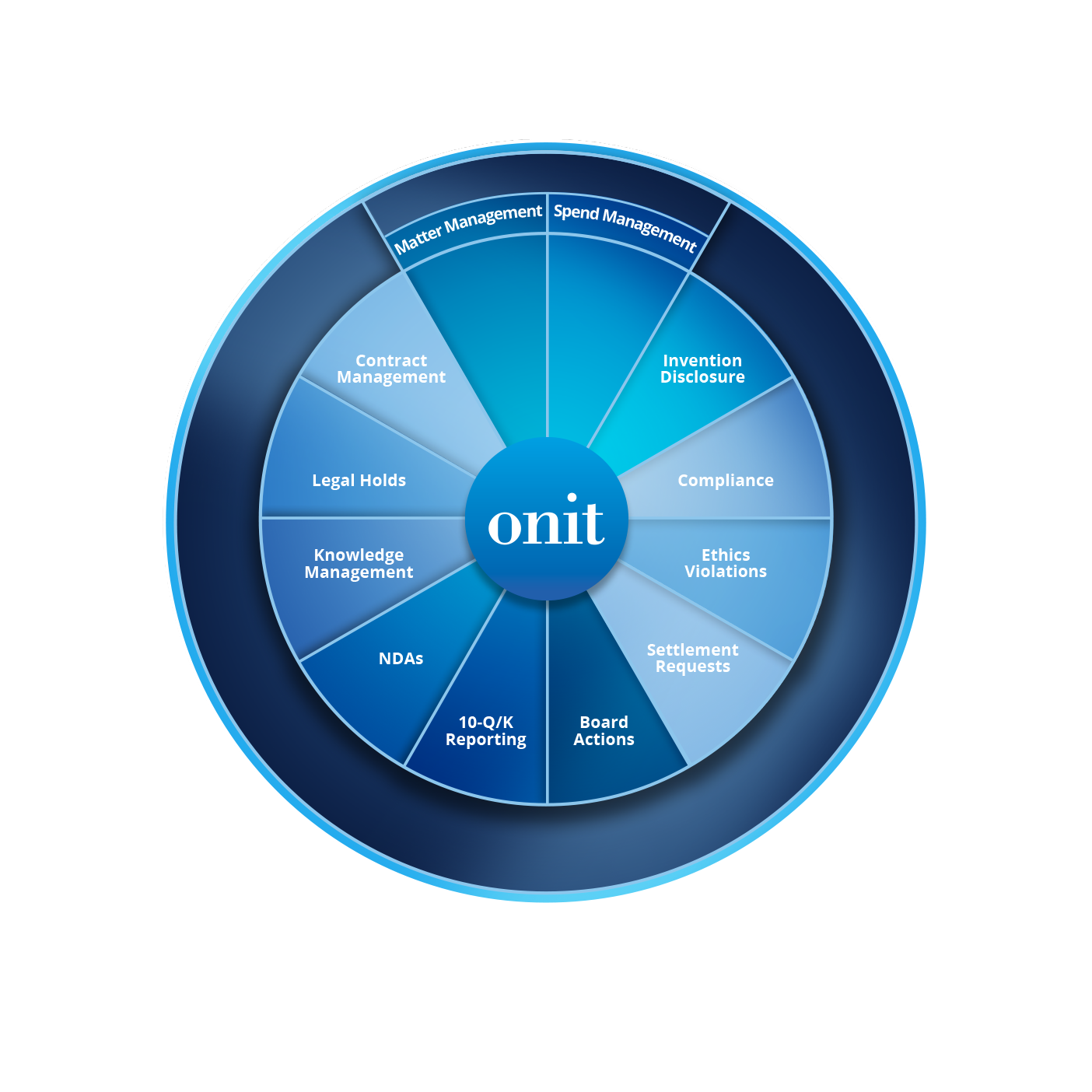
Technology has come a long way. By expanding our concept of ELM to include more of the day-to-day work that limits legal’s ability to contribute to the bottom line, we can improve process, collaboration and workflow to achieve a higher level of performance that better serves current and evolving business needs. In addition to matter management and spend management, ELM also includes (or rather, should be understood to include):

The Future of ELM 

Gartner predicts the adoption of ELM Solutions will increase from 20 to 50% by 2020. While traditional ELM systems require constant IT maintenance and attention, modern ELM solutions are lean and nimble and tend to work in a more straightforward manner. In many cases, users can configure, deploy, and support Onit solutions with no corporate IT involvement. This is because they are designed and built in an intuitive, “no code” environment that can be learned without even the need for a training session. 

Click here to read the full eBook.

Learn more about bringing your legal department into the future with Onit’s ELM solutions. Schedule a demo today or check out our blog for more information about the many benefits of ELM.

Top 4 Reasons Why You Need An Enterprise Legal Management Solution from Onit!

1. Efficiency – Enterprise legal management (ELM) from Onit are flexible, lightweight, and easy-to-use. To us, ELM is more than just matter and spend Management. Our ELM platform that lets you solve the “whole” of your legal department’s needs, whether that is for contract management, NDA creation and distribution, Legal Holds, SEC filings, eDiscovery or IP issues.

2. Quick Setup – In today’s environment, most ELM initiatives take between nine to 12 months for scoping, implementation and final execution — if not longer. ROI is typically not measured for months after completion. Our implementation process is unique in that no other ELM vendor can offer such quick deployments. Our typical ELM implementation beats the average implementation process by months.

3. Highly Regarded Solutions – From Gartner to Legaltech News, the legal industry is talking about Onit. It’s big news in the industry that no other ELM solution provider approaches legal department operations with “process” as its foundation.

4. Be Ahead of the Curve – Gartner predictions from the February 2016 Market Guide Report suggest that the adoption of ELM solutions will increase from 20 to 50% by 2020. Save your legal team some time by implementing early on.

Onit’s configurable solutions can help corporate legal departments of all sizes. Schedule a demo with us today to learn more. You can also check out our blog for additional articles to learn more about ELM.

Enterprise Legal Management is “Hot” Topic at Summer Tradeshows

Onit’s had a very busy summer so far. We’ve been attending conferences and tradeshows all over the country to educate corporate legal departments about the benefits of enterprise legal management. Last month we hosted a session at the CLOC Corporate Legal Institute, “Process Matters: ELM Redefined – Beyond Traditional Legal and Spend Management – Law Department Operations for the 21st Century.

Lead by Onit founder and CEO, Eric M. Elfman and David Cambria, Global Director of Operations – Law, Compliance and Government Relations, Archer Daniels Midland (ADM), the two thought leaders discussed trends in the Enterprise Legal Management (ELM) space and highlighted how “process” is redefining how legal department operation managers provide “continuous” value to their company.

Brad Blickstein, a contributor to Legaltech News attended and wrote an awesome article inspired by our session titled, “Next Generation ELM Must Be About Process, Collaboration, Automation.” Below are some of our favorite excerpts from the piece:

“Last month, I spent the better part of a week at the inaugural CLOC (Corporate Legal Operations) Institute in San Francisco. CLOC is a grassroots organization of law department operations professionals, and the Corporate Legal Operations Institute was their first effort at a conference. It was a big success, with legal operations leaders from more than 130 companies getting together for three days of networking and education.

One of the sessions I was most interested in was one of those forward-looking sessions, titled “ELM Redefined: Beyond Traditional Legal & Spend Management—Law Department Operations for the 21st Century.” The main speaker on the session was David Cambria, global director of operations, law, compliance and government relations at Archer Daniels Midland Company. David and I collaborate on the annual Law Department Operations Survey, and he’s about as knowledgeable as they come in this area…

…So what should a “next generation” ELM system look like? For starters, managing a legal enterprise in today’s environment requires a lot more than just information about matters and spend. “Of all the things we spend time on, 80 percent are not supported by the tools that supposedly provide enterprise legal management,” says Cambria. According to the 2015 Law Department Operations survey, an LDO’s time is split quite evenly (between 5 and 17 percent of their day) among seven different areas: outside counsel management, technology, law department strategy, law department administration, vendor management, financial reporting/forecasting and electronic discovery. If a system is going to call itself an “enterprise” system, it needs to help the department manage all those areas, and more.

Read the complete article here.

Thank you to everyone who attended our sessions over the past few months. Your presence and eagerness to learn more about ELM means the world to us. We appreciate your time and hope that if you’ll be able to join us again soon. If you have not had a chance to attend one of our sessions, check out our calendar of upcoming events. We’d love to see you this fall!

For more information about how ELM can help your corporate legal department, check out The Plain and Simple Facts about ELM.

The Plain and Simple Facts about Enterprise Legal Management

To get started, let’s first start with a few definitions:

  • The term Enterprise Legal Management (ELM) was coined about 12 years ago to connote broad support of everything that Legal Departments are involved with. The term is also practically defined and referred to as simply Matter & Spend Management.
  • Matter Management is essentially the database that legal project information is stored in, such as parties, details, vendors, etc.
  • Spend Management is the system that handles the electronic invoices, runs business rules against the line items providing audit and validation functions. It’s also the system where financial analytics are run.

Matter and Spend Management are foundational but represent just a fraction of the needs of a corporate legal department. Learn more about Legal Service Requests, Legal Holds, Contract Management, and NDAs.

The Benefits of ELM Solutions for Your Corporate Legal Department

Law departments must provide better service to their businesses and improve operational efficiency:

“In addition to the responsibility of managing documents, e-billing, matters and outside counsel, it’s equally important for corporate legal departments to be involved in business processes and continuously optimize the organization’s processes to improve business performance against goals and objectives. In an enterprise legal management context, BPM includes the automation of manual processes through methods such as workflow and collaboration functionality.” – Gartner: Magic Quadrant for Enterprise Legal Management, 23 Oct. 2013

The future is now and with the proliferation of enterprise solutions that respond to the full range of business needs, it has become increasingly hard for organizations to justify selecting or retaining an aging ELM system.

ELM solutions from Onit are flexible, lightweight, easy-to-use, and directly provide increased operational efficiency and decreased IT labor. We help corporate legal departments keep their practices and businesses running more efficiently.

This isn’t just a trend. Gartner predictions from the Feb. 2016 Market Guide Report suggest that the adoption of ELM solutions will increase from 20 to 50% by 2020. Get ahead of the technology curve and save your team some time by implementing early on.

Learn more about how Onit’s can customize solutions just for your corporate legal department. Schedule a demo with us today or check out our additional reading on ELM below.

Enterprise Legal Management Needs to Grow Up
4 ELM Code Phrases to Fear
Ten Things You Need to Know About Enterprise Apps and How They Relate to ELM
The New Technology Curve
The 4 Axioms of Enterprise Legal Management

4 Enterprise Legal Management (ELM) Code Phrases to Fear

Our previous two posts discussed – Enterprise Legal Management Needs to Grow Up and The Beginning of the ELM SaaS Revolution. This will address some of the ways traditional ELM vendors may try to shift the blame for problems introduced by overcomplicated, underpowered solutions to the customer.

If you hear the following four phrases when evaluating an ELM offering, consider the following translations before you make your decision:

“Senior management has to champion the idea.”

Translation: People won’t use this unless they are forced.

This is something you’ll hear if user experience (UX) isn’t considered an integral part of the design process. Onit ELM solutions are designed to be configured to existing workflows, making adaptability and user adoption simple.

“Change Management is essential for success.”

Translation: The benefit to your business and legal users is illusory.

If a solution claims to offer a significant benefit, that benefit shouldn’t be negated by the amount of effort required to enforce compliance with a new process. Change management is entirely unnecessary when a solution is designed with the user and workflow in mind.

“A strong training program is critical to adoption.”

Translation: This software is incredibly hard to use.

It’s 2016. The vast majority of us have daily interactions with multiple pieces of software. We know our way around a computer. If we still need to attend multiple training sessions to learn how to operate a user interface, that is not a failure on our end. It is a failure in design.

Business software should work and be designed with the same expectations of usability as consumer software.

“We release new versions once or twice a year.”

Translation: Prepare to spend a lot of time and money staying current.

With already lengthy implementation times, frequent version updates can make keeping an application current a full time job. You shouldn’t pay someone a salary to maintain minor changes and oversee the addition of features you never asked for and don’t need.

Case Study: Transforming the Way Legal Works

Now, let’s look at what you can expect from a standard Onit solution implementation.

Onit partnered with a large Fortune 500 client to deploy an NDA App. The company’s in-house legal department processed upwards of 10,000 NDAs annually, with an average turnaround time of 16 days.

Onit developed and deployed a prototype solution within a month to handle global submission, negotiation, and electronic signature of NDAs that supported the existing demand.

The company processed over one thousand NDAs within the first month of deployment, with the completion time reduced to just 24 hours (that’s a 95% reduction from the previous average.) 90% of the NDAs were processed without lawyer involvement.

Modern ELM solutions from Onit are cheaper, quicker to deploy, and more responsive to your actual business needs.

Learn more about what Onit brings to Enterprise Legal Management in our free white paper“ A New Approach to Enterprise Legal Management.”

Enterprise Legal Management Needs to Grow Up

To justify the bold assertion of this article’s subtitle, it is first necessary to understand how today’s traditional enterprise legal management (ELM) systems were born.

The ELM market as it exists today can be traced back to 1978, when Equitable Life’s law department saw the potential for their new WANG VS word processing system to do more. It could be used to manage the details of each legal matter, details regarding outside counsel, and many other things that Equitable Life needed to monitor about their day-to-day legal operations.

Matter Management

Partnering with CompInfo, Equitable developed a matter management system that ultimately became a product called Corporate LawPack. Over the next two decades, Corporate LawPack was ported to a variety of hardware and software platforms, leading to its eventual adoption by the legal departments of many Fortune 100 companies, as well as within many governmental and financial institutions.

The 1980s through the mid-1990s saw the broad adoption of matter management software, designed to facilitate the administration of corporate legal practices. These solutions, while providing a robust matter database, did not affect lawyers or law department efficiency. Primarily, they served as reporting tools.

These databases required a tremendous amount of data to be manually entered if it was expected to drive any meaningful value. For this reason, these systems were not widely used by lawyers themselves and instead relied heavily on support staff to operate.

Spend Management

In the mid-1990s to the early years of the 2000s, matter management’s twin sister, legal spend management, made its entrance — driven, in great part, by DuPont’s implementation of the DuPont Legal Model in 1992. DuPont helped embed the notion that focusing on partnering with outside counsel and managing the rich data provided on legal invoices would lead to significant operational efficiencies and reduced legal spend. This led to the Uniform Task Based Management System (UTBMS) initiative and spawned the new class of spend management software.

Legal spend management systems gave clients visibility into the details of what law firms were billing and it became the primary means of exercising more control over how matters were managed by outside counsel. This transparency initiated a shift in the way legal business is conducted that continues today, with clients having more power to require alternative fee arrangements, enforce billing guidelines, affect cost reduction.

The Beginning of the End

The inevitable followed: spend and matter management provided by different vendors required costly and complex integrations. Customers found themselves managing one vendor relationship for matter management and another for spend management. Ultimately, a number of spend management vendors were acquired by matter management vendors or vice-versa, along with the development of spend management capabilities being built into existing matter management systems.

In either case, the new integrated matter and spend management systems created even more complexity and even steeper learning curves. So much time figuring out how to build an integrated matter and spend management platform was invested during this period that innovation — particularly around the user experience and actual legal department work process — essentially stalled.

When coupled with migrating their platforms from multiple operating systems, databases and supporting the introduction of cloud-based or Software as a Service (SaaS) platforms and other more agile technologies, vendors now find themselves struggling under the weight of their legacy technologies with little focus on real innovation in supporting the broader notion of legal operations and process management. Customers wrestle with software built upon a decades old concept that ELM is essentially a database problem.

But what if that is only half of the equation?

According to Gartner, that’s exactly the case: ELM is no longer just about matter and spend management. In addition to the responsibility of managing documents, e-billing, matters and outside counsel, it’s equally important for corporate legal departments to be involved in business processes themselves.

Gartner states: “In an enterprise legal management context, BPM [business process management] includes the automation of manual processes through methods such as workflow and collaboration functionality. Examples of these include the distribution and approval of legal documents, assignment of tasks and legal resources, as well as the monitoring of alternative fee agreements.”

These are roles that existing ELM vendors were neither built nor prepared for.

Learn more about the modern solutions to ELM stagnation in our next blog post (hint: it’s SaaS)! Or get the full story now from our free white paper.

How Can I Be Sure My Data Is Safe with Legal E-Billing Software?

Even many otherwise highly sophisticated CFOs and financial departments have difficulty estimating expenses and doing fundamental accounting and bookkeeping, they need to control costs and keep outside counsel appropriately reined in.

You know it is time for a change to bring your legal billing process up to date. But you face a problem. Over the past several years, many legal e-billing software and billing apps have sprouted up. While you see the value of this kind of software, in the abstract, you are probably overwhelmed by all the choices and concerned about security and safety.

You’re not being paranoid. There are excellent reasons to be concerned. First of all, untested software (or at least software untested for the kinds of billing needs you need to get done) is out there and can expose you and your team to problems.

You want to maintain control of the billing process and avoid exposure to liability risks (for instance, what if billing data somehow got leaked?). Likewise, you want software without superfluous features that could complicate what you are trying to do.

LEGAL E-BILLING: HOW TO TELL IF YOUR BILLING SOFTWARE IS SECURE ENOUGH

Here are some tips for ensuring your data is safe with the legal e-billing application you select.

  • Choose a provider that takes information security seriously. BusyLamp is ISO 27001 certified, meaning we have a framework with specific policies and procedures around data risk identification, implications, and control.
  • Choose software with an excellent track record. BusyLamp works with many financial institutions, banks, and law firms. Our software helps them comply with complicated regulatory requirements, and we successfully work with institutions with significant data and privacy concerns. We use sophisticated encryption techniques as well as password-protected access to safeguard data.
  • Before purchasing billing software and installing it, ask good questions. For instance, how can you protect data and billing information from being vulnerable to unauthorized access, manipulation, or destruction due to a fire or accident?
  • Be watchful and systematize data review and backup. Even if the best hacking minds could not crack your systems, you still want to assess your billing statements and processes regularly to identify anomalies or red flags that could indicate problems.
  • Avoid using untested legal e-billing solutions. BusyLamp’s scalable software as a service model has allowed us to provide diverse e-billing and fee-tracking tools. Our product is unique in the world of legal expense management.
  • Respond immediately if you identify a security issue. A data breach or loss of important information is containable if caught quickly enough. By tracking your billing processes precisely and accurately, you will be able to respond faster if a problem occurs.
  • Remember: Encryption is key. To our knowledge, BusyLamp is the only provider that encrypts stored data and not only the end-to-end communication.

Read and bookmark our checklist for more data security considerations.

We would love to understand more about your e-billing concerns and help you find the right solution for your team and budget. Contact us today.

Looking Inward to Control Outside Legal Counsel Costs

Hiring outside counsel to handle urgent, time-sensitive work (or even ongoing, non-sensitive projects) can be heartburn-inducing, particularly if you must keep your team’s financials in line and reduce costs. Here are five battle-tested tips for ensuring that the money you spend on outside counsel gets spent wisely and that you get an appropriate return on any investment.

1. SET GUIDELINES FOR THE SPEND AND ENFORCE THEM.

Be specific and detailed when you create guidelines. Download “Getting Started with Billing Guidelines” for examples. Conduct record keeping, invoicing, and tracking attorney time and expenses according to strict formulas. This “by the book” approach may seem bureaucratic and even lead to accusations of micromanaging. But budget processes left unmanaged tend to evolve for the convenience of those involved rather than for the greater good of the company or customer. When everyone involved internally and externally understands billing expectations, there will be fewer surprises and less room for overinflated numbers.

2. EXAMINE PAST SPENDING AND BILLING HABITS AND LEARN YOUR LESSONS.

What’s gone wrong when you’ve worked with outside counsel? Examine metrics related to your relationship and conduct interviews with your team to gauge your process’s strengths and weaknesses. Map out how you spend money now (your “as is” budget), and then identify where you want to go. Don’t just harp on the problems; pay attention to what is working well, so you can do more of that.

3. MONITOR TO ENSURE QUALITY CONTROL.

After establishing a billing policy, defining how much you want to spend and for what, measuring your deliverables, and determining how to handle noncompliance, you still have work to do! Next, you must follow up on your process and identify slack and unnecessary constraints. When analyzing, look for duplicated steps, task waste, redundant research done on projects, poor communication, and billing at abnormally high rates for administrative tasks, like proofreading or document filing.

4. IDENTIFY BENCHMARKS TO MEASURE OUTSIDE COUNSEL’S OUTPUT.

For instance, if one firm is billing you at 1.5 times the rate you pay other outside counsel, you want to understand why. Why are you paying this extra amount? Is the spend worth it or not? By benchmarking across your relationships with various firms, you can clarify best practices and enforce expectations.

5. WHEN NEGOTIATING WITH OUTSIDE COUNSEL, FIRST LOOK INWARD TO DEVELOP THE BEST ALTERNATIVE TO NEGOTIATED ARRANGEMENT (OR BATNA).

Maybe outside counsel has been delivering good work but charging a relatively high rate. Before you dive into negotiations, determine in advance what you will accept in terms of a rate and your best alternative if you cannot get that rate. For instance, you might end the relationship, seek new partners, terminate the contract in question, and still do other business.

To control outside counsel costs and manage your business more efficiently and effectively, leverage Onit’s European legal management solution BusyLamp.space unique software. Explore our website for more details or call or email our team with any questions.

Request a demo of BusyLamp eBilling.space.

Outside Counsel Management 101: How Often Should You Review the Performance of Your Outside Counsel?

Whether you task outside counsel with predictable ongoing requirements or you and your team send work out ad hoc, you need metrics to track performance and processes to keep your budget in line and deliverables appropriate.

Developing a systematic approach to performance review can eliminate some financial uncertainty, assist your project managers, and identify key performance indicators (KPIs) to measure efficacy. Good reviews can help you purge, if necessary, or overhaul the process you use with counsel to make it work better and more efficiently.

OUTSIDE COUNSEL MANAGEMENT: THE SECRETS TO GREAT REVIEWS

There is no hard and fast rule regarding your review’s ideal timing or depth. These elements will depend on diverse factors, such as:

  • The size and scale of your team. Do you have a Chief Operating Officer or Legal Operations Manager in-house?
  • The length and stability of the relationship you have developed. For instance, have you worked with counsel for years and automated many aspects of the relationship, or are you still getting to know one another and trying to figure out how to work together?
  • The cycle and timing of the work. Are you engaged in long projects with relaxed timeframes or small projects with tight deadlines?
  • Whether you’ve encountered challenges with counsel before.
  • Whether you’re working with (or testing out) multiple attorney teams to determine the best fit.
  • Whether regulatory or compliance requirements necessitate certain types of reporting.
  • The degree to which you’ve solidified your business model. How well do you know what you need from outside counsel? Do you have a clear idea of the ideal relationship, or are you still evolving your business and developing your processes?
  • In general, the more problems you’ve had in the past (or you anticipate that you might have, based on experience), the shorter your review timeframes should be. Similarly, the less familiar you are with counsel and your processes and expectations, the more frequently you should conduct performance reviews.

TESTED TIPS FOR MAKING YOUR REVIEWS SUCCESSFUL (AND AS STRESS-FREE AS POSSIBLE, GIVEN THE STAKES):

1. Quantify the expectations of everyone involved. As we touched on before, the more precisely you can identify your KPIs, the easier it is to give feedback. It’s a lot easier to say, “you didn’t meet such and such a number in quarter three” than it is to say, “we are generally unhappy with how you have been communicating.”

2. Solicit internal and external feedback to determine how the performance evaluation process can improve. Don’t assume. Ask good questions. Ask the people inside the process to tell you what could be improved and what works well.

3. Document the performance review process. Even if you’ve worked with outside counsel for a dozen years, and your people know their people intimately, document everything. For instance, someone can quickly fill in if a critical stakeholder leaves. Documentation also lets you improve the process over time. Write down exactly what happens (your “As Is” map). Separately determine precisely how to conduct the review. Then build towards a better process.

4. Use powerful software to automate the review. Explore Onit’s European legal spend management solution BusyLamp eBilling.Space for insights. Our product can help you streamline your outside counsel performance review and strengthen and improve this crucial relationship.

How Performance Reviews Can Help the Outside Counsel Management Process

The process of formal performance reviews is not always the most eagerly anticipated part of the work year for most managers and employees. So why should outside counsel or general counsel and their in-house legal department look upon it more positively?

The answer is that, as with a successful performance review system at any progressive company, the process can help nurture and sustain a good, productive working relationship, which in the end, is what both parties desire. It gives general counsel a chance to discuss and confirm expectations; it can reveal possibilities for improving the efficiency or effectiveness of processes through reviewing reports and procedures; and it provides an opportunity for GCs to praise outstanding performance and bring up any areas for improvement.

Some law firms these days are proactively asking to be evaluated, believing that constructive criticism can be beneficial in the long run, and displaying a positive attitude about the process can only help their relationship.

One of the keys to a proper outside counsel review is to make law firms aware of client objectives/expectations and milestones and the metrics used.

OUTSIDE COUNSEL MANAGEMENT PERFORMANCE AREAS

Some suggested areas of performance for review include:

  • Quality of work — How does it compare with work performed with similar matters, in similar situations, or by this firm in the past?
  • Expertise — Did outside counsel exhibit proper knowledge in such important areas as procedural law and substantive law, opposing counsel, judges, etc.?
  • Timing in delivery of work against expectations
  • Adhering to the budget and staffing plan — and if there were adjustments, were they discussed with plenty of advance notice?
  • Communication with in-house management, including responsiveness and availability
  • Outside counsel collaboration, as appropriate
  • Results

Some of these performance areas should be monitored during outside counsel engagement as progress unfolds, at regular intervals, or in real-time. This is often when feedback and conversation can make a real difference — and this is where versatile tracking, e-billing, and legal spend and matter management software can provide valuable capabilities for compiling data, issuing reports, and analyzing performance.

The in-house team should also remember that outside counsel management is a two-way street, and the best performance reviews will also consider their performance. For example:

How did the general counsel/legal operations team do in managing processes? How did they partner and collaborate to help deliver value? What part of their performance can be better next time?

Request a demo of BusyLamp eBilling.Space today.