Stephanie Bullard plays a key role as one of Onit’s Client Delivery Managers in our Managed Services Group. Recently, Stephanie visited one of Onit’s long standing Enterprise Legal Management customers and “renewed enthusiasm for what Onit can do” by expanding their engagement and providing even more value through Managed Services. Stephanie applies Onit’s value of passion, stating “I don’t settle for ‘good enough’, opting instead to find the best solution for each unique situation. This includes seeing the full value and capacity of our product and using creativity to challenge it and develop it further to better serve clients.”
As Stephanie continues her role on the Managed Services team, she looks forward to seeing the first projects she’s managed from the beginning come to a successful close. This is often a long-awaited award as the projects in the Managed Services team are long-term. Stephanie’s favorite part about working at Onit is that every person she’s worked with “brings outstanding skills and creativity to every project, every client meeting, every day.” In Stephanie’s experience, “each of my team members is willing to share their skills and knowledge.”
Anggie Ramirez is one of Onit’s key employees based in our Austin office who has internally transferred to a role at the newly acquired company, SimpleLegal. In this role, Anggie has built a new team from the ground up. Anggie explains, “It is a professional challenge that I am enjoying every day.” Anggie enjoys “making our customers’ work days and responsibilities easier by streamlining and modeling their processes to our best practices and products.”
As Anggie has recently accomplished the milestone of hiring her full team, she continues to work towards running and delivering the best support service and experience for our customers. Throughout this development, Anggie will also work to balance the team and maintain SimpleLegal’s core values and culture as the team resides outside of the SimpleLegal headquarter office. Asked about her favorite part about working at Onit, Anggie stated that “At Onit, I feel that I have a voice and the feedback is appreciated and encouraged by my manager.” Anggie also values Onit’s support for her extracurricular activities, which includes being a sponsor for Anggie’s professional bowling career (as seen in her picture).
Lisa Schwaller is a Project Manager in Onit’s Professional Services Group in our Houston office. Over the past two years, Lisa has proven herself as a key contributor for implementations as she has completed successful projects over and over. Recently, Lisa’s team was able to deliver on a project with a quick turnaround and receive positive feedback from the client. With a motto of “everything is figureoutable!” Onit’s value of persistence resonates the most with Lisa, as her team is constantly challenged to deliver something new, often with aggressive timelines. Lisa states, “I’m consistently surprised by the creativity that the team applies, but it’s the persistence that makes those creative thoughts a reality.”
Lisa is working towards her next professional milestone of implementing process improvements that will allow the team to deliver a higher quality service to Onit’s customers. Lisa’s favorite part about working at Onit is “working with smart, creative coworkers,” as well as being in an environment where she feels like she can be “[her] own authentic self with [her] team.”
The Panama papers and Paradise papers cyberattacks against law firms. The issues of data harvesting emerging from the Cambridge Analytica scandal. The volume of reported data breaches. Cyber-attacks and data breaches are becoming inevitable as increasingly high quantities of information are stored electronically. In addition, GDPR has introduced requirements to notify the relevant supervisory authorities and individuals who may be adversely impacted much more promptly (within 72 hours of becoming aware).
As a result, there is a greater need for stronger controls around data security, both within your organization and for companies holding your data. A robust records management policy is integral to your company’s ability to understand what information is available, where it is, and in what format. Most importantly, it sets a clear framework for handling, managing, and storing that data.
You may have agreements with your external partners on how they manage and handle your data; historically, companies may have relied on this with little further investigation.
However, if you have ever handled the fallout of a data breach by one of your suppliers, you will appreciate the pressures of trying to assess the potential risk and exposure the breach might have on your company. All of which must be done within very tight timescales if you need to notify the authorities and individuals concerned.
USING LEGAL SPEND MANAGEMENT SOFTWARE TO IMPROVE DATA SECURITY
One often-overlooked tool that can help (both with an immediate investigation and future risk assessments) is a legal spend management system (Onit’s European legal spend management solution BusyLamp eBilling.Space). Integrated legal spend and matter management software can provide a wealth of information to help legal operations understand and manage the data that the law firms hold for you and can support you in building a records inventory.
Legal spend management tools can provide clarity on the following:
The external law firms used,
What type of work outside counsel are undertaking, and
Who at the law firms has worked on the matter and therefore had access to your data.
Knowing the data shared with your law firm is vital for an immediate investigation. Access to the matter details in your legal spend management system will provide you with a good starting point to gather information. Basic information will include the law firm’s name and the person(s) in your firm who may be working on the matter(s). It will also provide a contact point at the law firm. Finally, based on the work, you will have a rough idea of the documents shared with the firm.
If you are looking to assess the risks of sharing your data both now and in the future, legal spend management software will provide details of the number of times your company has used the firm. With this, you can assess the risks and controls in place with all your outside counsel and carry out appropriate system security assessments. You can also more easily check that the law firms have implemented and are complying with your records management and retention policies.
The amount and sensitivity of the data sent to your law firms comes from the type of work undertaken. Most companies will generally share similar types of data for specific categories of work with their external partners. As an example, for an employment issue, details about the employee and the grievance will be shared with the external counsel. Using the information in a legal spend management system about the types of work done by the law firms will help you assess the risks and controls each law firm has in place to protect your data and consider the best and most appropriate ways to transfer your data. Furthermore, it can help you build your records inventories.
Finally, as law firms record the time that a timekeeper spends working on a matter, invoice data captured by e-billing software will allow you to see who has access to your information at the firm.
Knowing and understanding the type and volume of data that your company has shared with your law firms will help you a) respond to and manage any data breach or data loss and b) understand the potential risks to your data. This knowledge will help you assess whether you are using the best legal technology for sharing your data and whether the processes you have in place to transfer your data are appropriate.
Learn more about BusyLamp from Onit, our end-to-end legal spend management solution built for European corporate legal departments.
Diana Plazas is Onit’s financial analyst in the Houston, Texas office. For more than a year, Diana has been crucial to the inner workings of Onit’s Professional Services Group. Diana was tasked with analyzing large sets of historical data of Onit’s past implementations and turned this into a model to help better estimate Onit’s time investment in the enterprise legal management implementations based on their specific characteristics and level of effort. Each day, Diana applies Onit’s value of passion – “being successful or achieving any goal takes hard work. When there is passion we find meaning and determination, and we are capable of achieving almost anything.”
Diana recently joined Onit’s finance team and continues to develop her skills as she completed her chartered financial analyst level 1 certification and is working towards completing level 2 and level 3. “I truly believe that developing these skills will not only make me a better professional but will enable me to contribute more at Onit.” Diana’s favorite part of Onit is that she is able to work with a “genuine group of people that truly enjoys sharing knowledge, support your initiatives, and make you feel valued.” The catered lunches on Wednesdays also make hump day that much more exciting!
Leah Knox is Onit’s senior business analyst based in our Houston, Texas office. Leah has been a critical role in the past year within Onit’s Professional Services Group. She has “several recent successes that make coming to work very exciting!” Recently, Leah supported a customer’s user adoption efforts by taking two trips onsite and conducting 25 user training sessions. Embodying Onit’s value of passion, Leah believes that “passion makes the work important to you, and importance drives you to be successful. For me, I am passionate about service – to the clients, to the users, and to my team.”
By taking Onit’s value of passion forward, Leah is working towards formalizing the roles of end user training and business analysts and applying more structure to those roles. Additionally, Leah has her sight set on being eligible for the K1 Investment Management (K1) Advance Management Program next year and will continue to work on her organizational leadership degree which she is working to complete by end of 2020! Leah’s favorite part of Onit is that “independent thought, innovation, and process improvement are encouraged at every level of the organization. Successes are celebrated and failures are treated as learning opportunities.”
Kanchan Joshi is one of Onit’s Customer Success Engineers in our Pune, India office. Over Kanchan’s nearly two years with Onit, she has played an essential role in delivering quality support to our customers, believing that “quality speaks for itself!” Kanchan’s team received one of the highest rating NPS scores and believes that her “success story is about playing an important role within the team and working towards achieving customer delight!” Kanchan sees that all four of Onit’s values make the company succeed by not only working towards a few of them, but by balancing and applying the appropriate value in the right situations.
Kanchan has always been passionate about working closely with Onit’s customers. As she progresses through her career, Kanchan looks forward to continuing to collaborate independently with customers and contribute more towards identifying their pain points rather than only being a contributor in resolving them. When asked what her favorite part about working at Onit, Kanchan shared that “it never feels like a burden to start a new day. The main contributing reason behind this, I feel, is the openness in culture.” Additionally, Kanchan has been impressed by “being empowered to take decisions at very junior level compared to other bigger players in the industry. This gives a sense of ownership and responsibility which means, every individual gets recognized for their work.”
As legal data is highly sensitive, data privacy, cybersecurity, and compliance are the top corporate organizational focus areas. Yet despite the scrutiny in-house legal rightly applies to business activities and counsel, they are not necessarily applying this same focus when evaluating the legal technology, they use within their departments. The sensitive nature of the information that passes through legal systems means that data security should be paramount.
Anecdotally, we hear of legal tech projects where data security requirements are raised late in the game, sometimes after IT becomes involved in the project, and can result in the favourite vendor getting immediately disqualified from the selection because of weak security features and policies.
This is understandable. Most lawyers and even technology-savvy legal operations managers are not data security experts. The main focus when buying legal software are the features that assist in daily work and decision-making, so the “under the bonnet” functionality is not always front of mind, nor do in-house counsel necessarily know the right questions to ask.
The following list of security considerations will aid you in asking pointed questions so you can address system safety at the same time as the ‘core’ functional requirements of the technology. This will save you time in the selection process and make picking the right solution for you that bit easier. There is already a lot of cyber risk that could be affecting your company, your legal technology should not be one of these worries.
ENCRYPTION (“AT-REST-ENCRYPTION”) Legal documents contain sensitive data. Therefore, encrypt with a secure and up-to-date algorithm. Many legal tech vendors encrypt the hard disk while storing unencrypted data in the database. This interpretation of at-rest encryption is a measure that prevents data leaks in the unlikely event of the theft of a hard disk. Onit’s European legal spend management solution BusyLamp eBilling.Space takes at-rest encryption to the next level by using AES256 to store customer data (including backups) with individual keys securely on the hard disk and in the database. The latter means we apply an additional layer of security as a countermeasure for potential cyberattacks.
ENCRYPTED TRANSMISSION (“IN-TRANSIT-ENCRYPTION”) The data must not only be stored in encrypted form but must also reach the user securely. Therefore, all communication should be encrypted. Since the methods are prone to attack, always use an up-to-date secure version. BusyLamp uses TLS with the version >= 1.2.
DATA SEPARATION
Especially with software as a Service (SaaS) offerings, it is common for an application to be used by several customers. In this scenario, store client data separately from that of other customers. This prevents access to your data by other users “by accident” (e.g., due to software programming errors). There are several ways to separate data, and BusyLamp offers the most secure options. We can provide physical separation, i.e., a customer has their own server, or the most effective logical separation, i.e., a customer owns its database on shared servers.
DATA ACCESS RIGHTS
GDPR and other internal and external regulations often require access rights to be set at a need-to-know level. Therefore, the legal software must allow data visibility to be set individually for each user. BusyLamp works according to the “principle of least privilege” – the normal user can initially see nothing. Then, specific data access for in-house and outside counsel users is activated on an individual or via group logic.
DATA LOCATION
Everyone is talking about the U.S. PATRIOT Act, CLOUD Act, CCPA, GDPR, and similar data security regulations that can have a massive impact on our client’s data hosting strategies. Onit’s BusyLamp legal spend management software is a German product and hence not subject to any potential claims by the U.S. government under such acts. We store data securely at your preferred geographical location.
FIREWALLS AND SERVERS
Any application is only as secure as the servers it runs on. Every application connected to the Internet becomes a daily victim of automatic or targeted attacks. Therefore, a well-thought-out strategy to defend against these attacks by the legal software operator is essential to ensure the protection and integrity of your legal data. This strategy should include several nested measures (the “onion technique”). First, a web application firewall protects the application itself. In addition, the server group gets protected by a firewall. The last link in the chain is an optimally configured server that fends off all unauthorized access. An independent service should monitor all components and actively report deviations from the norm. Regularly updating all systems involved should go without saying to guarantee up-to-date and optimal protection.
INDEPENDENT SYSTEM PENETRATION TESTS
Precautions taken always look good on paper. But is the vendor keeping their promises? To find out, the legal software provider should have their systems tested regularly by an independent third party. This “planned attack” attempts to remove all security measures before a malicious attacker does. All vulnerabilities found are documented and submitted to the vendor for an immediate fix. BusyLamp is tested at least once a quarter by a team of experts; we also allow all BusyLamp customers to view the corresponding test protocols.
SOFTWARE PASSWORD PROTECTION
Robust passwords are essential to prevent unwanted access to the legal system. BusyLamp has configurable password settings that administrators can set to ensure user passwords are sufficiently strong and meet your company’s password policies.
DATA SECURITY RIGHT FROM THE START
The ability to mitigate the impact of any security breaches is important, but security gaps should not arise in the first place. Therefore, your chosen legal tech vendor must deliver regular training to those involved in developing the software to maintain a consistently high level of data security. When testing the software, check the actual functions and search known security holes (e.g., OWASP Top 10).
In honor of Women’s History Month, Onit is recognizing our #Sheroes who go above and beyond every day. This week, we are celebrating Alexandra Divin, Sejal Supariwale, and Josie Johnson.
Alexandra Divin is a program manager in Onit’s Houston office. Throughout her three years at Onit, Alexandra has led her team to a multitude of project completions and continuously provides insight and guidance through milestones of our implementations. Recently, Alexandra faced the challenge of getting an implementation back on track. She was able to gain back the client’s trust, work through the various challenges, and continue to drive towards a successful go live despite the hurdles they previously experience.
Alexandra applies Onit’s values of passion and persistence on a daily basis as the professional services group presents its unique challenges. She is often tasked with finding a solution to these challenges and applies a creative outlook to drive her team, the projects, and ultimately Onit as a whole. Alexandra strives to continue to build out her team and refine their working relationship that they have with Onit’s partners. Alexandra enjoys the people that she works with and believes they are the best part of Onit. The delicious, free snacks provided don’t hurt either.
Sejal Supariwale is a quality assurance engineer in Onit’s Pune, India office. Over the past 18 months, Sejal has played a critical role in the quality of Onit’s solutions delivered to our clients. Sejal and her team were part of delivering a tool to efficiently validate the system fields and their attributes specified by clients which are then produced in a report. By delivering this tool, the team has been able to reduce field testing from 2-3 days down to 2 hours in addition to automating manual tasks. This is crucial to the success of Onit’s solutions delivered to our clients. Sejal embodies Onit’s value of passion as she continues to create something new, conceptualize a new idea and thrive to produce the best output: “I had, I am and I will always be driven by this force.”
Sejal aspires to grow her current role into managing the end-to-end processes by bringing her granular knowledge of the process to benefit the problems faced at the conceptual, functional, technical, and process level. Sejal loves seeing the innovation of ideas, articulation of thoughts, and the urge to reach the top as she looks across the teams at Onit.
Josie Johnson is Onit’s marketing director in our Houston office. Over the past year, Josie has served an essential role in planning and executing Onit’s exceptional events such as tradeshows, customer forums, special event dinners, and so much more. Josie has been able to see the success of her team blossom over the past year as a specific member began in the “starting out” phase and transitioned to the “growth and development” phase of a marketing events manager. Josie feels rewarded each time she sees this member take on a challenge and succeed. Josie is presenting Onit’s value of purpose each and every day as she sees the company rowing in the same direction rather than struggling against the currents that may come our way. This overall creates more positivity for Onit’s customers and the employees.
Josie enjoys sharing her experience with the younger employees at Onit and making an impact on the marketing team, thereby contributing to Onit’s success. Josie appreciates the comradery of the people of Onit as they are setup to deliver excellence through mutual respect and support, teamwork, and the ability to make decisions based on experience and their own analysis.
One thing’s clear: legal tech is being catapulted into the legal industry at a staggering rate. It is bringing about changes that will forever transform the practice of law and the delivery of legal services. The question you should be asking yourself is this: “Does my legal team have control over where our legal spend is going and why we’re spending where we are?”
1. Are your legal bills going up year over year?
If your legal bills are increasing, you’re not alone.
Transparent information about legal spending has become increasingly hard to find. Our data shows hourly firm rates are tracking at almost four times the rate of inflation. The industry is clearly shifting towards a boost in annual profits for law firms, but little has been done to hold them accountable for their rapid rate increases.
Today, law firms are operating like sports teams – gathering the top athletes and pulling them together. Ultimately, this can get extremely expensive.
We all agree that if you find and recruit LeBron, you should pay him LeBron wages. However, it is likely that only 5-10% of your firm’s partners are classified as top-tier talent, and within those firms, they charge Lebron rates for every other 2nd and 3rd-tier partner.
Bodhala helps you unbundle pricing and pay partners appropriately, based on their capabilities and the matters they work on.
https://www.youtube.com/watch?v=Us4HZOStKoo
At the end of the day, we’re advocates for data-driven solutions that improve the relationships, accountability, and transparency between legal firms and in-house counsel.
Now that we’ve got that out of the way, let’s continue to explore other factors to consider when purchasing legal tech solutions.
2. Identify your key challenges and bottlenecks
Committing to a new tech solution undoubtedly requires a certain level of internal due diligence. In order to get the most out of your investment and work towards your desired outcome, your in-house legal counsel must first identify its key challenges and bottlenecks to set clear criteria.
The truth of the matter is, no tech solution can solve all of your problems. The challenge is finding one solution that best addresses your core issues.
Begin the auditing process by holding internal discussions about the tasks that are taking up the majority of each employee’s time. This discussion may reveal budgeting issues or a lack of internal processes to manage rate card RFPs. Take note of all the issues at hand.
Once you identify the gap in processes, acknowledge the skills that you have on the team and the level of effort required to complete each task. Be sure to note any opportunities to improve efficiency.
Why stop there?
Some tech solutions are designed to help you become more efficient, while others provide capabilities that you could not handle on your own. Bodhala can do both, so let’s now explore how this materializes.
3. What systems do you use to ensure your data is clean and accurate?
While most legal-tech solutions tout analytics and reporting capabilities, few do it well. Effective solutions go beyond reporting and help you gather insights that inform key business decisions. The legal industry, in particular, faces complexities that are not often addressed in catch-all reporting and data-visualization solutions such as Tableau.
Further, e-billing platforms have also failed to efficiently analyze spending on a larger scale. E-billing may give you insight into what you’re spending your money on, without giving you the “why” or “how.”
The main reason for discrepancies and irregularities in your legal data is the fact that taxonomies vary across legal practices and firms, which complicates datasets and provides inaccurate results. Complexities in discounts applied, inaccurate data entry, and many other factors also contribute to the issue.
Bodhala’s Hercules database provides source-of-truth data sets that help augment and enhance line item data. Hercules provides data around firms, timekeepers, practice areas, anonymized street rates, and domain-specific measurements that provide unprecedented transparency.
Supplementary to Hercules’ QA rules, Bodhala’s Data Ingestion Team also guarantees that your data is clean and consistent across the board.
4. Capabilities that improve visibility and transparency
The lack of clarity, visibility, and transparency has allowed legal firms to get away with being big black boxes, complete with messy billing, hidden charges, and inconsistent rates. These factors have made accurate billing nearly impossible to track.
When shopping for a legal tech solution, identify unique offerings like Bodhala’s standardized rate cards.
In the past, rate cards provided little to no explanation on industry rates, net effective rates, relationship discounts, and the practice area discounts that were being applied to your invoices. Bodhala consolidates and standardizes all your rate cards in one place, which provides details on discounts and write-offs in every line, allowing you to dive into the details and uncover where your dollars are going.
5. Take data security seriously
Legal and financial data is comprised of personally identifiable and proprietary information that can put your business in danger if compromised. While basic security protocols may seem standard, it’s simply not safe to assume that your data will be protected.
When looking for your next legal tech solution, be sure to ask questions about the prioritization of data security, data encryption, backups, and other strategies that are being employed to keep your data safe.
6. Ease of implementation: integrations with your current workflow
Before you pull the trigger on finding the right legal tech solution, you must evaluate your onboarding process and how it affects your workflow. The last thing you need is an onboarding process that takes 10 times longer than expected and completely reorganizes the way you work. The time and resources that you lose implementing this new technology is too costly and must be considered when calculating the total cost of ownership.
Tech platforms are inherently complicated, especially when dealing with tremendous amounts of sensitive legal data. To better predict your success with a legal tech platform, look for a solution that works with you and your external teams. You want something that is easy to onboard, but is also easy to educate your team on. Don’t be afraid to ask questions about a dedicated account manager, training programs, reference materials, and communication channels.
7. Tracking and measuring your desired outcome
Set SMART (specific, measurable, attainable, relevant, time-bound) goals in the beginning of your tech evaluation process. Refine those as you make your vendor selection and hold both the team and platform accountable for them. Remember, if you set goals together, you’re sharing the responsibility to extract success from your new investment.
For example, you can set KPIs around time saved on RFPs or the percentage saved on outside legal spend. Whatever it may be, ensure these goals are baked into regular touchpoints with your account team during your QBRs.
8. Meaningful client support
Finding success on any tech solution requires a proper onboarding and training process. Adopting a new solution is rarely plug-and-play and requires new workflows, internal product experts, and comprehensive training.
As we like to say, garbage in, garbage out. You’re more likely to find success with your new platform if your team has the foundational training to use it correctly.
A dedicated client success manager is also integral to your success. A product expert can help you maximize results with the least amount of effort possible, so you’re not stuck wasting time on a product that you purchased in order to save time and money.
9. Leverage referrals to find the right solution for you
While online review sites like G2 and Capterra can provide a general sense of a product’s core capabilities, there’s no better way to see if a solution may be right for you than to obtain a word-of-mouth referral.
Ask for a reference and take some time to speak to current customers of the tech solution. Come prepared with questions and get an honest understanding of both the good and bad of the solution you’re shopping for.
In the not-so-distant past, legal operations was thought of as a field for people interested in administrating law offices (if it was thought of at all). However, in the past five years or so, the position has completely turned around and become extremely in-demand because of the myriad ways it has proven to improve legal process efficiency and service delivery in corporate legal departments.
One of the major catalysts for the upswing in legal operations careers is the information explosion that has affected all parts of legal. The steep increase in records and data attached to legal matters, and the cost of managing that increase, has resulted in a desperate need for dedicated professionals. While some legal ops professionals excel with more granular tasks among legal practice areas, the best of the bunch tend to be agile generalists who can multitask and take on a wide range of problems. This was a key theme of the session moderated by Onit’s Paige Edwards at Legaltech 2020. The session featured experienced legal ops professionals from Prudential, Purdue Pharma and Toyota.
As the practice of law and the business of handling an organization’s legal and regulatory matters becomes more multi-disciplinary and demanding, legal ops professionals must often be the bridge between people and technology. They often serve as interpreters between legal, IT and the business. Legal ops professionals are tasked with convincing executives that processes and/or technology need updating and overhauling. Sometimes the change can be costly and time consuming, and the best legal ops professionals are the ones that “wade through the tall grass and bring data” to prove that the change is worth it.
Legal ops professionals tend to be some of the most dedicated professionals in the legal industry, and their results speak for their tenacity. Some of the most notable professionals got their start from sitting in on meetings with the idea that they could do something better and faster and then having the courage to approach a manager or executive about their findings. If you think you have the skills to see legal matters on a big picture level, understand technology and have a drive for process efficiency, a career in legal operations might be a great fit.
If you’re interested in a legal operations career, or if you’re looking to hire and need a legal operations job description, check out this blog post from SimpleLegal.
Last year was a banner year for us with several significant milestones including a $200 million strategic investment from K1 Management, the acquisition of SimpleLegal and the launch of our new contract lifecycle management solution. And that’s just the beginning!
After much anticipation, the Legalweek Conference was back this year from February 4th to the 6th at the Hilton Midtown hotel in New York. After three packed days at the world’s largest and longest-running trade show for legal technology, one question remains: was it worth it, and should we be looking forward to next year? Let’s recap.
There were hundreds of exhibitors, dozens of workshops, and numerous speakers in the Hilton Midtown conference center. Every exhibitor brought amazing legal technology products and services and even had onsite demonstrations, including Onit. Our live demonstration of our enterprise legal management and contract lifecycle management software drew excellent crowds and sparked amazing conversations with countless industry professionals.
If you attended, you probably got a glimpse of our Mardi Gras parade on February 4th that led attendees to our happy hour located at the Dream Hotel.
Networking with the attendees provided us valuable insight into how the market was changing and adapting to new technologies such as AI. It is clear that most organizations and vendors are making the push towards incorporating AI technologies into their legal operations, which raised many questions and opinions on the best strategy for implementing and utilizing AI across not only legal but the entire enterprise. The Legalweek Conference also went far beyond just casual networking on the exhibit floor. There were countless sponsored happy hours including Onit’s Mardi Gras Happy Hour and exclusive in-house legal leaders’ dinner! I can guarantee that more business transactions took place during those private events than anywhere else.
But more importantly, the Legalweek Conference had a wealth of different sessions, speakers, and workshops. Onit’s own Account Manager Paige Edwards moderated the session, “Career Up! LegalOps for eDiscovery Professionals & Tech Wonky Attorneys” which was an enlightening discussion between Prudential, Toyota, and Purdue Pharma, that received an incredible turnout. There was also a keynote from blockchain and emerging technology researcher Bettina Warburg, co-founder and managing partner, Warburg Serress Investments and Animal Ventures, where she provided valuable insight into the future of blockchain technology within the legal industry.
So, should you be looking forward to attending Legalweek in 2021? Definitely! We cannot wait to see what new and exciting events, vendors, speakers, and knowledge next year will bring us.
Our clients tell us every day about their challenges budgeting for outside legal counsel. Every year their law firms impose higher rates causing our clients to find more money to cover the increased cost.
Law firms have historically had overwhelming pricing power in the market — far out of proportion to what they deserve in a properly functioning market. They have been able to set their prices and demand clients pay their rates.
It’s evident this power has been wielded irresponsibly. And it’s gone on for decades.
Since the financial crisis in 2008, law firm partner rates at the most prestigious firms have increased more than 72 percent, according to Bodhala data.
With increased pressure to control operating expenses for high-stakes legal matters, corporate legal departments are forced into acting like Sisyphus, pushing a boulder uphill every year trying to stay under budget with little control over the rates they pay to outside firms.
Law firms have justified their rate increases with a series of talking points related to the cost of goods sold — increasing real estate costs, higher salaries to associates, lower realization rates, and fear of losing their partners, among others. Firms have claimed that they are passing the costs of their business onto their clients. But when you look at the data, there is no justification for price increases other than to boost firm profits.
We were interested in this reality and dug into the market looking for trends. What we’ve found validates our assumptions.
We researched law firm billing rates from the turn of the century to now and compared it to the market at large. Interestingly, the findings revealed that, relative to inflation, law firm street rates have greatly outpaced hikes in the costs for college and average rent, and only barely lagged health care premium increases.
The Bodhala Big Law Partner Index
As you can see, these elite partners have seen their rates increase dramatically, right through the Great Recession. Has this been the case in any other market? Other than in monopoly or other non-competitive markets, do CEOs get the power to increase prices by 5-12 percent every year as a matter of course?
The Current Market: Compounding Rates Albert Einstein called compounding interest the 8th wonder of the world. “He who understands it…earns it. He who doesn’t pays it.”
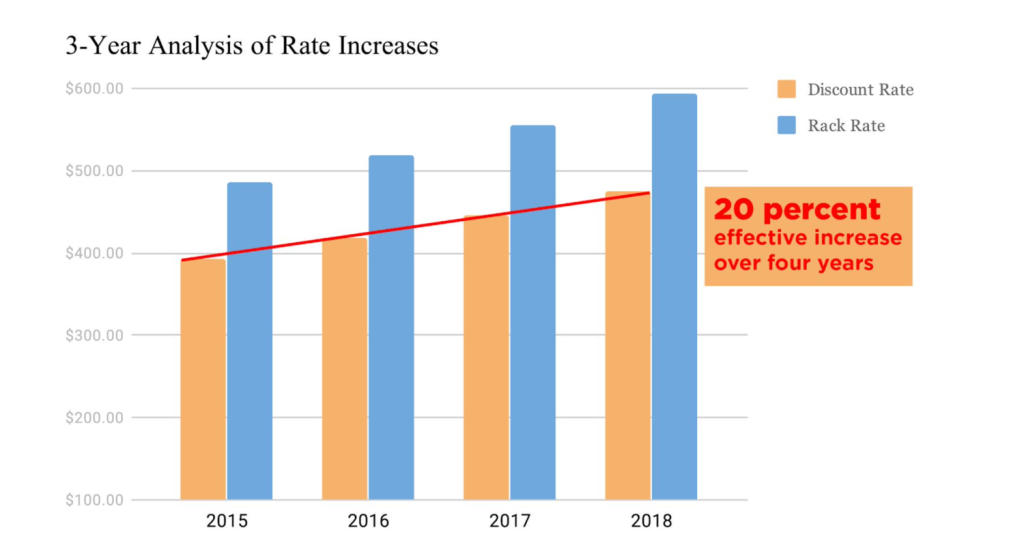
Law firms have used compounding interest to generate record profits even as they claim to give clients meaningful discounts. Here’s an anonymized representation of a real firm’s increasing rates to a client between 2015 and 2018. Note the trends behind those stated rates:
As a result of this shell game of sorts, the market itself is murky. Those in legal procurement wonder, what is the ‘true’ cost? Indeed, who sets the rates? Where do these market pressures lead?
It’s the same answer year after year: costs go up and clients foot the bill.
The Future: Resetting of a Broken Market At its basic level, a market of any kind should reset itself when the supply outnumbers the demand. The legal market has been unable to arrive at this market-clearing event due to the enormous pricing power of law firms. And law firms have that power in part because of the absence of a “source of truth” — a comprehensive dataset that gives the demand side an understanding of how law firms are price-takers in the market.
Enabling the demand side — corporate legal departments — to have verifiable, accountable data on their consumption of legal services will enable them to become active participants in the price market, and not just be passive price-takers.
This is the future we’re looking to build.
The Bodhala Difference Bodhala is a groundbreaking legal technology platform created by lawyers to transform the half-a-trillion dollar global legal industry. Our platform refines organizational processes by empowering your legal team with deeper insights that allow you to better analyze, interpret and optimize outside counsel spend, trailblazing a new era of legal market intelligence.
With our technology and expert guidance, your legal department’s budget — that Sisyphean boulder — gets easier to understand, predict, and manage. It’s our goal that you can end this cycle for good. But it takes the power of Big Data to take on the power of status quo systems.
We’re built on data – and how we develop it, utilize it and how we analyze it for the benefit of our customers sets us apart. Our proprietary benchmarking metrics and rate review algorithms generate detailed insights into every aspect of legal spend. An intuitive dashboard puts the information you need to make more cost-effective decisions about legal service providers at your fingertips, effectively boosting efficiency and reducing your bottom line.
Bodhala’s clients understand the complexity of their work, where the market trends are, and what the next steps need to be — based on market-wide benchmarks for legal spend.
Let’s talk about the process. Bodhala takes the data you own, along with our proprietary industry data, and delivers insights into efficiency levels, law firm leverage ratios, current rates against similar firms and industry-wide averages, average matter cost, and much more.
This trove of information makes a general counsel’s team much more effective at legal spend management and getting the best outcomes from that spend. What’s more, it’s configured to help you understand precisely where your spend is and should be, compared to others in the market.


 Stephanie Bullard plays a key role as one of Onit’s Client Delivery Managers in our Managed Services Group. Recently, Stephanie visited one of Onit’s long standing Enterprise Legal Management customers and “renewed enthusiasm for what Onit can do” by expanding their engagement and providing even more value through Managed Services. Stephanie applies Onit’s value of passion, stating “I don’t settle for ‘good enough’, opting instead to find the best solution for each unique situation. This includes seeing the full value and capacity of our product and using creativity to challenge it and develop it further to better serve clients.”
 Anggie Ramirez is one of Onit’s key employees based in our Austin office who has internally transferred to a role at the newly acquired company, SimpleLegal. In this role, Anggie has built a new team from the ground up. Anggie explains, “It is a professional challenge that I am enjoying every day.” Anggie enjoys “making our customers’ work days and responsibilities easier by streamlining and modeling their processes to our best practices and products.”
 Lisa Schwaller is a Project Manager in Onit’s Professional Services Group in our Houston office. Over the past two years, Lisa has proven herself as a key contributor for implementations as she has completed successful projects over and over. Recently, Lisa’s team was able to deliver on a project with a quick turnaround and receive positive feedback from the client. With a motto of “everything is figureoutable!” Onit’s value of persistence resonates the most with Lisa, as her team is constantly challenged to deliver something new, often with aggressive timelines. Lisa states, “I’m consistently surprised by the creativity that the team applies, but it’s the persistence that makes those creative thoughts a reality.”


 Kanchan Joshi is one of Onit’s Customer Success Engineers in our Pune, India office. Over Kanchan’s nearly two years with Onit, she has played an essential role in delivering quality support to our customers, believing that “quality speaks for itself!” Kanchan’s team received one of the highest rating NPS scores and believes that her “success story is about playing an important role within the team and working towards achieving customer delight!” Kanchan sees that all four of Onit’s values make the company succeed by not only working towards a few of them, but by balancing and applying the appropriate value in the right situations.

 Alexandra Divin is a program manager in Onit’s Houston office. Throughout her three years at Onit, Alexandra has led her team to a multitude of project completions and continuously provides insight and guidance through milestones of our implementations. Recently, Alexandra faced the challenge of getting an implementation back on track. She was able to gain back the client’s trust, work through the various challenges, and continue to drive towards a successful go live despite the hurdles they previously experience.
 Sejal Supariwale is a quality assurance engineer in Onit’s Pune, India office. Over the past 18 months, Sejal has played a critical role in the quality of Onit’s solutions delivered to our clients. Sejal and her team were part of delivering a tool to efficiently validate the system fields and their attributes specified by clients which are then produced in a report. By delivering this tool, the team has been able to reduce field testing from 2-3 days down to 2 hours in addition to automating manual tasks. This is crucial to the success of Onit’s solutions delivered to our clients. Sejal embodies Onit’s value of passion as she continues to create something new, conceptualize a new idea and thrive to produce the best output: “I had, I am and I will always be driven by this force.”
 Josie Johnson is Onit’s marketing director in our Houston office. Over the past year, Josie has served an essential role in planning and executing Onit’s exceptional events such as tradeshows, customer forums, special event dinners, and so much more. Josie has been able to see the success of her team blossom over the past year as a specific member began in the “starting out” phase and transitioned to the “growth and development” phase of a marketing events manager. Josie feels rewarded each time she sees this member take on a challenge and succeed. Josie is presenting Onit’s value of purpose each and every day as she sees the company rowing in the same direction rather than struggling against the currents that may come our way. This overall creates more positivity for Onit’s customers and the employees.