

Category: Business Process Management

Is it time for Contract Lifecycle Management (CLM)? 7 signs you need modern CLM software

Updated March 2026

Manual and fragmented contract processes create real business drag: slow deal cycles, hidden risk, compliance blind spots, and reactive renewals. Modern CLM solutions unite contracting into one automated system so teams can move faster, reduce risk, and gain real contract visibility at scale. Low-touch, automated workflows and centralized data mean you spend less time fixing broken process and more time driving value.

This article helps you answer, “Do we need CLM?” with tangible signals that your organization is ready for a better (and more modern) approach.

Why contract management matters more than you think

Improved contract development and management can increase annual revenue by up to 9%. Yet for most organizations, contract management still relies on manual processes spread across email threads, shared drives, and disconnected spreadsheets. The cumulative impact of these habits costs organizations an immense amount of time and money.

The good news: CLM software exists precisely to close these gaps. Before exploring what modern CLM does, it helps to recognize whether your current process actually needs it.

7 signs your contract process needs modernization

1. Contracts sit in silos and manual tools

If Legal, sales, procurement, and finance all keep contracts in different places, including emails, shared drives, and spreadsheets, you lack a single source of truth. Teams waste time chasing versions, reconciling duplicates, and second-guessing whether a document is current.

  • Legal: struggles with version control and audit trails
  • Sales: loses deal momentum searching for the right template or approval
  • Procurement: cannot confirm whether a vendor agreement is final or still under negotiation
  • Finance: cannot reconcile contract terms with actual performance data

Centralization is core to what CLM software solves. Without it, every team is operating on incomplete information.

CLM software manual

2. You cannot make changes easily or consistently

Contracts have lifespans. Pricing changes. Regulations shift. Clauses get updated. When your process for managing those changes is a manual chase across departments, you introduce inconsistency and risk at every step. Gaps in standardized language open the door to unexpected legal challenges.

If your contracts consistently have language consistency issues, or if updating one clause means hunting down every contract where it appears, that is a workflow problem, not just a documentation problem.

3. People rely on manual follow-ups

If your team constantly chases signatures, approvals, renewals, or milestones via email or chat, your workflow is working against you. Bottlenecked contract cycles and limited process control increase risk dramatically.

  • Legal: waits on business partners to return redlines without visibility into what changed
  • Sales: cannot tell where a contract sits in the approval queue
  • Procurement: misses renewal windows because no automated alert existed
  • Finance: receives invoices that do not match agreed terms because obligations were never tracked

Manual follow-up is a symptom of a process that has no automation underneath it.

4. You lack visibility into contract performance

When performance against obligations, renewals, or compliance is opaque, your team is stuck reacting instead of planning. Without visibility into contract terms and obligations, Legal teams cannot ensure the business is getting the right value from its deals.

Running customized reports on contracts based on specific criteria, such as commission rates, renewal term lengths, or business territory, gives organizations valuable insight into how contracts are actually performing. If generating that kind of report requires significant manual effort, visibility is the problem.

reporting clm software

5. Risk and compliance are hard to track

Missing termination clauses, auto-renewals, or regulatory requirements expose the business to real consequences. A single overlooked clause can mean significant financial and legal impact. When compliance tracking depends on individuals remembering to check, rather than a system designed to flag it, risk compounds quietly over time.

  • Legal: compliance reviews happen after the fact, not before obligations are triggered
  • Procurement: auto-renewals activate on vendor contracts that should have been renegotiated
  • Finance: audit requests surface contracts that were never properly stored or tracked

Structured, auditable contract controls are not a luxury. They are a baseline requirement for organizations managing any meaningful volume of contracts.

6. Legal and sales are in constant tension over speed vs. risk

Lawyers, who work to reduce risk, prefer to review contracts in detail. Sales professionals, who have the job of closing deals, want contracts through quickly. If your organization experiences friction like this regularly, it likely needs a better approach.

The tension itself is not the problem. The problem is a process that has no mechanism for resolving it efficiently. When Legal slows deals and sales finds workarounds, both sides lose. Automated policies and configurable workflows help balance speed and compliance without forcing a choice between the two.

7. You are losing value from renewals or performance issues

Missed renewals, poor terms, or unexpected penalties mean contract data is not working for your organization. When there is no system actively tracking key dates and obligations, value leaks quietly out of every contract.

Contracting delays impact the entire enterprise, stalling revenue generation, new services, and valuable partnerships. If your team is not proactively managing renewals, renegotiations, and performance benchmarks, you are leaving real money on the table.

CLM software contracts

What a modern CLM software actually does

Once the signs above resonate, it helps to understand what modern CLM software brings to the table:

  • Centralizes contract data and documents in one secure, searchable repository
  • Automates intake, workflows, approvals, and deadline reminders
  • Tracks obligations, compliance, key dates, and renewals with intelligent alerts
  • Provides dashboards and analytics for performance and risk insights
  • Integrates with CRM and ERP systems to connect contract data to revenue and operations

The goal is not just to store contracts digitally. It is to make contract data usable, visible, and actionable across the business.

CLM trends in 2026 you should know

CLM is no longer just about automation. AI-assisted insights, natural-language search, and intelligent clause extraction are reshaping how contracting works. Integrations with CRM, ERP, and analytics platforms are turning contracts into strategic data assets rather than static documents filed away after signature. Remote and hybrid work environments have also accelerated the demand for cloud-native, collaborative contract workflows that do not depend on anyone being in the same room or on the same email thread.

Organizations that treat CLM as infrastructure, rather than a one-time implementation, are the ones building durable advantages in how they manage risk, relationships, and revenue.

The business case for acting now

The CLM software market has grown significantly in recent years, and for good reason. Companies using contract management software find advantages across the board: self-service contract creation using approved templates, easier access to contracts stored in one repository, reduction in duplicative work, greater visibility into risk and compliance, and faster turnaround through automation.

CLM software 7 signs

When AI is added to CLM, the impact compounds. Research from Onit’s AI Center of Excellence found that AI-powered contract review can dramatically outperform manual review in speed and cost. A junior lawyer may take nearly an hour to review a single contract, while AI-powered tools complete the same task in minutes at a fraction of the cost. For teams managing high contract volumes, that difference is not marginal. It is transformational.

If your organization is experiencing three or more of the signs outlined above, the cost of staying on your current process is likely higher than you realize.

Frequently asked questions

What problems does CLM software solve?

CLM addresses fragmented contract storage, manual approval workflows, missed renewal deadlines, inconsistent contract language, compliance tracking gaps, and a lack of visibility into contract performance and obligations.

How do I know if my contract process needs CLM?

If your team regularly chases approvals by email, cannot quickly locate the current version of a contract, misses renewal windows, or struggles to report on contract performance, your process is ready for a more structured approach.

What does a modern CLM solution include?

A modern CLM solution typically includes a centralized contract repository, configurable workflow automation, integrated e-signature capabilities, AI-driven clause tagging and extraction, obligation tracking, and real-time dashboards for reporting and compliance.

If your contract process is creating more drag than it should, explore how Onit’s contract management and automation solutions help teams move from fragmented to connected. Or, if you want to see the financial impact of a better approach, Onit’s ROI Calculator can help you quantify what improved contract management could mean for your organization.

Originally published August 2020

Empowering Legal Departments: Onit Named as a Leader in IDC MarketScape for Enterprise Legal Management Software 

In a world where businesses face macroeconomic pressures to demonstrate value in new and visible ways, Onit is a dedicated partner in the journey. Legal’s impact is now, and Onit is at the forefront of ensuring that impact is transformative, efficient, and growth oriented. 

As a longstanding provider of enterprise legal management (ELM), contract lifecycle management (CLM), and business process automation tools, Onit is proud to announce its recognition as a Leader in the IDC MarketScape: Worldwide Enterprise Legal Management Software (Doc #US49842023, August 2023).  

“We are honored to be named a leader in enterprise legal management solutions,” commented Eric M. Elfman, CEO and co-founder of Onit. “At Onit, our mission has always been to empower legal professionals to do their best work through more intelligent and efficient workflows. We will continue to invest in innovation to deliver leading solutions that help legal departments drive material impact.” 

A Portfolio of Solutions for Legal Departments of All Sizes  

With solutions for businesses of all sizes, Onit enables legal departments to modernize workflows, improve operational and cost efficiency, and contribute to faster revenue generation and business growth.

Onit’s commitment to empowering legal professionals is reflected in its diverse portfolio of solutions designed to cater to legal departments of all sizes. Onit has continued to enhance its portfolio to include the following: 

  • OnitX: The next generation of Onit’s highly configurable platform for automating complex legal workflows for enterprise legal management and contract lifecycle management  
  • Onit Catalyst: A family of AI-enabled products purpose-built to elevate the impact of ELM and CLM solutions  
  • SimpleLegal: Tailored for the mid-market, this ELM solution brings transparency and management to e-Billing, matters, vendors, and reporting 
  • ContractWorks: A modular, out-of-the-box solution to manage contracts and legal documents at specific contracting stages or across the entire contract lifecycle 

Customer-Driven Innovation 

Onit’s mission extends beyond technology – it’s an organization that values the voice of customers. The naming as a Leader in the IDC MarketScape report follows a period of customer-driven innovation, including: 

  • Smarter spend management: OnitX Spend Management’s integration with Onit Catalyst empowers legal operations teams with external benchmarks for quicker, data-informed decisions on timekeeper rate approvals. 
  • Complete European ELM solution: OnitX Matter Management’s integration with Onit BusyLamp offers European corporate legal departments a flexible and configurable means to manage legal matter workflows, addressing specific currency, regulatory, and tax requirements. 
  • Seamless litigation compliance: OnitX Legal Holds Management streamlines litigation compliance management and reduces the risks associated with pending litigation. 
  • Visual forms builder: Build custom applications powered by the OnitX workflow engine to address simple legal-related requests like invention disclosures, trademark or logo usage and data breach incident reporting. 
  • Smarter contract lifecycle management: Onit Catalyst ReviewAI and Catalyst Contract Extraction help streamline the contract lifecycle pre- and post-signature processes by using AI to review contracts and extract essential data — such as key terms and obligations, dates and other relevant information — to quickly identify contract risks and opportunities. 
  • Application and data integrations: OnitX leverages scalable technology from Workato, an industry-leading iPaaS technology provider, to integrate with applications such as Salesforce, SAP Ariba and Microsoft 365 so users can work in their preferred tools while data flows into other critical business systems that support revenue and operating expense management. 

Elevating Legal’s Role Within the Enterprise  

Legal is most often viewed as a stellar guardian of the enterprise and outstanding advisor — yet its perception as a business partner is not quite as golden. In the 2023 Enterprise Legal Reputation (ELR) Report, four in five (78%) corporate employees perceive Legal’s enduring image as a trustworthy protector of the business that imparts sage advice. Yet even though respondents view Legal as an authority figure and business protector, nearly three in four (73%) do not consider Legal an approachable business partner. In fact, many view Legal as a “bottleneck,” as “adding unnecessary roadblocks,” or “simply expect to experience holdups” when interacting with legal teams. As a result, relationships between Legal and its internal clients have declined year-over-year (YoY) in every department — by almost 10% in HR, 18% in Finance, 30% in Sales, 27% in Marketing, and 41% in Procurement. 

Onit’s mission is to elevate Legal’s stature within the enterprise by automating business-critical workflows that drive material impact,” said Scott Wallingford, President of Onit’s Enterprise Business. “With the next generation of our platform in OnitX and key product updates from Onit Catalyst, customers can optimize legal workflows across their entire enterprise — from ELM functions like matter and spend management to CLM functions like contract management and review. Macroeconomic pressure influences enterprise functions to show value in new and visible ways, and we’re partnering with our customers to do just that. Legal’s moment of impact is now.” 

Additional Resources 

For more company news, industry trends and best practices from corporate legal innovators, read the Onit blog and follow us on LinkedIn

How AI Enables Legal Teams to Adapt in a Rapidly Changing World 

Between global economic, political, and social unrest, data privacy concerns, regulatory changes, and even the effects of climate change, the world is moving at a dizzying pace — and legal departments are hard-pressed to keep up. The secret to continued success? The rapid insights provided by AI-powered solutions.

Shepherding a legal department has always been challenging; the current business world presents more headaches for Legal than ever. Here are just a few of the things that can keep Legal practitioners up at night:

  • The continuing effects of the global pandemic forcing constant contractual monitoring, revisions, and examination to stay in compliance.
  • A new global focus on privacy concerns, bringing in a host of new rules and guidelines — differing across countries and regions.
  • Continued social and political unrest (along with the effects of climate change), causing disruptions to overseas vendors, supply chains, and more.
  • Ever-changing, constantly updated regulatory revisions at a wide variety of levels, requiring consistent, sharp vigilance.

Any one of these elements would be cause for massive concern. When combined, they create a perfect storm of factors that could easily overwhelm a legal department — a storm that does not look like it will subside anytime soon.

Another complicating factor? The sheer volume of contracts and data can also be overwhelming. For example, the average Fortune 1000 company has anywhere from 20,000-40,000 active contracts at any one time (per the US National Association of Purchasing Managers). For large national banks dealing with the effects of the Libor transition, a calculation of 20,000 negotiation processes at a conservative six hours apiece equals around 17,000 days (about 46 and a half years) of project time and a staggering £15-20 million in costs.

The Power of AI in Contract Management

How can Legal keep up with this rapid change that the fast-moving modern world demands? A Contract Lifecycle Management (CLM) system backed with the power of AI is the key to keeping up with the necessities of today’s speed-of-light business environment. CLM augmented by AI delivers the accessibility, flexibility, adaptability, and accessibility organizations need to thrive.

This combination enables users to:

  • Quickly track down those critical documents that have risk for the organization and require urgent attention, allowing for timely response.
  • Reduce overall risk by improving the accuracy of contract review and cutting down on the chance of human reviewers overlooking critical information.
  • Provide automated redlining, commenting, and critical guidance to reviewers on where to redraft, repaper, and/or renegotiate, speeding up overall work.
  • Make large volumes of documents much less intimidating with AI’s immense scalability features, allowing for the review of thousands of pages of dense contracts in minutes.

Without this edge delivered by a combination of AI and CLM, it is easy for an organization to fall behind in a world where dramatic shifts can happen so suddenly. CLM augmented by AI helps keep up with rapid change for a rapidly changing world.

Onit Catalyst Contract Extraction helps find, organize, and action critical information in large volumes of contracts. Click here to learn more.

Legal’s Brand Image: A Shining Opportunity for Positive Influence

Legal is most often viewed as a stellar guardian of the enterprise and outstanding advisor — yet its perception as a business partner is not quite as golden. In these uncertain economic times when businesses are searching for both cost efficiency and growth, what can Legal do to reconcile its reputation and magnify its material impact?

In business as in life, image is essential. It is also a principal focus of the 2023 Enterprise Legal Reputation (ELR) Report*, which reconfirms one of the most prominent findings from its inaugural edition: Four in five (78%) corporate employees perceive Legal’s enduring image as a trustworthy protector of the business that imparts sage advice.

Yet even though respondents view Legal as an authority figure and business protector, nearly three in four (73%) do not consider Legal an approachable business partner. In fact, many view Legal as a “bottleneck,” as “adding unnecessary roadblocks,” or “simply expect to experience holdups” when interacting with legal teams. As a result, relationships between Legal and its internal clients have declined year-over-year (YoY) in every department — by almost 10% in HR, 18% in Finance, 30% in Sales, 27% in Marketing, and 41% in Procurement.

Image is (Almost) Everything

Though Legal’s inherent image has remained, the world has changed dramatically over this past year. The bullish economy at the outset of 2022’s data collection is now besieged by the effects of inflation and layoffs due to the macroeconomic climate. This itself had been sparked by the continuing effects of the global pandemic and social and political unrest that have set off a chain reaction of privacy concerns, regulatory revisions, and disruptions to overseas vendors and supply chains.

Cost containment and EBITDA are now the terms of the day, and legal departments are no exception to enduring employee burnout and smaller budgets. For a function established to protect the business, it is not overwhelmingly startling, then, that when so much seems fragile and beyond our control, trust in Legal might experience a stress fracture of sorts.

There is a silver lining, however: The major finding in the 2023 ELR Report is that Legal can play a meaningful part in impacting business materiality, growth, and operational efficiency. Right now, Legal has the opportunity to reset expectations and reshape its reputation in the eyes of its internal clients and executive teams. Here are three ways that Legal can “up” both its positive image and material impact, especially in these times of economic uncertainty.

1. Collaborating more intently.

The 2023 ELR Report reveals that nearly half (43%) of the study’s non-legal respondents state that better communication and collaboration is the most essential way Legal can support its internal clients. Of course, execution of matters is always important. Providing better law firm or outside counsel management is as well. But what clients say they need more from Legal is more involved client service within the business, and that starts with better communication and greater responsiveness.

2. Accelerating processes and workflows.

While there are many capacities in which Legal shines, almost half (45%) of corporate employee respondents feel that Legal can be too slow. Another 15% cite the fact that they feel processes are overly manual, which also has a negative impact on efficiency. Some legal matters do take longer than others, of course, but this is where technology — including AI — can play a significant role in keeping everything from spend management to contracts moving.

3. Championing corporate culture.

Another way Legal can demonstrate its charter as protector is with diversity, equity and inclusion (DEI). Although current macroeconomic conditions may force companies to put the bottom line ahead of investment in cultural initiatives, Legal has a powerful base from which to influence DEI: More than half (57%) say Legal’s impact on corporate culture is positive. That fact must remain top of mind for Legal — to provide a safe and equitable work environment, to elevate problem-solving and competitive differentiation, and to foster and nurture lasting trust.

Reputation, it has been said, is the echo that remains once we are no longer in the room. It can make or break us — and that goes for legal departments as well. Fortunately, Legal has a firm foundation on which to continue building, with its enduring image as trustworthy protector and advisor. Yet Legal doesn’t exist only to protect.

This is Legal’s metamorphosis moment to evolve its image into that of a greater, more strategic business partner — by communicating more deeply with clients, accelerating efficiency, and embracing cultural and technological innovation. In turn, Legal will have a more positive and direct influence on the growth and materiality of every corner of the enterprise.

Read Chapter 1 of the 2023 ELR Report to discover new and enduring perceptions of the legal department, how corporate employees view their interactions and relationships with Legal, and ways in which Legal can evolve its brand image to more directly impact revenue generation, growth, and operational efficiency for its businesses.

*The 2023 Enterprise Legal Reputation (ELR) Report is the second installment of a multinational annual study spotlighting year-over-year changes in the brand image of corporate legal departments through the eyes of their internal clients.

Experts Evaluate the Potential of Legal Contract Management Software and AI  

Legal contract management software also referred to as contract lifecycle management, has made significant headway in the world of in-house counsel, racking up impressive stats such as reducing the average sales cycle by 24% and saving 9% on annual average costs. But what happens when you combine legal contract management software with AI?

A panel of legal and AI experts from organizations including Adobe and Onit, presented at Legalweek on just this topic, examining the potential impact of AI on managing contracts and how to start implementing AI into your contract management workflows. The conversation touched on the business value of using AI in legal ops, the efficiencies AI can bring to your business and future trends in AI, among other things.

Here are some of the biggest takeaways for AI and legal contract management software.

How to get started with AI

One of the easiest places for legal departments to start using contract AI and automation is in common use cases like reviewing NDAs and other routine contracts because these are high-value but time-consuming activities. The need to increase speed is high, but the risk is relatively low.

On the applicability of AI to law

AI has strong applications to both the business side of law and the practice of law. From a business perspective, contract AI can help with important, routine tasks like invoice review and billing. As for the practice of law, AI is ideal for tasks like tracking 20 different clauses in the 56,000 NDAs you handle each year, significantly boosting productivity and efficiency.

Do your research

To get the most out of your AI tools, you want your relationship with your technology vendor to be a true partnership, and you want to apply your own judgment to why your solutions are doing what they’re doing. With both your vendor and your solution, you want to retain a certain level of control to ensure you’re getting the results you want.

Have a strategy

When you start implementing AI with your legal contract management software, you don’t want to be thinking just six or twelve months down the road but further down the horizon. When you create a longer-term vision, you’ll be better able to take into account the needs of your various stakeholders and secure their buy-in for your chosen AI solutions.

Laying the groundwork for adoption

Many companies find it easiest to start with a single use case or data set and train their AI models from there. Once you have your first success, it will be easier to roll out your new technology across other business units and the organization as a whole.

AI and compliance

When you use AI for contract lifecycle management, your tools can help you stay on top of the constantly changing federal and state regulatory landscape. AI can assess your legacy contracts against new regulatory changes and ensure that any necessary updates are made.

Contract AI and CLM

AI helps in the pre-signature phase of contracts by creating centralized workflows for contract management and templates that allow your team to draft, review and redline contracts with just a click. AI also assists in the post-signature phase by extracting actionable intelligence from your contracts that can serve as the basis for informed decision-making.

On justifying spending money on AI to the C-suite

According to a recent study, users saw on average a 51.5% gain in productivity after using AI for contract review. That’s an almost immediate gain in productivity, and some use cases saw even better results. Moreover, the efficiency continued to increase over time as users became more familiar with the tools and the tools got smarter. The data extraction capabilities of AI contract tools also help to reduce risk and stop revenue leakage, which has a positive financial impact on the business as a whole.

Future trends in AI

While AI was originally targeted more toward law firms, the focus has shifted to in-house teams. We’re likely to see an even greater emphasis on using AI in contract drafting and CLM this year.

If you’d like to learn more about AI and contract lifecycle management, here are two helpful webinar replays:

  • The Future of Contracting: CLM + AI Transformation at Lenovo – Every company needs a faster and more efficient contracting process that enhances risk and spend management, improves revenue and profit margins, and increases visibility into counterparty relationships. The Lenovo Legal Department’s transformation journey is delivering value to the business by centralizing the global legal transactional support resources, standardizing the contract process across the company and optimizing the process with technology.
  • AI Mythbusters: Deprogramming Misconceptions – Confusion and misinformation around what Artificial Intelligence is and how it works is widespread, particularly in the legal technology space. Watch this webinar to debunk ten common misconceptions and learn how to decipher marketing-speak to separate true AI from just software.

OnitX Legal Holds Management: An Easier Path Through a Challenging Trail

The legal holds process is often a painful one; it’s also a necessary part of doing business, as a critical and extremely visible cornerstone of litigation and e-discovery. Unfortunately, too many legal holds products on the market present a poor fit for legal organizations. Most options for legal holds come built for specialized teams, with complex software, manual processes, and a highly technical focus; they’re built for e-discovery first, with the idea of legal holds as an afterthought (at best).

This presents a massive challenge to mainstream legal departments, as these options lack the accessibility, convenience, and straightforward management required to secure a smooth legal holds process throughout the organization. The good news? There is a better legal holds option out there.

A Simpler Solution for Legal Departments: The Benefits of OnitX Legal Holds Management

Purpose-built for mainstream legal teams, OnitX Legal Holds Management delivers an easy-to-use, easy-to-initiate solution for this vital task. OnitX Legal Holds Management offers a straightforward four-step process for initiating holds:

  • Select the custodians you want to put on the hold. A pre-configured integration works with virtually every HR and back-end system to ensure distribution to the correct parties. One-click options release or restore custodians from legal holds as the needs of the matter change.
  • Draft and review the legal hold notice. Utilize the Legal Holds Management template library to cut down on creation time and use for future holds.
  • Review the legal hold notice with essential parties. Approval steps can be configured and assigned to the appropriate reviewers.
  • Distribute the legal hold. Custom dashboards and reports allow organizations to check in on the status of legal holds and analyze key metrics.

Another benefit of OnitX Legal Holds Management? Significantly improved communication with essential custodians throughout the organization. Instead of a time-intensive administrative task — chasing down non-responsive custodians to secure their involvement – Legal Holds Management provides a streamlined, automated way to communicate the legal hold status to involved parties. Communication features include:

  • Automated custom scheduling of communications to remind custodians of the legal hold status — and alert others to non-responsive personnel
  • Proxy acknowledgment to reduce the burden on key executives, empowering assistants and other proxies to keep the legal holds workflow going
  • Custodian digest emails so custodians can quickly see which holds they are on and what they must do
  • Custodian dashboards to easily resolve all holds in one space

Finally, Legal Holds Management takes the pressure off an organization’s IT department by delivering simplified and comprehensive document preservation through Integration (powered by Workato). Legal no longer needs to coordinate with overworked IT staff to ensure the department secures every must-keep document. Legal Holds Management removes the ask for IT support with easy, fast preservation of all necessary files and includes:

  • Single-checkbox enablement by legal staff, with no IT help required (beyond initial setup)
  • Slack preservation by channel and direct message
  • Google Vault preservation for docs, chat, and/or email on a service level
  • Microsoft 365 email and Teams preservation with the click of a button

Legal Holds Management also delivers organizations complete auditability, getting a complete trail of legal hold activity and complying with Electronically Stored Information (ESI) requests for overseas employees.

Seamless Integration with Matter Management

In an economic environment where the organization expects every department to drive business revenue, Legal must take the initiative to create streamlined processes and make the most out of its resources. Legal Holds Management integrates seamlessly with OnitX Matter Management where the initiation of a litigation matter starts.

The simplified, user-friendly, and accessible Legal Holds Management gives Legal the efficient edge it needs.

Learn more about OnitX Legal Holds Management here.

Powering Scalable and Rapid Integrations: Onit’s Partnership with Workato 

A streamlined, scalable, and rapid application integration layer is essential to the success of a SaaS platform. A modern platform must ensure connectivity and communication with business-critical applications and data sources throughout the organization. This makes it easy for users to perform workflows that cross over multiple applications. Integrations also deliver critical connections between the platform and stand-alone analytic tools, enabling powerful insights derived from the platform’s data repository.

If application integrations are seamless and easy to implement, the solution can do what it must without any headaches for vendor or customer — and quickly secure its return on investment. On the other hand, a platform that fails to integrate rapidly with other necessary business applications can be devastating for an organization. Poor integration can bring about a loss in productivity, wasted time and resources, and overall platform failure (not to mention the catastrophic budgetary consequences).

OnitX, a smart workflow platform for sophisticated legal matters and contract solutions, has introduced a scalable and secure integration layer powered by Workato. One of the most honored companies in the space (recognition includes a coveted place on the “Forbes” Cloud 100 list and the “Leader” designation from Gartner five years in a row), Workato delivers simple connections of applications that match business needs and reinforce integrated workflows.

The new OnitX integration layer offers SSO authentication, tailored resources, and custom integrations. It also provides unlimited scalability, a centralized admin console, and high-end security features that allow for future growth, easy management, and complete customer and vendor safety. Powerful auditability features enable IT departments and compliance efforts to track the digital trail of essential documents and communications. Additionally, Workato API abstraction makes it simple to adopt new software versions.

Additionally, the platform makes it simple for organizations to preserve APIs as future versions roll out — keeping integrations up to date, so clients do not have to worry about time-consuming version maintenance.

The OnitX platform provides three integration options:

  • Standard OnitX integrations for typical applications that are part of legal matters and contract workflows
  • Custom integrations built by Onit to support the unique needs of individual corporations
  • Partner or customer-built integrations later this year using the OnitX Integration Builder

Several standard OnitX Integrations are either available today or will be available shortly, including:

  • OnitX Legal Holds Management integrations: Allows for the seamless preservation-in-place of electronic documents through integrations with standard productivity tools such as Google Workspace, Microsoft 365, and Slack.
  • Salesforce integration for OnitX CLM: Gives sales teams the transparency to always know the location and status of their contracts within Salesforce, including agreements coming up for renewal.
  • SAP Ariba integration for OnitX CLM: Enables users to initiate contract workspace creation within SAP Ariba and streamline the flow of supplier data into OnitX CLM, reducing data re-entry and improving efficiency.

To learn more about the OnitX platform, please read this blog.

Introducing Onit Catalyst – Upping the AI Game for ELM and CLM

Since the birth of artificial intelligence at a conference held at Dartmouth College in the summer of 1956, it has made rapid strides. In recent years, AI has garnered considerable investment; as of the end of 2020, the top 100 AI startups globally had a combined valuation of over $258 billion.

However, in some regards, AI technology has become a commodity, with many of the technologies being part of the open source community. Its application to specific business or technical use cases that depend on models built by a combination of data scientists and engineers, functional or industry experts, and a large amount of curated data makes AI a valuable business contributor.

We have been at the forefront of incorporating AI technology into our product as we seek to add more customer value through automation and intelligence. Beyond AI-based products developed in-house, we have acquired various AI-based products and technologies to bolster our capabilities.

We are excited to announce the new brand name of our AI-enabled products purpose-built to transform ELM and CLM is Onit Catalyst. A chemical catalyst is an inert substance, but when added to a reaction, it accelerates it. Onit is applying AI in the same way – combining it with your data, use cases, and other Onit products – to accelerate the value you receive from it. The Onit Catalyst products were previously marketed under the Precedent and Bodhala brands.

Onit Catalyst provides actionable insights from legal matters or contract data through better reporting, dashboards, benchmarks, and legal business intelligence. They can be implemented alongside an existing third-party ELM or CLM implementation or with the OnitX platform, to which they have tight and seamless integrations. With Onit Catalyst, we have done the data science for you. In addition, our AI Center of Excellence has applied AI and other analytic techniques to address real and practice use cases related to enterprise legal management and contract lifecycle management. Powering the Onit Catalyst products is a dataset that includes $47B+ in legal billings, over 200,000 timekeepers, 8,900 law firms, and more than 1 million assisted legal interactions each year.

Below are the products within the Onit Catalyst family:

Onit Catalyst for ELM
Proactive law firm management using legal business intelligence so legal can run like a business
Onit Catalyst for CLM
Smart management of legal documents via process automation, augmentation, and intelligence
Onit Catalyst Report Cards
Onit Catalyst Quarterly Business Review
Onit Catalyst Rate Benchmarking
Onit Catalyst Matter Benchmarking
Onit Catalyst Rate Proposal Analyzer
Onit Catalyst Comparative Analysis
Onit Catalyst ReviewAI
Onit Catalyst Contract Extraction

Onit Catalyst products will always work best with the OnitX platform to form smart solutions that provide insights at the point of decision and need.

Contact us to learn how Onit Catalyst can enhance your ELM and CLM workflows today.

From Manual to Magical: The Power of AI in Contract Management

World Commerce & Contracting states, “Smarter contracting is a new vision for how modern enterprises should experience contracting. A vision that elevates the role of contracts as a source of the real-time data needed to manage the complexity of today’s business environment.”

Contract management is a vital process in any business, and it can be complex and time-consuming. However, contracts are the backbone of any business relationship and must be well-managed to satisfy all parties involved. Contract Lifecycle Management (CLM) software has been around for some time, but the application of Artificial Intelligence (AI) re-introduced innovation to this field. Whether you are part of corporate legal, procurement, or sales operations, you need reliable tools to streamline workflows, reduce manual workloads, and increase productivity. So, what’s required to make this vision a reality?

By 2024, Gartner predicts a 50% reduction in manual effort for contract review % due to the adoption of AI-based contract analytics solutions. While technology is a vital part of this puzzle, it needs to be approached differently. AI-powered CLM is the way businesses go from manual to magical. AI is infinitely more effective when closely interwoven into enterprise functions connecting people, integrating systems and data, and facilitating the flow of intelligence.

Introducing Onit’s Smart CLM Solution

This is why Onit developed Smart CLM. Onit’s Smart CLM solution streamlines the contract management process pre- and post-signature, reducing the time and resources required to manage contracts. The solution uses AI to automate the review of contracts and extract essential data from them, such as key terms and obligations, dates, and other relevant information. As a result, businesses can quickly and easily identify potential risks and opportunities in their contracts, which can help them make informed decisions and negotiate better terms.

Key to Onit’s Smart CLM is the tight integration of OnitX CLM with two new products, Onit Catalyst ReviewAI and Contract Extraction. Catalyst ReviewAI utilizes advanced AI algorithms to analyze and extract key contract data points, such as dates, clauses, and obligations. As a result, you can quickly identify potential risks and issues and prioritize your work accordingly. By using ReviewAI, you can locate misaligned contract terms and missed renewal dates, reducing the risk of errors or misinterpretation. In addition, with powerful analytics and reporting capabilities enhanced by the Risk Analysis Dashboard, you can make informed decisions, negotiate better contract terms, and reduce your organization’s legal risk.

Contracts are only sometimes in a centralized repository, obligations are ambiguous, rules and regulations constantly change, and market trends and business decisions can send you in different directions. The newest addition to Onit’s Smart CLM solution, Catalyst Contract Extraction, solves this challenge and creates structure from unstructured contracts by automating and augmenting contract data extraction to report and act on previously hidden information. Catalyst Contract Extraction uses Natural Language Processing (NLP) to analyze the text in contracts and identify key phrases and clauses. It also uses advanced machine learning algorithms to automate bulk contract migration and accelerate the repapering process; Contract Extraction also locates poor data and contract clauses that may impact your contract’s compliance.

With Contract Extraction, you can reduce the time and resources required for legacy contract migration, manual document review, and management, ultimately minimizing the risk of errors or misinterpretation.

The Benefits of Onit’s Smart CLM Solution

One of the most significant benefits of using AI in contract management is that it can save time and reduce errors. Manual contract review is a time-consuming, error-prone process, especially when dealing with large volumes of contracts. With Onit Smart CLM, businesses can automate much of the review process, significantly reducing the time and resources required. As a result, companies can focus on more strategic activities, such as negotiating better terms and managing relationships with their partners.

Another benefit of using Smart CLM is that it can help businesses identify potential risks and opportunities in their contracts. By extracting essential data from contracts, companies can quickly identify areas of risk exposure, such as non-compliance with regulations or breaches of confidentiality. As a result, you can now proactively mitigate these risks and protect their business interests. Similarly, by identifying contract opportunities, businesses can negotiate better terms and improve their bottom line.

Onit’s Smart CLM, comprised of OnitX, Catalyst ReviewAI, and Catalyst Contract Extraction, is designed to help enterprise business professionals work more efficiently, make informed decisions, increase compliance, and reduce the legal risk for their organizations. By automating much of the contract review process, businesses can save time and resources, reduce errors, and identify potential risks and opportunities in their contracts. In addition, with the help of AI, companies can manage their contracts more efficiently and effectively, ultimately leading to better business outcomes. So why wait? Try Onit’s Smart CLM today and see the difference they can make for your enterprise.

Schedule a call with us today to see how Onit’s Smart CLM can help your organization.

Introducing OnitX – A Modern Platform for Transforming Legal-Related Workflows

We previously shared how 2023 is the year for every legal department to optimize their operations to deliver critical business outcomes with fewer resources and budget. It is our opinion that Legal needs to adopt a platform model approach to serve the internal demand for legal-related services more efficiently, so the legal team can spend more substantial time on initiatives impacting the entire enterprise.

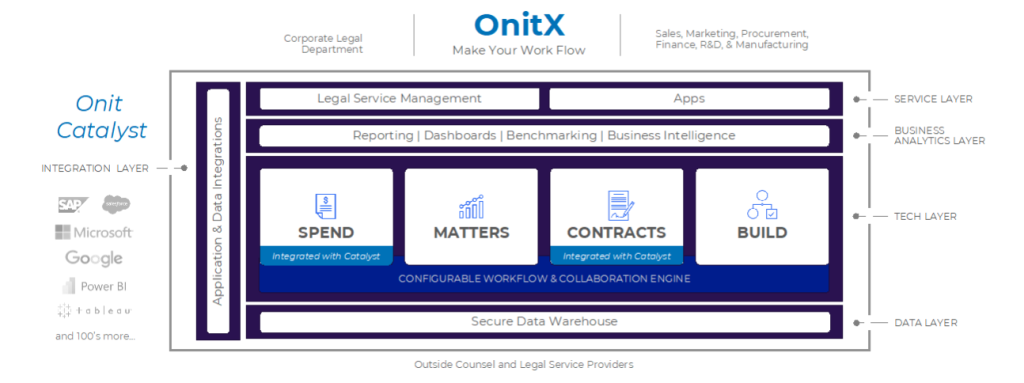
To usher in the era of optimized legal operations, Onit is proud to announce OnitX, the smart workflow platform for sophisticated legal matters and contract solutions that speeds the business. The “X” represents the innovative nature of Onit and signifies how the platform is highly configurable to customers’ unique needs, provides integrations with a broad range of technologies and business applications, and ensures a path to the future with extensibility to support new features and capabilities.

OnitX delivers several key customer benefits. First, it provides better visibility to legal services demand, which can feed an internal quarterly “report card” and give the data needed to forecast future needs. It supports greater operational efficiency for the legal department through user self-service, more seamless collaboration, and intelligent automation of legal workflows. Finally, OnitX enables better management of all legal resources, such as a deeper awareness of the “what and who” of legal operation, an improved ability to balance work done internally versus by outside counsel, and a greater understanding of outside counsel activity and spending so you can proactively manage outside law firm work.

OnitX is the evolution of the Onit Apptitude workflow platform that forms the foundation to many of Onit’s products. It includes the critical layers of a modern SaaS platform and adds several innovations:

OnitX also seamlessly integrates with the Onit Catalyst family of AI-enabled products to provide smart solutions for ELM and CLM.

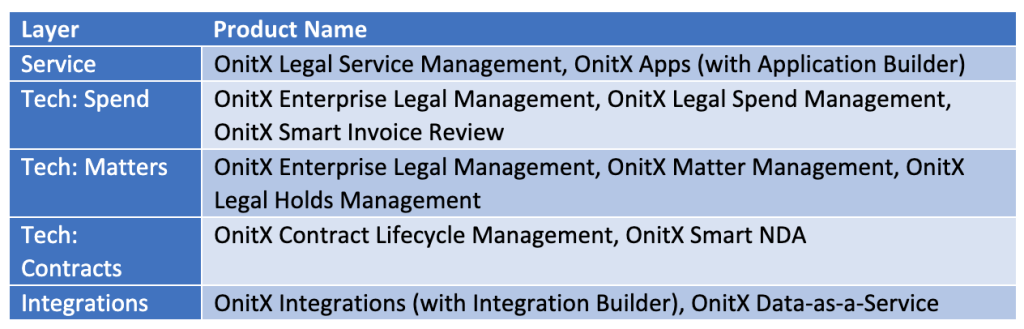
The following products are available within the OnitX platform:

Contact us today to learn how OnitX can be your modern matter and contract solutions platform.