
Tag: Legalweek

Lessons from a Legalweek conversation with Legal Ops leaders

legalweek converation

Innovation Is Easy. Execution Is Hard. 

Legal departments have never had more technology available to them. 

AI tools. Workflow automation. Advanced analytics. Unified legal platforms. 

And yet transformation still stalls. 

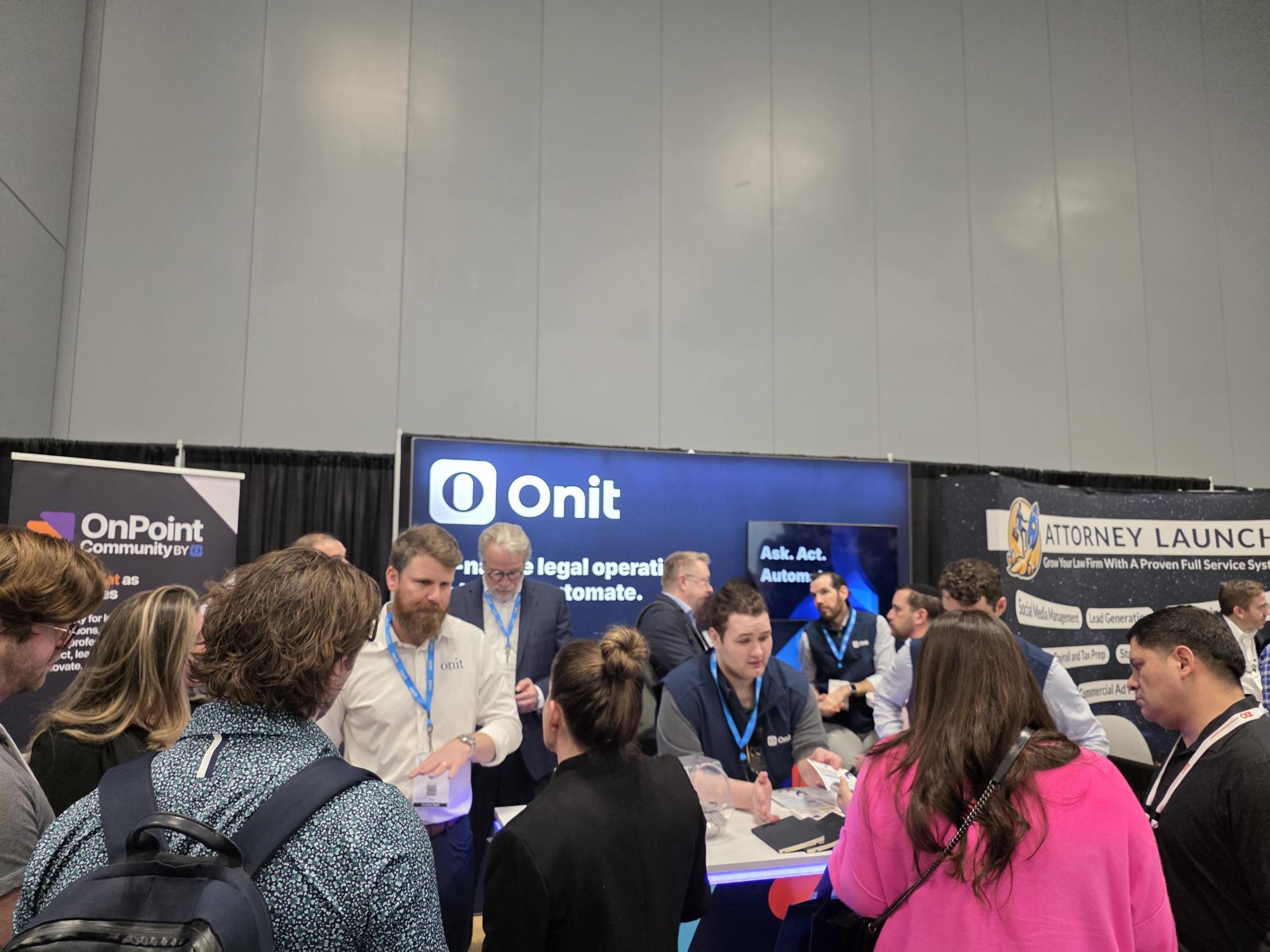
At Legalweek, Onit’s Jeffrey Solomon sat down with two legal operations leaders who know this problem well: 

Jasmine Sims, VP, Global Legal Ops at IBM  

Kim Wolfe, Senior Vice President – CAO for Legal and Head of Legal Operations, Contracts, and Innovation at State Street

The conversation wasn’t about the next tool. It was about something harder: executing innovation. 

The Problem Isn’t Technology 

Legal teams are investing heavily in systems designed to modernize operations, but many of those initiatives struggle to gain traction. 

  • Adoption slows. 
  • Workflows revert to old habits. 
  • The new platform becomes another system people work around. 

Not because the technology is flawed. Because the organization wasn’t ready. 

As the panel made clear, the biggest barrier to transformation in legal operations is rarely technical- it’s operational. 

legal operations

The Leaders Who Succeed Ask Different Questions 

Most teams begin transformation the same way. “What technology should we buy?” 

But the most effective legal ops leaders start somewhere else. They ask: “Is our organization ready to use it?” 

That question changes everything. It forces leaders to understand: 

  • Where work breaks down. 
  • Where decisions slow down. 
  • Where legal and the business fall out of sync. 

Before any automation happens or any platform goes live. 

Start With Listening 

Kim Wolfe explained that transformation in legal operations begins with understanding people. Every legal organization is different. 

Different GCs. Different priorities. Different risk tolerances. 

Solutions built without that context rarely stick. The work starts with listening. 

  • Where are the real friction points? 
  • Where does legal spend too much time? 
  • Where do business partners feel the pain? 

Only once those answers are clear does technology become useful. 

Fix the Process Before the Platform 

Another mistake legal teams often make: automating a broken process

Jasmine Sims put it plainly during the discussion. 

When budgets are tight, the fastest way to unlock technology investment is to fix inefficient processes first. 

Because good technology cannot repair a bad process. 

Legal ops leaders who understand this sequence focus on operational clarity first. Then they automate. 

Where AI Actually Helps 

There’s another assumption that slows progress in legal departments. That AI will replace lawyers. 

It won’t. 

The legal profession runs on judgment. 

Lawyers interpret context. Assess risk. Make decisions with accountability. 

AI does something different. It removes the low-judgment work. 

  • Reviewing standard clauses. 
  • Scanning large contract portfolios. 
  • Identifying patterns across thousands of documents. 

That’s where AI shines. Humans define the decisions, AI helps them get there faster while still allowing them the oversight that keeps them comfortable. 

Build the Foundation First 

The biggest takeaway from the Legalweek conversation was simple. 

The organizations that benefit most from AI will not be the ones that deploy it first, they will be the ones that prepare for it. 

That preparation looks like operational maturity: 

  • Asking better questions about processes and workflows. 
  • Governing how decisions are executed. 
  • Automating the work that slows teams down. 

When those elements come together, legal operations stops being a reporting function and becomes something more powerful – a system of execution. 

And that’s where real transformation begins. 

Experts Evaluate the Potential of Legal Contract Management Software and AI  

Light bulb with interconnected technology icons representing innovative legal solutions and AI in enterprise legal management.

Legal contract management software also referred to as contract lifecycle management, has made significant headway in the world of in-house counsel, racking up impressive stats such as reducing the average sales cycle by 24% and saving 9% on annual average costs. But what happens when you combine legal contract management software with AI?

A panel of legal and AI experts from organizations including Adobe and Onit, presented at Legalweek on just this topic, examining the potential impact of AI on managing contracts and how to start implementing AI into your contract management workflows. The conversation touched on the business value of using AI in legal ops, the efficiencies AI can bring to your business and future trends in AI, among other things.

Here are some of the biggest takeaways for AI and legal contract management software.

How to get started with AI

One of the easiest places for legal departments to start using contract AI and automation is in common use cases like reviewing NDAs and other routine contracts because these are high-value but time-consuming activities. The need to increase speed is high, but the risk is relatively low.

On the applicability of AI to law

AI has strong applications to both the business side of law and the practice of law. From a business perspective, contract AI can help with important, routine tasks like invoice review and billing. As for the practice of law, AI is ideal for tasks like tracking 20 different clauses in the 56,000 NDAs you handle each year, significantly boosting productivity and efficiency.

Do your research

To get the most out of your AI tools, you want your relationship with your technology vendor to be a true partnership, and you want to apply your own judgment to why your solutions are doing what they’re doing. With both your vendor and your solution, you want to retain a certain level of control to ensure you’re getting the results you want.

Have a strategy

When you start implementing AI with your legal contract management software, you don’t want to be thinking just six or twelve months down the road but further down the horizon. When you create a longer-term vision, you’ll be better able to take into account the needs of your various stakeholders and secure their buy-in for your chosen AI solutions.

Laying the groundwork for adoption

Many companies find it easiest to start with a single use case or data set and train their AI models from there. Once you have your first success, it will be easier to roll out your new technology across other business units and the organization as a whole.

AI and compliance

When you use AI for contract lifecycle management, your tools can help you stay on top of the constantly changing federal and state regulatory landscape. AI can assess your legacy contracts against new regulatory changes and ensure that any necessary updates are made.

Contract AI and CLM

AI helps in the pre-signature phase of contracts by creating centralized workflows for contract management and templates that allow your team to draft, review and redline contracts with just a click. AI also assists in the post-signature phase by extracting actionable intelligence from your contracts that can serve as the basis for informed decision-making.

On justifying spending money on AI to the C-suite

According to a recent study, users saw on average a 51.5% gain in productivity after using AI for contract review. That’s an almost immediate gain in productivity, and some use cases saw even better results. Moreover, the efficiency continued to increase over time as users became more familiar with the tools and the tools got smarter. The data extraction capabilities of AI contract tools also help to reduce risk and stop revenue leakage, which has a positive financial impact on the business as a whole.

Future trends in AI

While AI was originally targeted more toward law firms, the focus has shifted to in-house teams. We’re likely to see an even greater emphasis on using AI in contract drafting and CLM this year.

If you’d like to learn more about AI and contract lifecycle management, here are two helpful webinar replays:

  • The Future of Contracting: CLM + AI Transformation at Lenovo – Every company needs a faster and more efficient contracting process that enhances risk and spend management, improves revenue and profit margins, and increases visibility into counterparty relationships. The Lenovo Legal Department’s transformation journey is delivering value to the business by centralizing the global legal transactional support resources, standardizing the contract process across the company and optimizing the process with technology.
  • AI Mythbusters: Deprogramming Misconceptions – Confusion and misinformation around what Artificial Intelligence is and how it works is widespread, particularly in the legal technology space. Watch this webinar to debunk ten common misconceptions and learn how to decipher marketing-speak to separate true AI from just software.

Legalweek 2022: Connect with Onit and Its Family of Companies in New York City

City skyline at sunset featuring the Empire State Building and One World Trade Center, representing urban landscapes and architectural innovation relevant to legal operations discussions.

After a virtual detour last year, Legalweek is back in business. Legalweek 2022, scheduled for March 9-11 at the Hilton Midtown, welcomes thousands of attorneys, legal operations professionals and tech enthusiasts to New York to explore this year’s theme: “Addressing The Changing Legal Landscape.”

Onit has been a part of Legalweek since our founding 10 years ago, and each year we find a new, fun way to celebrate the show. If you attended in 2020, you might remember our Mardi Gras band that led a parade of attendees to happy hour. We’ll continue the tradition in 2022, and here’s how.

First, visit our Legalweek 2022 booth on the third floor of the Hilton by the conference’s registration. This year, we have an even larger presence to accommodate the entire Onit family of companies that includes SimpleLegal, ContractWorks, Bodhala, AXDRAFT and Busylamp.

Drop by to see demos of Onit products that include enterprise legal management, contract lifecycle management and our workflow and artificial intelligence platforms. You can also pick up fun giveaways (no spoilers!) and learn more about all the Onit companies.

Second, join us on Wednesday, March 9, at the Renaissance Hotel for a joint happy hour with PwC. Sip delicious libations, nibble on small bites and catch up with all the movers and shakers in legal technology. Sign up here.

Third, let’s break bread together. Onit and Consilio are hosting an exclusive dinner for in-house counsel and legal operations professionals on Thursday, March 10. Expect great food, even better conversations and a floor-to-ceiling view of lively Times Square as a backdrop. Let us know to reserve your seat by visiting here.

Finally, after you take in Legalweek 2022 keynotes from celebrity anchors Don Lemon of CNN and Dan Abrams of ABC News, make time to go to another must-attend session. On Thursday, March 10 (1:30-2:30 pm ET), Hearst, Corteva and MassMutual panelists will share their vision for why legal must connect to the broader enterprise and how they are implementing processes and technology to make these connections. Titled “Building Stronger Connections to the Enterprise,” the session is open to everyone with an all-access badge to the show.

See a complete list of all of our Legalweek 2022 activities here.

Coming Soon: InvoiceAI: AI for Legal Invoice Review

Close-up of an eye with a vibrant orange iris and electric blue lightning surrounding the pupil, symbolizing innovation and technology in legal operations.

Today, Onit kicked off its next phase of AI innovation at Legalweek(year) with the announcement of InvoiceAI, an AI-enabled legal invoice review offering for enterprise legal management. The offering, which will launch in May for both Onit and SimpleLegal, uses AI to create greater efficiencies in invoice review and allows general counsel and in-house counsel to focus on what they do best for their companies.

The invoice processing AI speaks to Onit’s founding principle: Help lawyers practice law more effectively. InvoiceAI eliminates tasks that aren’t related to practicing law – in this case, removing legal invoice review friction by relying on AI.

Onit leadership served as pioneers for legal e-billing, championing the Legal Electronic Data Exchange Standard (LEDES), the Uniform Task-Based Management System (UTBMS) and more. Now, that experience is taking legal invoice review to the next level with AI.

If you’re interested in learning more about Onit’s AI for legal invoice review, please speak with your account manager or email [email protected].

AI Innovation from Onit

When it launches in May, InvoiceAI will join three other AI offerings from Onit:

  • Precedent, Onit’s AI-powered business intelligence platform that automates and improves both legal and business processes for corporate legal departments, law firms, contract professionals, and procurement teams
  • ReviewAI, contract AI for pre-signature contract review that quickly and accurately reviews, redlines and edits all types of contracts in minutes.
  • ExtractAI, contract AI for post-signature contract management that extracts usable data from executed, legacy and third-party paper contracts.

You can schedule a demonstration of these three solutions by visiting this page.