

Author: Onit

Choosing the Right Software to Achieve Your Legal Operations Goals

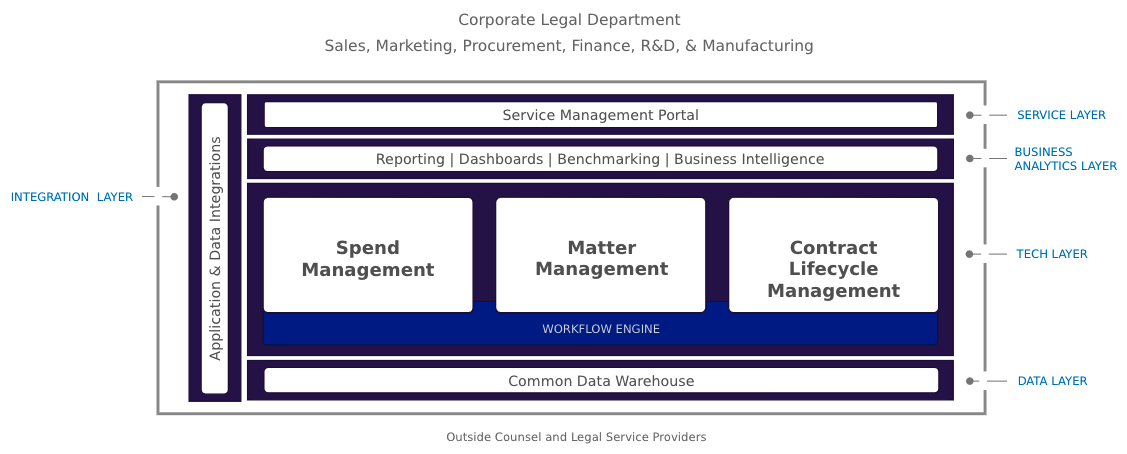
In today’s business world, achieving universal goals such as transparency, efficiency gains, and data analysis comes through the combination of skilled personnel and software. The discipline of legal operations is no exception; just glance at the world’s leading legal operations teams. They all rely on tailor-made legal operations tools in their daily work.

The scope of legal technology an organization deploys strongly correlates with the level of maturity of legal operations. Companies with more mature legal operations tend to utilize legal technology more extensively, resulting in greater success in achieving business goals. Utilizing technology can lead to the growth of legal operations departments and the establishment of more advanced goals and capabilities.

With business priorities for legal operations, there are four universal areas that are significant:

  • Reducing external legal spend.
  • Automating and streamlining manual processes.
  • Improving legal work prioritization.
  • Increasing the quality of legal advice.

Overarching these is the additional priority to evaluate and introduce legal technology. Although it may seem like a separate priority ranked alongside the others, it underpins all other legal operations priorities. As demonstrated by legal operations leaders using technology to enhance performance, the introduction of legal technology enables the achievement of other goals.

HOW LEGAL OPERATIONS LEADERS USE TECHNOLOGY TO ACHIEVE GOALS

Mature and advanced legal operations teams use technology. Smaller, less mature teams also need software tools to enhance their performance. Some of the benefits that technology delivers include:

  • Legal e-Billing ensures law firms adhere to billing guidelines which save money.
  • Workflows automate repetitive, manual processes, saving time and reducing manual errors, and freeing up lawyers to do more high-value work.
  • Real-time dashboards on matter or contract statuses give visibility to stakeholders.
  • Comparing law firm price and performance for more transparent and fair reviews and negotiations.
  • Knowledge and document management tools make it easier to collaborate, search, and find information and documents.
  • Consistent data creates reports and analytical capabilities to enable decision-making.

CHOOSING THE RIGHT LEGAL SOFTWARE FOR YOUR NEEDS

A common failing seen repeatedly is when legal operations teams get dazzled by features and buy technology they don’t need and won’t use. Not only is this a waste of investment, but it creates a skepticism that affects future projects. Some teams may need more than one highly customized solution with multiple integrations; others require a simple out-of-the-box tool to automate key processes.

Before you talk to any vendor, you need to know your challenges and goals and document your current process and workflows. Good vendors will not try to sell you all the bells and whistles that result in you buying an underused solution; we want your project to succeed just as much as you do.

Here are the recommended legal technology project steps:

  1. Identify your key challenges, needs, and requirements.
  2. Define the project team; include future users, stakeholders, and don’t forget members from other crucial teams.
  3. Document your current people, processes, and technology for your challenges. Look at how you might change this and your priorities; what is ideal and the acceptable and unacceptable outcomes.
  4. The vendor or consultant can help you refine this further down the line.
  5. Research the market, possible solutions, vendors, and consultants. Consider “build-or-buy” options.
  6. Only now should you approach vendors and consultants. If you do this any sooner, you will be overwhelmed with all the potential opportunities for improvement and lose focus on what is most important for your business right now.
  7. Calculate the business case, including any ROI. (Download our guide to building a business case for legal spend management).
  8. Consider and plan for the impact of change management, stakeholder management, and corporate culture.
  9. Choose the right solution for your team!

DATA-DRIVEN DECISION MAKING

The introduction of legal technology will achieve “quick wins” in the cost and efficiency goals mentioned above. Where mature legal operations departments excel is in the integration of multiple legal technology tools. This creates centralized, consistent data that, in turn, enables advanced data analytics across numerous legal practice areas and work types.

Due to their data analysis capabilities, mature legal operations functions can address more challenging legal department problems and make data-driven, strategic decisions around department staffing, matter resourcing, risk management, negotiations, panel reviews, and more. From your first legal technology project, you have started to create data that will take your cost and efficiency savings to the next level and position legal as a strategic value-generator for the business.

Request a demo of eBilling.Space today and see our RFP functionality for yourself.

Legal Operations: 3 Ways to Materially Influence the Enterprise

Although certain perceptions between Legal and enterprise employees may seem fathoms apart, that only speaks to the remarkable opportunities to deeply connect, materially grow, and further protect your business.

Tucked within an 18th-century ode to transformation penned by historian and scholar Thomas Gray is a familiar saying: “Ignorance is bliss.”

Many of us, however, are not aware of how that famous poem ends: “ …where ignorance is bliss / ‘tis folly to be wise.” Read in its entirety, this line is not so much an excuse to avoid the truth for the sake of happiness, but rather a reflection on embracing the unexpected. Because ready or not, change will come knocking.

Recently released, chapter two of the Enterprise Legal Reputation (ELR) Report, a multinational study spotlighting how legal professionals perceive their interactions with internal clients, revealed that while 73% of Legal cites positive relationships with its internal clients, only 60% of enterprise employees feel the same. Similarly, Legal reported greater connections with every department than employees did: IT (78%), Procurement (76%), Sales (74%), and Marketing (73%) for Legal as opposed to just 38% for IT, 37% for Procurement, 43% for Sales and 37% for Marketing for employee respondents. And though nearly every legal professional (95%) considered their department efficient in managing service requests, three in five employee respondents (59%) characterize Legal as “inefficient.”

What accounts for these incongruities? This perception predicament — where what one sees does not necessarily match what exists — presents an undeniable Iceberg Effect.

Sometimes, what we don’t know can hurt us. But while Legal may only be seeing part of the equation, the ELR report also uncovered untapped potential and opportunities glittering below the surface for legal operations to shine a beacon on everything from topline revenue and innovation to competitive differentiation, brand image, and corporate culture.

Here are three ways Legal can melt the Iceberg Effect and connect more deeply across the enterprise:

1. Spark faster sales cycles.

Nearly seven in 10 (68%) legal professionals feel they excel at helping Sales effectively close urgent deals, and more than half (56%) of enterprise employees acknowledge that Legal jumpstarts sales and revenue operations.

Legal, by its very nature and trade, is directed by precedents. Its main purpose is to provide risk mitigation and enterprise stability. However, as an authority figure and natural business protector, Legal also has the power to be an extraordinary change agent. Time, as they say, is money. And by examining processes and developing optimized, forward-thinking policies, Legal can accelerate business growth and revenue generation by securing deals faster so that more can be made.

2. Ignite an inclusive culture.

People are the heartbeat and lifeblood of an enterprise. Innovation and intelligent solutions require creativity, communication, and the collaboration that comes from clever and varied voices.

The right competencies on a team are also required for true and lasting accomplishment, but in this era of “the Great Resignation,” employee retention is proving a major issue. Half of all legal professionals (49%) believe recruitment and talent retention require improvement (49%), and more than one in three (35%) respondents point to a need for better workload planning for the sake of operational efficiency.

Diversity, equity, and inclusion (DEI) initiatives have consistently been linked to stronger work quality and competitive differentiation, and three in 10 legal professionals (29%) believe their companies are making DEI a priority in 2022. More than half (52%) also say they are increasing diversity via vendor partnerships, and in the United Kingdom especially, hiring practices are beginning to show incredible diversity. A more connected, values-driven culture can thaw the Iceberg Effect in a truly meaningful way.

3. Navigate the latest in tech.

In addition to hiring and retaining talented people, another necessary transformation for Legal to melt the Iceberg Effect and achieve material success is the integration of innovative technology, including contract lifecycle management (CLM), eBilling, and matter management tools that embrace automation, machine learning (ML), and artificial intelligence (AI).

However, half of all legal teams globally deem their current technology insufficient (47%) and outdated (46%) – despite the desire to streamline inefficiencies and boost productivity.

So, what’s holding up Legal’s tech revolution? Nearly half (44%) of legal professionals admit their department is averse to change, 39% blame a lack of budget, and 25% say they simply do not have time to learn new technology. Perhaps most surprising, and simultaneously concerning, two-thirds (67%) feel executives are unsupportive of Legal’s modernization, even if it means providing better client service and customer experience.

Although finding and incorporating the right tech can be a challenge, identifying recurring pain points and wish lists, devising an enterprise-wide implementation plan, and working with an experienced partner — as well as ensuring data security, privacy compliance, and a best-practices cybersecurity response plan — can provide tremendous operational cost savings and efficiency.

Steering your enterprise towards greater success

Ignorance is rarely bliss. In the end, it is knowledge that is power.

By banking on collaborative partnerships and insights to accelerate sales cycles and generate topline revenue, procuring diverse service providers and vendors to build an inclusive culture, and dissipating the gap between “old school” legal practices with the introduction of modern digitalization, Legal can demonstrate a distinct impact on materiality and efficiency and further protect, promote, and elevate its brand.

Even more, Legal will melt the Iceberg Effect once and for all, extracting new opportunities to connect more deeply throughout the enterprise, delivering exceptional business acumen and innovation, and evolving into a true leader to support and inspire the next generation of law.

Read the ELR Report to learn more about how legal professionals view their relationships with internal clients in comparison to the image enterprise employees have of their legal departments.

5 Ways Legal Can Connect More Deeply Throughout the Enterprise

Now is the perfect time to evolve Legal’s role and brand image for the path ahead. Here’s how to boldly do so, for the future of Legal and the growth of your business. 

When it comes to the relationship dynamic between Legal and the enterprise as a whole, an irrefutable Perception Paradox exists: While nearly four in five (78%) enterprise employees around the world* view Legal as stellar business protectors and good advisors, only one in four (27%) view Legal as a good business partner.

Corporate employees understand that Legal is just doing its job — and they believe Legal is doing it quite well. In the end, however, true success cannot be attained without inclusivity and collaboration.

Here are five opportunities for Legal to bridge gaps, improve alliances within the enterprise, and jumpstart greater overall impact on material growth, topline revenue generation, and bottom-line efficiency:

  1. Evolve the Department of “No”: Although 22% ELR Report respondents consider Legal the “no” police, 48% believe that the department is actively trying to cut red tape, minimize bureaucracy, and help accelerate deal cycles. Legal can capitalize on this perception by making the conscious effort to modernize processes in ways that cultivate further flexibility and adaptation. By challenging legacy paradigms and replacing them with new structures and optimized processes, Legal can find itself asking “How can we help?” far more often than having to say no.
  2. Spark Efficiency with Tech: The mainspring and linchpin of a modern legal department is its state-of-the-art technology. By working with corporate IT to drive the implementation and adoption of comprehensive enterprise legal management (ELM) and contract lifecycle management (CLM) solutions, Legal will not only maximize savings, increase operational efficiency, and enhance collaboration, but also introduce and leverage forward-thinking tools that can serve the entire enterprise.
  3. Solve the Need for Speed: Artificial intelligence (AI) can provide this impact Legal needs to work both smarter and faster. With automation, Legal can help streamline workflows and integrate data-driven decision making into standard processes, distilling complex and lengthy tasks and enhancing speed by at least 25%. A bonus: When combined with ELM solutions, process automation was found to cut business operating costs by as much as 90%!
  4. Bear the Torch for DEI: Most CEOs will tell you that diversity, equity, and inclusion (DEI) is of utmost importance to their organization. However, the perception among employee respondents is that much of what is said may not be translating to what is done as only 50% believe DEI is treated as a priority, and barely 25% believe that vendor diversity matters to the enterprise. But if Legal is a protector —and there is no greater purpose in the role of protector than sheltering the heartbeat of an enterprise, its people— this is a distinct advantage to embolden the department with new initiatives of respect, communication, and cooperation. That way, Legal becomes an advocate for empowering the outlooks and opinions of many divergent others, both in the workplace and world at large.
  5. Bring the Insight: More than three out of four (76%) enterprise employees feel that Legal manages data security governance well. However, when it comes to security, there is no such thing as half secure or almost secure. Security needs to be 100%, or it simply isn’t secure. With Legal’s involvement in countless confidential and sensitive matters, and with most legal professionals being inherently strategic thinkers, it is a natural leap that this an opportunity for Legal to become more contributory to the company’s data analytics and protection. In doing so, Legal will become a more visible and even more valued business partner, ensuring both the physical protection and cybersecurity of its constituents.

Become the Hero Your Enterprise Needs

As poet Langston Hughes once remarked, “The only way to get a thing done is to start to do it, then keep on doing it.” By aligning and partnering with corporate functions and anticipating how to meet ever-evolving needs, Legal will pivot the Perception Paradox. By championing open communication, resetting expectations, and holding the enterprise to forward-facing standards, Legal can transform its brand and perception on the way to creating a better future, having greater material impact for its businesses, and standing out not for the old reasons but the right ones.

Spark your revolution of evolution today by downloading ELR Report Chapter 1.

*The ELR Report is a third-party, multinational study of 4,000 enterprise employees and 500 corporate legal professionals across the United States, United Kingdom, France, and Germany intended to showcase relationship dynamics and perceived image between corporate legal teams and enterprise organizations.

Onit and its Family of Companies Earn Honors Through the First Half of 2022

Onit is proud to announce that the Onit family of companies has received several prestigious awards through the first two quarters of 2022. These honors illustrate Onit’s rapid growth and commitment to innovation in the field of enterprise workflow solutions, underscoring its place as one of the industry’s leading providers. 

In just 18 months Onit made four acquisitions, boosted revenue and expanded its portfolio of AI-enabled software products as part of a commitment to product innovation. These efforts were made to ensure Onit continues to help customers modernize workflows that directly impact the operational efficiency of legal departments and, ultimately, the speed of revenue generation.

Onit’s awards this year include: 

  • American Best in Business, Grand Globee winner: Onit was named Grand Globee winner — ABB’s highest award, reserved for only ten companies each year — for its overall innovative expertise, rapid growth, and other factors.
  • Inc. Regionals, #53: Onit placed #53 on the Inc. Regionals list, the most distinguished ranking of the fastest-growing private companies based throughout Arizona, New Mexico, Oklahoma and Texas. 
  • HBJ Vet Owned Business, #1: Onit was named the Houston area’s #1 veteran-owned business (to qualify, companies must be at least 51% veteran-owned and certified, privately held and headquartered in the Houston area). 
  • American Best in Business, Gold Award for Best Research/Survey Report: Onit was recognized for its ELR (Enterprise Legal Reputation) Report exploring how the relationship between enterprise employees and legal departments affects their businesses.
  • American Best in Business, Bronze for Most Innovative Tech Company of the Year: Recognizing Onit’s successful integration of AI with existing products. 
  • Vet100 List, Collaboration between Inc. 5000 and Syracuse University: Onit was named to the annual Vet100, a placement collaboration between Inc. Magazine and Syracuse University’s Institute for Veterans and Military Families. 
  • Legalweek Leaders in Tech Law Lifetime Achievement, Eric Elfman: The award recognizes Onit Founder and CEO’s Eric Elfman’s career achievements in the development and adoption of legal technologies and legal technology companies. 
  • Business Intelligence Group (BIG) Awards, AI Excellence: Awarded for Onit’s InvoiceAI software. Recognizes organizations, products and people who bring AI to life and apply it to solve real problems
  • Business Intelligence Group (BIG) Awards, Innovation: Awarded for Onit’s InvoiceAI software. Recognizes organizations, products, and people bringing new ideas to life in innovative ways. 
  • Houston Business Journal Middle Market 50, #10: Onit was named as one of the top 50 fastest growing companies in Houston (with revenue of $28 million to $1 billion). 
  • Houston Business Journal Fire Awards: Onit was recognized for overall growth, innovative ways of doing things, funding rounds, product launches and social impact. 
  • Austin Business Journal Best Tech Employer, #75: Onit earned placement on this list ranked by the number of direct local jobs provided.

Onit’s family of companies also earned honors through the first half of 2022:

  • CIO Review named SimpleLegal to its list of Top 30 Fastest Growing Tech Companies 2022. 
  • SimpleLegal’s Anggie Ramirez Perea, Head of Client Support, was named Manager of the Year in Business Intelligence Group (BIG)’s 2022 Excellence in Customer Service Awards for her work in leading a customer-centric support organization.
  • SimpleLegal’s Shri Iyer, Vice President, Products & Design, was recognized by The Software Report as one of its Top 25 Product Executives.
  • AXDRAFT was awarded American Best in Business Gold for Best Product, Service and Solution (small company category).

Legal’s Golden Opportunity to Shine: Report Finds New Potential to Directly Impact Revenue Growth

Chapter two of the Enterprise Legal Reputation (ELR) Report unveils new potential for legal departments to directly and positively impact material growth, operational efficiency, and cultural transformation. Here’s how Legal can be a top game-changer for its business.

There are two sides to every story.

Chapter one of the Enterprise Legal Reputation (ELR) Report — a third-party, multinational study of 4,000 enterprise employees — delved into the image of corporate legal teams through the eyes of enterprise employees and revealed a Perception Paradox: Although four in five (78%) employees consider Legal as outstanding protectors of the business who impart good advice, two in three (65%) have knowingly bypassed Legal, at least on occasion.

Chapter two of the ELR Report examines Legal’s perception of its own department by shining a spotlight on the parallels and perspectives of 500 corporate legal professionals from the United States (200 respondents), United Kingdom (100), Germany (100), and France (100). Is Legal aware of its brand image by its constituents? Does the department know what similarities and differences exist between their perceptions and those of its enterprise employees? And ultimately, how can Legal have greater impact on the materiality and growth of its business?

Similar attitude, legal latitude

When it comes to exploring the connection between Legal and its internal clients, nearly three in four (73%) respondents cite positive relationships. These figures are similar to the responses from enterprise employees in chapter one, where three in five (60%) reported harmonious partnerships. Legal believes its collegiality ranks highest with Finance (84%) and HR (79%), and employees reported the best collaboration with these departments as well, although at a slightly lower clip (62%). Further, nine in 10 (91%) corporate legal respondents believe they share exemplary interactions with their internal clients, and almost every corporate Legal respondent (95%) considers their department efficient in managing service requests, a number that wavered only slightly spanning the globe, with 98% in Germany, 96% in the United Kingdom, 95% in the United States, and 91% in France.

Why, then, do three in every four Legal employees feel the strength of their connection with internal clients is solid when less than two in five enterprise employees concur? Despite Legal believing it has “good” or “very good” relationships with IT (78%), Procurement (76%), Sales (74%) and Marketing (73%), the feeling is different from the enterprise employee perspective, sitting at just 38% for IT, 37% for Procurement, 43% for Sales and 37% for Marketing.

While Legal being confident about their relationships is to be commended, these inconsistencies in awareness represent an incongruity and potential obstacle — also known as the Iceberg Effect.

Part of the issue in differing levels of perception could be taking an outside-in view: Since Legal sets the standards for what needs to be accomplished in its department, Legal innately presumes it is accomplishing what needs to be done. And, in fact, many legal teams are doing an extraordinary job. In chapter one, enterprise employees were quick to note how Legal excels at negotiation, procuring vendors and services, and impacting the corporate brand.

Yet what this variance also indicates is the presence of untapped potential. Legal has the capability to be more than a risk mitigator and compliance officer; to do more than review, manage, and sign contracts. This is a chance for Legal to command a place at the table as a transformational change agent and business influencer impacting topline revenue, innovation, competitive differentiation, brand, and corporate culture.

Steering clear of the Iceberg Effect

When it comes to impacting the business where it matters most, Legal is in safe and steady waters supporting Sales and the revenue acquisition process. In fact, nowhere is Legal’s ability to steer the ship clearer than here: More than half (56%) of enterprise employees say Legal kickstarts sales and revenue operations, with 48% citing Legal’s acceleration of deal cycles. Nearly seven in 10 (68%) legal professionals also believe they help Sales effectively close urgent deals, a sentiment that skyrockets to an incredible 84% in Germany.

There can be no revenue recognition until contracts are signed, though, and with two in five legal respondents (40%) spending four to five hours – at least half of every business day – reviewing and managing contracts, Legal expresses a definite need for speed and modernization. Nearly half of respondents (47%) claim their current technology is insufficient. But optimizing with automated tools powered by the combination of artificial intelligence (AI) and contract lifecycle management (CLM) is the key to advancing the entire contract process, from document generation and redlining to e-signature and finalization. This acceleration can pilot faster decision-making on how to push contracts through review cycles, renewals, and negotiation, scaling the speed and growth of revenue generation (44%) as well as mergers and acquisitions (23%).

Legal’s role in materially impacting its business

While the crux of a business’ success may be defined by its sales and revenue, Legal holds the power to influence other functions across the enterprise, too. There can be no sales without a valuable product or service, and more than three in five (61%) legal professionals believe they play a prime role in positively impacting their businesses’ abilities to innovate and differentiate competitively by protecting company patents and intellectual property (IP).

Even beyond the scope of innovation and ideas, it is people who make up the atomic units of a business. Corporate culture and diversity, equity, and inclusion (DEI) are fundamental to operational efficiency and growth. Fortunately, four in five (80%) enterprise employees view Legal as a great partner for procuring vendors and services, and more than half of respondents (52%) worldwide report their departments and companies are now prioritizing vendor diversification. Yet another Legal priority is improving data security, with one in three employees (33%) highlighting the importance of cyber risk management.

It is within these forward-thinking sectors – DEI and data privacy — that Legal can uncover its formula for future success and evolve from a transactional, back-office brand into a visible business influencer, vanguard of innovation, and advocate for diversity and inclusivity. By doing so, Legal can pivot the Perception Paradox and melt the Iceberg Effect, connecting more deeply with its internal clients, ramping up material growth and operational excellence, and expanding its image as guardian of the enterprise into an even more significant role as protector.

Read the ELR Report to learn more about how legal professionals view their relationships with internal clients in comparison to the image enterprise employees have of their legal departments.

Guardian of the Enterprise: A Look Into Legal’s No.1 Role as Business Protector

The legal department is viewed as an outstanding protector of the business and remarkable advisor. The perception of Legal as a business partner is not quite as stellar. What can Legal do to reconcile these images and come out on top as both?

Bulwark. Safeguard. Defender.

With 77% of enterprise employees around the world rating their legal departments as talented negotiators and almost half (47%) believing Legal positively affects forward-thinking innovation, there are many different perceptions of Legal.

However, the Enterprise Legal Relationship (ELR) Report – a third-party, multinational study of 4,000 enterprise employees and 500 corporate legal professionals spanning the United States, United Kingdom, France, and Germany – revealed that, far and away, the number-one image that enterprise employees have of Legal is as a protector of the business, its assets, and its people.

Guardian of the enterprise

Legal is responsible for ensuring the compliance of a company’s actions, so it’s no surprise that the department is seen first and foremost as an authority figure both expected and enabled to protect the corporate mission. When one envisions the responsibilities of various functions within an enterprise along a spectrum between protection and promotion, Legal – as opposed to Sales and Marketing – falls soundly on the side of protection. Overall, the perception of Legal around the globe is primarily positive with three out of five respondents (60%) citing good relationships — no doubt due in large part to the protection the department imparts to the enterprise as a whole.

Two separate perceptions

When it comes to Legal, however, there is also a Perception Paradox: While Legal is highly respected as the protector of the business, three out of four enterprise employees (73%) do not consider Legal a good business partner.

How can Legal be lauded as protectors of the business when many of its internal clients don’t see it as a good business partner?

It all comes down to perception. Among enterprise employees, protection and trust appear to be two separate perceptions. In fact, 49% respondents globally describe Legal as “inflexible” and 59% call Legal “inefficient.” Additionally, one in 10 – and as many as one in five in the United States and United Kingdom – voiced concerns that Legal’s abundance of caution as protectors have extended the time to close and win deals, slowing and negatively impacting sales cycles.

That said, this is a cross to bear that shouldn’t entirely rest on the albeit strong shoulders of Legal. If Legal is indeed viewed as and expected to be the protector of the business, but those same employees believe that Legal hinders business from moving forward, it might explain why two out of three respondents (65%) admit to having bypassed the Legal departments and its policies in the past, at least on occasion.  

So then how is Legal supposed to act as the very protectors they are regaled as being?

The future of Legal: protector and partner

 Where Legal shines is in matters ensuring that accountable decisions are made and inherent risk is mitigated: patents, trademarks, and intellectual property (92%) and regional and global-specific matters (89%) top the list. Yet Legal has the potential to evolve its perceptions and become not only the intellectual “head” of an enterprise, but much more of its heart.

Employees want, need, and deserve to feel secure in an organization.  As a true protector, Legal can be empowered to let internal clients know Legal is “with them.” By freeing up time from mundane tasks with state-of-the-art automation, Legal will have an opportunity to contribute more collaborative support to its internal clients, earning greater trust and transforming into a truly valued business partner as well as the protector of the business they always have been.

Assist legal teams in better understanding their brand image by downloading ELR Report Chapter 1.

9 Advantages of a Matter Management Cloud Solution

In our Matter Management blog series, we have already addressed the fact that in-house counsel are under enormous pressure in today’s demanding business environment to serve their internal clients effectively and professionally while keeping costs low and minimizing potential risks. In this article, Carina Smolik-Fischer, director of product at BusyLamp (an Onit company), summarizes the top 9 benefits of a matter management cloud solution and how it can benefit your legal team.

In-house counsel are challenged to find innovative legal tech solutions for their legal departments that enable them to increase productivity and speed without sacrificing the quality and value of their work. At first, these may appear to be competing goals, but with the help of a matter management solution, you will make the first step towards reconciling these seemingly conflicting goals. With matter management, you have a centralized solution that allows you to create matters, centrally view files easily, and access related documents and emails.

Matter Management from Onit offers all the modules and features modern legal departments need for daily and efficient work. Legal market experts have developed Onit’s Matter Management solution with a strong understanding of the complex requirements of in-house counsel and the regional specifics of the DACH legal market.

And now to the good news: implementing such a matter management software does not have to be complicated. Using cloud software is the fastest way. Furthermore, cloud-based software programs offer you nine key advantages that can significantly benefit your business:

1. General Benefits

Any cloud-based application – including matter management – opens up new ways of collaboration, flexibility, innovation, and mobility. Users can access applications quickly and easily from anywhere via the internet, extend them as needed, and share their data with authorized third parties within seconds. New functions and innovations are immediately available in high quality, thus offering users more agility and flexibility. But that’s not all: cloud technology for matter management provides numerous benefits that would be difficult or impossible to achieve with local on-premise software.

2. Costs

With cloud software, there are no unique investment costs for purchasing and running hardware and operating system software. Also, there is no need for internal know-how about the software application besides the monthly license fee. With Onit, there are only one-time onboarding costs for the software’s individual configuration, including users, authorizations, master data, templates, and more. In addition, there is a short training session to get you started quickly and comprehensively. This allows you to calculate reliably, minimize financial risk and avoid surprises.

3. Direct Availability

Cloud software is always ready. No technical installation is required, so your IT deployment is limited to testing security-related issues. With Onit, for example, you are using software hosted in the EU that complies with the latest security standards, e.g., certifications such as ISO 27001 and ISO 9001.

4. State-of-the-Art Security Standards

There are often concerns that cloud technologies are unsafe and exposed to attacks. However, this is not the case. Our Matter Management solution runs on Microsoft Azure. Large providers like Microsoft are constantly investing in the security of their data centers, using the latest software, and having specialized employees.

5. Automated updates and upgrades

Cloud applications have automated upgrades and updates that keep your matter management solution up to date. This has the advantage of always providing you with innovative features and constantly guaranteeing the security of your software.

6. Collaboration

Cloud software is accessible via the internet – all you need is your normal browser like Google Chrome or Microsoft Edge. As an end user, you benefit from this, especially with matter management software. For example: once a digital file is created in our Matter Management solution, you can easily share or assign its content, such as documents, emails, appointments, tasks, etc., with authorized third parties (departments such as HR, procurement, or external law firms). Use the platform itself or MS Teams for this purpose – all required contents of the digital file are under your control 24/7. Legal services such as the internal Legal Service Request are also provided via the Internet browser and therefore do not require technical installation. Sharing on the intranet or using an MS Teams APP makes access easier and saves time. It gives you the flexibility to focus on your higher value-added work.

7. Apps and Plug-Ins

Easily extend your matter management software using APPs and plug-ins. These integrate directly into the application, extending your cloud software with just a few clicks. Matter Management offers integrations with MS Office, MS Outlook, and MS Teams so that you can communicate directly within the solution.

8. Data Security

We are very aware of the fact that your legal department manages extremely sensitive data. A loss of data could have serious consequences. As mentioned at the outset, established cloud providers such as Microsoft have significantly more capabilities to provide data in a highly available, stable, and secure manner. Furthermore, data communication between the local computer and the Internet service is always encrypted to prevent access by unauthorized persons and to protect your data using state-of-the-art technologies.

9. Scalability

Cloud software is flexible and dynamically scalable. Onboarding additional users, sites, or departments is possible anytime and immediately without any lead time or spare capacity in your IT department. This also applies to the use of more storage. Cloud-based software allows you to grow according to the unique needs of your legal department.

Summary

Cloud-based matter management provides legal departments with the tools and applications to make their processes more efficient, streamline their legal operations, and efficiently deliver value to their organization. Add value through smart technologies and improve the visibility of your contribution to the company’s success. Use Matter Management to optimize the spending of your costs. Use your valuable time to focus on high-quality legal advice and put aside the time-consuming management of your legal mandates.

Request a demo of BusyLamp eBilling.space.

Join Bodhala and the Onit Family of Companies at Envision Chicago

Bodhala is excited to announce the launch of Envision — a series of exclusive events in collaboration with our parent company Onit.

Starting with the first event June 21st in Chicago, Envision is an opportunity to meet the rest of the Onit family of companies, hear from product experts, and get a front-row seat to the next generation of innovation in legal tech.

Envision events are free to attend. Click here to register and learn more.

Attendees will also have the chance to network with peers in the Chicago area, and learn how they are working with Onit companies to achieve operational efficiency and build stronger connections between Legal and the rest of the business. 

By the end of the event, attendees will have a clear understanding of how to cost-efficiently and cost-effectively execute legal workflows, with help from Onit’s solutions purpose-built for contract lifecycle management, matter management, e-billing, spend management, analytics, and more.

Envision Chicago Details

Date: June 21, 2022

Location: Union League Club of Chicago – 65 W Jackson Blvd, Chicago, IL 60604

Agenda (All times CDT) 

11:00 AM – 1:00 PM

  • Lunch & Demos

1:10 – 3:30 PM (Keynotes)

  • Corporate Legal’s Reputation in the Eyes of Internal Clients and Its Opportunity to Materially Impact Enterprise Growth, Topline Revenue, and Bottom Line Efficiency
  • Evolving Expectations About Legal’s Business Impact: New Approaches That Connect Legal to the Enterprise Through Better Partnering and Workflows That Matter
  • The Roadmap That Makes Legal Work Flow Faster and Smarter: The Next Generation of Automated, AI-driven ELM And CLM Solutions

3:30 – 4:05 PM (Roundtables)

  • Session A — Connecting the Enterprise Through Data
  • Session B — Top Challenges Solved by SimpleLegal’s Enhanced Reporting

4:15 – 4:55 PM (Roundtables)

  • Session A —Rightsizing Contract Management
  • Session B — Using Market Intelligence to Improve Business Outcomes

5:00 – 6:30 PM

  • Evening Reception

Click here to register for Envision Chicago.

If you can’t make it to Chicago, you can meet us at a future Envision event later this year!

  • Envision Los Angeles, CA — August 24, 2022
  • Envision London, United Kingdom — September 20, 2022
  • Envision Stuttgart, Germany — September 22, 2022
  • Envision New York, NY — October 20, 2022

Stay tuned for updates and agendas for future Envision events!

3 Ways to Up Legal’s Approachability Factor

As many as 65% of enterprise employees bypass the legal department on occasion. Here’s how to turn that around and become the true leader Legal is meant to be.

Modern life teems with sigh-worthy moments: dodgy WiFi when you’re on deadline, your phone battery running out of juice with no place to recharge, the dreaded “You have two more password attempts before being locked out.”

But would it surprise you to learn that, for enterprise employees, dealing with Legal can also sometimes feel a little bit the same? The Enterprise Legal Relationship (ELR) Report – a third-party, multinational study of 4,000 enterprise employees and 500 corporate legal professionals across the United States, United Kingdom, France, and Germany – revealed that only 35% of respondents always engage with Legal on matters.

Even more astonishing, an inverse relationship exists: the fewer the transactions with Legal, the more positive the relationship. Employees from the United Kingdom, who tend to engage with the legal department most frequently, report the poorest interactions, whereas employees in France cite perhaps the best relationships with Legal, yet are most likely to bypass Legal.

It doesn’t have to be this way. These findings present a major opportunity for Legal to improve its approachability factor. In fact, the department has the chance to jumpstart efficiency, impact materiality, and grow the innovation and culture of the business in unprecedented ways.

Increase the percentage of employees that engage Legal by:

  1. Cutting the perception of red tape

By and large, employees believe Legal is doing its job – and exceedingly well! But for the enterprise employees who do admittedly bypass Legal on occasion, 36% say they feel the department has a tendency to sometimes be overly bureaucratic.

Legal excels at patents, trademarks, and intellectual property (IP), according to 92% of respondents, as well as matters involving HR issues (88%). But as business partners, nearly half (49%) claim that Legal can be “too process-oriented,” causing 53% of employees in even the most-compliant United States to occasionally circumvent legal processes. And in the other nations surveyed, those numbers skyrocket, to 63% in the United Kingdom, 68% in Germany, and 73% in France.

Legal is typically process-oriented – that’s how the department protects the business. This is a chance to examine existing policies and forge new ones that may reduce any unnecessary inefficiencies.

  1. Accelerating response times

Every internal client knows that mitigating enterprise risk is Legal’s essential purpose. Yet nearly half of global respondents worry that Legal’s abundance of caution while doing so could potentially damage sales cycles, affecting deal close rates (43%), missed earnings (35%), and even stock price drops and valuation loss (14% each, respectively). Further, many employees (41%) feel that Legal is not as responsive since many legal operations departments have been working remotely or on a hybrid schedule as a result of the COVID-19 pandemic.

It’s impossible to work well together if a salient entity like Legal even occasionally feels absent from the enterprise. But introducing methods to improve channels of cross-enterprise communication as well as automation and artificial intelligence (AI) tools to rapidly accelerate Legal’s response time can dramatically prevent Legal’s chance of being bypassed.

  1. Embracing flexibility and inclusivity

Trust has a way of naturally trickling downward. Half of all employees (49%) – and three out of five (58%) in France – believe Legal can sometimes be a bit too rigid. If employees feel that a situation is inflexible, they may be far less likely to interact, for fear of being rejected. However, as one ethical compass of the enterprise, Legal also has a unique and distinct advantage in its proverbial back pocket: the ability to transform company culture by bearing the torch for diversity, equity, and inclusion (DEI) and protecting the business’ atomic unit – data.

Knowledge is power

Legal always puts itself in the line of fire for a business. But how can you protect the business if two-thirds of your internal clients occasionally evade your oversight?

Bypassing legal is no way to reach your enterprise’s desired destination. Arm yourself, your department, and your team with this knowledge – the knowledge to automate both workflows and processes for greater efficiency and effectiveness between departments; to be a business partner that accelerates the cycle of winning deals; and to become more involved, approachable, and collaborative – so that employees always abide by Legal’s policies. This is how Legal becomes a leader. And, by doing so, Legal will secure a spot as a key differentiator for cost efficiency, operational excellence, and revenue generation.

Find out more about how to prevent your legal team from being bypassed by downloading ELR Report Chapter 1.

The ELR Report is a third-party, multinational study of 4,000 enterprise employees and 500 corporate legal professionals across the United States, United Kingdom, France, and Germany intended to showcase relationship dynamics and perceived image between corporate legal teams and enterprise organizations.

Introducing Legal Matter Benchmarking

To make the best decision on where to send your next big matter, you need the right data. That’s why we’ve added a brand new offering to Bodhala’s growing arsenal of benchmarking products: Matter Benchmarking. 

Bodhala’s Matter Benchmarking is the first of its kind, providing unparalleled insights into what a matter costs, how many hours were worked, and a deep analysis of staffing and rates — down to the individual task or document. 

Rates will always play a critical role in understanding your costs. But when you peel back a few more layers of the onion, you will find there’s almost always more to the picture than meets the eye. Now with a single click, you can find out not just how many hours it took to create an important document — but also how many hours it should have taken, and how it should be staffed.  

Backed by Bodhala’s proprietary machine learning and AI, this first-to-market solution is truly groundbreaking. Let’s break it down (see what we did there?): 

Bodhala’s New Matter Similarity Model

To make this work, we built a completely new way of comparing matters. Our proprietary matter similarity model uses machine learning and natural language processing to identify similar matters from similar firms. Each pairing is given a similarity score of 1 to 100, indicating the strength of the match. 

The model uses over 10,000 different factors to identify similar matters. Plus, it’s smart – as more matters enter the system, it is constantly improving, identifying new pairings and rescoring old pairings. This ensures matters are always compared to the most relevant set of matters. 

Get Both Internal & Market Benchmarks

Bodhala’s Matter Benchmarking compares your matters not just against similar matters from similar firms across the market, but also to your own internal panel. You may find that certain firms are much more efficient than others across your panel, but that the entire panel is far less efficient than the overall market for similar matters. 

Having both internal and market benchmarks provides you with a unique perspective on your current panel of firms. You can not only improve matter allocation on future matters but also make smarter decisions about how you manage your entire panel. 

Detailed Look at Rates & Hours

Every report breaks down both rates and hours by timekeeper level, comparing those rates and hours to both the market and your panel. Rates are only part of the picture so understanding how the matter was staffed, in addition to your rates, delivers true cost analysis. 

Drill Down Into Tasks & Documents 

Perhaps most exciting — and completely new — is Bodhala’s deep dive benchmarking on individual tasks and documents. Bodhala analyzes every matter, identifying key tasks and documents, and benchmarks those tasks against the market and your panel. 

Stop wondering how many hours that document should take to make — or if it should be handled by partners or associates. Bodhala’s Matter Benchmarking gives you the answers.

By combining rate and staffing analysis with market and panel benchmarks, Matter Benchmarking helps you understand the true “should cost” of upcoming matters while also supporting better matter allocation and panel management. 

Start simplifying your budgeting and counsel selection process today and sign up for a demo