

Category: Business Process Management

The Latest in Corporate Legal and Legal Operations News (July Edition)

Welcome to Onit’s July compilation of some of the most pertinent and timely articles for corporate legal and legal operations news.

In this month’s digest, we explore corporate legal departments as profit centers, CLM ROI, the latest ACC benchmarking survey results, how to build a more resilient legal department and an approach to evaluate and control legal spend.

1. Are Corporate Legal Departments the Next Profit Centers?

Is litigation the next big revenue generator for companies? According to a study by a finance firm, companies with inadequate affirmative recovery programs are 27% more likely to leave money on the table. Meanwhile, 73% of CFOs say they have adequate programs to capture value through affirmative litigation, but 46% responded that they needed improvement.

According to the report:

“The research suggests that companies are on the cusp of a paradigm shift in how they approach legal assets and that financial officers understand their value and have new opportunities to unlock them.”

As a result, we may see more corporate legal departments shifting some focus from managing risks and controlling costs to collaborating more closely with CFOs.

(source: Legaltech News and Burford)

2. Finding ROI for CLM

The latest legal tech darling – for a good reason – is contract lifecycle management (CLM). If you’re up-to-date on legal operations news, you’re probably all too familiar with the technology. Contract management is an area ripe for digital transformation.

Yet, the buzz around CLM is sometimes more hype than substance – especially when you consider CLM ROI. In this podcast, Matt DenOuden, Onit’s Senior Vice President of Global Sales, discusses how to get a CLM solution from hype to payoff and an innovative approach to CLM technology with all the rewards and none of the risks.

(source: Onit blog)

3. One in Four Corporate Legal Departments Are Dedicating Spend to Contract Management Technology (and Other ACC Survey Insights)

Speaking of CLM technology and its popularity, you might not be surprised to find out that the top legal tech area by allocated spend is contract management solutions. This is according to the 2021 Law Department Management Benchmarking Report. Rounding out the top five are compliance, legal research services, IP management and matter management.

The survey includes responses from 493 legal departments in organizations across 24 industries and 40 countries.

Other interesting findings from a legal operations news perspective include:

  • The mean legal department composition is 66% lawyers, 12% paralegals, 6% legal operations professionals and 8% admin/secretarial staff.
  • The median total legal spend for companies is $1.2M for small companies, $8.4M for mid-sized companies and $64M for large companies.
  • 77% of the participants have a list of preferred law firms, ALSPs and other legal service providers. In 2020, they worked with 36 law firms and two ALSPs on average.

(Source: ACC Law Department Management Benchmarking Report)

4. Build a More Resilient Law Department With These Six Tips from Gartner

The pandemic has been one of the most significant disruptors in recent history. According to Gartner, persistent disruption can be expected over the next five years, leading to further risks. To counter these effects, legal departments must be able to provide timely guidance by evolving their departments.

How can they do this?

Gartner offers six shifts that will be critical in the coming years. These include assessing issues rapidly, prioritizing legal’s service portfolio by the impact of decisions, experimenting to deliver business outcomes and more. Conquering these attributes will lead to a more flexible and effective legal department.

(Source: Gartner)

5. Keep an Eye on Corporate Legal Spend

Nowadays, there is increasing pressure to run the legal department like a business – all while doing more with less and containing costs.

Enter the challenge of outside counsel invoices. The bills are often long, complex and can have differing or vague descriptions of charges. With limited resources, in-house professionals don’t always have time to dig deep into each line item.

How can you evaluate this facet of legal spend and ensure invoices are sticking to outside counsel guidelines?

PYMNTS.com explores viable and easily attainable solutions to counteract unnecessary overspending, offering an opportunity to support external legal service providers’ cash flow and optimize corporate’s legal spend.

(Source: Pymnts.com)

Bonus Resource for Legal Operations News: How CLM  and AI Pay Off for Corporate Legal, Sales and Procurement

This Quick Start Guide offers a bite-sized approach for exploring CLM and AI benefits and how they extend beyond in-house lawyers to sales and procurement. Learn how the technology can help you close deals faster, improve business outcomes and decrease risks. You can find the guide here.

To AI or Not to AI: The Great Debate on Legal AI Tools

From invoicing to contract review, you’ve probably heard how much legal AI tools can help you with routine, time-consuming tasks.

Is legal AI always the right answer, though? On June 9th, Onit hosted a webinar with Consilio and Buying Legal Council to answer precisely that question. Titled “To AI or Not to AI? The Big Debate Part II,” the webinar presented this challenge to two different teams:

There is no budget for additional headcount this year, even though your legal department is faced with the daunting task of repapering a massive number of contracts due to LIBOR, data privacy and other regulatory changes. Not to mention, you still have mounds of legal invoices to review. At the same time, strategic and risk management demands are higher than ever. What should be done? The GC has asked you to present a solution.

Team one, led by Onit, argued that AI tools for lawyers were the answer. Team two, led by Consilio, focused on outsourcing the work to an alternative legal service provider (ALSP).

Team Legal AI Tools

Team one’s main objective was to leverage AI to accomplish goals and improve operations. They argued that implementing legal AI tools internally would allow them to maintain control over their technology and use it to its greatest advantage.

The job of a general counsel at a multi-billion dollar global company is to increase the quality, consistency and velocity of every matter they touch while providing the team with resources that drive efficiencies throughout the enterprise. The question is which investments – whether humans or AI – will ultimately yield the returns you need down the road.

Team one aimed for standardization via legal AI tools to provide knowledge and data that would allow the organization to operate effectively, efficiently and consistently. They also dispelled lingering myths that legal AI tools are complicated to configure and implement. With Precedent, Onit’s AI platform, team one could configure their AI solutions within 15 minutes with no specific technical knowledge or training.

Team one noted, however, that the human/AI choice doesn’t have to be binary. Humans will always be a critical part of practicing law. But even superhuman employees need some help – specifically, they need legal AI. When you hire the best and the brightest and then allow them to use legal AI tools, you optimize your opportunities for success and retain your top talent. Institutional knowledge plus the processing power of AI is the winning combination.

Team ALSP

Team two presented a very different argument – that AI tools for lawyers are not always the answer because you’ll always need people. While legal AI tools have seen great advances, it’s not a sufficient replacement for humans. They also argued that it costs too much to train, takes too long to implement and demands too many resources for training.

Therefore, Team two advocated for outsourcing to ALSPs, rather than implementing legal AI in-house. ALSPs, they argued, save significant costs while offering faster start-up times, higher quality and more transparency.

In Team two’s experience, standing up a technology solution at a global company takes at least six months from the negotiation stage through implementation. If you’re lucky, you have your complete AI solution up and running in a year, which isn’t helpful for addressing your current, pressing needs. While implementing AI might certainly have long-term benefits, that wasn’t the challenge at hand. They believed going the AI route would delay ROI and sidetrack employees from their high-value work to focus on training the AI.

ALSPs, on the other hand, they argued, offer flexibility. An ALSP can serve as either a stop-gap or a more permanent part of a long-term, flexible model. You get instant access to top talent and expertise without investing in hiring or stretching your resources. Going the ALSP route still gives you access to legal AI tools – you just don’t have to train it yourself or invest in it. Those responsibilities fall to the ALSP.

Who Won The Great Debate Over Legal AI Tools?

Both teams presented worthy arguments pro and con legal AI tools for lawyers, but there can be only one winner. Listen to the debate to hear both sides’ full arguments and see which group the audience voted to win.

Many thanks to Consilio, an Elite partner in the Onit Strategic Alliances Program, and Buying Legal Council for participating in our second great debate!

This is the second debate event Onit has held. Explore our first debate, in which three teams argued different approaches to reduce outside counsel expenses. See the on-demand recording or read more about it.

The Onit Outlook Email Integration That Works Where Lawyers Work

Email remains one of the critical tools in-house lawyers use every day, making email integration with legal technology mandatory.

Too often, though, email programs exist outside of the systems that lawyers use to handle the rest of their day-to-day work. The disconnect forces them to navigate back and forth between different software programs like matter management or contract lifecycle management, undoing valuable efficiency gained during the day.

Simply put, while it’s essential, email can bog down productivity.

Onit Outlook Connect: The Email Integration that Enhances Efficiency

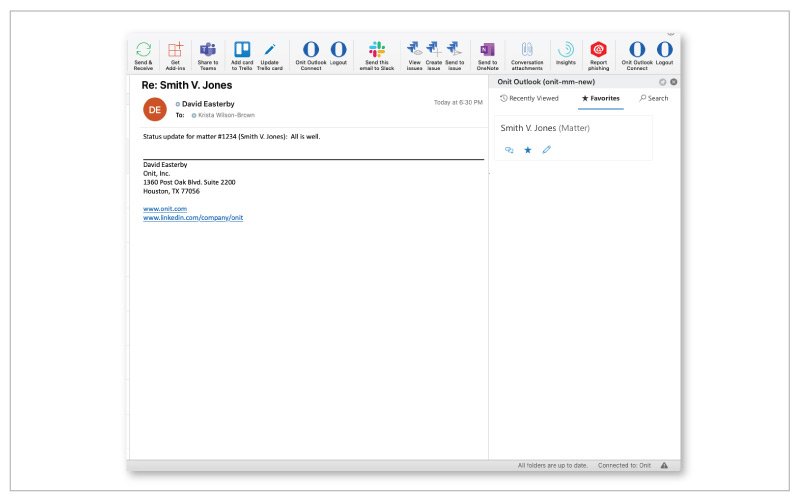
As part of Onit’s goal to work where lawyers work, we’ve recently made enhancements to Onit Outlook Connect. Our Microsoft Outlook plug-in allows you to connect your email with all of your favorite products and solutions on Onit’s business process automation and artificial intelligence platforms.

Onit’s email integration allows you to file your emails directly into other systems, such as specific matters in your enterprise legal management software or contracts in your contract lifecycle management software. You get direct access to Onit from within Microsoft Outlook without having to navigate to different windows or launch new tools.

The plug-in appears in a panel on the right-hand side of your Outlook window. It gives you a quick view into your matters and most recent or favorite records, so you can easily see a snapshot of the essential information you need. From there, you can link directly into the record you need and do your work in Onit, all without having to jump to another panel or browser or re-authenticate your credentials.

The Onit email integration is the shortcut you need to handle your email and work in the same place
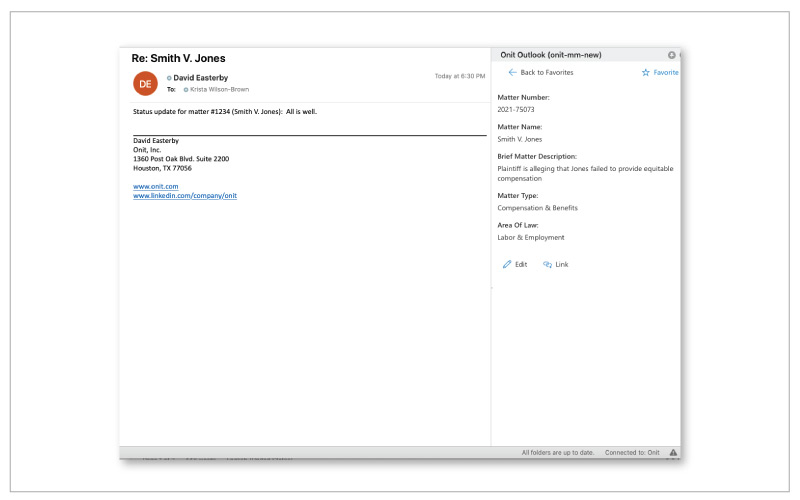


Simply choose the apps or tools you want to link to Outlook, and you’ll start seeing synopses of your work alongside your email every time you access it going forward. Get in, get out and focus on the work that matters most. Not only do you get to work where you’re already working, but you can keep everything organized in one place. Email linking and better organization mean better efficiency. Your email no longer has to be a hindrance to productivity.

At Onit, we’re always looking to create solutions that help lawyers do their best, most efficient work. Our ELM, CLM and other solutions are constantly innovated to provide process efficiency and work where our customers work.

Email is no different.

Reach out to your account manager today to learn more about how Onit Outlook Connect can change the way you use email in your day-to-day work. You can also schedule a demonstration or email [email protected].

A CLM Solution With None of the Risks and All the Rewards – Introducing Onit’s CLM 60-Day Money-Back Guarantee

If you’re in corporate legal, you’re probably all too familiar with the concept of contract lifecycle management (CLM) by now, even if you haven’t implemented a CLM solution yet. CLM is one of the hottest technologies in the legal space today, but much of the talk is more hype than substance.

CLM is an area that’s ripe for digital transformation, but not all technologies actually deliver. When you’re choosing a CLM solution, ROI matters – and to prove how serious we are about that, we’re offering a 60-day money-back guarantee on Onit’s CLM software.

In this podcast, Matt DenOuden, Onit’s Senior Vice President of Global Sales, discusses the CLM money-back guarantee and how to get from hype to payoff.

CLM Tool ROI

Contracts are all about money, whether you’re selling your own goods and services or paying to secure the goods and services of others. That means that the efficiency of the contracting process is directly tied to revenue – the faster you can complete your contracts, the faster you get to making revenues or realizing the benefits of the money you’re spending.

A vast majority of legal teams (86%) say they need to modernize by using more technology, while 71% of in-house lawyers say they feel stuck doing low-value work, including manual contract work that requires multiple systems.

If you can find a way to reclaim that time and substantially shrink the overall contract cycle, you’re going to have a very tangible impact on your ROI. The trick is finding the right CLM solution.

CLM From Onit

The Onit CLM solution stands out from others in the space because we took the time to perfect it before we marketed it – we weren’t going to enter the marketplace until we had a market-leading product. We started our company 10 years ago by custom-building a CLM solution for a client and have continued to invest in and evolve our solution ever since.

Onit’s CLM software provides a strong workflow that’s configurable to your individual needs. We don’t just presume that the steps in your process for a certain contract type are going to be the same for the next. The flexibility in our tool allows you to always have transparency into your contracting process.

Our CLM AI also significantly accelerates contract review and extraction with:

  • ReviewAI, which reviews and redlines contracts such as NDAs, MSAs, SOWs and purchase agreements in less than two minutes
  • Smart Checklists in the ReviewAI Word Add-In, which turns playbook checks into intelligent, actionable and collaborative tasks.
  • ExtractAI, which extracts contract data and obtains usable data from executed, legacy and third-party paper contracts in less than five seconds.

We believe so strongly in our CLM technology that we’re giving you a 60-day money-back guarantee.

Try It Today

It takes 30.9 days for the average contract to be approved without CLM technology. Chances are, you and your business stakeholders would like to see that 30 days shortened significantly. With Onit CLM, you can make that happen.

Most software trial offers give you nothing more than a demo of the product. We’re offering a bona fide trial period at our own risk, backed by a commitment to return your money if you’re not happy after 60 days. Even with an average contract cycle of 30 days, you get 60 days for all your stakeholders to try our software, understand its value and realize the extent to which it can improve your ROI.

To start your money-back trial today, visit onit.com/60-day-guarantee or email us at [email protected].

How to Balance Legal Cost Management with Rising Associate Fees

Legal cost management has become more challenging for corporate legal departments, as law firms’ associate salaries continue to climb.

Despite the global pandemic, many law firms had surprisingly strong financial performances in 2020. Reports show AmLaw 50 law firms saw a revenue increase of more than 7%, with other firms reporting double-digit growth and profits per partner jumping 30%.

Now, the nation’s top law firms have raised associate salaries in the hopes of remaining competitive and retaining top legal talent. First-year associate salaries at top firms now sit at $200,000, increasing as associates go up in seniority.

While this is certainly good news for associates, many corporate legal departments are conflicted since the bump will surely be reflected in law firm fees. Some corporate legal leaders view the salary increase with skepticism, especially when companies are under heavy pressure to cut costs and control legal spend. As more and more firms continue to match the new associate pay scales, in-house counsel and legal operations will have to find new ways to respond to the rising fees.

Six Strategies for Legal Spend Containment

While higher associate rates might lead to more pressure, the challenge isn’t insurmountable when it comes to legal cost management. The following are just a few strategies that corporate legal departments can employ to better understand and potentially offset those increased charges on their end.

  1. Set automated billing rules that address time charged to junior associates. Many corporations disallow billing by first-year associates during their ramp-up period and may start more closely scrutinizing overall firm staffing on matters now that rates are increasing. Any such rules should be clearly included in outside counsel guidelines.
  2. Closely review all your bills. No one enjoys legal invoice review, but it’s critical for catching improper costs. While not necessarily intentional, inconsistent coding and charges from improper billers happen all the time. They’re often missed because they’re buried in long bills with extensive charges.
  3. Pursue alternative fee arrangements. Whether it’s flat fee billing or contingency arrangements, alternatives to the billable hour model are increasing in popularity among corporate clients. Outside counsel might collaborate with you to implement them.
  4. Consider shifting some work in-house or to alternative legal service providers (ALSPs). As outside representation becomes more expensive, now is the time to take a detailed look at whether all the work you’re outsourcing to law firms could be handled just as well by internal resources or more cost-effective ALSPs.
  5. Move work from associates to paralegals or administrative personnel where possible. Junior lawyers often handle tasks that don’t require someone of their skillset. As associate rates go up, it’s more important than ever to ensure that every task is being handled at the right staffing level.
  6. Understand your overall approach to legal cost management to see where your dollars are going. Are you paying for things like overhead charges and photocopies or are you allowing invoices that include block billing? Eliminating these charges can help offset the newly increased associate fees.

The Role of Enterprise Legal Management and AI Invoice Review

All of the above cost-cutting measures will be significantly easier and more effective if you have the right enterprise legal management software (ELM) and AI-powered invoice review tools. These tools incorporate electronic billing, automated billing rules, machine learning and more which make it easier to enforce your outside counsel guidelines and engage in legal spend management.

AI is far more efficient at reviewing lengthy legal invoices and better at catching improper coding – charges that aren’t allowed, work that’s being handled at the wrong level and more. In-house legal professionals are already tasked with doing more with fewer resources and manual invoice review shouldn’t add to that burden.

Whether you turn to third-party review or implement your own internal solutions, you stand to better understand your overall spend and significantly reduce costs. InvoiceAI, Onit’s new AI offering for legal invoice review, has already identified six-figure savings in improperly billed travel costs for Onit customers during a time when travel was at an all-time low. The potential savings from using the right tools is significant.

ELM enables the e-billing, legal spend management and matter management you need to get insight into and control over your legal spend. Schedule a demo today or email [email protected] to learn more.

Quick Start Guide: AI-Powered CLM Tool for Corporate Legal, Procurement and Sales

Corporate legal departments are increasingly relying on AI and other technologies like a CLM tool and automation to reduce costs, boost efficiency and better collaborate with other business units on contracts.

While many organizations have started to focus on how contract AI benefits the corporate legal department, the right CLM system offers advantages beyond legal to other contract stakeholders in your organization like sales and procurement. To explain how AI-powered CLM benefits all these different groups, we recently put together our handy Quick Start Guide: Contract AI: How it Pays Off for Corporate Legal, Sales and Procurement.

Here are just a few of the AI and CLM benefits covered in the Quick Start Guide.

Better Productivity and Insight for Legal with a CLM Tool and AI

A CLM tool powered by AI improves productivity by handling much of the scut work related to pre-signature contract review. AI manages the first-pass review, makes recommendations and delivers a risk profile. One study showed that new users of legal AI contract review software were immediately 51.5% more productive and 34% more efficient. When you multiply those gains across all the lawyers in an average midsized organization (55, according to this survey by the Corporate Legal Operations Consortium), it’s the equivalent of adding 28 lawyers to your team without actually increasing headcount.

AI-powered CLM tools are also transforming the legal ops role by standardizing and automating legal processes and creating a single point of truth for contract data. Contract AI empowers legal ops professionals to have better visibility into deals, keep drafting and negotiations on track, reduce risk and improve governance, accelerate turnaround time, cut costs and more.

Shorter Sales Cycles

Legal doesn’t have to serve as a black box for sales departments, where requests go in and responses come back with zero insight into progress or process. AI-powered CLM tools allow sales departments to break free from using disparate systems and instead operate in a single repository and workflow for all their contracts.

Inefficiency and lack of transparency are two of the biggest roadblocks for sales departments, and contract AI removes them. This allows sales professionals to close deals faster, automate contract requests, have real-time insights on active contracts, have access to the information they need when they need it, and engage in newfound levels of self-service.

Better Spend Management for Procurement

Much like it does for sales, the right AI-powered CLM tool serves as a single point of truth for all procurement activities across an enterprise. Procurement can’t function without contracts, and contract AI allows procurement to be flexible enough to tackle all the contract-related tasks essential to the procurement function.

Among other things, AI-powered CLM systems empower procurement professionals to improve business outcomes, decrease risk, manage spend against budget, have insight into contract negotiations and engage in self-service for routine contracts like NDAs.

For more insight into how AI and CLM are revolutionizing day-to-day business for legal, sales and procurement, you can download the complete Quick Start Guide for an AI-powered CLM tool here.

Five Legal Operations Trends Uncovered in the CLOC 2021 State of the Industry Report

What are the latest legal operations trends affecting corporate legal? According to the Corporate Legal Operations Consortium’s (CLOC) 2021 State of the Industry Survey report, the median external spend increased by 84%, more work has moved in-house and legal departments continue to grow.

In collaboration with the Association of Corporate Counsel, the survey solicited responses from 200 organizations, 48 of which were Fortune 500 companies, across more than 22 industries in 31 states and 21 countries. Respondents spanned a wide range of industries, with the most (26%) coming from the technology sector.

1. External Legal Spend Up by 84%, But Internal Legal Spend Catches Up

While outside legal spend varied widely across survey participants, the overall results showed a marked increase in external legal expenditure in 2020 as compared to 2019. Median outside spend nearly doubled in the past year, up to $14.5 million from $7.9 million the previous year. (For those looking to control legal costs, here’s a good place to start.)

The median internal legal spend wasn’t far off, coming in at $13.3 million. While there was some variation based on the size of the companies, overall legal spend across all survey participants broke down exactly 50-50 between internal and external legal expenditure. In the previous year, the split came in at 60-40 in favor of external spend.

2. In-House Counsel, ALSPs Taking on More Work

Despite increased external spend, companies are bringing more work in-house – something indicated by past legal operations trends founded by CLOC. In fact, 39% of respondents reported moving more work in-house in 2020, compared to 28% the year before.

The prominence of alternative legal service providers (ALSPs) continued to slowly increase over the past year, highlighting other significant legal operations trends. For example, when it came to ALSPs, 71% of respondents reported using the same number of ALSPs as in the previous year. However, 24% increased the number of ALSPs they used and 21% reported shifting more work to ALSPs as opposed to law firms. Three-quarters of the participants said that the law firm/ALSP balance remained the same as in the previous year.

3. Legal Operations Trends Point to Larger Legal Departments

Among the companies surveyed, the average size of the legal department was 104 full-time employees, with smaller companies reporting fewer legal department employees and larger companies reporting larger legal departments. The entertainment/media, insurance and biotech/pharma/life sciences sectors reported having the most full-time employees in their legal departments.

Increases in legal department headcount mirrored those of last year – 40% of respondents in 2021 said they increased their number of dedicated legal operations full-time employees, just as they did in 2020. The most notable increases in headcount were seen at mid-sized companies. The average size of legal operations teams also increased across both industry sectors and company sizes.

4. Clarity Around Legal Operations Responsibilities – Proof of Function’s Maturity

Not surprisingly, the top-five most common services provided by legal operations were the same in 2021 as they were in 2020, according to survey participants. This signals the growing influence and prevalence of legal operations on the whole – meaning there’s a consensus in the industry on the role and value of the responsibility.

The most common legal operations services include:

  • Process development and project management
  • Data analytics
  • Technical and process support
  • Vendor management
  • Financial management

5. Priorities for 2021 and Beyond

According to the legal operations trends uncovered by CLOC, in-house legal departments are also looking ahead to shifting priorities. Implementing a Diversity and Inclusion program was ranked as the top priority in 2021 for 61% of respondents, up from a fifth-place ranking the previous year. Other priorities included automating legal processes (as exemplified by this contract lifecycle management case study), implementing new technology and right sourcing legal work.

You can read the entire survey report here.

Get the inside track on legal operations trends, the very best events and helpful content from the legal community by joining Lean Into LegalOps today.

Legal Industry News: Current News and Trends in Legal Department Operations, June 2021

Welcome to Onit’s June industry run-down, where we share with you some of the most pertinent and timely articles on legal department operations news. We hope this roundup of legal industry trends provides some useful takeaways.

In today’s digest, we share a recap of CLOC’s annual State of the Industry Survey and its recent virtual Global Institute, words of advice for corporate legal transformation, how AI finds even more billing guidelines violations and more.

#1 AI in the Legal Sector by the Numbers

More and more corporate legal departments are turning to AI every day to handle manual tasks, boost efficiency and gain insights for informed decision-making. You’ve likely already incorporated AI into some aspect of your day-to-day practice. After all, we’ve all heard the claims about how much it transforms everyday tasks. But just how much of a difference does AI really make?

This blog post breaks down the numbers and outlines some of the most significant gains to be gained through AI in the legal sector, including:

  • A 24% reduction in the average sales cycle and a 9% annual cost reduction by using an AI-powered CLM solution
  • A 51.5% increase in user productivity and the ability to redline a contract in under 2 minutes with legal AI software for contract review
  • The ability to review 6,000 contracts at once and access over 500 contract data points with AI for contract extraction
  • A 5-10% reduction in outside counsel spend with an AI-powered ELM solution

(Source: Onit blog)

#2 CLOC Sets Benchmarks for Legal Department Operations

The Corporate Legal Operations Consortium (CLOC) recently released the 2021 State of the Industry Survey report, the organization’s annual review of trends to watch in the legal ops space. This year’s survey, conducted in collaboration with the Association of Corporate Counsel, garnered responses from 200 organizations (including 48 Fortune 500 companies) across more than 22 industries in 31 states and 21 countries.

The 2021 report highlights how priorities have shifted through the uncertainty of 2020, with legal ops growing, legal spend increasing and more work coming in-house. Some of the most notable survey results include:

  • 39% of respondents said they brought more work in-house in 2021, compared to only 28% the year before
  • Nearly all respondents reported using the same number or more ALSPs than the year before
  • 40% of respondents increased their number of dedicated, full-time legal ops employees
  • 61% of respondents identified implementing a Diversity and Inclusion program as a top priority for 2021

You can read the entire survey report here.

(Source: CLOC)

#3 Workflow Automation, Return to Office Top “Big Picture” Plans for Legal Department Operations

On the final day of CLOC’s recent virtual Global Institute, one legal department operations panel took an in-depth look at why organizations need a well-defined plan for implementing new technology and preparing to handle business in a post-pandemic world.

Legal ops professionals will play a huge role in that planning and implementation. They’re pivotal in big-picture technology adoption because they’re often the most on top of innovation and the latest trends in the legal tech market. Legal ops will also be integral to making sure the rest of the legal department and the business as a whole actually adopt the new technologies they find.

(Source: Legaltech News)

#4 Legal Department Operations Leaders Share Their Best Strategies for Transformation

Change is a constant in our world, especially in the last year and a half. While workloads continue to increase in-house, the need to work quickly and effectively remains a common goal. But how can legal operations professionals spur change – especially technological change  – in corporate legal?

Corporate legal department operations experts from Mastercard, McKesson, Microsoft and GlaxoSmithKline sat down at the CLOC Global Institute to explain their best approaches, including:

  • Understanding the reasons for resistance
  • Communicating the vision of change and what that means
  • Conveying the importance of transformation on a personal level to team members
  • Understanding what resources are necessary to enact change, including people, tools and priorities

Bonus: What’s driving transformation in legal? Operations expert Brad Rogers digs into the topic, breaks down what is accelerating the need for change in corporate legal. Scroll to the bottom of this blog post to hear the podcast. You can also find the Onit podcast on Apple, Google Play, Spotify or other podcast platforms.

(Source: Corporate Counsel)

#5 How to Find Up to 11% More Non-Compliant Charges in Legal Invoices After Billing Rules and Standard Review

Growing workloads and other priorities limit the time in-house counsel can devote to reviewing outside counsel bills spanning hundreds of pages and thousands of line items. Enterprise legal management, matter management, e-billing, billing code standards and automated billing rules reduce the burden of invoice review. However, AI offers the opportunity for even more technological innovation.

On May 26, Onit announced the debut of InvoiceAI, an AI offering for first-pass legal invoice review and analytics that’s now available to customers. InvoiceAI handles first-pass legal invoice review to identify errors better and increase the consistency of application of billing guidelines and spend management best practices.

On average, InvoiceAI has identified 6-11% of unactioned errors in historical invoices, above and beyond what had already been identified by standard invoice review. Even in a year when travel was significantly restricted, InvoiceAI uncovered an average of $100,000 worth of savings on travel-related time and expenses that had been improperly submitted to customers.

For a free AI analysis of 90 days of historical billing data, Onit customers can reach out to their account managers and other interested parties can email [email protected].

(Source: LawSites Blog)

Get the inside track on legal department operations trends, the very best events and helpful content from the legal community by joining Lean Into LegalOps today. The program unites the legal community, providing them with a forum to share and learn from one another and get the latest news and trends in legal operations and technology.

CLM AI: Does Your Contract Software Redline Contracts for You?

When you ask today’s busy lawyers what they most need from legal AI, the answer is tools that help them be more productive like CLM AI contract redlining software.

While much of life might have gone on pause in the last year, contracts didn’t. In fact, lawyers have been handling more contracts than ever. For most companies, hiring more staff just to handle contracts isn’t a viable option. How, then, can lawyers speed up the contracting process and boost their productivity? The answer is having the right technology and features, like the features you can find in the right legal AI contract lifecycle management solution.

Take, for example, redlining contracts.

There are a lot of products and software that claim to help increase the efficiency of your contract review, but does your current contract AI redline your contracts for you? It should.

Contract Redlining Software to Help Protect Your Company From Risk

In a typical legal team, junior lawyers can be tasked with first-pass contract review, with the goal of flagging any issues that appear problematic or go against company standards. For example, if a third-party contract has a questionable clause, the junior attorney will usually circle the clause in red pen or mark it digitally and send it up the chain to senior lawyers for review. The senior lawyers would then review the clause and determine whether it’s something the company is willing to accept.

It doesn’t always go that smoothly, though.

Today’s busy lawyers are handling multiple tasks at once, while also juggling the demands of an increased workload and remote collaboration, meaning that errors can happen. If that clause is on page 45 of a 50-page contract and the lawyer has been reviewing it for several hours, it might not always get the attention it deserves due to fatigue or other priorities.

AI legal document review supports the contract review process and reduces the chance of human error. The contract redlining process is critical to protecting company interests. It’s also a fairly standard process, though it has historically been inefficient and time-consuming. All these factors make redlining a prime candidate for CLM AI.

What if there is a way to automate that first-pass review, better flag potential issues and get the whole job done in less than two minutes?

The Benefits of Redlining by CLM AI

Tapping into legal contract AI with automated redlining software is an incredible advantage when it comes to keeping up with increasing contract demands. It also creates a legitimate solution for reducing attorneys’ low-value, busy work.

Contract AI redlining isn’t only a tool that’s useful for lawyers – it’s also a great way to allow other business units, like sales or procurement, to engage in self-service. These other departments touch the company’s contracts all the time, but they typically have to wait in line to have their contracts reviewed by legal when they come in.

With ReviewAI contract management, business users can run an AI-powered redline in less than two minutes, spot potential issues right away, determine if there are problems to solve and then automatically escalate critical issues to legal as necessary. The redlining provided by CLM AI essentially allows business users to self-service the review of common contracts such as NDAs.

As with any contract AI, automating the redlining process isn’t replacing lawyers, it’s helping them be better at their jobs. It even performs a critical training function for junior lawyers and new legal team members. Company playbooks are based on decades of institutional knowledge. As junior lawyers see the AI data extraction results the software produces, they learn the playbook, essentially learning from the company’s best and brightest.

ReviewAI contract management from Onit redlines and automates your contract review, applying your playbook to find the things humans might miss and looking for any crucial terms that are missing. CLM AI takes less than two minutes, speeds up contract review by up to 70% and increases productivity by more than 50%.

Schedule an Onit demo today to learn more.

Meet InvoiceAI: Onit’s New Artificial Intelligence Offering for Legal Invoice Review

Legal invoice review is a necessary process for corporate legal departments and also notoriously complex and time-consuming – even with business rules applied. Nevertheless, legal departments spend countless dollars every year for in-house counsel and other professionals to manually inspect invoices, whether flagged or not. That’s time wasted on administrative tasks that in-house professionals can reallocate to higher-value work and strategies.

That’s all about to change.

Today, Onit announced the debut of InvoiceAI for its customers. The artificial intelligence offering for first-pass legal invoice review and analytics decreases the burden of invoice review while providing insights into spend analytics.

An Intelligent Review

The sheer volume of legal invoices has pummeled Fortune 500 corporate legal departments for years, challenging corporate counsels’ ability to understand and control legal spend and build productive partnerships with law firms.

Even with flagged invoices, corporate counsel can face a large number of line items on each invoice to reconcile and miss noted issues or errors. Enforcing outside counsel guidelines is complicated even further with issues like vague or incomplete invoices, improper block billing, incorrect coding and more.

InvoiceAI builds off Onit’s existing billing rules engine, enhancing the invoice review process by incorporating machine learning and natural language processing to more accurately and efficiently identify invoice issues that need further review. Our machine learning models identify potentially problematic billing issues like administrative tasks or travel and integrate with existing eBilling, legal spend management and enterprise legal management technologies. What you get is an intelligent review that learns more as you process more invoices, plus all the advantages of our configurable rules engine – the best of both worlds when it comes to understanding legal spend.

AI-Powered Invoice Review Leads to Significant Cost Savings

While InvoiceAI’s models continue their training, the offering is already used to analyze past invoices and identify potentially non-compliant charges under company billing guidelines and legal spend management best practices.

A select group of Onit Fortune 100 customers ran InvoiceAI through historical bills with significant results. InvoiceAI uncovered on average of 6-11% unactioned errors for invoices submitted in 2020, above and beyond the savings that Onit’s rules-based invoice review tools had already found.

For example, even though 2020 was a notably slow year for travel, InvoiceAI identified travel charges in the high six-figure range that should not have been billed.

On top of better invoice review, you also get powerful analytics. The results generated by InvoiceAI can serve as a learning tool for outside counsel, giving them a clear report on the core commercial expectations of the companies they represent. The reports are also beneficial for demonstrating immediate savings in outside spend to internal stakeholders.

The Future of Legal Invoice Review, Ready Now for Customers

InvoiceAI is available to Onit customers now and will be generally available to the public in the fall.

AI-enabled invoice review from SimpleLegal, Onit’s subsidiary, will launch this summer, with availability open now for select existing corporate legal customers.

If you’re currently an Onit or SimpleLegal customer and you want a complimentary AI analysis of the last 90 days of your billings, contact your account manager today.

If you’re not currently a customer but want to learn more about how InvoiceAI can improve your legal invoice review and legal spend management, contact [email protected] today.