Category: Contract Lifecycle Management

Quick Start Guide: AI-Powered CLM Tool for Corporate Legal, Procurement and Sales

Corporate legal departments are increasingly relying on AI and other technologies like a CLM tool and automation to reduce costs, boost efficiency and better collaborate with other business units on contracts.

While many organizations have started to focus on how contract AI benefits the corporate legal department, the right CLM system offers advantages beyond legal to other contract stakeholders in your organization like sales and procurement. To explain how AI-powered CLM benefits all these different groups, we recently put together our handy Quick Start Guide: Contract AI: How it Pays Off for Corporate Legal, Sales and Procurement.

Here are just a few of the AI and CLM benefits covered in the Quick Start Guide.

Better Productivity and Insight for Legal with a CLM Tool and AI

A CLM tool powered by AI improves productivity by handling much of the scut work related to pre-signature contract review. AI manages the first-pass review, makes recommendations and delivers a risk profile. One study showed that new users of legal AI contract review software were immediately 51.5% more productive and 34% more efficient. When you multiply those gains across all the lawyers in an average midsized organization (55, according to this survey by the Corporate Legal Operations Consortium), it’s the equivalent of adding 28 lawyers to your team without actually increasing headcount.

AI-powered CLM tools are also transforming the legal ops role by standardizing and automating legal processes and creating a single point of truth for contract data. Contract AI empowers legal ops professionals to have better visibility into deals, keep drafting and negotiations on track, reduce risk and improve governance, accelerate turnaround time, cut costs and more.

Shorter Sales Cycles

Legal doesn’t have to serve as a black box for sales departments, where requests go in and responses come back with zero insight into progress or process. AI-powered CLM tools allow sales departments to break free from using disparate systems and instead operate in a single repository and workflow for all their contracts.

Inefficiency and lack of transparency are two of the biggest roadblocks for sales departments, and contract AI removes them. This allows sales professionals to close deals faster, automate contract requests, have real-time insights on active contracts, have access to the information they need when they need it, and engage in newfound levels of self-service.

Better Spend Management for Procurement

Much like it does for sales, the right AI-powered CLM tool serves as a single point of truth for all procurement activities across an enterprise. Procurement can’t function without contracts, and contract AI allows procurement to be flexible enough to tackle all the contract-related tasks essential to the procurement function.

Among other things, AI-powered CLM systems empower procurement professionals to improve business outcomes, decrease risk, manage spend against budget, have insight into contract negotiations and engage in self-service for routine contracts like NDAs.

For more insight into how AI and CLM are revolutionizing day-to-day business for legal, sales and procurement, you can download the complete Quick Start Guide for an AI-powered CLM tool here.

CLM AI: Does Your Contract Software Redline Contracts for You?

When you ask today’s busy lawyers what they most need from legal AI, the answer is tools that help them be more productive like CLM AI contract redlining software.

While much of life might have gone on pause in the last year, contracts didn’t. In fact, lawyers have been handling more contracts than ever. For most companies, hiring more staff just to handle contracts isn’t a viable option. How, then, can lawyers speed up the contracting process and boost their productivity? The answer is having the right technology and features, like the features you can find in the right legal AI contract lifecycle management solution.

Take, for example, redlining contracts.

There are a lot of products and software that claim to help increase the efficiency of your contract review, but does your current contract AI redline your contracts for you? It should.

Contract Redlining Software to Help Protect Your Company From Risk

In a typical legal team, junior lawyers can be tasked with first-pass contract review, with the goal of flagging any issues that appear problematic or go against company standards. For example, if a third-party contract has a questionable clause, the junior attorney will usually circle the clause in red pen or mark it digitally and send it up the chain to senior lawyers for review. The senior lawyers would then review the clause and determine whether it’s something the company is willing to accept.

It doesn’t always go that smoothly, though.

Today’s busy lawyers are handling multiple tasks at once, while also juggling the demands of an increased workload and remote collaboration, meaning that errors can happen. If that clause is on page 45 of a 50-page contract and the lawyer has been reviewing it for several hours, it might not always get the attention it deserves due to fatigue or other priorities.

AI legal document review supports the contract review process and reduces the chance of human error. The contract redlining process is critical to protecting company interests. It’s also a fairly standard process, though it has historically been inefficient and time-consuming. All these factors make redlining a prime candidate for CLM AI.

What if there is a way to automate that first-pass review, better flag potential issues and get the whole job done in less than two minutes?

The Benefits of Redlining by CLM AI

Tapping into legal contract AI with automated redlining software is an incredible advantage when it comes to keeping up with increasing contract demands. It also creates a legitimate solution for reducing attorneys’ low-value, busy work.

Contract AI redlining isn’t only a tool that’s useful for lawyers – it’s also a great way to allow other business units, like sales or procurement, to engage in self-service. These other departments touch the company’s contracts all the time, but they typically have to wait in line to have their contracts reviewed by legal when they come in.

With ReviewAI contract management, business users can run an AI-powered redline in less than two minutes, spot potential issues right away, determine if there are problems to solve and then automatically escalate critical issues to legal as necessary. The redlining provided by CLM AI essentially allows business users to self-service the review of common contracts such as NDAs.

As with any contract AI, automating the redlining process isn’t replacing lawyers, it’s helping them be better at their jobs. It even performs a critical training function for junior lawyers and new legal team members. Company playbooks are based on decades of institutional knowledge. As junior lawyers see the AI data extraction results the software produces, they learn the playbook, essentially learning from the company’s best and brightest.

ReviewAI contract management from Onit redlines and automates your contract review, applying your playbook to find the things humans might miss and looking for any crucial terms that are missing. CLM AI takes less than two minutes, speeds up contract review by up to 70% and increases productivity by more than 50%.

Schedule an Onit demo today to learn more.

ReviewAI Tools Revolutionized with ReviewAI Smart Checklists

It’s no secret that in-house lawyers have too much to do and too little time to do it, making contract review tools a necessity, not a luxury. So, how can contract AI help in-house lawyers? They often have a long list of what they want and need from AI and technology that includes:

  • Eliminating painful, repetitive and non-complex work
  • Freeing up time to focus on strategy and high-value work
  • Increasing the quality of contract review
  • Working faster and handling higher volumes of work

With these priorities in mind, Onit launched contract AI tool ReviewAI seven months ago. ReviewAI does the repetitive work that lawyers want to streamline so they can concentrate on more strategic contributions. It reviews, redlines and edits all types of contracts in less than two minutes, including NDAs, MSAs, SOWs, purchase agreements, employment agreements and more. In addition, its Microsoft Word Add-In enables lawyers to work the way they are accustomed to working.

Now, Onit has announced a substantial enhancement to ReviewAI – Smart Checklists. It’s contract AI that goes beyond alerts and does the work.

Keep reading to learn more, view a demo here or you can hear Jean Yang, Vice President of the Onit AI Center of Excellence, explain it in the latest episode of our Onit podcast.

Contract AI That Goes Beyond Alerts – It Does the Work

Smart Checklists, offered as part of the ReviewAI Word Add-In, evolves contract review tools by turning playbook checks into intelligent and collaborative tasks. It tracks what’s important, what to do next and what is done – all in an intuitive solution that requires no training.

How does it work? Open a contract, and ReviewAI has Smart Checklists ready to go.

As a result of this contract AI tool, lawyers save upward of 52% of their time on contracts, while legal teams improve consistency, lower contract risks and better support the business.

Making ReviewAI Tools Smarter

Lawyers have always worked off of some sort of checklist during contract reviews. The problem is that the lists often only exist on a piece of paper or in someone’s head. They’re static.

ReviewAI Smart Checklists uses AI to create checklists made up of concrete, task-based actions that are generated from your company playbook. Rather than going through the tedious undertaking of applying that playbook yourself, ReviewAI digitizes it for you automatically. If you need to break your contract review into multiple sessions, ReviewAI and its Smart Checklists remember where you left off and make it easy to keep track of where you are, what’s been done and what you still need to do.

How to Get Started with ReviewAI Smart Checklists

Onit’s ReviewAI Smart Checklists, a revolutionary approach for contract review tools, is available immediately.

To learn more, you can:

Three Examples of In-House Legal Operations Excellence

It’s no secret that in-house legal operations faced a 2020 that was anything but business as usual. As the pandemic stretched on for far longer than anyone expected, companies found new ways to do business, accommodating employees who were now working from home and implementing technology solutions that would streamline processes and replace manual tasks and in-person activities.

In-house legal operations professionals took the lead at many companies to figure out how to see organizations through the pandemic. In some cases, this meant overhauling processes and procedures that had been in place for years or even decades. Simply put, legal operations teams became the masters of the new normal.

Following are three examples of how legal operations flipped conversations from uncertainty to success during challenging times.

1. Building a Technology Roadmap for Legal Success

Even the world’s most well-established corporations faced unprecedented challenges and found new ways to surpass them.

When the pandemic hit, fast-food giant McDonald’s made responding to it and helping employees adapt top priorities. The McDonald’s in-house legal operations department placed other company goals aside if they didn’t immediately contribute to its crisis response. Their first step was to survey the organization’s various business and legal teams to identify their technology needs and wish lists. From there, legal operations created an aspirational roadmap for getting the most effective technology into the hands of the company’s global teams.

Three overriding needs emerged from the survey:

  1. A rebalancing of workloads
  2. A reduction in workloads
  3. A means for self-service

Using sophisticated platform technology, the legal operations team created systems to address each of these needs – ones that were flexible enough to quickly respond if needs shifted or changed. At the end of the day, a platform approach allowed McDonald’s to build the workflow and collaboration solutions needed to respond to the COVID crisis and keep the company moving forward.

To listen to the McDonald’s story, visit here.

2. Embracing Enterprise Legal Management

Handling domestic business was hard enough for most companies during the pandemic. But corporations with an international presence faced additional unique challenges – especially if they didn’t have the right technologies.

Jaguar Land Rover North America (JLRNA) is a perfect example. As a multinational corporation, JLRNA routinely has to respond to international legal service requests. Unfortunately, though, they lacked the technology to do it efficiently during the onset of the COVID-19 crisis.

JLRNA’s in-house legal operations team acted quickly to implement a sophisticated enterprise legal management solution that was customizable, allowing them to track and manage all the different areas of the company in the ways they needed to. Within the enterprise legal management system, they also created a document repository for storing contracts and capturing contract data and a system for submitting legal service requests. By replacing rudimentary matter management processes with an ELM solution, JLRNA legal operations provided the company with a seamless transition to a new way of doing business that could adapt.

You can hear JLRNA share their journey in this podcast.

3. Adapting Existing Solutions to Meet New Problems

Much of the focus in discussing how organizations navigated recent challenges has been on the adoption of new technologies. For some in-house legal operations, though, the answer was to leverage tools and solutions that had already been implemented. That was the case for publishing company Pearson.

Pearson had already implemented a comprehensive contract lifecycle management (CLM) solution to help contain costs. In 2020, that CLM solution served as the foundation for Pearson’s legal department to create the Transaction Services Center (TSC), an effective means for handling high-volume, low-risk standard agreements. This freed up internal counsel to focus on more complex agreements and activities that helped support the business. Having a comprehensive CLM solution enabled Pearson to better handle legal service requests, review and approve contracts, and respond to legal advisory requests, at the same time achieving savings, increasing efficiency and gaining unprecedented visibility into contract portfolios and internal workloads. The results were so impressive, Pearson won the Association of Corporate Counsel’s Value Champions Award.

You can hear Pearson’s story here.

No one can predict for sure when the pandemic and its effects on business will end. Until it does, in-house legal operations professionals will continue to play a crucial role in guiding their organizations to success. The stories above are just a few perfect examples of how ingenuity and technology make that possible.

You can read more about corporate legal departments transformations in this eBook:

Lean Into LegalOps: The Ultimate Guide to Legal Operations in the New Normal and Advice from Transformative Corporate Legal Departments.

Meet the New Onit User Interface: A Quicker Way to Tackle Automation and Workflow for Corporate Legal

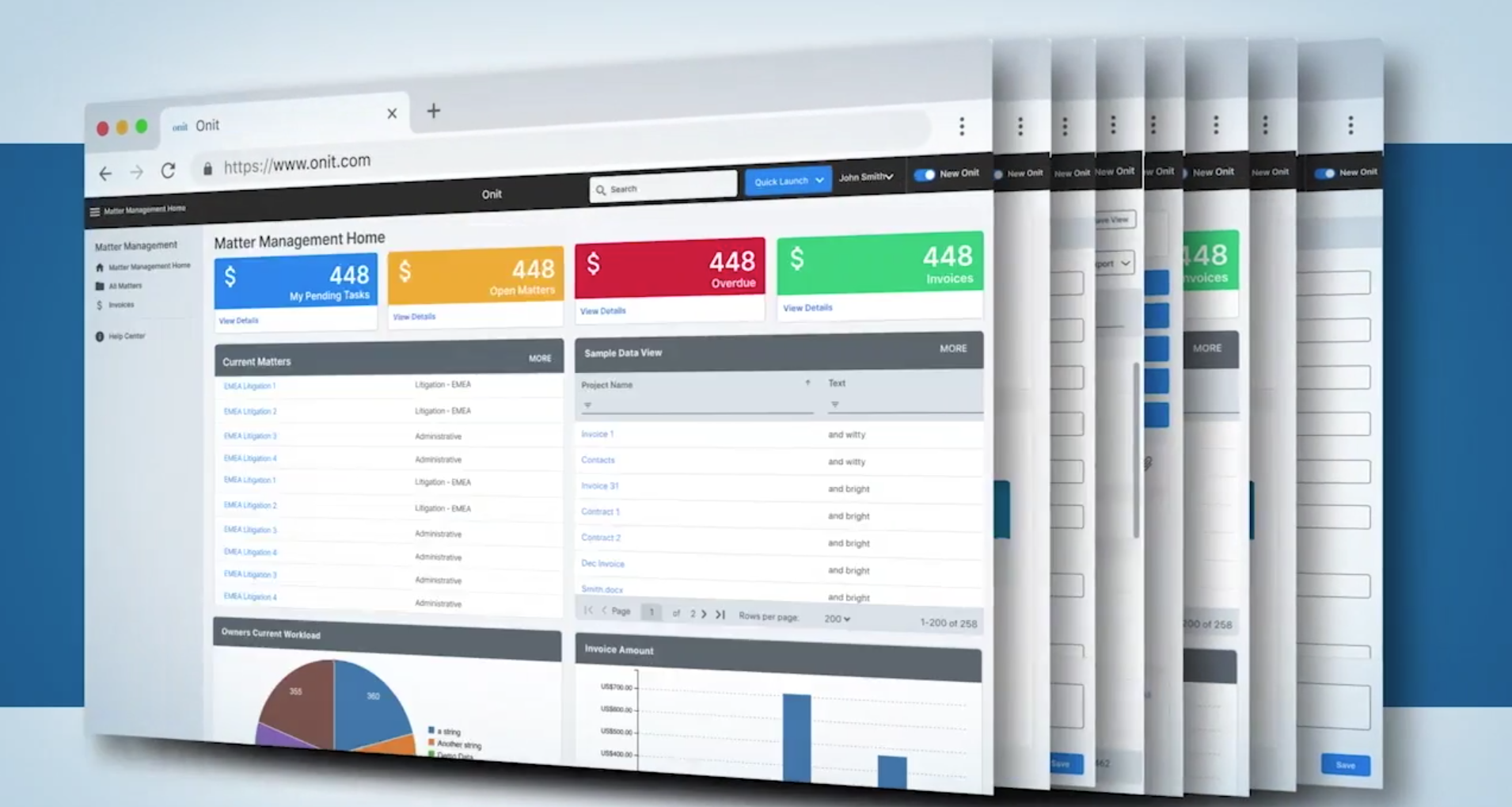
Onit Matter Management dashboard displaying open matters, pending tasks, overdue invoices, and sample data view for legal operations and enterprise legal management.

The technology demands for most corporate legal departments have become increasingly more complex in the past decade – especially for automation and workflow. With corporate legal prioritizing efficiency, cost control and collaboration across the enterprise, technology must be flexible enough to meet ever-evolving needs and easy enough to use to encourage widespread adoption.

Onit understands, which is why we’re excited to announce our new user interface. The enhanced design allows corporate legal professionals, Onit App builders and business collaborators in departments such as compliance, sales and IT to create, collaborate and get more done in fewer clicks.

The new UI provides a cleaner visual language, enhanced indicators and status effects and a more straightforward way to identify and act on pertinent data and deadlines. Powered by Onit’s no-code platforms for workflow automation (Apptitude) and AI-based business intelligence (Precedent), the even more intuitive experience maximizes productivity for enterprise legal management, contract lifecycle management, legal service requests, legal holds and more.

No Automation and Workflow Challenge Too Big or Too Small to Solve with Onit

Our new UI joins a variety of Onit innovations that make it simpler to streamline and automate critical processes. Thanks to our no-code platforms and intuitive UIs, legal operations professionals and in-house counsel can create time-saving, automated Apps that simplify automation and workflow.

Our Process Builder provides a visually oriented, drag-and-drop interface that allows users of all levels of technical proficiency to build workflows. It removes learning hurdles by making it easy for users to understand how to build applications, allowing corporate legal to create Apps in minutes.

To see this in motion, check out our Hack the House competition.  Corporate legal professionals from companies including Colgate-Palmolive, Corteva Agriscience and McDonald’s identified business needs for areas such as diversity, IP and HR and created Apps and solutions to meet them in three weeks. In the end, Team IP won by creating Apps and a solution that automated the trademark renewal process.

Onit’s AI also provides a valuable edge for automation and workflow. ReviewAI uses artificial intelligence to quickly review, redline and edit all types of contracts, increasing productivity by more than 51%. ExtractAI leverages AI-based software to extract and obtain usable data from executed, legacy and third-party paper contracts.

To learn more about Onit, our new UI and our platforms and products, reach out to [email protected] or schedule a demonstration.

With the Rising Use of AI In Legal Services, What Should In-House Counsel Look For?

Robot hand balancing scales of justice with icons representing legal technology, law, and legal operations.

The increased use of AI in legal services is indisputable. Analysts predict that corporate legal departments will see technology budget increases as significant as three times by 2025 and an ongoing push to automate legal work for productivity. With its ability to bring immediate results out-of-the-box and learn and improve over time, AI offers the ideal technological solution to boost efficiency and save time for high-performing legal departments. In fact, this study found that AI for contract review can increase productivity by 51.5%.

However, not everything that claims to be AI these days is actually AI, and not all AI solutions are created equal. AI can significantly boost efficiency, streamline workflows, and save costs – if you invest in the right AI solutions.

Given the tremendous benefits of AI technologies, it’s helpful to understand the features that set the best AI tools apart from the competition. When you’re looking to purchase AI solutions and transform your legal department, you should consider whether they offer the following characteristics and features.

Time to Value

When you invest in new technology like AI, you want to start reaping the benefits as soon as possible. Therefore, when looking at AI options, you want to find solutions that allow you to quickly begin realizing value after you implement them.

Several factors can decrease the amount of time it takes to realize value from an AI solution. The software should be quick and easy to implement and roll out across all your users. Your AI should also ideally be pre-trained, meaning it’s ready to go straight out of the box, rather than requiring additional time to train it. The faster your users can capitalize on all the benefits of your AI solution, the faster it will translate into value for your organization.

Pricing Structure

Technology vendors take a wide range of approaches to pricing their products, and how they price them can significantly impact their value and usability for your enterprise. As the use of AI in legal services increases, the last thing you want to do is agree to a pricing structure based on the number of users.

When the price of your AI solution is not based on user numbers, you have the option of using the technology to work across all business units in your organization without having to worry about incurring extra costs when additional collaboration would be valuable. The ideal solution will have no limit on the number of users who can interact with the system for the initial price of your investment.

User Experience

Like any technology, AI is only valuable if your users can use it effectively. Any solution you choose should be easy to understand and execute without excessive training or a steep learning curve. Look into whether the product you’re considering has a proven implementation department.

The right tools will also have a good track record in the customer satisfaction department. It’s worthwhile to look into the vendor or product’s Net Promoter Score (NPS). An NPS is based on customers’ ratings of their likelihood of recommending a company, product, or service on a scale of 0 to 10 – so the higher the NPS, the better.

Underlying Platform

Any AI solution you purchase will have to operate on some underlying platform to function. At a minimum, that platform should be a trusted product that has the capacity necessary to meet all your needs and the ability to scale as those needs change.

Even better is not having to rely on external platforms for your chosen AI solution to work. The ideal tools will run on a reliable platform supplied and maintained by the same vendor as the AI solutions themselves. This will allow you to deploy products and updates quickly. Also, look for no-code platforms that will enable you to build your own apps with little or no technical experience.

Immediate Usability

A solution is only helpful if your users actually use it. It’s also most helpful if they can start using it right away. Long implementation delays or the need to invest significant time in learning to use a product can outweigh the benefits that product might eventually offer.

You should look for out-of-the-box products that require minimal configuration before they can be used in order to get the full use of AI in legal services. Such products are ready to go almost immediately, meaning you can quickly start using them to address the problems that drove you to seek out AI in the first place. At the same time, however, they can also be customized to meet the most simple or customized workflows within your organization.

Partner Network

While the vendor of your chosen AI solution certainly matters, so do your vendor’s partnerships. You want a technology provider that partners with other top-notch providers and professionals who can address your needs outside of those related to the specific AI technology you’re buying.

You want your AI product vendor to have alliances with experienced implementation service providers to ensure that your chosen solution succeeds across your entire enterprise. Beyond implementation, your provider should also be part of a robust ecosystem of partners who can address your needs as they arise, from the most routine business needs to the most novel demands that might arise. Having the right partnerships also means that your vendor can leverage those partnerships to design the most optimal solutions to address a particular problem.

The Use of AI in Legal Services – Investing in the Right AI

The excitement about AI is understandable – today’s technologies can accomplish tasks that seemed impossible even just a few years ago. Wanting to incorporate those advancements into your organization to improve the ways you do business is a great impulse.

You need to be sure, however, that you’re getting products that are effective and not just hype. Even more importantly, they must be tailored to your organization’s needs if you want to see actual benefits from them. Not every AI solution is suitable for every organization, and not every AI provider will give you the support you need for your products to succeed.

By considering the factors outlined above before you purchase any solution, you’ll put your organization on the right path to genuinely benefiting from AI. It’s worth the time to do your research and think before you buy.

Legal Industry News: Current News and Trends in Legal Operations, March 2021

Digital globe with illuminated continents and abstract data connections, symbolizing global business and legal technology innovation.

Welcome to our March industry run-down, where we share with you some of the most pertinent and timely articles on legal industry news. We hope this roundup of legal industry trends provides some useful takeaways.

In today’s lineup, we share insights about how Lenovo uses AI and automation for contract management, legal technology trends from Gartner and how leaning into communications and leadership traits exhibited by women can enhance collaboration between lawyers and clients.

#1

 An AI Checklist for Every Phase of Contract Lifecycle Management

Contracts are the main source of risk and obligations for corporate legal teams, and if not managed properly, they can lead to a whole host of complications and business failures. The right contract lifecycle management (CLM) tool allows you to modernize the way you deliver legal services, automating and standardizing processes to create a single point of truth for all your contracts.

Nick Whitehouse, general manager of Onit’s AI Center of Excellence, tackles the latest in legal industry news by sharing a checklist for contract AI, covering all phases of CLM. The article includes considerations for both the pre-signature and post-signature contract management phases, including topics like the importance of pre-trained AI, how a CLM solution can turn contract data into actionable intelligence and the overall benefits of contract AI.

(Source: Lexology)

#2

Are You AI-Certified? According to Experts, You Might Want to Look Into that.

While AI solutions are often touted as the solution to human error and bias, the data underlying those tools can contain just as many biases. Problematic data means problematic results, and even potential liability.

One current initiative is trying to change all that by empowering attorneys to give their clients reliable and substantive advice about the AI tools they’re considering using. The University of Toronto’s Schwartz Reisman Institute for Technology and Society has partnered with AI Global, a nonprofit focusing on advancing responsible and ethical AI, to create a certification project for lawyers looking to help their firms implement AI tools or advise their clients about AI. The goal of the new program is to create an international framework of AI across a number of industries that is fair, ethical, and responsible, eliminating bias and privacy breaches.

(Source: ABA Journal)

#3

Five In-House Legal Tech Trends from Gartner

In recent years, automation and other technologies have emerged as the obvious solution for beleaguered legal departments that are under constant pressure to cut costs and boost efficiency. While the legal industry has historically been resistant to technology, things have slowly been changing. When the pandemic hit, legal departments shifted gears. As a result, they’ve been able to discover the many benefits of incorporating and embracing technology to achieve business outcomes.

The trend toward widespread technology adoption is only expected to continue. Gartner recently predicted five trends we should expect to see in legal tech in the coming years:

  • By 2024, 20% of generalist lawyers in corporate legal departments will be replaced by nonlawyer staff
  • By 2024, 50% of corporate legal departments’ work related to major corporate transactions will be automated
  • By 2025, corporate legal departments will triple their spending on legal technology
  • By 2025, at least 25% of corporate legal application spending will be on nonspecialist technology providers.
  • By 2025, corporate legal departments will have only captured 30% of the potential benefits of their CLM solutions

 (Source: Gartner)

#4

Look to Women to Advance Success and Collaboration in the Legal Industry

In honor of Women’s History Month, the Women’s Network of the Legal Value Network’s shined the spotlight on what makes women leaders successful and how adopting feminine leadership and communication styles can benefit law firms by advancing collaboration between lawyers and clients.

Female leadership has really risen to the occasion in the face of the pandemic’s challenges, largely because traditionally female leadership qualities – compassion, humility, and collaboration – have been what companies have needed to thrive despite uncertainty. “The qualities that make women great leaders through times of crisis are also what make them great leaders every day,” says Shelley Zalis, CEO of The Female Quotient and founder of The Equality Lounge.

(Source: Legal Value Network)

#5

The Future of Contracting: CLM Automation + AI Transformation at Lenovo

Every legal department can benefit from more efficient processes. Technology is the key to making that possible. The World Commerce and Contracting Association recently held a webinar that looked at the Lenovo legal department transformation journey, highlighting how Lenovo successfully built a strategy for an effective global rollout of contract lifecycle management technology that relied heavily on AI.

Key themes of the webinar included:

  • Lenovo’s CLM evolution and transformation roadmap
  • Multi-year goals related to their contract management technology
  • Why the culture must eat change management for breakfast
  • The benefits and ROI of a single CLM platform

You can watch the entire webinar to learn how AI is driving the future here.

(Source: World Commerce and Contracting Association)

Bonus Resource: Lean Into LegalOps

Get the inside track on corporate legal and operations trends, the very best events and helpful content from the legal community by joining Lean Into LegalOps today. The online forum lets Onit customers and other members of the legal community share and learn from one another with webinars, debates, weekly catch-up calls and more.

Ten Things to Look For When Choosing a Legal Platform

Laptop displaying digital analytics and data visualization, representing legal technology solutions and optimization in legal operations.

Legal platform technologies have proven invaluable for helping corporate legal departments adroitly navigate the ups and downs of the past year. Thanks to the flexibility, customization, unlimited scalability and limitless building opportunities they offer, no-code platforms have provided legal departments with the tools they need to innovate and adapt to meet change after change.

Perhaps you’ve already decided that a platform approach is right for your legal department. How do you know how to pick the right one?

What to Look for When Buying a Legal Platform

Here are ten things to consider when choosing a legal platform to meet the unique needs of your corporate legal department.

  1. Enterprise-wide solution development

The ideal online platform will give you the ability to create all the solutions you need for day-to-day operations, both within your legal department and in any department across the organization, allowing for cross-collaboration between all departments.

  1. Agile project management

The right platform will be able to adjust and evolve as your department’s and organization’s needs change. When considering a platform, make sure it continually releases updates, so you know you’re always incorporating the most up-to-date security standards and user feedback in the solutions you create.

  1. No-code technology

You shouldn’t have to be a technology or coding expert to reap the benefits of an online platform. Many platforms today are no-code, bridging the gap between business and technical users. This makes it simple for anyone in the legal department to build new workflows, even if they have little or no technical training.

  1. Quick realization of value

With any business change or new technology, the faster it can start creating value, the better. A legal platform that allows you to quickly build solutions from day one lets you start realizing value for your organization almost immediately.

  1. AI and automation

The platform you choose should ideally incorporate the power of automation and artificial intelligence to eliminate time-consuming and costly manual legal processes. You’ll also benefit from continuous learning, which automatically examines and adjusts business process rules and workflows over time, even predicting necessary changes before they arise.

  1. Third-party integration tools

While it’s critical that you’re able to build whatever solutions you need on your platform, it’s equally important that those solutions are able to connect to the other tools you use every day. The ideal platform will include a third-party integration tool that seamlessly moves data between all your systems and acts as a centralized hub for your operations.

  1. Robust business intelligence tools and analytics

Today’s legal departments are sitting on more data than ever before. It’s time to make that data useful. Your platform should integrate robust business intelligence tools and analytics capabilities that empower you to leverage your data to make valuable, informed business and legal decisions that will benefit the entire organization.

  1. A responsive user interface

For a long time, technology struggled to find a way to be suitable for viewing on all devices. Instead, what you saw varied depending on your screen size or resolution. Enter responsive user interfaces, which adjust your content according to the device that’s being used, so your users can always view the content as you intended it to be viewed.

  1. An adaptive end-user experience

Adaptive platforms offer multiple layouts in order to provide the best possible experience for your end users. An adaptive platform will detect where your user is accessing it and automatically provide the most appropriate layout for that user’s situation, role, or activity.

  1. Best-in-class partner programs

The best technology providers should be partnered with the best talent, resources, and experience in the industry. Your platform provider should give you access to a top-notch partner network where you can get whatever help you need with technology, implementation, or services in order to maximize your investment.

Onit’s legal platforms, business process automation platform Apptitude and AI-based business intelligence platform Precedent, help corporate legal departments adapt and innovate to meet whatever challenges arise. Contact us today to learn more about how a platform approach can benefit your corporate legal department.

For fmore information on how to choose the right platforms to benefit your corporate legal department, consider these resources:

An AI Checklist for All Stages of Contract Lifecycle Management

Person typing on a laptop at a wooden desk, with a notebook, pen, and coffee cup, illustrating legal technology and operations in a professional setting.

Since contracts are the primary source of risk and obligations that corporate legal teams need to manage, all stages of contract lifecycle management should be managed properly. Failure to do so can lead to complications such as failure to enforce negotiated supplier terms, regulatory breaches, inadequate delivery to customers, time lost, revenue leakage and inflated costs.

Many legal departments are struggling to find effective solutions for handling contracts for all stages of contract lifecycle management, with 71% of in-house lawyers reporting that they are stuck doing manual work which should be automated. Another 86% say that they need to modernize the way they deliver legal services. The industry is seeing legal departments making moves to adopt comprehensive contract lifecycle management (CLM) solutions to standardize processes and obtain a single source of truth for all their contracts.

However, not all CLM technologies are created equal. Many require time-consuming manual entry and maintenance, putting further burden on already stretched teams. AI-powered CLM systems abstract away much of this manual work, giving corporate legal departments the ability to control their contracts from start to finish and free up lawyers to focus on higher-level tasks that will help grow the business.

But what exactly should the combination of AI and CLM look like? It should intelligently augment, assist and automate manual activities throughout the entire contract lifecycle, improve consistency, save time and surface insights that allow the legal team to become much more proactive.

As legal teams incorporate this new technology, there are several functions they should expect when it comes to pre-signature contract management and post-signature contract management.

AI for the Pre-Signature Contract Management Stage

Pre-Trained

AI contract management solutions should come pre-trained, meaning you aren’t doing the “heavy-lifting” on the implementation side. To learn a task, AI often needs large data sets to analyze, which is a highly specialized and technical process. Modern legal AI providers should handle this training, giving lawyers out-of-the-box functionality to use it within days – not weeks or months.

The real value of AI is that it is always learning and improving. Pre-training will have it ready to use quickly, giving you a faster return on your investment. As you use it more, it should identify and enforce preferences unique to your corporate legal department. This pre-learning also gives the legal team the space needed to improve the overall CLM process.

First-Pass Review

For the pre-signature contract management stage, AI should function as a human lawyer for the first-pass review. It should scour Microsoft Word or PDF contracts like NDAs, MSAs and purchase agreements, flag key contract issues, apply contract review templates, suggest edits and provide an overall risk profile.

The AI should also work where your people work, ensuring that the intelligence you’ve invested in slots into your existing processes, be it from email, Microsoft Word, Web portals or third-party systems. This ultimately maximizes the benefits and impact of AI.

Self-Service

AI should also enable self-service for non-legal business professionals during this stage. For example, business users should get an AI-assisted contract review in minutes through email or a self-service portal. The AI runs the contracts by the company’s playbook, helping to enforce corporate standards.

AI for the Post-Signature Contract Management Stage

The contract process doesn’t end once you’ve signed. Contracts offer a wealth of usable data that you can, and indeed should, harness to save time, reduce risk and make more informed business decisions. Proper management of contracts in this stage also ensures that the terms of the agreement are fulfilled and helps to assess if the company is meeting expected business results. For most teams, this work is currently done manually or not done at all.

When added to contract lifecycle management after execution, AI dramatically increases the efficiency and scope of data extraction. It quickly and securely extracts valuable, high-quality data from all the contracts in your CLM system and turns it into actionable information in several ways, including:

  • Batch review, by extracting data from multiple legal documents at once
  • Repapering, by amending or redlining contract details and critical terms to comply with regulatory changes or M&A activities
  • Contract abstraction, by identifying critical legal clauses, terms and details in documents for easy analysis and syncing with your CLM.
  • Audit compliance by automating large-scale legal contract review when regulatory changes occur and exporting relevant details in notes and reports
  • Due diligence through the automation of batch review of contracts for routine legal due diligence, freeing up resources
  • Legacy contract migration by rapidly analyzing and extracting legacy contract metadata, including critical dates, terms, and clauses, to assist in importing

AI tools empower you to simplify contract data extraction and get your hands on the valuable intelligence you need to make the best-informed decisions for your company.

How quickly does it accomplish this?

Imagine the highly manual process of data extraction from contracts. Now, imagine AI technology that can review thousands of contracts at once, view hundreds of contract data points and export relevant data in seconds.

The Benefits of Contract AI

Using AI in all stages of contract lifecycle management provides sizeable benefits. For example, legal professionals reported in this study that AI increased productivity by more than 51.5% and led to cost reductions of 33% related to contract processing. During the post-signature contract management stage, you should be looking to reduce manual entry in CLM by upwards of 80%.

The legal profession is continually evolving, getting faster and more complex as demand increases and resources decrease. AI can help you meet those demands without adding resources – especially when it comes to contract lifecycle management.

The Future of Contracting: CLM + AI Transformation at Lenovo

If you’d like to learn more about AI for CLM, access the replay of “The Future of Contracting: CLM + AI Transformation at Lenovo.” Legal operations executives from Lenovo shared their strategy for a global rollout of contract lifecycle management technology and why artificial intelligence is considered a key part of the services delivery model of the future.

How Contract Automation Tools with Legal AI Reduce Processing Time by 60-70%

Hourglass with sand, globe, and scattered coins, symbolizing financial management and legal technology solutions by Onit.

By some estimates, contract processing time can take up to 70% or more of an in-house counsel’s work hours. The often manual and collaborative process – if not properly managed – can lead to complications such as failure to enforce negotiated supplier terms, regulatory breaches, inadequate delivery to customers, revenue leakage and more if not properly managed.

That’s where Contract Lifecycle Management (CLM) comes in. Contract automation tools with legal AI can streamline all phases of the contract lifecycle from capture and creation, through negotiations and approvals, to execution and post-execution management, often resulting in an average of 9% average cost savings and reducing the average sales cycle by 24%. It also offers a single source of truth for all contracts, whether buy-side, sell-side or corporate contracts.

Now, Onit is pleased to announce that contract processing times are shrinking even more, thanks to our enhanced integration between Contract Lifecycle Management and ReviewAI, which uses legal AI on legal contracts to review and redline documents in two minutes or less. The integration combines the power of contract automation and AI-based contract management into one tool that accelerates contracts at management phases. Plus, it ensures that corporate legal departments have everything in one CLM workflow.

Legal AI for Contract Automation and Lifecycle Management

With the newly enhanced, seamless integration, business users can submit contracts to corporate legal via an online intake form. ReviewAI handles the first-pass review, noting recommendations and offering a contract risk assessment – freeing corporate counsel from a highly manual process. In fact, when paired with Onit Contract Lifecycle Management, legal AI from Review AI increases productivity by 50% or more.

Onit’s Ongoing Commitment to AI

The robust integration of Onit CLM and ReviewAI is one of many AI product innovations. In November, we launched our AI Center of Excellence, the AI-powered business intelligence platform Precedent and ReviewAI. In May, we’ll release InvoiceAI, an AI-assisted invoice review for legal spend and enterprise legal management. Between now and then, you can also expect more AI and product announcements.

Reduce Contract Processing Time Now. Here’s How.

Deploy contract automation tools and leverage the power of legal AI to improve your contract lifecycle management. Free up legal counsel from a manual, time-intensive legal contract management process. Find out how you can use automated contract analysis tools and risk assessments with legal AI contract automation tools.

To learn more about contract lifecycle management, ReviewAI and Precedent, reach out to your account manager or schedule a demonstration here.