

Category: Enterprise Legal Management

Five Legal Operations Trends Uncovered in the CLOC 2021 State of the Industry Report

What are the latest legal operations trends affecting corporate legal? According to the Corporate Legal Operations Consortium’s (CLOC) 2021 State of the Industry Survey report, the median external spend increased by 84%, more work has moved in-house and legal departments continue to grow.

In collaboration with the Association of Corporate Counsel, the survey solicited responses from 200 organizations, 48 of which were Fortune 500 companies, across more than 22 industries in 31 states and 21 countries. Respondents spanned a wide range of industries, with the most (26%) coming from the technology sector.

1. External Legal Spend Up by 84%, But Internal Legal Spend Catches Up

While outside legal spend varied widely across survey participants, the overall results showed a marked increase in external legal expenditure in 2020 as compared to 2019. Median outside spend nearly doubled in the past year, up to $14.5 million from $7.9 million the previous year. (For those looking to control legal costs, here’s a good place to start.)

The median internal legal spend wasn’t far off, coming in at $13.3 million. While there was some variation based on the size of the companies, overall legal spend across all survey participants broke down exactly 50-50 between internal and external legal expenditure. In the previous year, the split came in at 60-40 in favor of external spend.

2. In-House Counsel, ALSPs Taking on More Work

Despite increased external spend, companies are bringing more work in-house – something indicated by past legal operations trends founded by CLOC. In fact, 39% of respondents reported moving more work in-house in 2020, compared to 28% the year before.

The prominence of alternative legal service providers (ALSPs) continued to slowly increase over the past year, highlighting other significant legal operations trends. For example, when it came to ALSPs, 71% of respondents reported using the same number of ALSPs as in the previous year. However, 24% increased the number of ALSPs they used and 21% reported shifting more work to ALSPs as opposed to law firms. Three-quarters of the participants said that the law firm/ALSP balance remained the same as in the previous year.

3. Legal Operations Trends Point to Larger Legal Departments

Among the companies surveyed, the average size of the legal department was 104 full-time employees, with smaller companies reporting fewer legal department employees and larger companies reporting larger legal departments. The entertainment/media, insurance and biotech/pharma/life sciences sectors reported having the most full-time employees in their legal departments.

Increases in legal department headcount mirrored those of last year – 40% of respondents in 2021 said they increased their number of dedicated legal operations full-time employees, just as they did in 2020. The most notable increases in headcount were seen at mid-sized companies. The average size of legal operations teams also increased across both industry sectors and company sizes.

4. Clarity Around Legal Operations Responsibilities – Proof of Function’s Maturity

Not surprisingly, the top-five most common services provided by legal operations were the same in 2021 as they were in 2020, according to survey participants. This signals the growing influence and prevalence of legal operations on the whole – meaning there’s a consensus in the industry on the role and value of the responsibility.

The most common legal operations services include:

  • Process development and project management
  • Data analytics
  • Technical and process support
  • Vendor management
  • Financial management

5. Priorities for 2021 and Beyond

According to the legal operations trends uncovered by CLOC, in-house legal departments are also looking ahead to shifting priorities. Implementing a Diversity and Inclusion program was ranked as the top priority in 2021 for 61% of respondents, up from a fifth-place ranking the previous year. Other priorities included automating legal processes (as exemplified by this contract lifecycle management case study), implementing new technology and right sourcing legal work.

You can read the entire survey report here.

Get the inside track on legal operations trends, the very best events and helpful content from the legal community by joining Lean Into LegalOps today.


Legal Industry News: Current News and Trends in Legal Department Operations, June 2021

Welcome to Onit’s June industry run-down, where we share with you some of the most pertinent and timely articles on legal department operations news. We hope this roundup of legal industry trends provides some useful takeaways.

In today’s digest, we share a recap of CLOC’s annual State of the Industry Survey and its recent virtual Global Institute, words of advice for corporate legal transformation, how AI finds even more billing guidelines violations and more.

#1 AI in the Legal Sector by the Numbers

More and more corporate legal departments are turning to AI every day to handle manual tasks, boost efficiency and gain insights for informed decision-making. You’ve likely already incorporated AI into some aspect of your day-to-day practice. After all, we’ve all heard the claims about how much it transforms everyday tasks. But just how much of a difference does AI really make?

This blog post breaks down the numbers and outlines some of the most significant gains to be gained through AI in the legal sector, including:

  • A 24% reduction in the average sales cycle and a 9% annual cost reduction by using an AI-powered CLM solution
  • A 51.5% increase in user productivity and the ability to redline a contract in under 2 minutes with legal AI software for contract review
  • The ability to review 6,000 contracts at once and access over 500 contract data points with AI for contract extraction
  • A 5-10% reduction in outside counsel spend with an AI-powered ELM solution

(Source: Onit blog)

#2 CLOC Sets Benchmarks for Legal Department Operations

The Corporate Legal Operations Consortium (CLOC) recently released the 2021 State of the Industry Survey report, the organization’s annual review of trends to watch in the legal ops space. This year’s survey, conducted in collaboration with the Association of Corporate Counsel, garnered responses from 200 organizations (including 48 Fortune 500 companies) across more than 22 industries in 31 states and 21 countries.

The 2021 report highlights how priorities have shifted through the uncertainty of 2020, with legal ops growing, legal spend increasing and more work coming in-house. Some of the most notable survey results include:

  • 39% of respondents said they brought more work in-house in 2021, compared to only 28% the year before
  • Nearly all respondents reported using the same number or more ALSPs than the year before
  • 40% of respondents increased their number of dedicated, full-time legal ops employees
  • 61% of respondents identified implementing a Diversity and Inclusion program as a top priority for 2021

You can read the entire survey report here.

(Source: CLOC)

#3 Workflow Automation, Return to Office Top “Big Picture” Plans for Legal Department Operations

On the final day of CLOC’s recent virtual Global Institute, one legal department operations panel took an in-depth look at why organizations need a well-defined plan for implementing new technology and preparing to handle business in a post-pandemic world.

Legal ops professionals will play a huge role in that planning and implementation. They’re pivotal in big-picture technology adoption because they’re often the most on top of innovation and the latest trends in the legal tech market. Legal ops will also be integral to making sure the rest of the legal department and the business as a whole actually adopt the new technologies they find.

(Source: Legaltech News)

#4 Legal Department Operations Leaders Share Their Best Strategies for Transformation

Change is a constant in our world, especially in the last year and a half. While workloads continue to increase in-house, the need to work quickly and effectively remains a common goal. But how can legal operations professionals spur change – especially technological change  – in corporate legal?

Corporate legal department operations experts from Mastercard, McKesson, Microsoft and GlaxoSmithKline sat down at the CLOC Global Institute to explain their best approaches, including:

  • Understanding the reasons for resistance
  • Communicating the vision of change and what that means
  • Conveying the importance of transformation on a personal level to team members
  • Understanding what resources are necessary to enact change, including people, tools and priorities

Bonus: What’s driving transformation in legal? Operations expert Brad Rogers digs into the topic, breaks down what is accelerating the need for change in corporate legal. Scroll to the bottom of this blog post to hear the podcast. You can also find the Onit podcast on Apple, Google Play, Spotify or other podcast platforms.

(Source: Corporate Counsel)

#5 How to Find Up to 11% More Non-Compliant Charges in Legal Invoices After Billing Rules and Standard Review

Growing workloads and other priorities limit the time in-house counsel can devote to reviewing outside counsel bills spanning hundreds of pages and thousands of line items. Enterprise legal management, matter management, e-billing, billing code standards and automated billing rules reduce the burden of invoice review. However, AI offers the opportunity for even more technological innovation.

On May 26, Onit announced the debut of InvoiceAI, an AI offering for first-pass legal invoice review and analytics that’s now available to customers. InvoiceAI handles first-pass legal invoice review to identify errors better and increase the consistency of application of billing guidelines and spend management best practices.

On average, InvoiceAI has identified 6-11% of unactioned errors in historical invoices, above and beyond what had already been identified by standard invoice review. Even in a year when travel was significantly restricted, InvoiceAI uncovered an average of $100,000 worth of savings on travel-related time and expenses that had been improperly submitted to customers.

For a free AI analysis of 90 days of historical billing data, Onit customers can reach out to their account managers and other interested parties can email [email protected].

(Source: LawSites Blog)

Get the inside track on legal department operations trends, the very best events and helpful content from the legal community by joining Lean Into LegalOps today. The program unites the legal community, providing them with a forum to share and learn from one another and get the latest news and trends in legal operations and technology.

Meet InvoiceAI: Onit’s New Artificial Intelligence Offering for Legal Invoice Review

Legal invoice review is a necessary process for corporate legal departments and also notoriously complex and time-consuming – even with business rules applied. Nevertheless, legal departments spend countless dollars every year for in-house counsel and other professionals to manually inspect invoices, whether flagged or not. That’s time wasted on administrative tasks that in-house professionals can reallocate to higher-value work and strategies.

That’s all about to change.

Today, Onit announced the debut of InvoiceAI for its customers. The artificial intelligence offering for first-pass legal invoice review and analytics decreases the burden of invoice review while providing insights into spend analytics.

An Intelligent Review

The sheer volume of legal invoices has pummeled Fortune 500 corporate legal departments for years, challenging corporate counsels’ ability to understand and control legal spend and build productive partnerships with law firms.

Even with flagged invoices, corporate counsel can face a large number of line items on each invoice to reconcile and miss noted issues or errors. Enforcing outside counsel guidelines is complicated even further with issues like vague or incomplete invoices, improper block billing, incorrect coding and more.

InvoiceAI builds off Onit’s existing billing rules engine, enhancing the invoice review process by incorporating machine learning and natural language processing to more accurately and efficiently identify invoice issues that need further review. Our machine learning models identify potentially problematic billing issues like administrative tasks or travel and integrate with existing eBilling, legal spend management and enterprise legal management technologies. What you get is an intelligent review that learns more as you process more invoices, plus all the advantages of our configurable rules engine – the best of both worlds when it comes to understanding legal spend.

AI-Powered Invoice Review Leads to Significant Cost Savings

While InvoiceAI’s models continue their training, the offering is already used to analyze past invoices and identify potentially non-compliant charges under company billing guidelines and legal spend management best practices.

A select group of Onit Fortune 100 customers ran InvoiceAI through historical bills with significant results. InvoiceAI uncovered on average of 6-11% unactioned errors for invoices submitted in 2020, above and beyond the savings that Onit’s rules-based invoice review tools had already found.

For example, even though 2020 was a notably slow year for travel, InvoiceAI identified travel charges in the high six-figure range that should not have been billed.

On top of better invoice review, you also get powerful analytics. The results generated by InvoiceAI can serve as a learning tool for outside counsel, giving them a clear report on the core commercial expectations of the companies they represent. The reports are also beneficial for demonstrating immediate savings in outside spend to internal stakeholders.

The Future of Legal Invoice Review, Ready Now for Customers

InvoiceAI is available to Onit customers now and will be generally available to the public in the fall.

AI-enabled invoice review from SimpleLegal, Onit’s subsidiary, will launch this summer, with availability open now for select existing corporate legal customers.

If you’re currently an Onit or SimpleLegal customer and you want a complimentary AI analysis of the last 90 days of your billings, contact your account manager today.

If you’re not currently a customer but want to learn more about how InvoiceAI can improve your legal invoice review and legal spend management, contact [email protected] today.

Three Examples of In-House Legal Operations Excellence

It’s no secret that in-house legal operations faced a 2020 that was anything but business as usual. As the pandemic stretched on for far longer than anyone expected, companies found new ways to do business, accommodating employees who were now working from home and implementing technology solutions that would streamline processes and replace manual tasks and in-person activities.

In-house legal operations professionals took the lead at many companies to figure out how to see organizations through the pandemic. In some cases, this meant overhauling processes and procedures that had been in place for years or even decades. Simply put, legal operations teams became the masters of the new normal.

Following are three examples of how legal operations flipped conversations from uncertainty to success during challenging times.

1. Building a Technology Roadmap for Legal Success

Even the world’s most well-established corporations faced unprecedented challenges and found new ways to surpass them.

When the pandemic hit, fast-food giant McDonald’s made responding to it and helping employees adapt top priorities. The McDonald’s in-house legal operations department placed other company goals aside if they didn’t immediately contribute to its crisis response. Their first step was to survey the organization’s various business and legal teams to identify their technology needs and wish lists. From there, legal operations created an aspirational roadmap for getting the most effective technology into the hands of the company’s global teams.

Three overriding needs emerged from the survey:

  1. A rebalancing of workloads
  2. A reduction in workloads
  3. A means for self-service

Using sophisticated platform technology, the legal operations team created systems to address each of these needs – ones that were flexible enough to quickly respond if needs shifted or changed. At the end of the day, a platform approach allowed McDonald’s to build the workflow and collaboration solutions needed to respond to the COVID crisis and keep the company moving forward.

To listen to the McDonald’s story, visit here.

2. Embracing Enterprise Legal Management

Handling domestic business was hard enough for most companies during the pandemic. But corporations with an international presence faced additional unique challenges – especially if they didn’t have the right technologies.

Jaguar Land Rover North America (JLRNA) is a perfect example. As a multinational corporation, JLRNA routinely has to respond to international legal service requests. Unfortunately, though, they lacked the technology to do it efficiently during the onset of the COVID-19 crisis.

JLRNA’s in-house legal operations team acted quickly to implement a sophisticated enterprise legal management solution that was customizable, allowing them to track and manage all the different areas of the company in the ways they needed to. Within the enterprise legal management system, they also created a document repository for storing contracts and capturing contract data and a system for submitting legal service requests. By replacing rudimentary matter management processes with an ELM solution, JLRNA legal operations provided the company with a seamless transition to a new way of doing business that could adapt.

You can hear JLRNA share their journey in this podcast.

3. Adapting Existing Solutions to Meet New Problems

Much of the focus in discussing how organizations navigated recent challenges has been on the adoption of new technologies. For some in-house legal operations, though, the answer was to leverage tools and solutions that had already been implemented. That was the case for publishing company Pearson.

Pearson had already implemented a comprehensive contract lifecycle management (CLM) solution to help contain costs. In 2020, that CLM solution served as the foundation for Pearson’s legal department to create the Transaction Services Center (TSC), an effective means for handling high-volume, low-risk standard agreements. This freed up internal counsel to focus on more complex agreements and activities that helped support the business. Having a comprehensive CLM solution enabled Pearson to better handle legal service requests, review and approve contracts, and respond to legal advisory requests, at the same time achieving savings, increasing efficiency and gaining unprecedented visibility into contract portfolios and internal workloads. The results were so impressive, Pearson won the Association of Corporate Counsel’s Value Champions Award.

You can hear Pearson’s story here.

No one can predict for sure when the pandemic and its effects on business will end. Until it does, in-house legal operations professionals will continue to play a crucial role in guiding their organizations to success. The stories above are just a few perfect examples of how ingenuity and technology make that possible.

You can read more about corporate legal departments transformations in this eBook:

Lean Into LegalOps: The Ultimate Guide to Legal Operations in the New Normal and Advice from Transformative Corporate Legal Departments.

Meet the New Onit User Interface: A Quicker Way to Tackle Automation and Workflow for Corporate Legal

The technology demands for most corporate legal departments have become increasingly more complex in the past decade – especially for automation and workflow. With corporate legal prioritizing efficiency, cost control and collaboration across the enterprise, technology must be flexible enough to meet ever-evolving needs and easy enough to use to encourage widespread adoption.

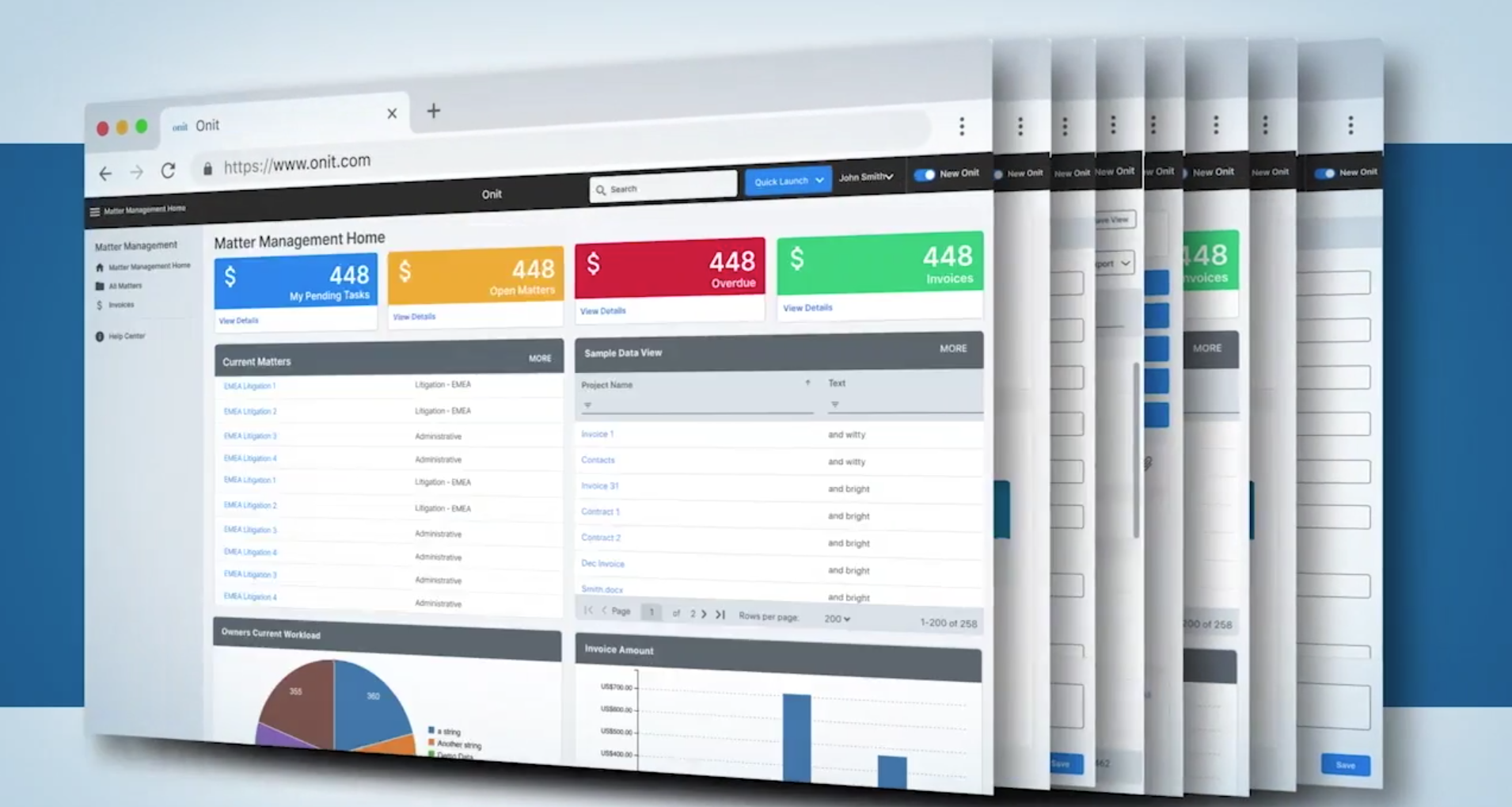
Onit understands, which is why we’re excited to announce our new user interface. The enhanced design allows corporate legal professionals, Onit App builders and business collaborators in departments such as compliance, sales and IT to create, collaborate and get more done in fewer clicks.

The new UI provides a cleaner visual language, enhanced indicators and status effects and a more straightforward way to identify and act on pertinent data and deadlines. Powered by Onit’s no-code platforms for workflow automation (Apptitude) and AI-based business intelligence (Precedent), the even more intuitive experience maximizes productivity for enterprise legal management, contract lifecycle management, legal service requests, legal holds and more.

No Automation and Workflow Challenge Too Big or Too Small to Solve with Onit

Our new UI joins a variety of Onit innovations that make it simpler to streamline and automate critical processes. Thanks to our no-code platforms and intuitive UIs, legal operations professionals and in-house counsel can create time-saving, automated Apps that simplify automation and workflow.

Our Process Builder provides a visually oriented, drag-and-drop interface that allows users of all levels of technical proficiency to build workflows. It removes learning hurdles by making it easy for users to understand how to build applications, allowing corporate legal to create Apps in minutes.

To see this in motion, check out our Hack the House competition.  Corporate legal professionals from companies including Colgate-Palmolive, Corteva Agriscience and McDonald’s identified business needs for areas such as diversity, IP and HR and created Apps and solutions to meet them in three weeks. In the end, Team IP won by creating Apps and a solution that automated the trademark renewal process.

Onit’s AI also provides a valuable edge for automation and workflow. ReviewAI uses artificial intelligence to quickly review, redline and edit all types of contracts, increasing productivity by more than 51%. ExtractAI leverages AI-based software to extract and obtain usable data from executed, legacy and third-party paper contracts.

To learn more about Onit, our new UI and our platforms and products, reach out to [email protected] or schedule a demonstration.

With the Rising Use of AI In Legal Services, What Should In-House Counsel Look For?

The increased use of AI in legal services is indisputable. Analysts predict that corporate legal departments will see technology budget increases as significant as three times by 2025 and an ongoing push to automate legal work for productivity. With its ability to bring immediate results out-of-the-box and learn and improve over time, AI offers the ideal technological solution to boost efficiency and save time for high-performing legal departments. In fact, this study found that AI for contract review can increase productivity by 51.5%.

However, not everything that claims to be AI these days is actually AI, and not all AI solutions are created equal. AI can significantly boost efficiency, streamline workflows, and save costs – if you invest in the right AI solutions.

Given the tremendous benefits of AI technologies, it’s helpful to understand the features that set the best AI tools apart from the competition. When you’re looking to purchase AI solutions and transform your legal department, you should consider whether they offer the following characteristics and features.

Time to Value

When you invest in new technology like AI, you want to start reaping the benefits as soon as possible. Therefore, when looking at AI options, you want to find solutions that allow you to quickly begin realizing value after you implement them.

Several factors can decrease the amount of time it takes to realize value from an AI solution. The software should be quick and easy to implement and roll out across all your users. Your AI should also ideally be pre-trained, meaning it’s ready to go straight out of the box, rather than requiring additional time to train it. The faster your users can capitalize on all the benefits of your AI solution, the faster it will translate into value for your organization.

Pricing Structure

Technology vendors take a wide range of approaches to pricing their products, and how they price them can significantly impact their value and usability for your enterprise. As the use of AI in legal services increases, the last thing you want to do is agree to a pricing structure based on the number of users.

When the price of your AI solution is not based on user numbers, you have the option of using the technology to work across all business units in your organization without having to worry about incurring extra costs when additional collaboration would be valuable. The ideal solution will have no limit on the number of users who can interact with the system for the initial price of your investment.

User Experience

Like any technology, AI is only valuable if your users can use it effectively. Any solution you choose should be easy to understand and execute without excessive training or a steep learning curve. Look into whether the product you’re considering has a proven implementation department.

The right tools will also have a good track record in the customer satisfaction department. It’s worthwhile to look into the vendor or product’s Net Promoter Score (NPS). An NPS is based on customers’ ratings of their likelihood of recommending a company, product, or service on a scale of 0 to 10 – so the higher the NPS, the better.

Underlying Platform

Any AI solution you purchase will have to operate on some underlying platform to function. At a minimum, that platform should be a trusted product that has the capacity necessary to meet all your needs and the ability to scale as those needs change.

Even better is not having to rely on external platforms for your chosen AI solution to work. The ideal tools will run on a reliable platform supplied and maintained by the same vendor as the AI solutions themselves. This will allow you to deploy products and updates quickly. Also, look for no-code platforms that will enable you to build your own apps with little or no technical experience.

Immediate Usability

A solution is only helpful if your users actually use it. It’s also most helpful if they can start using it right away. Long implementation delays or the need to invest significant time in learning to use a product can outweigh the benefits that product might eventually offer.

You should look for out-of-the-box products that require minimal configuration before they can be used in order to get the full use of AI in legal services. Such products are ready to go almost immediately, meaning you can quickly start using them to address the problems that drove you to seek out AI in the first place. At the same time, however, they can also be customized to meet the most simple or customized workflows within your organization.

Partner Network

While the vendor of your chosen AI solution certainly matters, so do your vendor’s partnerships. You want a technology provider that partners with other top-notch providers and professionals who can address your needs outside of those related to the specific AI technology you’re buying.

You want your AI product vendor to have alliances with experienced implementation service providers to ensure that your chosen solution succeeds across your entire enterprise. Beyond implementation, your provider should also be part of a robust ecosystem of partners who can address your needs as they arise, from the most routine business needs to the most novel demands that might arise. Having the right partnerships also means that your vendor can leverage those partnerships to design the most optimal solutions to address a particular problem.

The Use of AI in Legal Services – Investing in the Right AI

The excitement about AI is understandable – today’s technologies can accomplish tasks that seemed impossible even just a few years ago. Wanting to incorporate those advancements into your organization to improve the ways you do business is a great impulse.

You need to be sure, however, that you’re getting products that are effective and not just hype. Even more importantly, they must be tailored to your organization’s needs if you want to see actual benefits from them. Not every AI solution is suitable for every organization, and not every AI provider will give you the support you need for your products to succeed.

By considering the factors outlined above before you purchase any solution, you’ll put your organization on the right path to genuinely benefiting from AI. It’s worth the time to do your research and think before you buy.

LSM LESSONS: Associated British Foods and EDF

Legal spend management software solves several different challenges depending on the organization. During the pandemic specifically, this could be as fundamental as no longer being able to review and pay paper-based invoices in the office. For Associated British Foods (ABF), who were already using e-billing before lockdown, usage of the system increased because remote working meant e-billing was the only option! However, legal spend management software really comes into its own when applied strategically.

For ABF, this meant maximizing volume discounts with firms. Daniel Wate, their Legal Technology Analyst, says, “Legal isn’t revenue generating, so we implemented legal spend management software to ensure we were spending responsibly and give us accountability. With last year being challenging, for example, the temporary closure of our Primark stores, we’ve been more likely to maximize volume discounts with firms, something we couldn’t do unless we knew what we were spending.” This has been achieved by consolidating the number of firms and reaching volume thresholds faster. Another savings area is through using spend data to make the case for hiring internally, “we’ve noticed that sometimes it’s cheaper if we hire someone else rather than using a law firm,” Dan explains.

As Managing Legal Counsel, Lynne Kellett says that EDF UK NNB (EDF) uses the tool for a similar purpose, “We leverage local firms as an extension of the in-house team, so we need spend data to encourage our firms to deliver additional services and value add in line with our panel arrangements.”

Even in BAU times, spend management is an essential strategic tool. ABF started its e-billing journey in 2012. Daniel reflects, “It was a very manual process. We spent a lot of money but didn’t know with which firms, how many firms, where in the world, who was instructing the firms, or how much we were spending!” They also suspected that the rule, “notify legal must before engaging law firms,” was not being followed. Using BusyLamp eBilling.Space has allowed them to control this more effectively.

This cost visibility is also essential for EDF. Lynne remarks, “the General Counsel wanted to “press a button” to find out how much was being spent, when, and where, without using spreadsheets.” Legal spend management tools today go beyond the process of e-billing, with RFP, WIP, vendor management, and complex analysis and prediction capabilities now commonplace. EDF looked for such a tool after identifying that the end-to-end process for engaging firms was just as important as tracking the costs. Freeing the team from admin and reporting was also critical.

INVOLVING STAKEHOLDERS IN THE LEGAL SPEND MANAGEMENT PROJECT

Although the primary users of legal spend management software, the legal team is not the only stakeholder, and it’s crucial to involve other departments in the project journey. Sourcing, finance, tax, and IT are typical functions that need to be involved. They can help you draft RFP requirements, offer a different perspective, ensure legal processes integrate with other departmental processes, and help solidify the business case if the tool benefits more than just the legal team.

Involving finance was key for EDF since reporting to finance was a heavy administration burden before they implemented Onit’s European legal spend management solution BusyLamp e-billing.Space. Lynne remembers, “part of the streamlining of the process was to remove some of those manual steps, so we wanted to make sure the output would still meet finance’s requirements.” Lynne also recommends getting help from IT as they have experience rolling out tech projects but cautions it may take longer than you expect, “legal is not profit-generating like other departments, so you need to make your case early and strongly!” Daniel echoes this sentiment, “while IT is a useful resource because they do rollouts all the time, they are busy, and you will have to join a queue. So, get them involved as soon as possible and communicate often.”

FUTURE LEGAL SPEND MANAGEMENT PLANS

As referenced earlier, legal spend management is more than just e-billing. In the near future, EDF plan to use the RFP tool in e-billing.Space and also wants to report objectively on how law firms deliver additional value. Lynne explains, “The longer we use the software, the more data, and more consistent data, we are getting about our firms. This will help us drive not only the best price but the best value – especially for larger projects. This is win/win – it’s not free for law firms to give us these value-adds, so tracking it means we can recognize it.” Being able to do this in one single system means avoiding yet another spreadsheet.

Next on ABF’s agenda is billing guidelines, which are already in place for the company’s USA law firms, but they plan to implement them throughout the rest of the world. Using BusyLamp for driving value is also important, though. Daniel says, “we pull a lot of reports but don’t get the maximum benefit from them; we need to think how we can use them to drive discussions with and leverage usage of law firms.”

Learn more about BusyLamp from Onit, our end-to-end legal spend management solution built for European corporate legal departments. 

What to Look For in Enterprise Legal Management Software

Enterprise legal management software turboboosts legal operations and brings new levels of operational efficiency to corporate legal departments. A comprehensive solution that combines e-billing, matter management and legal service request intake into a single, streamlined platform provides a game-changing way to analyze legal spend, minimize company risk and drive process efficiency.

All these benefits are only possible, though, if you find the enterprise legal management software (ELM) that can support your corporate legal department and its unique needs. Finding ELM software that meets the following criteria will put you on the path to success.

  • Future-Proof Functionality: You don’t want your enterprise legal management software to run on a platform with limited capabilities. Look for an ELM that runs on its own business process automation and business intelligence platforms that can accommodate the department’s future technology needs for AI, contract lifecycle management and legal holds. The workflow integration between products will be native and much more robust this way, compared to multiple systems on different, poorly integrated platforms.
  • Good User Experience: You want your ELM solution to be easy to use, with a modern interface and experience that gets users up and going quickly. You also want it to be something people enjoy using. Look into your product or vendor’s Net Promoter Score (NPS) – a rating of how likely customers are to recommend a company, product or service on a scale of 0 to 10. The higher the NPS, the better.
  • Enhanced collaboration: Prioritize no-code platforms for your enterprise legal management software, as they allow you to build whatever apps you need for your corporate legal department – even if you have little or no technical expertise. For example, the Onit Nation (our customers, partners, business analysts and developers who use Onit platforms) has developed more than 5,500 Apps. These Apps do everything from automating government regulation reporting to managing trade association approval to streamlining the trademark renewal process and beyond.
  • Flat Pricing: Speaking of collaboration, consider the pricing structure for ELM solutions. You want to avoid ELM solutions that are priced based on how many people use the software. Per-user pricing limits how you can use your solution, forcing the choice between cost and collaboration. When that choice is no longer needed, you can work across business units, automate requests and increase transparency and trust.
  • System of Engagement: Traditional ELM vendors take a data collection-minded approach to managing matters and legal operations. Their technology platforms act as a system of record but are rarely used by lawyers and legal operations managers to deliver any real strategic value. Look for a vendor that offers an ELM system of engagement. This process-driven solution integrates workflow and collaboration and allows you to define the legal business processes that are critical to your organization.
  • Partner Implementation Network: While your vendor is key to a smooth implementation, so is their partner network. Your ELM provider should have an experienced and professional partner implementation network made up of strategic alliances that will ensure success across your entire enterprise.

Interested in learning more about enterprise legal management software, platforms and optimizing technologies? Check out our guide to platforms or our breakdown on driving efficiency in a post-pandemic environment.

To learn more about how ELM from Onit can transform your law department operations, contact us or schedule a demo today.

How to Prepare Your Team for an Enterprise Legal Management Software Implementation

An enterprise legal management software implementation brings all-new operational efficiency levels to corporate legal departments. By combining e-billing, legal spend management, matter management and legal service request intake into a single, streamlined platform, corporate legal departments can gain visibility into legal operations, cut costs and automate manual processes. In fact, some estimate that enterprise legal management (ELM) helps save up to 10% on outside counsel spend.

While it’s critical to focus on the technologies and processes involved in the implementation, often the people component lacks the same level of attention and planning. We asked ELM implementation experts from Onit about best practices to manage the people side of implementation and here are the four actions they recommend.

1.   Get the right hands on deck for your enterprise legal management implementation.

To start, you want to establish internal governance over your ELM implementation. You should determine crucial involvement from the beginning, such as who will have a vote on decisions, who will have input into decisions, who will be involved in reviewing implementation progress and how often, and more.

At many corporate legal departments, this involves creating an internal steering committee responsible for overseeing the implementation and an internal project sponsor who is usually the business unit leader who’s receiving the implementation. You might also involve the PMO and someone from finance who can monitor whether you’re getting what you expect out of your investment. The software provider should also provide a steering committee on their side, but your essential players should still be involved in your internal governance.

Because you’re likely making a pretty significant investment in your ELM solution, you’ll want to establish a consistent cadence for reviewing the implementation progress. For example, set a weekly or monthly schedule for monitoring whether you’re on track to hit milestones and whether progress is dependent on anything else within your organization that needs to be addressed.

2.    Get your internal business partners on board.

Implementation will look different for every legal department depending on who is spearheading the effort. If your legal team is contracting with a provider, have you lined up the support of IT or other departments in your company? Many departments try to move forward without any internal consultation. Because implementing ELM will require integrations with other systems and migration of data from your old system, you’ll need to get all your internal partners on board and determine what agreements and resources need to be set up before your implementation.

You’ll also want to assess the impact of your implementation on the rest of the business. Who do you need to inform? Will you need to notify an internal change in the control board that your company’s data will be hosted in another system? Will your internal audit team or information security need to check project documents before going live?

To get the engagement you need, you should start working within your internal channels as early in the process as possible. That groundwork needs to be paved by your team before implementation starts.

3.    Get your users ready and excited for the enterprise legal management software implementation.

As with any change, it’s important to prepare your users. The more you can get buy-in across the organization, the more successful the implementation will be.

Determine who needs to know when the solution is going live and how you’re going to tell them. Getting them excited about the change will be easier if you can proactively address any concerns they might have about new processes or systems. Whether it’s a company-wide email, a newsletter, a town hall meeting, or something else, you want to generate buzz about your new enterprise legal management software implementation.

Also critical to overall implementation success is a well-defined user training program. The proper training will allow end-users to be comfortable with both the system and your change management efforts. The means they feel empowered and confident to complete their daily tasks with minimal interruption after the ELM system becomes part of their workflows. You can tailor the training program to be as formal or casual as you need. There are endless options to deliver the right information in the right way for your end-users.

4.   Help your ELM provider deliver the system you need.

Preparation and testing are key components that your department can provide to help your ELM provider deliver the best implementation possible. Invest some time analyzing your department’s current state before implementation kicks off, documenting your processes end to end. Process maps and use cases are valuable for requirements and design and can save a lot of time and minimize distraction during the ELM design phase.

After all, you know your business better than anyone. As you work with your provider to design your system, think about how you’ll test the system via User Acceptance Testing before it goes live.

If you take the proper steps in advance, you can make sure you’ll get the best enterprise legal management software implementation for your corporate legal department and the business units that work with you.

Contact Onit today to learn more about how Onit offerings can help you provide better service to your business while improving operational efficiency.

Free Yourself from Legal Invoice Review with InvoiceAI

What’s the best part of the day for in-house counsel? Probably not legal invoice review.

While it’s often necessary to ensure adherence to outside counsel billing guidelines, it still consumes valuable time on highly manual work.

That’s why we are introducing InvoiceAI to our enterprise legal management – to free in-house lawyers from the manual labor of tedious legal invoice review.

Onit announced this next significant phase of innovation at Legalweek(year) with our first InvoiceAI video. Launching in May for both Onit and SimpleLegal, InvoiceAI harnesses AI’s power to increase the efficiency of the invoice review process. It handles the first-pass review of incoming bills and sets up a framework that will continuously learn as invoice corrections are refined in the system. The result: General counsel and in-house counsel can transfer rediscovered bandwidth and energy to higher-value work for their companies.

This second InvoiceAI video shares more about the InvoiceAI.

To learn more about InvoiceAI from Onit and how AI can streamline your legal invoice review, contact your Onit account manager today or email [email protected].

Legal Invoice AI Joins Our Contract AI

AI-enabled invoice review from InvoiceAI modernizes the legal operations function and automates the review of law firm billing for corporations. It perfectly illustrates our founding principle: To help lawyers more effectively practice law.

When InvoiceAI launches in May, it will join an impressive roster of AI solutions already on offer from Onit, including:

  • Precedent, Onit’s AI-powered business intelligence platform that automates and improves both legal and business processes for corporate legal departments, law firms, contract professionals and procurement teams.
  • ReviewAI, contract AI for pre-signature contract review that reviews, redlines and edits all types of contracts in minutes, increasing contract review speed by 60-70%.
  • ExtractAI, contract AI for post-signature contract management that extracts usable data from executed, legacy and third-party paper contracts.

You can schedule a demonstration of any of Onit’s AI solutions here.

A Legal AI Refresher

The field of AI is continually evolving, and it’s essential for today’s legal professionals to stay ahead of the curve. If you’re looking to bone up on AI, here are some great places to start:

Remember: AI won’t replace lawyers. But lawyers using AI will replace those that don’t.

Thanks for your time and stay tuned to our blog. We’ll have more InvoiceAI and contract AI announcements coming soon.