

Category: Business Process Management

Innovation in Action: ADM’s Self-Built Vendor Management App for Legal Operations

In an earlier blog post, we looked at some of the latest Apps legal operations professionals build to solve some of their most complex business problems. Now, we’re excited to continue this exploration – this time by highlighting a genuinely innovative approach to vendor management developed by Fortune 100 company ADM.

Why an App?

As a massive company, ADM not surprisingly engages with numerous vendors to accomplish many crucial aspects of its business. What they didn’t have, though, was a standardized process around selecting the right vendor for a particular matter or project. They needed a complete process from start to finish for how teams would operate and how they would engage law firms on their various matters.

ADM has built a strong law firm network and has devoted significant time to negotiating rates and pricing systems, including alternative fee arrangements in some instances. The next step was creating a means to obtain competitive bids on projects to make sure that they had the right law firms handling the right matters. That meant instituting a matter-specific RFP process – but there were a lot of cumbersome communications and past practices to sort through in order to get there. In addition, they needed a consistent and reliable way to score RFP responses.

Simply put, ADM wanted an easy way to empower its attorneys to handle RFPs, law firm selection and executing engagement letters for themselves.

The Vendor Management Solution

ADM’s legal ops team is incredibly lean, so it was critical that any vendor management solution could be managed by their attorneys. Ultimately, the answer was to build it themselves.

A crucial factor for ADM was that the entire vendor management process happen in a single place, rather than relying on cobbling together disparate tools that don’t necessarily integrate to create a seamless workflow. ADM turned to Onit’s Apptitude workflow automation platform, which allows organizations to turn ad hoc, chaotic, inefficient, everyday manual intensive work into manageable defined processes, to build the vendor management App that would meet its needs.

The App they created addressed vendor selection at the matter level, was standard across how their teams operate and combined the processes they were already using rather than reinventing the wheel.

At the end of the day, ADM’s new App addressed three problems that had been hindering efficiency: standardizing vendor approval,  automating engagement letter creation and execution, and streamlining the RFP process. They were able to combine all three aspects of the vendor management process into a single App that also leveraged vendor data and metrics. A key component of the App is always showing the attorney where they are in the process, what steps are left to complete and showing help text to walk them through the process. ADM utilized visualization of both phases and a task grid within the Onit tool.

As Aaron Van Nice, Vice President of Legal Operations at ADM, explains:

“I wanted a tool that really helped us and empowered our attorneys to conduct matter-specific Competitive RFPs themselves. There were some steps that we wanted to help them with, but the idea was to make this easy enough for them to do it themselves. We needed something that was efficient that could be managed by our attorneys. And that’s what we built.”

Today, ADM can use Onit Apptitude with their vendor management App to draft RFPs, send communications to vendors, accept questions or proposal submissions, review submissions, score proposals for each vendor and pre-approve vendors for review by Van Nice and ADM’s GC, who can ultimately approve hiring within the App. In addition to the vendor management App, ADM also built an engagement letter App that allows them to automatically generate engagement letters and send them through e-signature for execution.

In a nutshell, ADM succeeded in connecting all the dots in the vendor management process via Onit Apps.

To hear more about Onit’s new App Catalog and see a demo of ADM’s new vendor management App, you can listen to the webinar, Drive Legal Innovation One App at a Time, here. The webinar offers valuable insights about driving legal ops innovation.

To learn more about getting started with Onit Apptitude and building your own Apps to solve critical business problems, contact Onit today.

Corporate Legal Operations Resources and News (October 2021 Edition)

Welcome to Onit’s October compilation of some of the most pertinent and timely articles and legal operations resources. In this month’s digest, we explore a piece of concrete proof for diversity advancement, lagging adoption in automation, the Gartner Hype Cycle and how to reduce time spent on invoice review. We hope you find some valuable takeaways.

1. New Study Reveals Women Legal Execs’ Salaries Outpacing Their Male Counterparts

Women legal executives have some great news to celebrate. According to a recent survey, while salaries for male general counsel remained flat at $2.7 million, the median total compensation for women GCs topped more than $3 million last year – and pay has increased more than 17% since 2019. The number of women GCs surveyed also increased from 33% to 36% in the same amount of time. This offers some proof that companies are willing to pay upper-echelon salaries for diverse legal talent. (Source: Law.com)

2. Gartner Reveals that Trust, Growth and Change are Driving Emerging Technology

Quantum ML is on the rise, and NFTs and decentralized identity are on the cusp of disillusionment, according to the latest Gartner Hype Cycle for Emerging Technologies. This intriguing article illustrates three overarching trends that its analysts believe will drive organizations to investigate emerging technology, including engineering trust, accelerating growth and sculpting change. Gartner, who is always one of the most valuable legal operations resources for technologies, also explores how a key enabler of competitive differentiation and a catalyst for transformation are driving technology innovation. (Source: Gartner)

3. Are Law Firms Lagging on Automation?

Many law firms continue to demonstrate interest in technology that helps automate manual workflows and improve efficiency, but surprisingly, many others are still lagging behind. About 75% of law firms that responded to a recent survey report that they are not provided with the technology to do their jobs effectively. One reason for this is a crucial disconnect. Administrators mistakenly believe they have provided legal with all the technology they need. The result is that staff spend too much time on routine administrative tasks that automation could handle. (Source: ABA Journal)

4. Legal Trends Lawyers Should Know About

We’re going meta now by sharing legal trends from a compilation of legal trends. The National Law Review recaps a recent report by the ABA that discusses the impact of COVID-19 on the legal industry, how attorney wages are growing faster than inflation, an increase in bar passage rates, progress on the diversity front and some insights on the post-pandemic job market. (Source: The National Law Review)

5. How to Free Yourself from Legal Invoice Review

Legal invoice review often invokes frustration from in-house counsel. After all, which busy lawyer wants to set aside interesting work to review a 100-page law firm bill?  Advances like e-billing and billing guidelines have helped the process tremendously, but there’s still room for improvement. In this podcast, Onit’s Matt DenOuden and Mary Fuzat sit down to discuss the challenges of legal invoice review and how AI finds “between the rules” savings and gives attorneys back time for more strategic contributions. (Source: Onit podcast)

A Bonus Option for Legal Operations Resources

Ready for a break? Try out this video if you need a change from watching puppies or listening to guided meditations for a mid-day lift. You’ll never look at legal billing the same again.


How to Find the Latest Updates in the Legal Operations Software Market

The legal operations software market is rapidly evolving, thanks to technologies such as AI and the ever-growing operational sophistication of corporate legal departments.

Fortunately, a slew of resources are available for those interested in legal operations and the technology that turbocharges it, including:

  • The Corporate Legal Operations Consortium (CLOC) – A community of legal operations experts focused on redefining the business of law. In addition to releasing its yearly State of the Industry Report, it offers programming worldwide, educational resources and online connections for its membership.
  • The Association of Corporate Counsel (ACC) – Founded in 1981, this legal organization represents, guides and supports the global in-house counsel community in over 85 countries. In addition to valuable programming and online resources, it hosts the annual ACC Value Champions awards program, which highlights leaders in improving costs, predictability and outcomes.
  • Corporate Counsel – This magazine explores corporate legal department trends and challenges and how innovative legal leaders respond to them.

These are only a few of the resources available. And now, there’s one more.

A Podcast for the Legal Operations Software Market

Over the past several years, we’ve been tackling some of the most significant issues in legal ops, automation and more through a series of podcasts. Now, we’ve collected them all in one place, so that anyone in corporate legal can hear candid discussions on some of the latest news and advances in the legal operations software market.

Podcast highlights include:

  • How BT Enacted its Award-Winning Digital Transformation – In less than a year, BT transformed its global legal department, creating award-winning operations that judges described as admirable “not only due to the speed of their roll-out of the platform, but by taking an existing process and migrating it into a streamlined, efficient platform.” In less than three months, the company has been awarded the Legal Innovation Award in the category of Future of Legal Services Innovation – In-House Legal Operations and joined the shortlist for the Legalweek Leaders in Tech Law awards. In this episode, David Griffin, Head of Legal Technology and Change at BT, shares how this happened.
  • How to Alleviate the NDA StrainReviewing and managing NDAs is a pain in the neck for in-house counsel. They’re the highest-volume contracts handled by businesses today. In fact, some corporate legal departments tell us they process between 500 and 100,000 a year. That’s a lot of time and cost that can be redirected to other contributions. Nick Whitehouse, GM for Onit’s AI Center of Excellence, talks about how AI and automation are transforming the NDA process – in some cases shaving the time spent on NDA processing by 70%.
  • How to Build World-Class Legal Operations – Brad Rogers, former Chief Operations Officer and Chief of Staff for Advocacy and Oversight at a Fortune 100 global financial services company with more than $1 trillion in assets under management and 14,000 employees globally (and now SVP of Strategy and Growth for Onit), shares his insights into what goes into creating world-class legal ops. While budget is an essential factor to how fast you can move on technology, it’s important to remember that you need to tailor the speed of your transformation to the human capacity for change.
  • What Lawyers Really Want from Contract AI – Everyone from tech companies to industry influencers tells lawyers what they need from AI. And, if there’s one thing about lawyers, they don’t generally like being told what they like. Jean Yang, Vice President of Onit’s AI Center of Excellence, a lawyer and technologist, talks about ways legal and contract AI technologies are actually giving lawyers what they need.
  • CLM ROI: Is It Hype or Really Happening? – Surveys – both formal and informal – show a rising interest in contract lifecycle management (CLM). As interest grows in this technology, how can legal operations professionals cut through the hype to find ROI? Matt DenOuden, Onit’s Senior Vice President of Global Sales, discusses unique ways to find CLM ROI.
  • Ten Years of Onit: Stories from the Companies’ Co-Founders – How do four very different and strong-minded people come together to create one of the leading companies in the legal operations software market? Well, there’s success in dysfunction. In this podcast, Onit’s co-founders share their journey from startup to scaleup.

You can listen to all these podcasts and more here. Be sure to like our podcast LinkedIn page to get the latest episodes. You can also subscribe on Apple, Spotify or anywhere you listen to podcasts.

To learn more about how Onit is revolutionizing legal ops through AI and automation, schedule a demo or reach out to [email protected].

The Top Risk and Compliance Automation Tools Created by Legal Operations

Managing risk and compliance are critical tasks for keeping companies safe, which is why corporate legal departments are turning to compliance automation tools.

Between an ever-changing regulatory landscape, an increased focus on data privacy, the need to monitor internal policies and guidelines and more, risk and compliance represent a challenging task. It spans multiple departments within an enterprise, requiring collaboration and management of often manual tasks. These elements increase the possibility of the proverbial dropped ball and, in turn, increase the likelihood of noncompliance with external or internal protocols or higher risks for companies.

Take, for example, data breach incident reporting for GDPR and other data privacy regulations. Organizations must take immediate action to report potential data breaches to the Information Commissioner’s Office (ICO) within 72 hours. However, this can be a challenging timeline for large organizations relying on spreadsheets, phone calls and emails as tools for compliance.

What if legal operations could build their own compliance automation tools? It’s happening – and quite often. Here’s how.

The Power of Business Process Automation

As a general rule, the lower the number of tools needed to manage a process, the higher the overall efficiency. That’s where business process automation and compliance meet.

Corporate legal departments of all sizes across the globe are rethinking how they work. They are looking for ways to radically improve their process performance to optimize compliance activities. Technology is rapidly accommodating this need through the rise of no-code platforms and visual interfaces. These innovations have made it possible for almost anyone to build and deploy solutions and applications without writing a single line of code.

Let’s return to the example above of data breach incident reporting. Automation vastly streamlines this process. One team of legal operations experts, which included BT and Standard Chartered, built an App on a no-code business process automation platform to streamline the process. The resulting App reports, manages and tracks data breaches and notifies regulators. It collects data breach information, automatically sends a notice to the security and compliance team and offers a rules-based dashboard and a quick entry point to review records. It even generates ICO reports and submits them in addition to collecting feedback from the organization. (You can see the App in action in this video.)

Risk and Compliance Automation Tools and Apps

The Onit Nation – a group of Onit Fortune 500 corporate legal customers, partners and employees – has built an impressive range of Apps on our business process automation platform. These 5,500+ Apps cover a wide range of industries and practices, including accounting, finance and procurement, enterprise operations, general and administrative, human resources, IT, legal operations, marketing and IP and risk and compliance.

Here are some of the risk and compliance automation tools the Onit Nation has created:

  • Compliance Questionnaires: Creates, distributes and keeps track of responses to questionnaires for various compliance-tracking needs.
  • Directors’ Stock Election Unit Form: Assists with distributing, collecting and tracking annual Board of Director’s instructions for stock options.
  • Employee Incident: Provides a secure intake mechanism for employees to report incidents, both named and anonymous.
  • Ethics Violations: Provides intake and oversight for ethics violations, collecting all ethics cases together for better oversight, collaboration and management.
  • Gifts and Business Entertainment: Provides robust workflows and automation for company-wide gift and business entertainment to improve compliance with relevant policies.
  • Internal Investigations: Traces internal allegations end to end and creates capture points for intake.
  • Power of Attorney Agreements: Handles the approval and management of power of attorney contracts used when a company needs to act on behalf of an employee.
  • Whistleblower: An anonymous intake of any alleged activities brought by employees that allows you to organize, assess and manage whistleblower allegations in a secure, centralized, workflow-driven solution.

These are just some of the tools that make risk and compliance tasks easier. Peruse the App Catalog now to find even more inspiration for ways you can revolutionize your workflows and increase your efficiency. You can also learn more about no-code platforms by reading this white paper – No-Code Platforms: How They Are Transforming Legal Operations and Their Enterprises.

To get started with building your own Apps, request a demonstration of Onit’s Apptitude platform or email [email protected].

Four Mistakes to Avoid When Considering a Contract Management Platform

Has your corporate legal department been struggling to figure out ways to cut down time spent on contracts, reduce the average sales cycle and find a better way to manage buy-side, sell-side and corporate contracts? Contract management platforms offer the ideal technology to help on all counts.

You may be at the stage where you’re considering contract lifecycle management (CLM) technology to help you reach these goals, but are unsure about how to proceed. You’ve likely already heard and read about all the benefits of using a premier CLM solution. After all, it’s a technology many corporate legal departments have prioritized, and you’ve probably already reviewed resources or spoken with vendors. We’d like to take a different angle here and tell you about four common mistakes to avoid when evaluating a CLM solution.

Four Common Mistakes Encountered When Considering A Contract Management Platform

  1. Believing That A Cutting-Edge CLM Solution Is Not Worth The Cost Of Investment.

For several years, the new paradigm has been to do more with less money and fewer resources. Technology has increasingly played a prominent role as legal operations focus on achieving objectives with “less.”

Driving efficiencies and controlling costs in the legal department are being borne, to a significant degree, by well-chosen technology solutions and legal operations managers who understand this are taking action. For example, Onit’s contract management platform streamlines the entire contract lifecycle. It provides ease of use for all parties involved while reducing risk in the process and enables departments to save an average of 9% annually, reduce the average sales cycle by 24% and reduce by 20% the average hours spent on contracts.

  1. Assuming That Staff Reduction Will Be Possible With Your CLM Implementation

It’s true that a good CLM offering streamlines the entire contract lifecycle. It provides ease of use for all parties involved while reducing risk and enabling departments to save valuable time. The ideal contract management platform also makes quick work of many processes, relieving staff of repetitive and mundane tasks.

Having said that, it is easy to fall into the trap of believing that you can save even more money with staff reductions. It’s a better strategy to remember that while you’re automating many processes and some staff functions may change or even be eliminated, staff reductions are usually not the best option in many cases.

  1. Forgetting About AI When Selecting Your Solution

Many legal departments already know how well CLM products empower legal and business teams with an enhanced contract management process. Some key benefits are conditional contract generation, MS Word integration, document management, secure collaboration and eSignature integrations.

With all that, what could be missing? Integrated artificial intelligence.

For example, in the pre-signature contract phase, the AI engine provides a first-pass review of the contract and annotates it based on your company’s checklist, playbook and information learned from AI models. By allowing a lawyer to focus on the medium- to high-risk areas, your legal team can reduce contract lead times, automate guidance and proactively address common pain points in the legal workflow.

In the post-signature contract phase, AI-driven data extraction allows you to complete projects at scale and at a fraction of the time manual processes take. Additionally, you can gain powerful insight from your contracts in real-time when coupled with a contract lifecycle management solution.

  1. Implementing a CLM Solution That Doesn’t Have All The Bells And Whistles

You’ve gone through the vendor selection process and are ready to implement your new CLM technology. It’s zero hour, and one of the staff asks you if the solution provides for automated risk mitigation – which somehow didn’t come up during the selection process. You learn that this system doesn’t have that feature, and now you’re wondering what other vital elements may be missing. Depending on your specific needs, here are five other features that are must-haves:

  • Conditional Contract Generation: Automatically generate a contract with appropriate clauses based on a robust rules engine and contract metadata.
  • Routing and Approval Workflow: The ability to design and build simple to complex workflows to generate and route your contracts.
  • Obligation Management: Give your users the power to manage and measure tasks or milestones related to compliance.
  • Clause/Template Library: Manage and maintain contract clauses and templates in a centralized and secure cloud-based location.
  • Partner and Client Self-Service: Provide partners and clients an easy-to-use portal to request, submit, or create contracts.

It can undoubtedly be overwhelming trying to determine the best route to take in your digital transformation project. There are contract management platforms out there for practically every budget – meaning there is no longer a good reason not to take advantage of cutting-edge technology. Still, the best advice is to go into your implementation with realistic expectations, a good understanding of exactly what your department needs and a plan to avoid common mistakes.

If you’d like to learn more about contract lifecycle management, here are some additional resources:

Creating Custom Legal Software: The Apps and Solutions Legal Operations Pros Are Building Themselves

To meet the needs of today’s modern corporate legal department, many legal operations professionals are creating their own custom legal software. And here’s what they’re building.

But first, let’s take a look at the past year and a half.

Corporate legal departments completed many nimble adjustments as they’ve faced new challenges and demands. Legal operations professionals play a vital role in this success, finding ways to make it easier for lawyers to work while bringing in more efficiency, cost savings and other benefits of operational excellence.

Technology undoubtedly plays a role in supporting these endeavors, bringing automation and AI to systems like enterprise legal management and contract lifecycle management. However, even the most customized solutions must have the flexibility to evolve with a corporate legal department’s needs – especially when considering collaboration across the enterprise.

Building Your Own Custom Legal Software

Custom-built software for legal traditionally seems like a luxury, requiring precise planning, contributors across multiple departments and a good piece of the budget. But now, with technology innovations, legal operations pros can create Apps (and combine Apps into solutions) quickly and efficiently. They do this with tools that simplify the process and offer no-code-needed interfaces.

Business automation platforms and App builders with drag-and-drop visual interfaces make the creation process more accessible for those unfamiliar with coding. Instead of relying on developers, they can use a platform and its simplified interface to program the software. The key is indeed the underlying business process automation platform, which acts as a blank canvas. While it supports large solutions for legal spend, contract management and matter management, it also supplies the flexibility to enhance those solutions with complementary Apps, create new Apps altogether and combine Apps into solutions to tackle more complex challenges.

A perfect example of this in action is Hack the House, our inaugural virtual hackathon. Five teams comprised of in-house legal professionals, consultants and business analysts identified business cases and built Apps to solve complex workflow challenges in less than three weeks. They created solutions for data breach incident reporting, career development, diversity and pro bono program management. The winning team took it a step further by creating multiple Apps and combining them into a solution to streamline trademark renewal decisions and track trade secrets.

As impressive as that sounds, we’ve seen custom legal software built even faster – with Apps up and running in as little as an hour.

What Legal Operations Is Building

To date, the Onit Nation – Onit’s master App builders, customers and strategic partners – have used the Apptitude platform to build more than 5,500 Apps to solve everyday business problems. Among them are several custom legal software solutions that are helping to automate and accelerate nearly all aspects of legal operations, and we’ve collected many of them in our new App Catalog.

Our corporate legal customers have been prolific in building Apps and solutions. In addition to the Apps mentioned for Hack the House, other Apps have been created to handle:

  • Board Kit Distribution: Centralizes board of director information and notifies board members of new or revised documents while giving them access to the most current information
  • Ethics Violations: Provides intake and oversight for ethics violations and consolidates all ethics cases in one place for better oversight, collaboration and management
  • Gifts and Business Entertainment: Provides robust workflows and automation on gift and business entertainment requests company-wide to improve compliance with relevant policies
  • Settlement Authority Request and Approval: Provides a workflow for approving documents that detail settlement authority requests
  • Task Assignment: Handles task assignments made to non-departmental resources
  • Whistleblower: Provides anonymous intake of any alleged activities brought to you by employees and allows you to organize, assess and manage whistleblower allegations in a secure, centralized, workflow-driven solution

These are examples of just some of what our customers have created to automate processes and solve pressing issues. In fact, the Apps work across the enterprise, automating processes with HR, marketing, risk and compliance, accounting, finance, procurement and more. Peruse the App Catalog now to find even more inspiration to revolutionize workflows and increase efficiency.

To get started with building custom legal software on Onit’s no-code business process automation platform Apptitude, schedule a demonstration or email [email protected].

Corporate Legal Department News and Updates for September 2021

As we ease into month nine of 2021, here are some of the most interesting and timely pieces of corporate legal department news. In this edition, we look into the NDA strain, how COVID and diversity impact GCs and law firms, the numbers behind contract management, legal analytics and more.

1. Are GCs Now Chief Medical Officers Too?

The pandemic has been responsible for many of the most drastic return to work policies in history. But it’s also been changing the roles of chief legal officers. This article examines how GCs are now considering COVID-related ethical questions and the impact of vaccinations on policy decisions and return to office working. Interestingly, some GCs feel as if they are ad hoc medical officers since they need to interpret the proliferation of governmental guidance issued around COVID.

Source: Law.com

2. Cold, Hard Contract Lifecycle Management Numbers [Infographic]

$1,893,312. That’s the average cost for in-house counsel to manage contracts each year. Why so pricy? Contracts often come with unrefined and time-consuming processes, creating a real drain on attorneys and gnawing away at their valuable time. This infographic presents the numbers behind the burden, who is estimated by analyst to use contract lifecycle management and AI and the real-life benefits of adopting both.

Source: Onit blog

3. Corporate Legal Department News Update: Progress Still Lacking in Law Firm Diversity

Corporate legal departments prioritizing diversity for outside counsel may find this recent survey disappointing. According to the Law360 Diversity Snapshot 2021 survey, there’s been only an “incremental change” in diversity numbers. The report found that 18% of law firm attorneys are minorities, a statistic that has crept up by only four percentage points over seven years.  Robert Ambrogi digs into reasons and solutions.

Source: LawSites

4. The New Champions of Driving Business Value Are Corporate Counsel

Digital transformation – either a large initiative or a smaller-scale, specialized project like NDA automation – can positively impact corporate legal departments. According to this article, the concept invites attorneys to step forward as agents of change. In-house attorneys have a chance to champion innovation, advance digital transformation and bring demonstrable value to their business. This article breaks down the fundamentals of becoming a change agent, including where to start, the keys to success and driving digital transformation.

Source: Corporate Counsel

5. Now Hiring: A Data Scientist?

In April, Gartner wrote about the rise of analytics and how legal leaders should tap into a new skill set to advance capabilities. According to the post:

“Legal should hire data scientists only once it has a sufficient number of legal analytics use cases, a solid foundation of data and technology, and a culture that supports advanced analytics.”

If your corporate legal department isn’t quite ready to go that route, it can still find insights into the data it gathers every day. Above the Law examines the demand for legal analytics, the Moneyball effect and news about a recent acquisition that expands legal spend analytics with benchmarking, market intelligence and AI.

Source: Above the Law

Bonus Resource: Avoiding the NDA Strain [Podcast]

The average cost to draft, review, negotiate and file a single NDA is between $114 and $456. Multiply that cost across 500 or 100,000 NDAs a year, and the price tag skyrockets quickly.

And don’t discount the mental burden NDAs take on attorneys.

In 2018, the American Bar Association studied 15,000 attorneys and found that nearly 30% struggled with depression and burnout. What causes depression and burnout? Tedious work, long hours and high stress. It’s not hard to see how high-volume NDAs contribute to those conditions.

In this podcast, AI and digital transformation expert Nick Whitehouse discusses a unique and quick way to avoid the NDA strain with automation and AI.

How Legal Hold Software Supports Litigation Peace of Mind

Legal hold software plays a vital role in the litigation process, helping companies preserve forms and relevant information when litigation is reasonably anticipated. Companies have a duty to demonstrate the proper care to preserve digital evidence and ensure that the entire organization is not at risk.  This duty arises at the point in time when litigation is considered possible, whether the organization is the initiator or the target of litigation.

Simply put, companies must have a well-documented process for executing legal holds and exercise the proper care to preserve and collect electronically stored information (ESI).

The financial and legal risks of doing anything less are vast and would likely fuel damaging repercussions across the entire organization. Potential consequences include penalties, evidentiary sanctions, adverse rulings or fines.

The History of Legal Holds

In the case of Marsulex Envt’l. Tech v. Selip S.P.A., we see an example of the repercussions of failure to implement a legal hold (also known as a litigation hold). The plaintiff Marsulex sued the defendant for a defective product. After the plaintiff requested that the defendant produce certain documents, the defendant resisted providing particular vital records. The plaintiff maintained that the defendant had not put in place a formal legal hold, and thus did not preserve pertinent evidence. Ultimately, the court found that the defendant’s CEO failed to implement a legal hold. The court then granted the plaintiff’s motion for sanctions and ordered a forensic investigation of the defendant’s computers.

Some of the lessons learned from this case include:

  • Companies must quickly take all necessary steps to adequately implement a legal hold as soon as litigation or a subpoena is reasonably anticipated.
  • Robust legal hold software must be in place so the company is prepared for the threat of legal holds.

Interestingly, even if a company issues a legal hold in a timely manner, other things can go wrong if something gets missed along the way. For example, if the issued legal hold was not broad enough in scope, some employees failed to comply with the order or the company’s legal hold software was simply “broken,” severe court sanctions and financial penalties may result.

The Role of Legal Hold Software

Fortunately, help is readily available. A robust legal hold software solution offers a quick and highly cost-effective way to reduce the ever-present risk of costly court sanctions. The best solutions will feature real-time dashboards, automated workflows, real-time status tracking, custodian record repositories and advanced audit capability. With just the right solution, you can streamline the legal hold process, easily create new holds, gather information from custodians and have the peace of mind of ensured compliance, swift deployment ability, enhanced visibility and maximized performance.

More Information on Legal Holds and Legal Hold Software

If you would like to learn more about legal holds and legal hold software, here are three resources. They discuss the significance of legal holds in today’s corporate environment, why you need gold-standard legal hold automation software and strategies to fuel your company’s path toward a robust legal hold process.

Automated NDA: Speed Up Non-Disclosure Management for In-House Counsel

Non-disclosure agreements (NDAs) are the highest-volume contracts handled by businesses today, with our customers telling us that they process anywhere between 500 and 100,000 NDAs every year. Processing that volume of contracts, no matter how standardized or routine, quickly adds up in cost and creates a real risk of spreading your legal department employees too thin.

Onit is transforming automated NDA with the introduction of Automate NDA, an easy-to-implement, best practice solution that automates NDA management and cuts time spent on them by up to 70%. Automate NDA brings together the best aspects of Onit’s workflow and AI platforms, Apptitude and Precedent, to automate drafting, review, negotiation, execution and management of NDAs at a price that won’t break the bank. All of this happens in an accessible, simplified legal portal that enables self-service.

Hear about NDA Automate and how it helps corporate legal departments from Nick Whitehouse, the GM of Onit’s AI Center of Excellence. He discusses what it does, why it’s important and how it works in this podcast.

The Challenges of NDAs

The average cost to draft, review, negotiate and file a single NDA is between $114 and $456.1 Multiply that cost across 500 or 100,000 NDAs a year and the price tag skyrockets easily.

Despite this volume and expense, NDAs are still frequently considered to be low-value work, even though they’re often the most frequent touchpoint between the legal department and the wider organization. This is a low-value dynamic that serves as a great source of frustration and friction – and is usually a lose-lose situation for the legal department.

There’s a widespread misconception out there that NDAs are always straightforward. That is most definitely not the case, particularly in increasingly competitive environments. This increasing complexity, when added to the sheer volume of NDAs at most organizations, creates a perfect storm of pressure and time demands on those reviewing the NDAs.

Finally, the mental toll this type of work takes on attorneys deserves consideration. In 2018, the American Bar Association conducted a study of 15,000 attorneys and found that nearly 30% struggled with depression and burnout.

The study cited these culprits: tedious, boring work, long hours and overwork, and high-stress situations. Voluminous routine processes like NDAs contribute to all three.

A Step-by-Step Look at How Automate NDA Works

Automate NDA is a cost-effective solution that requires minimal effort to implement and speeds up the end-to-end NDA process by 70%.

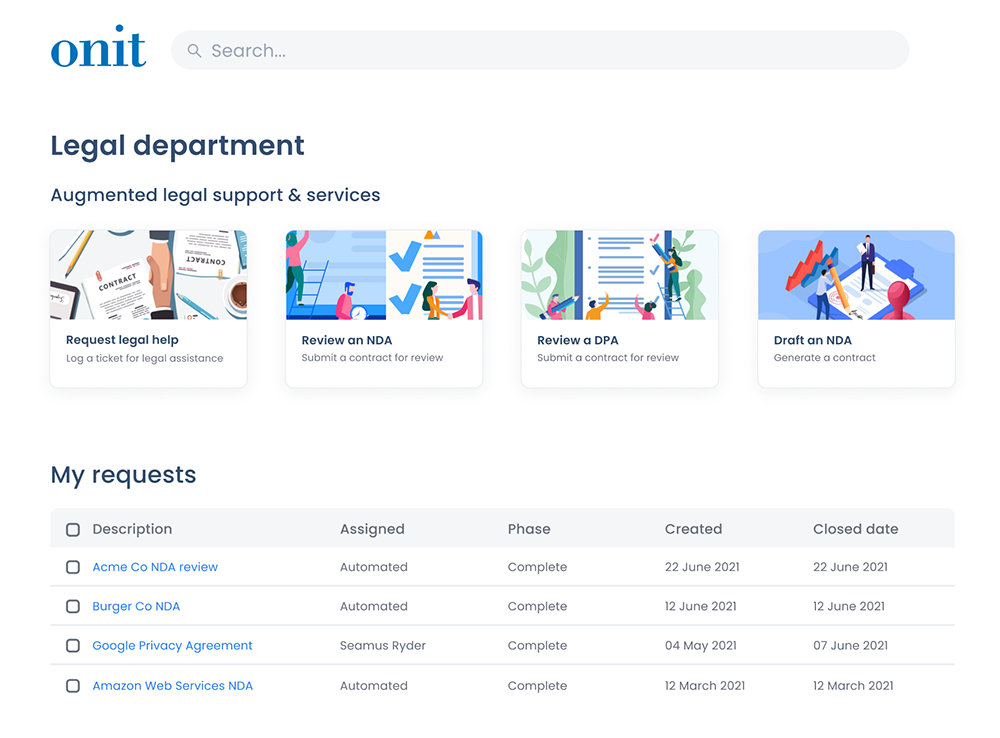
The process starts with online submission. Anyone in your organization can visit the Automate NDA portal and request an NDA to be drafted or reviewed or ask for help.

Automate NDA Portal

When a request is submitted, Automate NDA automatically routes it through the appropriate workflow, be it generating your standard NDA and sending it for e-signature, or reviewing and redlining a third-party NDA.

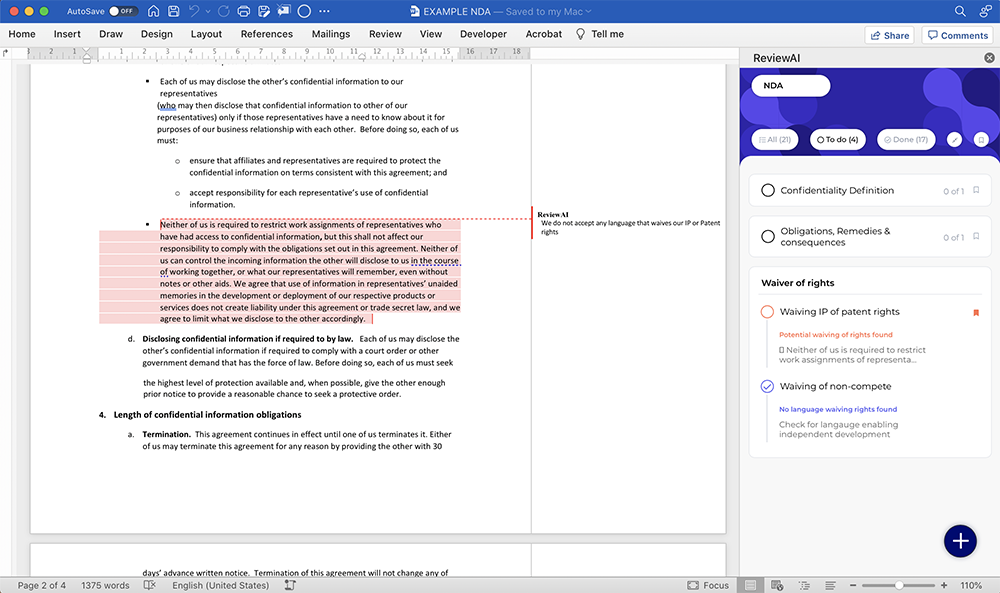
In the example of a third-party NDA review, once you upload the NDA, Automate NDA will review and redline the contract based on the corporate legal department’s contract playbook and provide a link to the edited Word document. If there are major issues, Automate NDA will instead escalate the NDA to the legal team.

Automated NDA reviews and redlines contracts

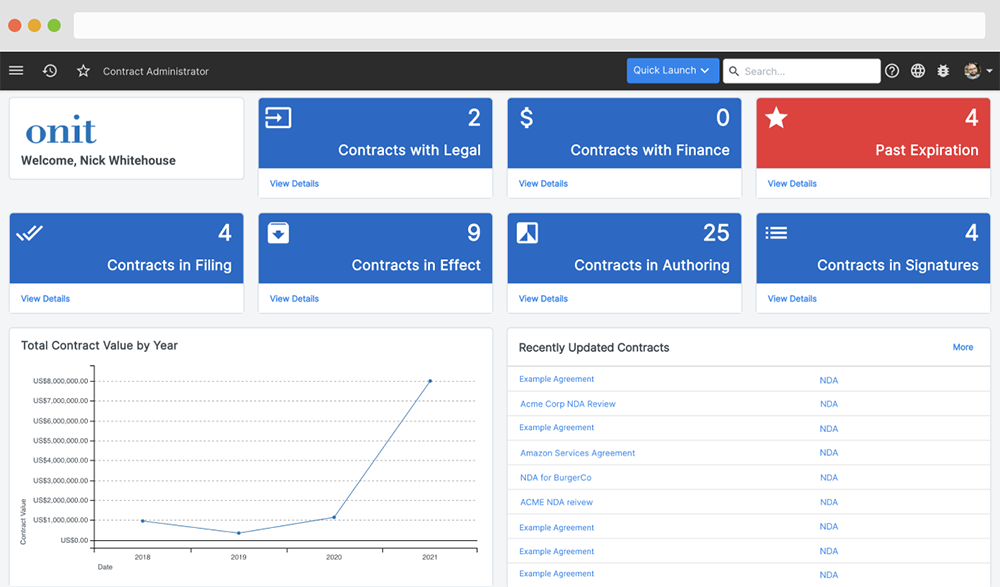
The legal team can track all of this work from the Automate NDA dashboard.

Automate NDA dashboard

Interested in creating a streamlined, automated NDA experience? Schedule a demonstration today to learn more about Automate NDA.

1 Based on 1-4 hours of work per each NDA and the average rate per hour for an in-house attorney of $114 according to the 2019 Association of Corporate Counsel Global Legal Benchmarking Report.

How to Intentionally Design World-Class In House Legal Operations

The rise of in house legal operations is changing the way organizations approach and structure their legal function. As the discipline of legal operations continues to evolve, so does the conversation on what world-class operations should look like and how to intentionally design them to meet that status.

Last month, we sat down with Brad Rogers, Onit’s Vice President of Strategy and Growth and a former leader of operational excellence in Fortune 500 companies, to discuss what it takes to build world-class legal operations in today’s demanding legal environment. (You can find his full podcast here.)

In our first installment, we discussed the goals of an in house legal operations transformation journey and how to secure the funding to build the legal ops function your organization needs.

Now, we turn our attention to what that legal ops function should look like.

Legal ops should deliver productivity back to lawyers, significantly reduce and reallocate legal spend and future-proof the environment your lawyers are working in. But what would that legal ops function look like if it were intentionally designed?

Brad laid out three elements that are crucial to world-class legal ops: technology, support services and partnerships and business discipline.

In House Legal Operations Technology

Technology is a major factor in any legal ops transformation journey. We live at a peak time for innovation, with capabilities for legal professionals that are constantly evolving through advancements in areas like AI.

When you’re building your in house legal operations function, you should be thinking about your entire technology ecosystem – that means not just your foundational tools like matter management, e-billing and document management, but the surrounding technologies as well. You want to structure a solution set for your lawyers, not simply gather a collection of disparate tools for them to learn how to use.

A successful transformation journey requires a road map that connects all your capabilities to give you a better understanding of the nature and trends of your business. Once you understand that, you can start considering things like how AI would enhance your capabilities even further or where there are additional workflow efficiencies to be gained.

Support Services and Partnerships

One of the most beneficial capabilities a mature in house legal operations team can bring is the ability to leverage support services and strategic partnerships. When you’re first building out legal ops, however, this might look a little different.

You might start by approaching the lawyers and telling them to refer any nonlegal work they’re handling to legal ops. Even further, you can help them identify that work and cement your legal ops department as a valuable support team for legal. Going forward, legal ops should be involved in projects from the start and serve as proactive problem-solvers. Lawyers should be practicing law, not focusing on things like project management and business improvement. A strong legal ops team should also offer support for billing, which historically leads to significant lost time and inefficiency for legal departments.

The final aspect is managing the legal department’s internal partnerships with other departments, such as HR, risk compliance and security, and its external partnerships with vendors. Legal departments shouldn’t have to do everything by themselves. The point of legal ops is to let the lawyers focus on the law while ops handles the rest.

Business Discipline

One thing people often overlook when building world-class legal operations is the ability of in house legal operations to harness the power of data – both your internal data and data that exists outside the organization. Data analysis is key to understanding your business and trends in the market, allocating resources and making strategic plans for your organization.

Legal ops should be looking at all the available data and making informed decisions for the business. This can include outsourcing work, vendor management, strategic hiring and more. The goal is to get as much nonlegal work off the lawyers’ plates as possible to allow them to practice better law. Every legal department has hidden factories – pockets of inefficiency – that prevent them from being the most effective, disciplined legal function possible. Legal ops should ideally always be looking for those areas and figuring out the best way to eliminate or transform them.

For more legal ops insights, you can listen to the full podcast discussion with Brad here. You can also subscribe to the Onit podcast anywhere, including through Apple and Spotify or any service you use to listen to podcasts.