

Category: Business Process Management

Discover the Latest Workflow Automation Apps for Accounting, Finance and Procurement

Apps for accounting, finance and procurement professionals have spurred a significant digital transformation in recent years – especially those focused on workflow automation. Workflow automation Apps are making headway in these professions, streamlining tasks that were once purely manual and gathering and analyzing valuable data.

Members of our Onit Nation – Fortune 500 customers, industry partners and employees who build on Onit’s platforms – have identified process challenges in these departments. To address them, they did what comes naturally. They quickly made Apps for accounting, finance and procurement on Onit Apptitude that do everything from expense management to PO requests.

Apptitude is a workflow automation platform that allows users to easily create, modify and deploy Apps without special technical training or expertise. Any business user can access its visual, drag-and-drop interface to quickly build the Apps needed to address an organization’s biggest (and smallest) challenges. How fast does this happen? We’ve had customers complete builds within an hour.

Apps for Accounting, Finance and Procurement

As with legal, accounting and finance are professions that require precision. Errors can have significant consequences that can complicate business.

With these Apps for accounting, finance and procurement, the Onit Nation has found ways to streamline processes and improve accuracy by automating reporting, balance sheet reviews and more. They include:

  • Board Approval: An App that tracks and manages internal board of directors appointments and approval workflows
  • Balance Sheet Review: An App that runs a quarterly review of a company’s balance sheet for various businesses, allowing balance sheets to be circulated, reviewed and approved worldwide
  • Application for Expenditure: An App that handles the approval of expenditures, including tracking for costs and benefits over time
  • Fund Management: An App that oversees the asset transfer between receiving and contributing entities within a company and includes various steps that are approved through e-signature workflows
  • PO Request: An App that facilitates request and payment approval for purchase orders

The Onit App Catalog – Representing More Than 5,500 Apps

These Apps, and many others, are now collected in one place – our new App Catalog.

The App Catalog showcases the breadth of Apps built on Apptitude and represents a decade of innovation creating digital transformation one App at a time. The Apps cover a wide range of industries and practices, including accounting, finance and procurement, enterprise operations, general and administrative, human resources, IT, legal operations, marketing and IP and risk and compliance.

With the App Catalog, all of our customers can now draw from the innovation of others to find the inspiration they need to build the tools that will automate processes and solve their most pressing issues.

Peruse the App Catalog now to find even more inspiration for ways you can revolutionize your workflows and increase your efficiency. If you’d like to see these Apps in action, you can schedule a demonstration here.

Corporate Legal Market Trends for August 2021

Welcome to the August edition of our monthly look into corporate legal market trends. In this edition, we share some thought-provoking articles covering innovative GCs, the digital transformation of BT’s legal operations and how AI and contract lifecycle management help legal departments run like a business. We hope you find some practical takeaways in the following articles.

1. Examples of Operational Excellence from Legal Teams Running the Department like a Business

Running corporate in-house legal departments like a business is quickly gaining traction in legal departments around the globe. The age-old complaint that lawyers are holding up critical processes is rapidly turning into a thing of the past. Technology solutions have significantly contributed to alleviating this problem, providing faster processes and newfound collaborative abilities at unforeseen levels. Of particular note: Lenovo’s contract management transformation, which happened thanks to a strong vision and the adoption of contract lifecycle management technology and AI.

According to the article:

Lenovo has recently digitised its contracting processes and is now able to measure how much time is spent on a contract, how many lawyers worked on it, and how much a template has been modified. “Data analytics has enabled insights we never had before,” says [Marcelo] Peviani [legal director at the centre of excellence for Lenovo].

Source: Financial Times

2. The Next Legal Market Trend to Put on Your Radar: Running the Post-Award Phase of Contract Management

According to a World Commerce & Contracting Association and Deloitte survey, contract professionals are shifting their focus to the post-signature phase of contract management. The results show a growing emphasis on the post-award stage of contract management. According to the survey, “less than 30% of organizations currently have centralized or center-led post-award contract management resources” and “only a little over 20% attempt to monitor or calculate the costs or overall benefits associated with contract management.” It also discovered that nearly 40% of the participants are looking to improve post-award processes, and more than one-third are striving to introduce more “robust approaches to obligation management.”

Source: World Commerce & Contracting Association

3. Hear BT Discuss Its Award-Winning Legal Operations Digital Transformation  

David Griffin, head of legal technology and change at BT, joined the Onit podcast recently to discuss his company’s award-winning legal operations transformation. He shared how the company led legal market trends by replacing manual and disconnected process and management tools. The change helped the department handle workload and matters across the teams from inception to closure.

Judges for the Legal Innovation Awards took note, sharing with Law.com that BT stood out “not only due to the speed of their roll-out of the platform but by taking an existing process and migrating it into a streamlined, efficient platform.”

BT won the Legal Innovation Award for “Future of Legal Services Innovation – In-House Legal Operations” and was named a finalist for the Legalweek Leaders in Tech Law Awards. You can hear David’s story here.

Source: Onit

4. Thinking outside of the Box Reaches New Level among In-House Lawyers

The Financial Times has featured 20 highly experienced GCs who are directly challenging traditional legal roles. By redefining themselves as strategic thinkers, they are making market-leading headway when it comes to sustainability and digital transformation. Companies are now operating in ways that require lawyers to use their skills and experience in new ways. The continuing proliferation of implementing legal technology gives these lawyers more time to focus on high-impact legal work.

Source: Financial Times

5. AI and Contract Lifecycle Management: What Should You Expect?

If you’re following legal market trends, you’ve probably already heard how contract management software can drastically streamline contract creation, review, execution and management. But now that AI is in the mix, how does that affect contract lifecycle management? A new visual guide tackles this topic to get you up to speed in no time. It explores questions such as:

  • Should you look for pre-trained AI?
  • What redlining capabilities should contract AI offer?
  • Can AI offer interactive checklists to accelerate review?
  • How can AI repaper contracts for regulatory, policy and commercial changes?
  • Can AI help you analyze legacy contract data for better contract management?

Source: Onit resources

Bonus Resources: The Latest on CLM and AI

Year after year, legal market trends have pointed to lawyers and legal departments finding ways to be more efficient while controlling costs. Adopting cutting-edge technology, thinking outside of the box and running the department like a business are important ways to achieve these objectives.

Combining contract lifecycle management tools with AI is a prime example of working toward those means. When paired, they offer streamlined processes, a decrease in friction for employees across the enterprise and deliver more business value. If you’d like to learn more about legal market trends for contract lifecycle management tools, check out some of our recent blog posts:


Ensure Accurate Legal Billing By Avoiding These Four Common Invoicing Problems

While having accurate legal billing is something all parties involved can agree on, it’s still a complicated process for large corporate legal departments. A single law firm bill may have hundreds of pages, clock in at millions of dollars and cover multiple matters, tasks and timekeepers. Outside counsel guidelines, billing code confusion and the sheer volume of bills further complicate invoice review.

As a result, charges can routinely fall in a gray area or violate outside counsel guidelines. They can slip past first-pass reviewers who are short on time and have multiple responsibilities. Even the most stringent automated billing rules may not flag some costs because of a wide variation in descriptions and billing tactics.

Take travel, for example. With lockdowns over the past year, accurate legal billing for travel-related costs should be a given. You logically expect that travel charges from law firms substantially decreased during that time. However, that wasn’t the case.

When Onit’s AI-enabled invoice review tool scoured historical invoices from a set of Fortune 500 customers, it discovered an average of six figures of savings in travel-related billed time and expenses submitted to customers. These are “gray area” charges that surpassed what had already been found by traditional billing rules and standard invoice review.

Common Invoice Errors That Make Accurate Legal Billing Challenging

Corporate legal departments want to know what services they’re paying for as part of their law firm partnerships. Otherwise, it’s difficult to make proper efficiency and cost control refinements.

We recently conducted an informal poll, asking corporate legal customers to name problems they encounter when reviewing invoices. Each of the following top-four improper e-billing and invoicing practices is a significant barrier to understanding and controlling legal spend.

  1. Vague or insufficient details in invoices

“For services rendered” or other vague descriptions are insufficient explanations of legal services. While each poor description may not seem like a pressing concern, the cumulative costs of this practice over several invoices reveal a much larger problem. Vague billing descriptions make understanding and controlling legal spend a nearly impossible task to undertake.

  1. Block billing

Block billing, or the practice of putting multiple work segments on multiple dates into one line item description, is raising red flags at corporate legal departments – especially when “going lean” is the name of the game. While it was a somewhat accepted standard for years, the dollars add up quickly and are difficult to catch. The practice also acts against conveying the value of law firm contributions since there is no transparency for the work they undertook.

How much of an impact can block billing have on spend? One legal operations leader reported a block billing charge of more than a million dollars – one that AI caught but only after it had made it past first reviewers.

  1. Improper coding of invoices

While it sounds like a simple task, you’d be surprised how often improper coding happens in a single day. Often the mistake is as simple as billers failing to select appropriate codes on dropdown menus. When work is attributed to the wrong billing code, it may trigger an additional review, taking extra time while also skewing legal spend analytics.

  1. Work being done by wrong staff class

How often have we done other people’s work and vice versa, whether above or below our pay grade? Not a real problem, right? Wrong. Sure, it happens, but it can add up quickly and work against accurate legal billing.

Certain types of work are better suited to a paralegal, legal assistant or intern than an attorney. Too often, though, those work efforts are being done by an attorney at a much higher rate. Or perhaps a task that would take a higher-billing partner five minutes to complete would take an associate much longer and so cost more. At the end of the day, corporate legal departments want the work performed by the appropriate level of staff.

Alleviating the Pain of Legal Invoice Review

Lean legal – doing more with less money and fewer resources while maintaining the same high quality – is the new paradigm at corporate legal departments. Technology plays a prominent role in achieving legal ops objectives with “less.” As hard as we try, law firm billing errors still happen, and corporate in-house legal teams will struggle to catch them. Well-chosen technologies – like AI and automated billing rules – bolster the opportunity for accurate legal billing.

If you’d like to read more about alleviating invoice review challenges, here are some resources:

Onit Portals: The Welcome Mat for Your New Business Intake Process

Streamlining the new business intake process and automating inefficient processes are high on the list of priorities for most busy corporate legal departments today. Any technology that can help with legal service requests and allow users from other business units to engage in self-service tends to be welcomed with open arms.

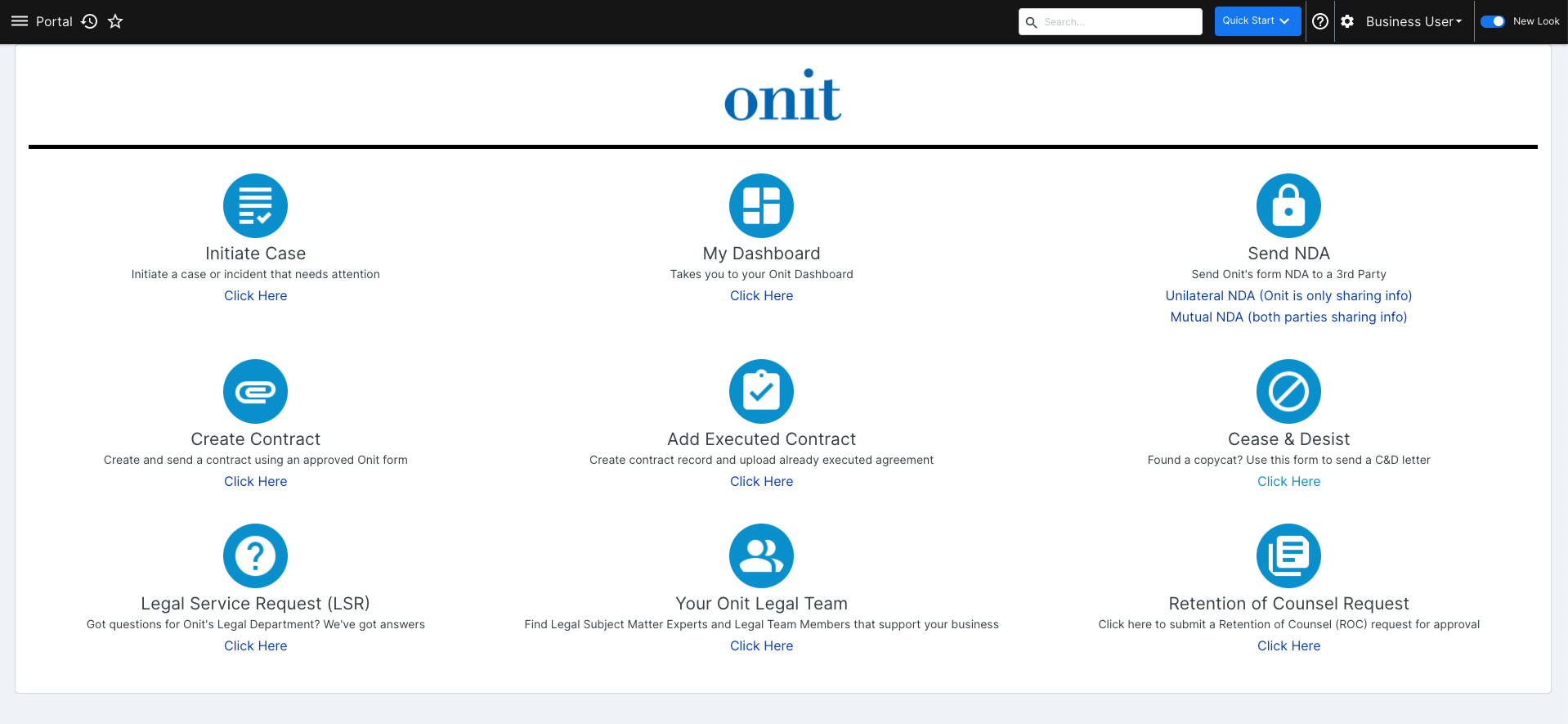
Enter Onit portals. They’re powerful dashboards with Apps that let users solve their problems without wasting time finding the proper channels to reach legal. From legal service requests to contract review to audit help, a portal puts the functions your company needs most front and center for the entire organization.

You can think of your Onit portal as the welcome mat for your legal department: the best, most efficient way to enable self-service or route work to the legal professional most suited to handle it.

How Portals Streamline the New Business Intake Process

Your portal acts as the main landing page for legal (that welcome mat to your legal department we mentioned). On it, you can include as many Apps as you want that allow users from across your organization to submit workflow requests like audit requests, employee incident reports, investigations, legal service requests and more. The Apps then automate the new business intake process for each submission, delivering the project to the right legal contact, tracking progress and notifying appropriate parties.

Onit portals are customizable for the needs of any organization, from small businesses to the largest Fortune 100 corporations. We can build out the portal that works for both your organization’s size and the types of workflows you most need.

Better yet, we don’t charge per user. Under our flat-rate user model, you can open up the power of Onit to everyone in your organization, whether you have 200 employees or 20,000 employees. It also means your workflows don’t have to be strictly tailored toward your legal staff. Your portal represents a powerful opportunity to increase collaboration between legal and other units and allow business users to engage in a higher level of self-service than ever before.

Building the Perfect Portal

When it comes to building your portal, your options are nearly limitless. No two legal departments are the same, so your portal shouldn’t be one-size-fits-all.

Think about your most significant pain points regarding the new business intake process for your legal department. Is handling and routing legal service requests your biggest headache? Do you need a better way for sales and procurement to redline routine contracts? Do your users struggle to open new matters in your matter management system?

Whatever workflows you need can be linked in your portal. With over 5,500 Apps currently available in Onit’s new App Catalog, all of which can be connected in your Onit portal, the possibilities are endless.

Workflow requests submitted through the portal don’t just disappear into the ether. As part of the portal process, some rules help to route specific requests to the right department or employee whose job it is to handle the task at issue. This can be as simple as a standard assignment for certain types of work, as complex as an auto-assignment system based on attorney capacity, or anything in between.

Via your portal, Onit does the heavy lifting of making sure the workflows are directed properly and the work is being assigned as efficiently as possible. This triage component, coupled with notifications that are sent to the responsible party, creates a centralized system for handling legal requests.

There’s no workflow too big or too small – if you need it, your Onit portal can handle it. Portals give your organization better access to your legal department while making workflows more efficient and streamlined for your legal employees.

Schedule an Onit demo today or email [email protected] to learn more.

CLM Process Flow: Making Contracting Easier for Legal

The contract lifecycle management (CLM) process flow challenges many corporate legal departments. While contracts play a critical role in the success of any business, getting them to execution can be an uphill battle, thanks to antiquated processes and outdated tools. Popular software like Microsoft Outlook, Word, Excel and SharePoint doesn’t offer the transparency you need during drafting, review and approval to keep contracting processes moving forward in a timely manner.

That’s where contract lifecycle management (CLM) software comes in. Managing your contracting doesn’t have to be overwhelming. The right contracting tools create a CLM process flow that allows corporate legal departments to eliminate delays, keep relationships with suppliers, vendors and customers running smoothly and gain insight into the contracting process to help with risk management and compliance.

Eliminating Contracting Bottlenecks In the CLM Process Flow

When the legal department is responsible for drafting, reviewing and approving even the most routine agreements, bottlenecks inevitably happen. Without a proper system for keeping track of contract volume and status, legal will inevitably be overwhelmed by contract requests from other departments, causing a backlog and frustration that will reverberate throughout the organization.

With the right CLM process flow, however, you speed up the creation and review process and free your lawyers to focus on high-value matters rather than administrative tasks. CLM software can remove delays in all stages of the contracting process, including creating intake forms configured to specific contract types, using data from those forms to automate the contract assembly process via templates, tailoring workflows to a contract’s subject matter, prioritizing contracts for review based on risk and more.

Gaining Transparency Into Review and Approvals

In the past, contract review occurred via inefficient emails between all the various stakeholders, making the approval process unclear and leaving contracts stagnating in inboxes for far too long. A better collaboration tool is necessary for legal to properly coordinate with procurement, sales and other departments, regardless of location or contract complexity.

Cloud-based CLM that’s designed and implemented to meet the needs of a specific organization can allow all parties in the approval chain to access the current status of contracting no matter where they are. More sophisticated CLM systems can create parallel approval processes incorporating e-signatures, eliminating hard copies and significantly accelerating the contracting timeline.

When you add AI to the CLM process flow, it accelerates it even more. Contract AI lets business users can run an AI-powered redline in less than two minutes. It can also identify potential issues and then automatically escalate critical issues to legal as necessary. The AI redlining essentially allows business users to self-service the review of common contracts such as NDAs.

Keeping Track of Executed Contracts

Many organizations lack a centralized contract repository, meaning that contracts are typically tucked away after being signed, too often in a place where they’re difficult to find again when they’re needed. Hard-copy storage and scattered electronic filing cabinets create disorganization, which in turn creates the risk of missing important dates or necessary compliance updates.

Having a single, designated repository for all contracts as part of your CLM process flow eliminates these problems. Contracts are simple to find, even after those who were originally involved with them have moved on. The right repository will be searchable across all document formats, so less time is spent trying to find contracts and more time is spent focusing on high-value work.

A CLM Process Flow that Stays on Top of Compliance

Compliance is critical to minimizing organizational risk. That means complying both with legal and regulatory requirements and complying with the terms of your contracts themselves. The best way to ensure compliance on all fronts is to implement CLM tools that track the terms of all your contracts, including conditions and pertinent dates, rather than leaving that task open to manual processes and costly human error.

CLM software with AI can extract the necessary data to have a clear picture of all your obligations and relevant legal standards. It can also track all changes to contracts and generate reports to create a reliable audit trail to lower your risk. For example, the contract AI can identify which contracts need repapering due to regulatory, policy or commercial changes and extract data from multiple legal documents at once for due diligence, applying contract updates or importing legacy contracts.

To capitalize on all these benefits of CLM process flow, you need a CLM solution that’s flexible enough to work the way your department works and can meet the needs of your entire organization, not just legal. Onit CLM is the simple, flexible, agile solution you need to stay on top of your contracting and boost your efficiency.

Contact Onit today to schedule a demo or email [email protected] to learn more.

Legal Operations Manager Advice: How to Self-Fund Corporate Legal Transformation (Podcast)

A legal operations manager stepping into the role will probably face many of the same challenges peers do, according to the 13th Annual Law Department Operations Survey.  These include cost containment (60%), business process improvements (56%) and departmental resources, including funding for personnel and technology (38%).

As a result, corporate legal departments are building up their operations teams. CLOC reported that the average size of legal ops teams has increased compared to last year – one of many data points that illustrate the movement to transform how in-house counsel and legal professionals work. The ultimate goal is to spark transformation and create operational efficiencies that reduce low-value work for attorneys, save money and produce greater insight into legal spend.

Operational excellence comes with a price tag, though – one that may not be budgeted for. So the challenge is: How can corporate legal create world-class operations and self-fund the transformation?

According to Brad Rogers, Onit’s Vice President of Strategy and Growth, it requires a longer-term rethinking of how in-house counsel and legal professionals work. He recently shared his insight in a podcast (embedded below and available anywhere you listen to podcasts including Apple, Google, Spotify and more) on how to start a transformation journey and build a modern legal operations function. He draws this information from nearly three decades’ experience with operations excellence at companies including one Fortune 100 global financial services company with $1 trillion in assets, Bank of America, GE and JP Morgan Chase.

Goals of Transforming Legal Operations

Building world-class legal ops isn’t about changing what you do. In-house counsel will still give legal advice and manage matters. The concept focuses more on how this is accomplished by leveraging state-of-the-art capabilities – like automation and AI – to make work more streamlined and efficient.

A legal operations manager can lay the foundation needed for world-class legal ops by meeting these three goals:

  1. Protect the enterprise by practicing good law.
  2. Assemble a team of highly engaged top talent.
  3. Be efficient along the way.

It’s crucial to keep all three goals in mind. Too often, companies focus solely on efficiency and implement technologies that ideally save some time in day-to-day work. Ignoring the first two goals, however, is a misstep. Without keeping a purpose of protecting the organization in mind and strategically hiring the staff to meet that goal, technology alone won’t get you where you want to be.

When implementing new capabilities, legal operations should aim at building an environment that’s more engaging for lawyers and helping them get work off their plates so they can spend more time practicing.

Three Ways a Legal Operations Manager Can Self-Fund Transformation

Building world-class legal operations requires investment. You need to attract and mobilize the right resources that will help you accomplish your goals. However, when you’re starting from scratch, budget restrictions will likely make it harder to put the pieces together. There are three primary ways organizations can explore funding their journey.

  1. Examine legal spend. The first source of funding is to review your current spend and free up some dollars. Suppose you can find a way to cut your outside counsel spend by even 5 or 10%, either by better managing your outside counsel guidelines or finding other areas where you’re overspending. In that case, you can leverage those savings to self-fund part of your transformation.
  2. Redirect dollars. The second way is to keep an eye on the turnover in the legal department. If someone leaves, you might be able to leverage the money budgeted for that position into a few strategic, lower-price hires that can help you start the legal ops journey.
  3. Find investment funding. The third source, and typically the hardest one to tap, is to come up with a compelling business case to finance in an attempt to secure some investment funding. While it may be a long shot, it’s worth it if you can find any extra money to invest in legal ops.

Listen to the full podcast now.

If you’d like to hear more about legal operations transformation, here are some resources to explore:

Getting Started with Legal Contract Management Software and AI

Legal contract management software can drastically streamline contract creation, review, execution and management – processes that are often fraught with complications and errors.

Data from the World Commerce & Contracting Association supports this idea. The organization recently surveyed its 70,000+ members about their contract challenges and priorities and found that 85% experience pressure for contract simplification. Another 81% said they have plans to implement contract automation. These points speak to the fact that poorly managed contracts lead to lost revenue, higher costs and more time devoted to manual tasks for all parties involved.

The Challenges of Contract Management

To understand the actual value of legal contract management software, it’s helpful to recap the inefficiencies associated with contract handling.

Manual processes open the door for errors and slow down overall contract execution. For example, approvals and negotiations done via email are often sluggish or overlooked. Untracked revisions can lead to confusion, conflict or non-compliance and a lack of standard legal language may result in lengthy review times or require lawyers to get involved.

Disparate repositories result in inefficient reporting and reduce contract visibility. Contracts spread out over different repositories, departments and geographical locations make monitoring corporate contracts holistically almost impossible. Without tracking expiring contracts and renewals, companies run the risk of compliance exposure as well as revenue loss.

Changes occur over the lifetime of a contract, including renewal dates, pricing, emerging legal requirements and other events. They require amendments and approvals from the contract parties. If these changes aren’t managed, implemented  and communicated correctly and quickly, organizations can increase compliance risks for themselves and all parties involved.

How Legal Contract Management Software Helps

Legal contract management software can reduce the average hours spent on contracts by 20%, accelerate review and save on costs. It does this by:

  • Automating the contract lifecycle and maximizing speed and control. Workflows can be configured and automated to support how your company interacts with the contract lifecycle. Clause libraries in CLM automatically create new and approved contract language quickly, and pre-approved templates dramatically reduce creation time. Additionally, contracts can be delivered to all appropriate parties from the CLM solution and integrate with e-signature capabilities to maximize contract execution.
  • Centralizing contracts in one repository in the cloud. This makes them easier to find for appropriate parties and provides a real-time configurable dashboard that shows business-critical contract information at a glance. The legal contract management software also applies the proper metadata when a new contract is created or captured to ensure tracking and sends alerts to notify parties of key events, obligations, milestones and expiration and renewal dates.
  • Allowing lawyers to work where they’re comfortable working. In this case that means enabling them to manage contract changes with a Microsoft Word Add-In. They can receive contracts in a Word doc format with change-tracking locked, save the contract directly into the CLM solution and leave remarks while checking it back in.

CLM + AI: What Is the AI Difference?

CLM centralizes contract storage and automates the request, creation, negotiation, execution and management of any type of contract.

When you combine AI with CLM, you can lower the number of contracts needing to be reviewed. This gives the reviewer the ability to speed up a review and provide consistency across processes. AI also significantly enhances contract management after execution by extracting and obtaining usable data from executed, legacy and third-party paper contracts.

AI and Legal Contract Management Software: What to Look For and How to Get Started

Not all CLM AI is created the same. To get the full benefits of contract lifecycle management solutions, you should carefully evaluate AI for both the pre- and post-signature phases of contract management.

If you’re not sure what to look for in an AI-powered CLM solution, we’ve got you covered.

We’ve prepared a Quick Start Guide that highlights the ideal legal contract AI features you need if you want to reduce inefficiencies, errors and time spent on contracts without sacrificing compliance or visibility. It also provides valuable expert tips to help you get started.

The guide includes information such as:

  • Should you look for pre-trained AI?
  • What redlining capabilities should contract AI offer?
  • Can AI offer interactive checklists to accelerate review?
  • How can AI repaper contracts for regulatory, policy and commercial changes?
  • Can AI help you analyze legacy contract data for better contract management?

Download the guide today to discover how AI can enhance your legal contract management software, what to look for and how you can get started quickly.

5,500+ Ways Corporate Legal Innovates Business Process Automation

Business process automation solves a crucial challenge for corporate legal departments. Tasked with doing more with fewer resources, in-house counsel are happily exchanging highly manual processes for Apps and automation.

For example, consider a typical trademark renewal process. An App can reinvent that process, bypassing spreadsheets and emails, automating communications and reminders and helping stakeholders quickly and efficiently determine which trademarks to renew. (You can see a demo here.) The result: Fewer touchpoints for in-house counsel without comprising the integrity and results of the process.

Inspiration for Business Process Automation with the Onit App Catalog

The trademark renewal App is just one example of business process automation innovation from the Onit Nation – the customers, partners and employees building on Onit Apptitude every day. After a decade in existence, Onit currently supports 5,500+ Apps that streamline critical processes like tracking vendor and law firm diversity, managing whistleblower allegations and supporting career development.

Today, we launched our new Onit App Catalog, which shares some of these Apps targeting business process automation in the following areas:

The catalog shares some of the most intriguing solutions and Apps created around the globe. These Apps are trusted by 400+ companies, from privately owned entities to Fortune 50 corporations.

Now, you can search the catalog and find inspiration in the powerful workflows in-house colleagues have built to run within enterprises of all sizes and specialties.

Examples of App Excellence from Corporate Legal Departments

The catalog represents a decade of business process automation innovation that has created digital transformation, one App at a time. Examples of Apps built by and for corporate legal departments include:

  • The vendor and law firm diversity tracking App, which helps internal teams gather diversity statistics from law firms and vendors to track and manage compliance with corporate policies and diversity goals.
  • The whistleblower App, which provides an anonymous intake of any alleged activities brought in by employees. It organizes, assesses and manages whistleblower allegations in a secure, centralized and workflow-driven solution.
  • The trade secrets access management App, which maintains accurate records of who has access to trade secrets or components of trade secrets within an organization. It streamlines the process of securing them upon an employee’s departure.
  • The mentorship and career development App, which creates a more formal method of linking mentors to mentees and tracks opportunities for career development, both inside and outside of an employee’s current role within an organization.

Platforms Make It All Possible

Onit is the only company to offer its users two platforms, combining the power of process and workflow automation with artificial intelligence. Apptitude is Onit’s business process automation platform, where users can easily create, modify and deploy Apps. Because it’s a no-code environment, you can quickly build without technical training to develop Apps for your organization. And unlimited licensing ensures that everyone in the company, regardless of which department they work in, can access the Apps they need to get work done efficiently.

Precedent, our AI platform, complements Apptitude and allows legal and business departments to automate processes faster while making them more cost-effective and efficient. Precedent is 100x faster than other AI systems and enables users to recognize a 40% increase in productivity.

Register for the Onit App Catalog Webinar on July 28

Onit will host a webinar on July 28 at 12 p.m. ET titled “Drive Legal Innovation One App at a Time.” The webinar will provide an overview of the new App Catalog and demonstrate examples of customer Apps for workflow, process and automation across the enterprise. Registration is available here.

Over 5,500 Business Process Automation Apps and Counting

This impressive collection of workflow, process and automation Apps from corporate legal can help enterprises of all sizes attain operational efficiencies, reduce risk and gain greater insight into data and operations. Read the App Catalog to find inspiration for new ways to continue your corporate legal department’s digital transformation journey.

To start with Apps on Onit’s no-code Apptitude platform, request a demonstration or email [email protected] today.

Legal Billing Review: How to Right-Size Invoice Charges

When it comes to legal billing, corporate legal departments often have a baseline expectation: Charge my company the correct amount.

What sounds like a simple premise (and one that should be easy to meet) comes with serious challenges. Invoice review is a rigorous process. Due to the work they represent, law firm bills are often long and complex and contain entries from numerous timekeepers. With hundreds of thousands of line items, vague descriptions or block billing may be missed by busy in-house reviewers. Violations of outside counsel guidelines, such as copy charges or work, may be hard to pinpoint. To top it off, in-house counsel and other professionals usually count invoice review as one of their many responsibilities – a list that has grown as work increases and resources remain stagnant or decrease.

Technology, such as enterprise legal management, has helped to alleviate some of the challenges. Paper invoices have moved to electronic billing. Billing rules, built to scour for specific terms in invoices, flag charges for review. Legal spend analytics identify trends and help to frame performance.

However, even with these additions, many reviewers often default to hitting approve. Who has time in the department to dig deeply into every questionable charge? Is there another approach to invoice review that will ensure companies aren’t overcharged?

We dug into these questions in a recent webinar.  Jonathan Weber, Chubb’s Vice President, Claim Optimization and Legal and Operations Lead, Marci Waterman, President of Sterling Analytics (and the newest member of Onit’s strategic alliance program), and Matt DenOuden, Onit’s SVP of Global Sales, explored the ideal approach that adds efficiency and expertise to invoice review while still honoring the company’s relationship with law firms.

Three Categories of Invoice Review Violations

Potential violations during invoice review often fall into three categories.

First, you have basic facts. For example, is the math correct? As Weber illustrated in the webinar, this is along the lines of getting a bill at a restaurant that is added correctly. Does your bill for two $25 entrees show $50?

Next, you have black and white decisions. For example, is the bill consistent with litigation management guidelines? Going back to the restaurant analogy, were you charged with what you ordered? Or did charges from another table end up on your tab?

Finally, you have gray areas. Are the charges reasonable? When we return to the restaurant idea, one way this might look is being charged for food that was ordered but was served cold. Generally, in a situation like that, the restaurant will comp the meal or replace it with another at no charge. Or perhaps you have three servers working your table. For a party of two, that makes no sense. But for a party of 25, it fits perfectly.

How can corporate legal ensure they’re billed properly in each of these categories? By combining AI and human review.

The Ideal Approach to Legal Billing Review: AI + Third-Party Human Expertise

Webber provided his insight on combining AI and third-party bill review. The company pays hundreds of invoices every day and has a sizeable legal spend. Meeting their goal of always being sure they’re paying the correct amount is a difficult task. They’ve defined strict processes for the flow of invoice review that allows them to look at their data in an organized way.

Part of that process is relying on AI and third-party legal billing review.

AI identifies non-compliance for things like wrong math, improper descriptions and block billing.  These are the kinds of basic or black-and-white decisions that machines handle well. As a bonus, the AI continues to learn so it will get more adept each day at identifying these types of issues.

For the gray areas, the human element comes in. This is where judgment is required. Sometimes the AI might flag things for a valid reason, but humans (such as the lawyers at Sterling) can understand the context and circumstances that make certain charges acceptable or unacceptable.

The result? Chubb is better able to accomplish its goal of always paying the right amount. You can hear the entire discussion, which goes more in-depth into this topic and its benefits.

The Benefits of AI and Third-Party Invoice Review for Legal Billing (and More Resources)

Combining AI-powered invoice review with human third-party review decreases the burden of invoice review while offering:

  • More consistent enforcement of outside counsel guidelines
  • A better understanding of the work being performed by outside firms
  • More time for in-house staff to focus on important, high-value work
  • Substantial cost savings

Here are resources for those who would like to learn more about this:


Onit and BT plc Named Finalists for Legalweek Leaders in Tech Law Awards

Onit and London-based BT Group plc have been named joint finalists for the Legalweek Leaders in Tech Law Awards 2021 in the category of Legal Operations. The awards recognize innovation in the legal technology sector and precedent-setting, game-changing projects and initiatives.

Scroll down to hear David Griffin, Head of Legal Technology and Change at BT, talk about the company’s award-winning transformation in the Onit podcast.

This news is even more exciting since BT earned a significant win with the Legal Innovation Awards in June. The team took home the prize in the category of Future of Legal Services Innovation – In-House Legal Operations. This is the second year in a row an Onit customer has won this award.

BT replaced manual and disconnected process and management tools and helped the department manage workload and matters across the teams from inception to closure. Onit’s business automation and workflow platform Apptitude played a pivotal role in BT’s transformation, helping manage their matters and documents. The system was live for matter management and real-time reporting within three months, enabling trend analysis and analytics across work done by the enterprise team.

The BT legal department plans to build and deploy new custom solutions on Onit Apptitude to automate legal operations and compliance processes and better collaborate with business users outside of legal.

BT’s technology implementation results speak for themselves. For every hour automation returns to their lawyers, they can reinvest that time back into something more productive for their company.

Congratulations to BT on this additional recognition from the Legalweek Leaders in Tech Law Awards! Onit is excited to partner with them to support their innovative vision.

About the award

The Legalweek Leaders in Tech Law Awards shine a light on the well-established Legalweek community and seeks to recognize the key players from the legal tech universe. It honors participants in a wide array of categories across in-house, law firm, and technology providers. Those who are shortlisted must demonstrate originality in the delivery of the products and/or service and exemplify the quality of the product or service being supplied. They must also highlight concrete and measurable ways in which the project has attributed to the success of the organization.