

Category: Enterprise Legal Management

COVID-19: Ten Lessons Learned by Law Firms and Clients

Several years ago, the global Corona pandemic emerged. We all experienced different waves, had to be flexible, and changed our way of working as we knew it previously. We want to sum up: what have law firms and their clients learned from COVID–19 and what changes to their systems, working practices and organizational structure have they made and are retaining post–pandemic?

Rather than dwelling on the immediate past, we will focus on the positive outcomes for the future. We can also say that at this stage of the pandemic, much is still relevant – it is not over yet – with new variants and the possible results of easing the lockdown and the lack of 100% vaccine coverage – the legal profession will need to continuously deal with challenges and retain a positive perspective. Nobody planned for Covid-19 and knows what is coming next, but there will be something! If Covid-19 is like other “catastrophic” events, such as flood, fire, or other external event, many law firms and their clients had business continuity and resilience plans in place, some parts of which allowed them to respond quickly and positively. Others, however, did not and had to face major problems.

WHAT HAVE WE LEARNED?

So, what have law firms and clients learned, what came out of Covid-19, and what will the longer-term “business as usual” look like? We have spoken to many Legal Operations Managers and GC in corporate legal departments. We also have an excellent ongoing dialogue with many law firms. We have gained insight into what they did in the immediate lockdown scenario and what they do in the (hopefully) post-pandemic world.

  1. Remote Working: As we know, clients and their law firms had to immediately go into lockdown near the start of the pandemic and institute remote working for almost all their staff. One client organization had to set up remote working for 75,000 people and did it successfully. Many organizations, not just in the legal world, are rethinking their longer-term office requirements and whether their current capacity should apply to the future. No one is saying that the traditional office will disappear. Still, all our contacts believe there will be a significant re-evaluation of the accepted norm to provide a desk for every individual.
  2. Greater need for technology: Lockdown also required a swift move to technology that supported home/remote working – at a scale never envisaged. Some law firms and in-house departments had already implemented a degree of technology and support for people to work from home (WFH), but the pandemic meant that this had to be done very quickly with almost no notice. Immediately, Zoom, Teams, Skype, or whatever became required for any meeting and for work colleagues to maintain visual contact with their peers. Tools to enable collaboration and communication have become vital, leading to a massive take-up of document-sharing applications, electronic document signing, and instant messaging systems. Additionally, those responsible for IT must ensure that data and access security are not compromised! Other applications within legal departments manage work, including workflow and case management, complete contracts access and administration, eDiscovery, IP systems/brand protection, e-billing/spend management, law firm instructing (including RFPs), and matter progress tracking.
  3. Flexible business priorities: For clients, there was an immediate re-evaluation of their business priorities, and what seemed like a sensible plan at the beginning of 2020 was suddenly thrown into confusion. For example, one client realized that their customer call centers could not continue as they were and had to be home-based with all the supporting technology that went with that. Some organizations, such as airlines, faced an immediate financial crisis as thousands of flights got canceled, and the business went into survival mode. All clients have said that as a priority, they dropped all non-core tasks/processes and focused on what the business needed to survive.
  4. Agile workflows with internal clients: Certainly, one lesson learned from the pandemic has left many corporate legal departments realizing that they must be more agile in how they approach working for their internal “clients.” One GC has said that the in-house lawyer must be more self-critical and demonstrate how they add value to the business. This will involve being more flexible, preparing to adopt new roles as required, and showing how the legal team can influence the rest of the organization. Another GC said that the in-house team must focus on taking a more “risk management” approach and that mitigating risk for the business will be even more critical. Also, communicating back to the business on what they are doing is vital, as it shows how their work has a positive ROI (return on investment).
  5. Higher value requirement from law firms: There is an expectation from several clients we have spoken to that they want their external law firms to be more proactive and expressed disappointment that they were not anticipating their client’s needs. One client said that just sending a newsletter in response to the pandemic was not enough, and he expected more engagement from his outside law firms. Some clients were looking for much more from their firms – not only legal advice but clear added value, a more cost-driven approach, and to come up with ideas to challenge the status quo. They also expect any relationship meeting to be more meaningful, with better cost tracking and post-matter reviews being essential. At panel review time, these clients will seek a positive response from prospective external law firms.
  6. Greater need for knowledge exchange: Some law firms have already implemented knowledge management systems, but now all organizations realize that there must be more formal ways for sharing information within the law firm and potentially with the clients. Certainly, within law firms, the introduction of a high degree of remote working means there is little or no opportunity for easily sharing information or even asking the quick question that a chat around the water cooler or walking down the corridor to speak to a colleague can achieve – i.e., informal knowledge sharing. Now, this knowledge sharing must be more formal – calling for the development of knowledge management or “legal know-how” systems – and this means not just using the firm’s document management system but building data stores of indexed information that is easy to find and reflects the law firm’s collective experience.
  7. New management methods for legal staff: More than one in-house counsel believes there will have to be an innovative approach to managing and staffing legal work in the future. For example, more generalist work is in-house, leaving the specialist work to external sources. Rather than taking each matter and deciding on internal or external, clients can go even further and use e-billing technology to break a matter into phases, with some phases done internally and others done externally.
  8. Changed working models: While much legal work gets done by remote working and good technology and communication systems in place – some work done by the legal department and the law firm is less easy to do remotely, for example, HR or disciplinary issues. It is not easy to have specific conversations over a video link; they must be face-to-face. We believe law firms and clients must find a solution to this problem. However, working from home can have other benefits, like allowing for more flexible working hours. Some individuals may find it easier to work unsocial hours – maybe in the early morning or the evening and this can be useful if working with non-Europe based colleagues, for example, to cover the working time in (say) the USA or Asia.
  9. Mental and physical health of employees: One key feature that has come to the fore during the pandemic is that of health and well-being – both mental and physical – not just in the workplace but also in the home and broader society. Many organizations were quick to try and assist staff working in a new environment in various ways, for example, by giving grants for purchasing specialist chairs and equipment. Certainly, if staff continue to work from home in the future, even for only one or two days a week, maintain this kind of support. Although many organizations were already proactive in this area, more companies now provide access to CBT and other stress management services. They are more willing to discuss these issues openly and without stigma. However, there are now new debates about the vaccination status of staff returning to the office, with some organizations saying that unvaccinated staff may not be allowed to return. This issue will no doubt run on over the coming months.
  10. Dealing with work backlogs: Obviously, the pandemic impacted those law firms involved in the justice system from the start of the pandemic – for example, the UK suspended jury trials at the beginning of the first lockdown. Some other cases did continue as the courts introduced video conferencing and other technology. Even though jury trials have been resumed, with strong COVID-19 precautions in place, there is a massive backlog of cases in all the courts caused by the requirements of remote working and other restrictions placed on all parties involved.

IN SUMMARY

So, what has living and working through the pandemic in the past two years taught us? The pre-pandemic trend for some people to work from home became the “normal” way for those who could work. No doubt there will be a return to the office, but many people believe we will see a more hybrid way of working with WFH (at least part-time) becoming accepted. However, we believe that working from home will not be the universal standard as organizations have realized that a degree of office-based working is still needed – especially for the less experienced staff who require more personal mentoring and colleagues’ support in the real than the virtual world.

The pandemic accelerated developments in collaboration and communications technology. These applications will become more mainstream in our work and personal lives.

Finally, all organizations working in the legal profession know that changes are inevitable, and the pandemic has highlighted the need for a review and transformation of organizational structures, new ways of working, a re-prioritization of projects, and increasing flexibility and agility in the approach to delivering successful outcomes.

Written by Bryan King

The History of the Enterprise Legal Management System and How Today’s Innovators Use It

The enterprise legal management system (ELM) has evolved significantly since its first iteration more than 40 years ago. Before ELM solutions, paper ruled every aspect of legal operations, overrunning critical processes like matter intake and bill submissions. Processes that powered critical legal operations workflows lacked visibility and efficiency.

Now, ELM systems digitize and automate legal operations, analyze legal spend, minimize company risk and drive process efficiency – all while helping corporate legal departments better support their businesses.

How did ELM software become critical to today’s corporate legal departments? And how are innovative GCs, in-house counsel and legal operations professionals using it today? Read on to find out.

The Enterprise Legal Management System – Introducing Matter Management

Enterprise legal management solutions trace back to 1978. Equitable Life’s legal department saw the potential for their new WANG VS word processing system to do more. They determined that it could be used to manage the details of each legal matter, outside counsel and many other things that the company needed to monitor for day-to-day legal operations.

Equitable developed a matter management system that ultimately became a product called Corporate LawPack. Over the next two decades, Corporate LawPack was ported to a variety of hardware and software platforms. This led to its eventual adoption by the legal departments of many Fortune 100 companies, government agencies and financial institutions.

During the 1980s and 1990s, matter management was broadly adopted and refined to facilitate the administration of corporate legal practices. These solutions provided a matter database and served as reporting tools but had little effect on overall efficiency. They required manual entry for a large amount of data to create meaningful value, which meant the systems were operated by support staff and not widely used by lawyers.

The Rise of Legal Spend Management

In the mid-1990s to the early 2000s, legal spend management – the companion to matter management and an essential component of an enterprise legal management system – made its debut. The DuPont Legal Model (1992) drove its development. DuPont partnered with outside counsel to manage the data provided on legal invoices, theorizing that it would lead to significant operational efficiencies and reduce legal spend. This led to the Uniform Task Based Management System (UTBMS) initiative and spawned the new class of spend management software.

Legal spend management systems gave clients visibility into the details of what law firms were billing and it became the primary means of exercising more control over how matters were managed by outside counsel. This transparency began a shift in the way legal business is conducted that continues today, with clients having more opportunities to require alternative fee arrangements, enforce billing guidelines and reduce costs.

The Modern Enterprise Legal Management System

Today, technologies like the cloud, workflow automation platforms, AI and business intelligence platforms have allowed for greater advances and enabled the execution of visionary thinking.

Corporate legal departments no longer want systems of record – software that merely tracks data added to them. Instead, they want systems of engagement for ELM. These systems move the needle of productivity, streamline and accelerate workflows and provide greater transparency and less risk to the legal department and the enterprise it serves.

Even more importantly, these legal leaders – both for operations and the practice of law – want to address larger challenges, ones that might be felt across the enterprise. Adopting a no-code platform approach for all solutions means legal departments can solve any needs, including enterprise legal management, NDA creation and distributionlegal holds and legal service requests. The no-code platform also makes it incredibly easy to create solutions that solve intradepartmental and cross-departmental needs. For example, this catalog shows how corporate legal departments have built their own Apps and solutions to work with HR, IT, compliance, marketing and more.

Innovative Use of ELM Solutions

How are innovative legal leaders using enterprise legal management solutions?

BT’s innovative approach, which combined matter management, legal spend management and a business process automation platform, won the 2021 Legal Innovation Awards in the category of “Future of Legal Services Innovation – In-House Legal Operations.” According to the awards program, “BT’s new platform, ‘My Legal,’ allowed the legal team to overhaul how it managed external spend, as well as several other process improvements. Judges agreed that this winner stood out, not only due to the speed of their roll-out of the platform, but by taking an existing process and migrating it into a streamlined, efficient platform.” You can hear David Griffin, Head of Legal Technology and Change at BT, talk about the company’s award-winning transformation in this Onit podcast.

Christine DiDomizio, Legal Operations Lead at Jaguar Land Rover North America, shared the company’s story about implementing an enterprise legal management solution, digitizing processes and how collaboration changed after ELM. As a bonus, the solution also prepared them for the onset of the COVID crisis by providing a seamless transition from in-office to virtual work.

In this blog post, legal technology experts discuss four exciting ways in-house professionals are leveraging enterprise legal management, including workload management, diversity and inclusion, proving value and enterprise-wide operations.

You can find more ELM innovation and digital transformation stories in this Quick Start Guide: Advice on Legal Digital Transformation from the Leaders Who Created It.

The Latest Advancement For AI in Spend Analytics: Finding Legal Invoice Errors “Between the Rules” with InvoiceAI

Legal invoice review is rarely a top-ten task for corporate legal departments, meaning it’s the ideal process for AI in spend analytics to improve. That’s why Onit has announced the general availability of its AI-enabled invoice review offering – InvoiceAI.

Onit’s InvoiceAI analyzes historical and real-time legal invoices to find errors “between the billing rules.” It uses AI and machine learning to support outside counsel guidelines, looking into common invoice areas of note such as non-working travel, block billing, vague descriptions and work done by improper staff class.

How InvoiceAI Works

Before the rise of e-billing and legal spend management, paper ruled the invoice process. Law firms sent substantial bills – think hundreds of pages – to their corporate clients. In-house counsel, in return, rarely had the time, tools or resources to scrutinize line items.

The transition to e-billing opened the door for more technologies to improve bill review – namely, billing rules. Billing rules rely on specific descriptions and context provided (or not provided) by in-house legal professionals to evaluate line items. However, descriptions for line items can vary based on the biller and service. Invoices without the exact language or terms outlined in billing guidelines may evade review and be approved for payment. There is simply no way to code billing rules to cover every possible permutation of language that might populate future invoices.

This is where AI in spend analytics enters the picture.

InvoiceAI has been trained on millions of legal invoice charges. It fully integrates with Onit’s enterprise legal management system and works with billing rules to look for areas where overpayment is common. When these issues are flagged, InvoiceAI can automatically adjust an invoice to comply with guidelines or bring the item to reviewers’ attention.

Essentially, InvoiceAI allows machine learning to do what it does best, looking for discrepancies and continually learning and improving its invoice review. It also allows Onit’s existing e-billing rules to continue doing what they do best – focusing on compliance with outside counsel guidelines and flagging issues for additional expert review. Finally, it allows legal operations teams to do what they do best: reviewing trends for compliance, managing vendor relationships and implementing best practices across outside counsel guidelines.

As a result, corporate legal departments benefit from:

  • A reduction in invoice review time due to better recommendations and less manual work
  • The ability to review past invoices and have AI identify errors and unnecessary payments
  • Insight into legal spend trends and vendor performance
  • Access to Onit’s partner Sterling Analytics, the leader in third-party invoice review.

How to Learn More About AI in Spend Analytics

To learn more about InvoiceAI, hear Matt DenOuden, Senior Vice President of Sales, and Mary Fuzat, Vice President of Product Management, discuss how AI in spend analytics boosts efficiency and saves money in this podcast.

InvoiceAI is now available to all Onit customers. Reach out to us today at [email protected] to learn more about InvoiceAI and Onit’s enterprise legal management system. You can also schedule a demo here.

Creating Custom Legal Software: The Apps and Solutions Legal Operations Pros Are Building Themselves

To meet the needs of today’s modern corporate legal department, many legal operations professionals are creating their own custom legal software. And here’s what they’re building.

But first, let’s take a look at the past year and a half.

Corporate legal departments completed many nimble adjustments as they’ve faced new challenges and demands. Legal operations professionals play a vital role in this success, finding ways to make it easier for lawyers to work while bringing in more efficiency, cost savings and other benefits of operational excellence.

Technology undoubtedly plays a role in supporting these endeavors, bringing automation and AI to systems like enterprise legal management and contract lifecycle management. However, even the most customized solutions must have the flexibility to evolve with a corporate legal department’s needs – especially when considering collaboration across the enterprise.

Building Your Own Custom Legal Software

Custom-built software for legal traditionally seems like a luxury, requiring precise planning, contributors across multiple departments and a good piece of the budget. But now, with technology innovations, legal operations pros can create Apps (and combine Apps into solutions) quickly and efficiently. They do this with tools that simplify the process and offer no-code-needed interfaces.

Business automation platforms and App builders with drag-and-drop visual interfaces make the creation process more accessible for those unfamiliar with coding. Instead of relying on developers, they can use a platform and its simplified interface to program the software. The key is indeed the underlying business process automation platform, which acts as a blank canvas. While it supports large solutions for legal spend, contract management and matter management, it also supplies the flexibility to enhance those solutions with complementary Apps, create new Apps altogether and combine Apps into solutions to tackle more complex challenges.

A perfect example of this in action is Hack the House, our inaugural virtual hackathon. Five teams comprised of in-house legal professionals, consultants and business analysts identified business cases and built Apps to solve complex workflow challenges in less than three weeks. They created solutions for data breach incident reporting, career development, diversity and pro bono program management. The winning team took it a step further by creating multiple Apps and combining them into a solution to streamline trademark renewal decisions and track trade secrets.

As impressive as that sounds, we’ve seen custom legal software built even faster – with Apps up and running in as little as an hour.

What Legal Operations Is Building

To date, the Onit Nation – Onit’s master App builders, customers and strategic partners – have used the Apptitude platform to build more than 5,500 Apps to solve everyday business problems. Among them are several custom legal software solutions that are helping to automate and accelerate nearly all aspects of legal operations, and we’ve collected many of them in our new App Catalog.

Our corporate legal customers have been prolific in building Apps and solutions. In addition to the Apps mentioned for Hack the House, other Apps have been created to handle:

  • Board Kit Distribution: Centralizes board of director information and notifies board members of new or revised documents while giving them access to the most current information
  • Ethics Violations: Provides intake and oversight for ethics violations and consolidates all ethics cases in one place for better oversight, collaboration and management
  • Gifts and Business Entertainment: Provides robust workflows and automation on gift and business entertainment requests company-wide to improve compliance with relevant policies
  • Settlement Authority Request and Approval: Provides a workflow for approving documents that detail settlement authority requests
  • Task Assignment: Handles task assignments made to non-departmental resources
  • Whistleblower: Provides anonymous intake of any alleged activities brought to you by employees and allows you to organize, assess and manage whistleblower allegations in a secure, centralized, workflow-driven solution

These are examples of just some of what our customers have created to automate processes and solve pressing issues. In fact, the Apps work across the enterprise, automating processes with HR, marketing, risk and compliance, accounting, finance, procurement and more. Peruse the App Catalog now to find even more inspiration to revolutionize workflows and increase efficiency.

To get started with building custom legal software on Onit’s no-code business process automation platform Apptitude, schedule a demonstration or email [email protected].

Onit Acquires Bodhala, the Leading Provider of Legal Spend Analytics, Benchmarking, and Market Intelligence

At Onit, we always look for ways to innovate for our customers. An essential part of this priority has been strategically combining with other disruptive companies that are changing the way the world does business. To that end, Onit is proud to announce its fourth strategic acquisition since 2019: Bodhala, the leading provider of  legal spend analytics, benchmarking and market intelligence.

The combination of Onit’s and Bodhala’s capabilities creates the most complete enterprise legal management solution on the market, allowing corporate legal departments to evolve legal spend data into actionable intelligence.

Hear Onit CEO Eric M. Elfman and Bodhala CEO Raj Goyle discuss the acquisition and how actionable intelligence is the next wave of business transformation.

Actionable Intelligence for Legal Spend Management

A revolution of data and intelligence has been hitting every sector in recent years, and the legal industry is no exception. Running legal departments on actionable data is the future of digital transformation.

Bodhala helps corporate counsel understand what they should be paying outside counsel, making it easier to source law firms at competitive and market-driven rates. With its data and actionable intelligence, corporate legal departments can identify whether they should be paying the amounts they’re paying, whether they’re paying market price, if they’re properly allocating their work among their various law firms and more.

How does this translate to success? Here’s one example.

The general counsel of one of the largest private equity firms wanted to address annual rate increases from outside counsel. Their rates had been rising well above inflation every year. With Bodhala, the company conducted a competitive analysis of its law firms, compared rates to other firms in the market based on the type of law and complexity of work and gathered internal benchmarking across its panels.

After this analysis, the PE firm had the quantitative, actionable intelligence needed to negotiate a decrease in proposed annual outside counsel rates by 17% and save $27 million.

The Most Complete Enterprise Legal Management Solution on the Market

The combination of Onit and Bodhala creates the most complete, full-lifecycle enterprise legal management solution on the market.

Onit customers already have access to industry-leading enterprise legal management, AI-enabled invoice review and AI-based business intelligence and business process automation platforms. Now, with Bodhala, they can leverage legal spend analytics, benchmarking and market intelligence for a quantum leap in the value and savings they can produce for their businesses.

Bodhala will operate as an independent subsidiary of Onit. It is the third acquisition for Onit in less than a year. In November 2020, Onit acquired legal AI innovator McCarthyFinch and then document automation leader AXDRAFT 30 days later. Onit also acquired SimpleLegal, a modern legal operations software provider, in May 2019.

If you are an Onit or Bodhala customer, reach out to your account managers for more information or you can email Onit at [email protected].

To hear the CEOs of Onit and Bodhala discuss the acquisition, the strategy behind it and what it means for Onit and Bodhala customers, tune in to this podcast.

Trending Legal Operations Podcasts

Podcasts have become the listening content of choice for many people worldwide, providing engaging audio on the way to work, during daily workouts or as part of a morning routine. Podcasts enable their listeners to gain new insights, expand their existing knowledge and keep track of trends in our fast-evolving world. Legal is no exception. Many exciting Legal Tech podcasts have emerged in recent years. However, finding the perfect series for you without listening to every episode can be tricky.

But don’t worry — we’ve got you covered! Our industry experts have compiled a list of leading legal operations podcasts to help you learn and stay up to speed on the latest legal tech, operations and innovation news and developments.

LEGAL TECH MADE SIMPLE, SYKE

Dom Burch, VP of marketing at SYKE, is neither a lawyer nor a tech expert, which makes him ideally qualified to make legal tech simple. Join him as he interviews expert legal engineers, software developers, and personnel in law firms and large corporations implementing legal tech. He aims to provide listeners with diverse views and opinions by speaking with thought leaders and innovators across the legal tech spectrum.
LISTEN NOW

LEGALTECH ARCADE, ROB MACADAM

Legaltech Arcade is a series of long-form interviews hosted by Rob MacAdam. The podcast focuses on tech-enabled legal service delivery and the people and products that make it happen through in-depth discussions with legal tech founders and senior industry leaders. Topics of discussion include legal platforms, no-code automation, digital transaction management, creating digitally driven law firms, professional services 2.0 and computational contracts. If you want to know more about what goes into setting up a legal tech start-up and gain insight into the latest industry developments, then be sure to check out this podcast.
LISTEN NOW

FRINGE LEGAL, ABHIJAT SARASWAT

Aimed at law firm leaders and influencers, each Fringe Legal episode is a thoughtful discussion with a diverse range of voices about ideas impacting the evolution of the legal profession. Along the way, listeners will learn about the challenges to overcome, what’s worked in the past, and expert tips on what could make a difference.
LISTEN NOW

LEGALTECH WEEK, BOB AMBROGI

LegalTech week presents a weekly round-up and review of legal technology and innovation news hosted by lawyer and journalist Bob Ambrogi, with commentary from a revolving panel of industry experts. It releases every Friday, all in 15 minutes or less.
LISTEN NOW

THE LEGAL OPS PODCAST, ALEX ROSENRAUCH AND ELLIOT LEIBU

The Legal Ops Podcast is about all things legal operations, legal business, and legal technology. The hosts are Alex Rosenrauch and Elliot Leibu, legal ops professionals with experience and passion for this subject and deep connections in the industry. Every episode covers a new aspect of transformation, operationalization, and technology implementation, overlaid with the human elements of change management and organizational psychology. If you’re interested in the changing nature of legal services delivery and want to be a part of it, this podcast is for you.
LISTEN NOW

Ensure Accurate Legal Billing By Avoiding These Four Common Invoicing Problems

While having accurate legal billing is something all parties involved can agree on, it’s still a complicated process for large corporate legal departments. A single law firm bill may have hundreds of pages, clock in at millions of dollars and cover multiple matters, tasks and timekeepers. Outside counsel guidelines, billing code confusion and the sheer volume of bills further complicate invoice review.

As a result, charges can routinely fall in a gray area or violate outside counsel guidelines. They can slip past first-pass reviewers who are short on time and have multiple responsibilities. Even the most stringent automated billing rules may not flag some costs because of a wide variation in descriptions and billing tactics.

Take travel, for example. With lockdowns over the past year, accurate legal billing for travel-related costs should be a given. You logically expect that travel charges from law firms substantially decreased during that time. However, that wasn’t the case.

When Onit’s AI-enabled invoice review tool scoured historical invoices from a set of Fortune 500 customers, it discovered an average of six figures of savings in travel-related billed time and expenses submitted to customers. These are “gray area” charges that surpassed what had already been found by traditional billing rules and standard invoice review.

Common Invoice Errors That Make Accurate Legal Billing Challenging

Corporate legal departments want to know what services they’re paying for as part of their law firm partnerships. Otherwise, it’s difficult to make proper efficiency and cost control refinements.

We recently conducted an informal poll, asking corporate legal customers to name problems they encounter when reviewing invoices. Each of the following top-four improper e-billing and invoicing practices is a significant barrier to understanding and controlling legal spend.

  1. Vague or insufficient details in invoices

“For services rendered” or other vague descriptions are insufficient explanations of legal services. While each poor description may not seem like a pressing concern, the cumulative costs of this practice over several invoices reveal a much larger problem. Vague billing descriptions make understanding and controlling legal spend a nearly impossible task to undertake.

  1. Block billing

Block billing, or the practice of putting multiple work segments on multiple dates into one line item description, is raising red flags at corporate legal departments – especially when “going lean” is the name of the game. While it was a somewhat accepted standard for years, the dollars add up quickly and are difficult to catch. The practice also acts against conveying the value of law firm contributions since there is no transparency for the work they undertook.

How much of an impact can block billing have on spend? One legal operations leader reported a block billing charge of more than a million dollars – one that AI caught but only after it had made it past first reviewers.

  1. Improper coding of invoices

While it sounds like a simple task, you’d be surprised how often improper coding happens in a single day. Often the mistake is as simple as billers failing to select appropriate codes on dropdown menus. When work is attributed to the wrong billing code, it may trigger an additional review, taking extra time while also skewing legal spend analytics.

  1. Work being done by wrong staff class

How often have we done other people’s work and vice versa, whether above or below our pay grade? Not a real problem, right? Wrong. Sure, it happens, but it can add up quickly and work against accurate legal billing.

Certain types of work are better suited to a paralegal, legal assistant or intern than an attorney. Too often, though, those work efforts are being done by an attorney at a much higher rate. Or perhaps a task that would take a higher-billing partner five minutes to complete would take an associate much longer and so cost more. At the end of the day, corporate legal departments want the work performed by the appropriate level of staff.

Alleviating the Pain of Legal Invoice Review

Lean legal – doing more with less money and fewer resources while maintaining the same high quality – is the new paradigm at corporate legal departments. Technology plays a prominent role in achieving legal ops objectives with “less.” As hard as we try, law firm billing errors still happen, and corporate in-house legal teams will struggle to catch them. Well-chosen technologies – like AI and automated billing rules – bolster the opportunity for accurate legal billing.

If you’d like to read more about alleviating invoice review challenges, here are some resources:

The Onit Outlook Email Integration That Works Where Lawyers Work

Email remains one of the critical tools in-house lawyers use every day, making email integration with legal technology mandatory.

Too often, though, email programs exist outside of the systems that lawyers use to handle the rest of their day-to-day work. The disconnect forces them to navigate back and forth between different software programs like matter management or contract lifecycle management, undoing valuable efficiency gained during the day.

Simply put, while it’s essential, email can bog down productivity.

Onit Outlook Connect: The Email Integration that Enhances Efficiency

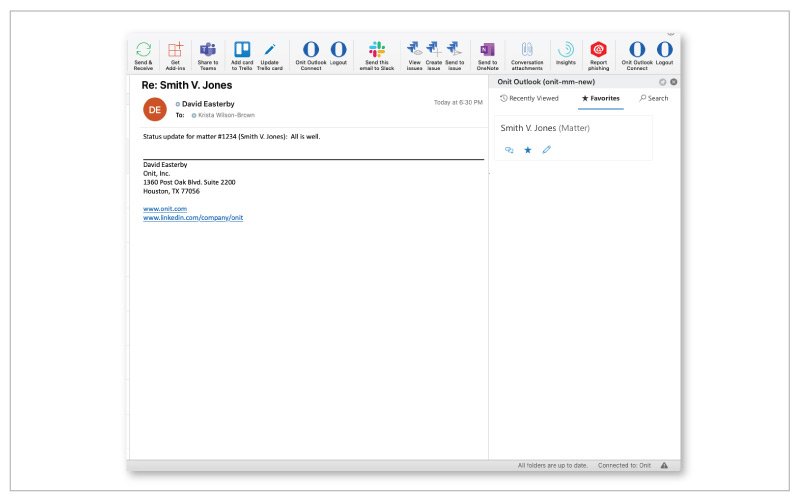
As part of Onit’s goal to work where lawyers work, we’ve recently made enhancements to Onit Outlook Connect. Our Microsoft Outlook plug-in allows you to connect your email with all of your favorite products and solutions on Onit’s business process automation and artificial intelligence platforms.

Onit’s email integration allows you to file your emails directly into other systems, such as specific matters in your enterprise legal management software or contracts in your contract lifecycle management software. You get direct access to Onit from within Microsoft Outlook without having to navigate to different windows or launch new tools.

The plug-in appears in a panel on the right-hand side of your Outlook window. It gives you a quick view into your matters and most recent or favorite records, so you can easily see a snapshot of the essential information you need. From there, you can link directly into the record you need and do your work in Onit, all without having to jump to another panel or browser or re-authenticate your credentials.

The Onit email integration is the shortcut you need to handle your email and work in the same place
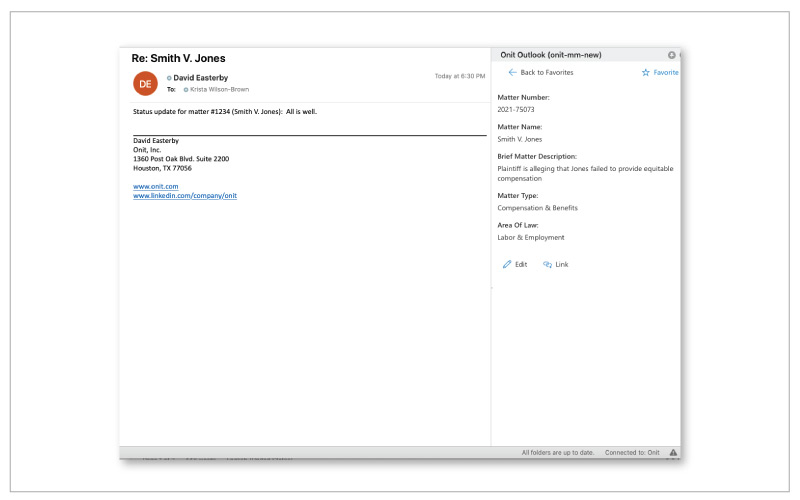

Simply choose the apps or tools you want to link to Outlook, and you’ll start seeing synopses of your work alongside your email every time you access it going forward. Get in, get out and focus on the work that matters most. Not only do you get to work where you’re already working, but you can keep everything organized in one place. Email linking and better organization mean better efficiency. Your email no longer has to be a hindrance to productivity.

At Onit, we’re always looking to create solutions that help lawyers do their best, most efficient work. Our ELM, CLM and other solutions are constantly innovated to provide process efficiency and work where our customers work.

Email is no different.

Reach out to your account manager today to learn more about how Onit Outlook Connect can change the way you use email in your day-to-day work. You can also schedule a demonstration or email [email protected].

How to Balance Legal Cost Management with Rising Associate Fees

Legal cost management has become more challenging for corporate legal departments, as law firms’ associate salaries continue to climb.

Despite the global pandemic, many law firms had surprisingly strong financial performances in 2020. Reports show AmLaw 50 law firms saw a revenue increase of more than 7%, with other firms reporting double-digit growth and profits per partner jumping 30%.

Now, the nation’s top law firms have raised associate salaries in the hopes of remaining competitive and retaining top legal talent. First-year associate salaries at top firms now sit at $200,000, increasing as associates go up in seniority.

While this is certainly good news for associates, many corporate legal departments are conflicted since the bump will surely be reflected in law firm fees. Some corporate legal leaders view the salary increase with skepticism, especially when companies are under heavy pressure to cut costs and control legal spend. As more and more firms continue to match the new associate pay scales, in-house counsel and legal operations will have to find new ways to respond to the rising fees.

Six Strategies for Legal Spend Containment

While higher associate rates might lead to more pressure, the challenge isn’t insurmountable when it comes to legal cost management. The following are just a few strategies that corporate legal departments can employ to better understand and potentially offset those increased charges on their end.

  1. Set automated billing rules that address time charged to junior associates. Many corporations disallow billing by first-year associates during their ramp-up period and may start more closely scrutinizing overall firm staffing on matters now that rates are increasing. Any such rules should be clearly included in outside counsel guidelines.
  2. Closely review all your bills. No one enjoys legal invoice review, but it’s critical for catching improper costs. While not necessarily intentional, inconsistent coding and charges from improper billers happen all the time. They’re often missed because they’re buried in long bills with extensive charges.
  3. Pursue alternative fee arrangements. Whether it’s flat fee billing or contingency arrangements, alternatives to the billable hour model are increasing in popularity among corporate clients. Outside counsel might collaborate with you to implement them.
  4. Consider shifting some work in-house or to alternative legal service providers (ALSPs). As outside representation becomes more expensive, now is the time to take a detailed look at whether all the work you’re outsourcing to law firms could be handled just as well by internal resources or more cost-effective ALSPs.
  5. Move work from associates to paralegals or administrative personnel where possible. Junior lawyers often handle tasks that don’t require someone of their skillset. As associate rates go up, it’s more important than ever to ensure that every task is being handled at the right staffing level.
  6. Understand your overall approach to legal cost management to see where your dollars are going. Are you paying for things like overhead charges and photocopies or are you allowing invoices that include block billing? Eliminating these charges can help offset the newly increased associate fees.

The Role of Enterprise Legal Management and AI Invoice Review

All of the above cost-cutting measures will be significantly easier and more effective if you have the right enterprise legal management software (ELM) and AI-powered invoice review tools. These tools incorporate electronic billing, automated billing rules, machine learning and more which make it easier to enforce your outside counsel guidelines and engage in legal spend management.

AI is far more efficient at reviewing lengthy legal invoices and better at catching improper coding – charges that aren’t allowed, work that’s being handled at the wrong level and more. In-house legal professionals are already tasked with doing more with fewer resources and manual invoice review shouldn’t add to that burden.

Whether you turn to third-party review or implement your own internal solutions, you stand to better understand your overall spend and significantly reduce costs. InvoiceAI, Onit’s new AI offering for legal invoice review, has already identified six-figure savings in improperly billed travel costs for Onit customers during a time when travel was at an all-time low. The potential savings from using the right tools is significant.

ELM enables the e-billing, legal spend management and matter management you need to get insight into and control over your legal spend. Schedule a demo today or email [email protected] to learn more.

The Evolution of Matter Management

A recent webinar hosted by ECLA and Onit’s European legal spend management solution BusyLamp eBilling.Space charted the development of matter management from document repository to connected workspace – looking at current solutions, the impact of COVID-19, and future trends.

The webinar, part of the ECLA Learning Centre series, brought together Rob McAdam, VP of product at BusyLamp (an Onit Company), Sven Preiss, head of legal commercial at Scout24, and Xavier Langlois, general counsel at Beamery.

The webinar started by considering the meaning of matter management and what it entails for a corporate legal team. It was agreed that matter management is fast evolving beyond a system of record to one of collaboration and engagement, with increased use of automation and self-service tools built in. Indeed, given the pandemic, ways of working have changed dramatically. From asynchronous working to increased knowledge sharing – seismic changes in our ways of operating are all relevant to future matter management systems. “The most important area for me now is collaboration,” said Sven Preiss. “Not everyone is there all of the time. To give consistent, quality legal advice, it’s important to have somewhere to search.”

Today’s often remote and more flexible working patterns also increase the need for matter management systems that can be integrated with tools such as Slack and Teams that so many of us use. “The need to capture detailed notes and status reports about where things stand will become more important,” pointed out Rob MacAdam. “And with even conservative law firms moving to things like DocuSign, this is clearly a time for change,” added Xavier Langlois. Indeed, for Beamery’s legal team, it’s also accelerated the implementation of a new matter management tool. “This was a perfect opportunity to start with a clean slate,” he explained, adding: “The legal team has to be able to speak the same language as the business.”

The panel also agreed that – in many ways – technology had brought disparate groups together, bringing positive behavioral changes that look set to make legal teams more efficient and more accountable. Looking ahead to six key trends in the coming months and years, the below points were identified as critical components of an effective matter management system:

1. Data and Intelligent Insight

With legal functions turning to data to track performance and status and to monitor risk, matter management systems are helpful as they aggregate data gathered through workflows. This leads to insights, with the system having the potential to act as an early alert system or a predictive tool. Yet teams must learn how to analyze this data effectively. “This is a great opportunity to align to company objectives through data,” said Xavier. “Predictive and machine learning has to be the next level of matter management. It can free up legal teams to do other things.”

But the panel also agreed on the need for training and guidance in terms of the usage of AI and for systems to have parameters built in. “Don’t overpromise the benefits of using certain tools,” warned Rob. “Technology can offer so much value, but you get out what you put in. You must invest in time, too.” Fortunately, with younger generations, in particular, keen to leverage data and technology, it was agreed that the will, and the energy, are often there.

2. Interoperability

With so many of us comfortable working in systems such as Zoom, Teams, and Slack, interoperability is increasingly important regarding matter management. It’s important that users don’t feel forced to leave the tools they like working with to engage with legal teams while the use of plug-ins and APIs looks set to rise. “People want to work within their preferred tools. We picked the one which integrated most easily,” pointed out Xavier.

3. Knowledge Delivery

Knowledge delivery also looks set to be one of the biggest trends over the next couple of years. For instance, MacAdam pointed to the potential for matter management systems to deliver relevant, up-to-date information in the context in which it is needed. “What would be perfect would be a really good search engine for your knowledge database, being able to deliver knowledge in a structured way and at your fingertips,” added Sven. “There are lots of questions that come up all the time and which could be categorized and answered by a chatbot,” he said, pointing out that AI could play an important role there.

4. Process Automation

With in-house teams frequently getting bogged down in lower value, manual, routine tasks, process automation can dramatically improve productivity. This has led to an increased focus on process automation – for instance, to support contract approval. A key piece of advice in this regard was to look first at high volume, low touchpoint engagements such as NDAs – “which should not require six email exchanges” – and then to build on that.

5. Self-Service

Self-serve systems can be a way of demonstrating value to clients – helping them to get their jobs done more quickly, too. And, with more and more matter management systems incorporating such tools, it’s easy to deliver quick wins. For instance, many new contract management tools now have native e-signature functionality.

6. External Collaboration

As matter management systems become engagement and collaboration tools, they look set to enable diverse teams to work on tasks together, tracking status and improving efficiency. Yet, to make technology-driven matter management a success, Rob’s advice – before deployment – was to start small but aim high; to prioritize problems to solve; to look at current processes while talking to IT and procurement, and to build a business case that includes a vision for the value a system will bring, and which is subsequently monitored. It’s also important to ensure adequate training and support are in place while responding to feedback. If something is not working, simply change and adapt.

Find out more by watching the full webinar on demand here.

Thank you to The European Company Lawyers Association (ECLA) for inviting BusyLamp to run this matter management session. 

Request a demo of BusyLamp eBilling.space.